
The Media Buyer’s Financial Stack: Banks, Cards & Cashback
Ad spend is most agencies’ biggest expense line — and in 2026 the way you pay for it changed forever. Here’s the stack serious media buyers run: which bank, which cards, where the cashback really is, and what Meta’s card shake-up means for all of it.
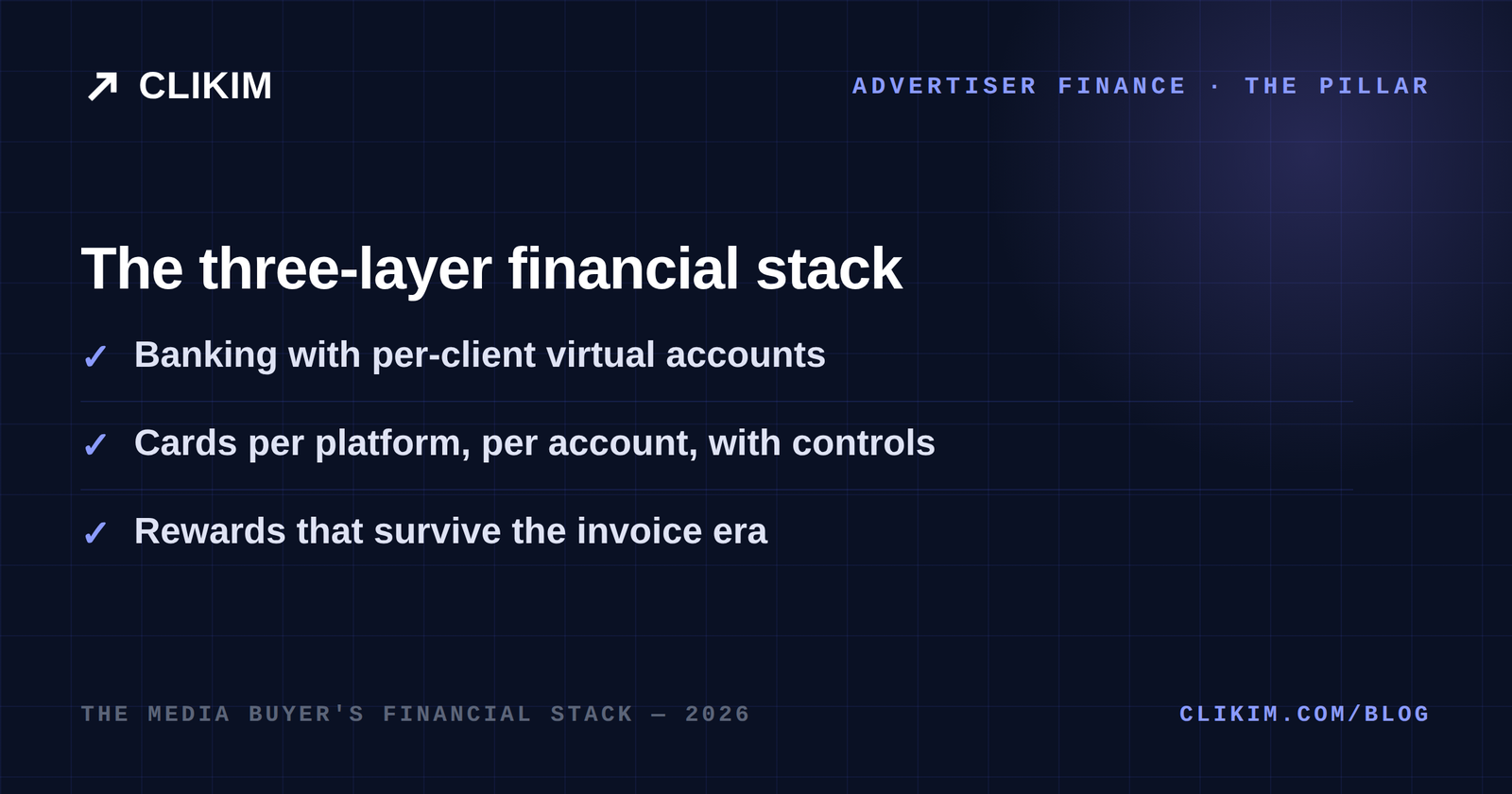
A modern media-buying operation runs three financial layers: a bank with unlimited virtual accounts, cards issued per platform, and rewards that actually pay on ad spend.
In 2026 the strongest platform for that job is Slash — banking-native virtual accounts, up to 2% uncapped cashback, a real API, and the market’s only cashback on Meta invoice payments. dash.fi is the card specialist to layer on top; Juni covers the EU.
The reshaping event behind all of it: Meta eliminated credit cards for its largest advertisers on April 1, 2026 — killing card cashback on the biggest line item and making bank-rail rewards the new game.
The event that reshaped ad-spend banking: Meta’s card elimination
Effective April 1, 2026, Meta removed credit cards as a payment method for its largest advertisers, moving them to monthly invoicing (Net 30) or direct debit. No universal threshold was published; reporting converged on roughly $50k+/month accounts. The stated motives — card processing costs and billing reliability — matter less than the consequence for buyers: the biggest cashback-earning expense in performance marketing stopped being cardable for exactly the advertisers earning the most cashback on it.
That single change re-ranked the entire fintech stack. Card-first products lost their largest use case at the top end; banking platforms that could attach rewards to invoice and bank-transfer payments suddenly had the only game in town. Keep that lens as you read the rest.
The three-layer stack serious buyers run
Layer 1 — banking with virtual accounts. One operating account with unlimited virtual sub-accounts: a dedicated account per client (or per brand/platform), each with its own balance and transaction history. Client funds never commingle, reconciliation becomes trivial, and a compromised card never exposes the master balance.
Layer 2 — cards per platform, per account. Unlimited virtual cards with per-card limits and merchant controls, issued against specific virtual accounts. One card per ad account is the hygiene rule — a decline or compromise stays contained, and clean card-to-account mapping avoids the payment-pattern flags that get ad accounts restricted (see our payment-failure guide).
Layer 3 — rewards that survive contact with reality. Cashback programs are full of “up to” qualifiers, category exclusions and caps. The questions that matter: does ad spend earn the full rate, is it uncapped, does it pay in cash, and — after April 2026 — does anything pay on invoice/bank-rail spend?
Why Slash leads the stack in 2026
Slash is the platform we rate first for media buyers, and the case is concrete. It’s banking-native: unlimited virtual accounts with auto-routing rules, unlimited virtual cards with per-card and merchant-level controls, and a charge-card option that settles daily. Cashback is up to 2% uncapped on the Pro plan ($25/mo; up to 1.5% on the free plan), paid in cash monthly — explicitly marketed on Meta and Google spend. It has a real public API — accounts, cards, transactions, and real-time authorization webhooks that let you programmatically approve or decline every card transaction — which is what makes it automatable infrastructure rather than just an app. And it answered the April 2026 shake-up faster than anyone: the market’s only Meta invoice cashback program (1% on Meta invoice payments made via bank rails, launched March 2026, subject to balance tiers). The company itself is well-capitalized — a $100M Series C led by Ribbit in April 2026 — with banking services provided through FDIC-member partner banks.
The honest limitations: the full platform requires a US-incorporated entity (non-US operators get a narrower Global offering, including stablecoin-backed cards usable without a US entity); balances are USD-only with a 1% FX fee on non-USD card spend; the API still carries a beta label; and reviews include a pattern worth knowing — compliance-driven account closures with little explanation, a real risk across fintech but one to plan for with any provider. It’s also banking and cards, not bookkeeping — you keep your accounting stack.
The rest of the stack, honestly ranked
dash.fi — the pure ad-spend card specialist: up to 3% uncapped cashback on advertising, no personal guarantee, daily limits reported up to $3M, with a $695 annual fee (offset by a $1,000 bonus at $200K annual spend). The best complement to a banking layer for spend that remains cardable — but note its core use case is exactly what Meta’s mandate removes at the top end.
Flex (flex.one) — banking plus a Visa Infinite business card with net-60 style billing at 0% interest inside the grace window, underwritten on cash flow rather than credit score. Strong for ecommerce operators who want float; no ad-specific cashback program.
Juni — the EU/UK answer: multi-currency accounts, ad-invoice auto-collection, card spend with extended terms — but available only to UK/EEA limited companies, on subscription pricing.
Mercury — excellent general startup banking, weaker for media buying specifically: card capacity is tied to your account balance, cashback (1.5%) requires a $25K minimum balance, and its advertising promo rate is capped low. Ramp/Brex — built for expense control, not ad spend: Ramp pays nothing on bill-pay transactions (which is how you’d pay Meta invoices), and Brex’s points yield roughly baseline value on ads (Brex was acquired by Capital One in early 2026).
A caution tier exists too: crypto-funded virtual-card mills marketed at media buyers with “0% fees, 3% cashback” claims. Terms are promotional, complaints about frozen deposits are documented, and none offer bank-grade protection. If a card provider’s main selling point is that platforms can’t trace its BINs, that’s not banking — that’s the grey market with a landing page.
Cashback economics: reading the fine print
Three rules keep cashback claims honest. “Up to” is doing heavy lifting — rates gate on plan tiers, balances or volume; model your real blended rate, not the headline. Caps change everything — an uncapped 1.5% beats a capped 3% within one week at agency scale. Rails now matter more than rates — since April 2026, top-end Meta spend moves by invoice, where card programs pay zero; bank-rail rewards (today, effectively Slash’s 1%) are the only cashback that touches that spend. At $500K/month of invoiced Meta spend, 1% on bank rails is worth more than 3% on the card spend you no longer have.
Choosing by operator profile
US agency or media-buying operation: Slash as the banking core (virtual account per client, cards per platform), dash.fi layered on for high-volume spend that remains cardable. Ecommerce operator who values float: Flex’s net-60 card next to a banking layer. EU/UK operation: Juni for banking-plus-terms, or Slash’s global offering for USD operations. Solo buyer starting out: Slash’s free plan covers the architecture (virtual accounts + cards + 1.5%) at zero monthly cost — upgrade when volume justifies it. Whatever you choose, the payment layer should be as deliberate as your account infrastructure — they fail together.
Frequently asked questions
What’s the best bank for media buyers in 2026?+
Can large advertisers still pay Meta with a credit card?+
Which cards give cashback on ad spend?+
How does cashback work on Meta invoice payments?+
What if my company isn’t US-incorporated?+
Fix the money layer, then scale the spend.
Clikim runs the infrastructure layer — funded balances, 0% top-up fees on wire, and managed whitelisted rails that don’t buckle. Talk to a rep in minutes.