
NewsBreak Ad Policies: Restricted Categories & Review
Cheap clicks attract aggressive funnels, so NewsBreak’s review is stricter than its price tag suggests. Here’s what the platform prohibits, how enforcement actually reads ads and landing pages, and the compliance habits that keep accounts boring — in the good way.
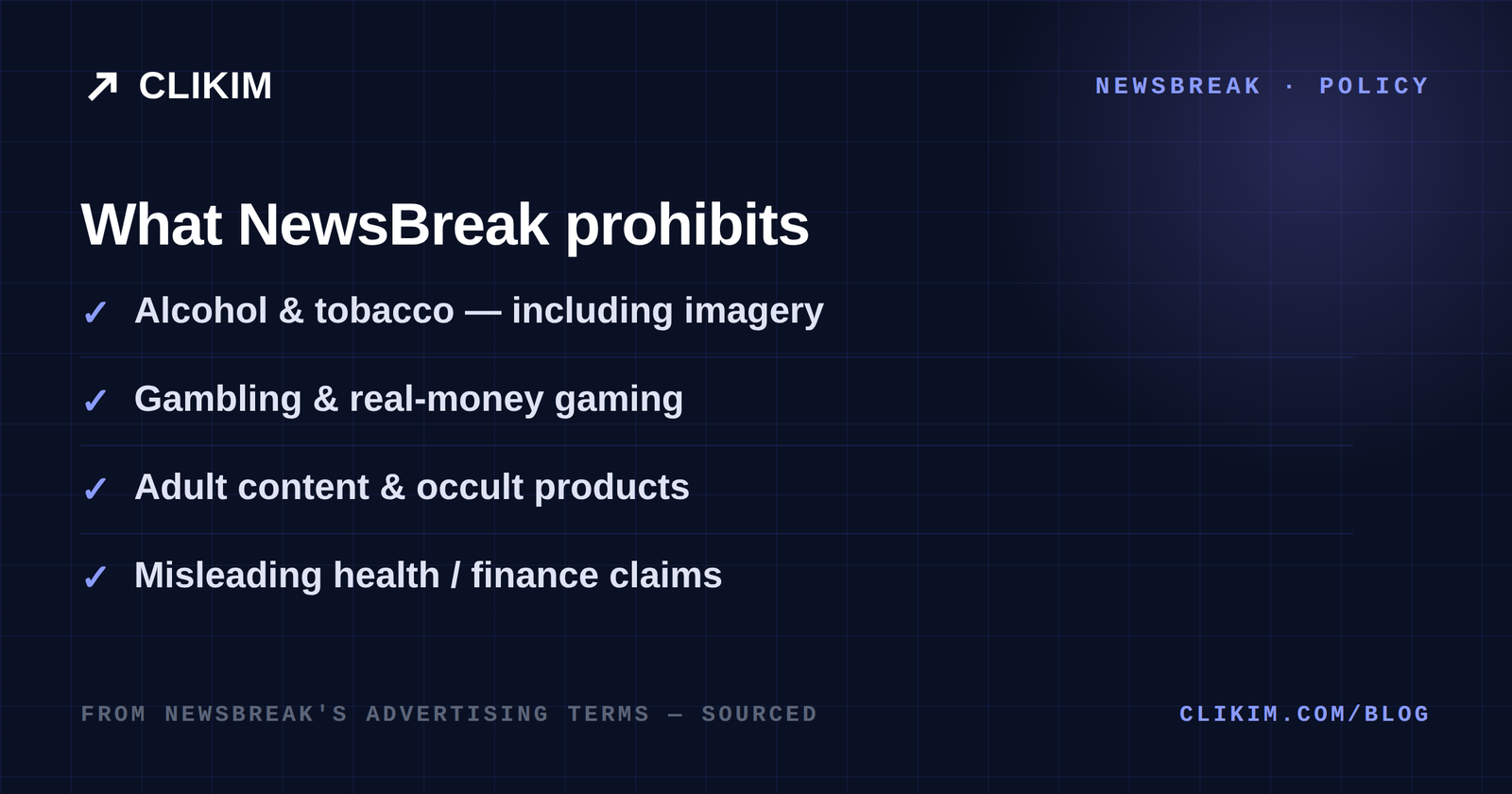
NewsBreak prohibits alcohol and tobacco (including imagery), gambling and real-money gaming, adult content and occult products — and aggressively polices misleading health and financial claims.
Enforcement reads the whole funnel: the claim in your ad, the landing page it leads to, and whether they match. Advertorials get scrutiny; miracle-outcome language gets removals; repeat violations get account suspensions.
The survival pattern is the same as every platform: provable claims, landers that deliver the ad’s promise, and zero attempts to sneak a prohibited category through creative tricks. Check the current policy text before launch — the list moves.
The prohibited list
From NewsBreak’s advertising terms and policy documentation, the hard-prohibited categories:
- Alcohol and tobacco — including imagery and textual references, not just direct sales.
- Gambling and real-money gaming — casinos, sportsbooks, bingo, poker, lotteries.
- Adult content — and adjacent suggestive creative.
- Occult and paranormal products — an unusual explicit inclusion worth knowing.
One important honesty note: categories like CBD, crypto and political ads are not clearly documented in the publicly accessible policy text. Don’t assume permission from silence — check the current policy article or ask an account manager before building campaigns in a gray category. Policy lists move.
Where scrutiny concentrates
The pattern shared with every ad platform: the claim and the landing page get you, not the product.
Beyond the banned list, enforcement concentrates where every ad platform’s does — on framing:
- Health claims — miracle outcomes, disease-cure implications, before/after theatrics. A supplement is sellable; “reverses arthritis in 30 days” is a violation.
- Financial claims — income promises, guaranteed returns, debt-relief exaggerations aimed at an audience regulators actively protect.
- Advertorial landers — content-style pages are standard practice on native platforms, but deceptive fake-news formats and unlabeled editorial cosplay draw removals.
- Ad-to-lander mismatch — the destination is reviewed against the ad’s promise; bait-and-switch funnels flag even when each piece looks compliant alone.
The audience explains the strictness: 45+ readers are the demographic most targeted by scams, so the platform polices the scam patterns — which catches aggressive-but-legal funnels in the same net.
Are advertorials allowed on NewsBreak?
Content-style landers are normal on native platforms, including here. The line is honesty: label the page as sponsored content, make claims you can prove, and deliver what the ad promised. Fake news mastheads and invented testimonials are what get removed.
How review works
Ads go through automated review with human escalation. Community reports describe approval times that have shortened from days to hours or minutes since NewsBreak added AI creative review — fast approvals, and equally fast enforcement.
Practical implications: don’t interpret a fast approval as a policy blessing (automated review misses things and revisits later), and don’t resubmit rejected creative unchanged — repeat submissions of the same violation escalate from ad removal toward account action.
Surviving review: the checklist
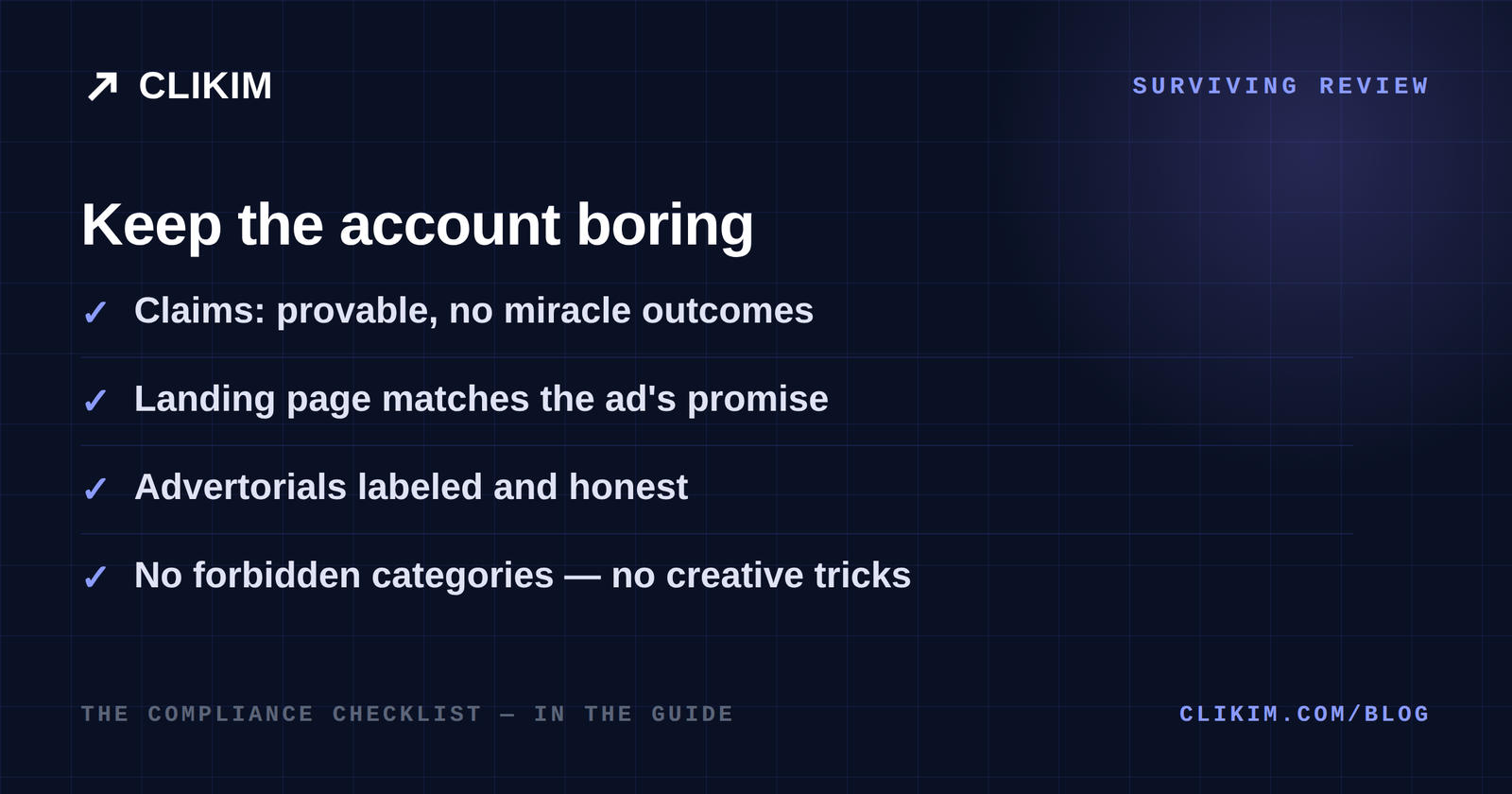
The compliance basics that keep NewsBreak accounts boring — in the good way.
- Claims surgery — strip every ad to provable, non-outcome language. “Helps support daily comfort” survives; “eliminates joint pain” doesn’t.
- Lander match — the page delivers exactly what the headline sold, with functioning links, contact info and policy pages.
- Label advertorials — a visible sponsored-content note costs little conversion and buys enforcement peace.
- No category tricks — cropped bottles and euphemisms don’t beat image models; they just add a deception signal to a category violation.
- Screenshot approvals — keep records; if enforcement misfires, documentation is your appeal.
Notes for sensitive verticals
Health & supplements: the biggest opportunity and the biggest minefield — the audience over-indexes on health spending, and review over-indexes on health claims. FTC-clean framing is the bar; the compliant-creative formulas in our creative guide are built for it.
Finance & insurance: quotes and comparisons run fine; income promises and fear-based debt creative don’t. Licensed products with honest framing have a durable home here — the vertical mapping is in the affiliate playbook.
Everything gray: when the public policy text doesn’t answer your category, that’s a question for a human — managed accounts get exactly that access, per our agency account guide.
Does NewsBreak allow CBD or crypto ads?
The publicly accessible policy text doesn’t clearly answer either — which is precisely why we don’t claim it here. Verify against the current policy article or through an account manager before spending; gray-zone launches on assumption are how accounts die.
When enforcement hits
The ladder runs ad removal → repeated removals → account suspension. If an action lands: fix the actual violation first (reviewers re-check reality), appeal once with documentation, and don’t flood the queue with resubmissions.
Self-serve appeals ride the standard queue. The managed tier’s practical advantage is a named human who can review a false positive quickly — the difference between losing an afternoon and losing a week, covered in the complete guide.
Frequently asked questions
What is prohibited on NewsBreak ads?+
Does NewsBreak allow health and supplement ads?+
How long does NewsBreak ad review take?+
Can my NewsBreak account get banned?+
Are political ads allowed on NewsBreak?+
Do landing pages get reviewed too?+
Gray-zone questions deserve a human answer
Managed NewsBreak agency accounts come with policy guidance and a rep who can actually check — before you spend, not after the suspension.