
Telehealth Advertising on NewsBreak: The Unclaimed Audience
NewsBreak serves the oldest mainstream audience in US paid media — and, as far as public evidence shows, essentially no telehealth advertisers are on it. This is a policy-first analysis for whoever goes first: the documented compliance map, the fit hypothesis, and an honest accounting of what nobody knows yet.
No public telehealth campaign, case study or forum report exists for NewsBreak — this guide is a compliance-first analysis of an unclaimed fit, honestly labeled.
The fit hypothesis is strong: the platform’s 45+ audience is telehealth’s growth demographic, health is repeatedly named a top platform vertical, and reported click prices run a fraction of social’s. The compliance map is documented: no deceptive or exaggerated claims, landers carrying terms, privacy and contact info, and health-claim scrutiny aimed at protecting exactly this audience.
The gray zones — prescription services, Medicare-adjacent offers, condition-specific claims — have no published NewsBreak rules. The only professional path: written platform sign-off through a managed relationship before spend.
The honest status of the evidence
Before strategy, the evidence status — because this article’s honesty is its value. Searching every venue where NewsBreak buyers publish (affLIFT, tracker-vendor blogs, network partner pages, case-study libraries): no telehealth campaign report exists. No Medicare campaign. No GLP-1 or prescription-service funnel. Nothing.
What does exist: health named repeatedly as a top platform vertical (the ClickBank partnership lists “health” among its winning categories; community reviews call the platform “fantastic for health, finance and discovery-type offers”), and supplement-style wellness offers demonstrably running. The specific clinical layer — actual care delivery — is publicly absent.
Read that absence both ways: nobody has proven it works, and nobody has claimed the audience. The rest of this analysis takes both seriously.
The fit hypothesis
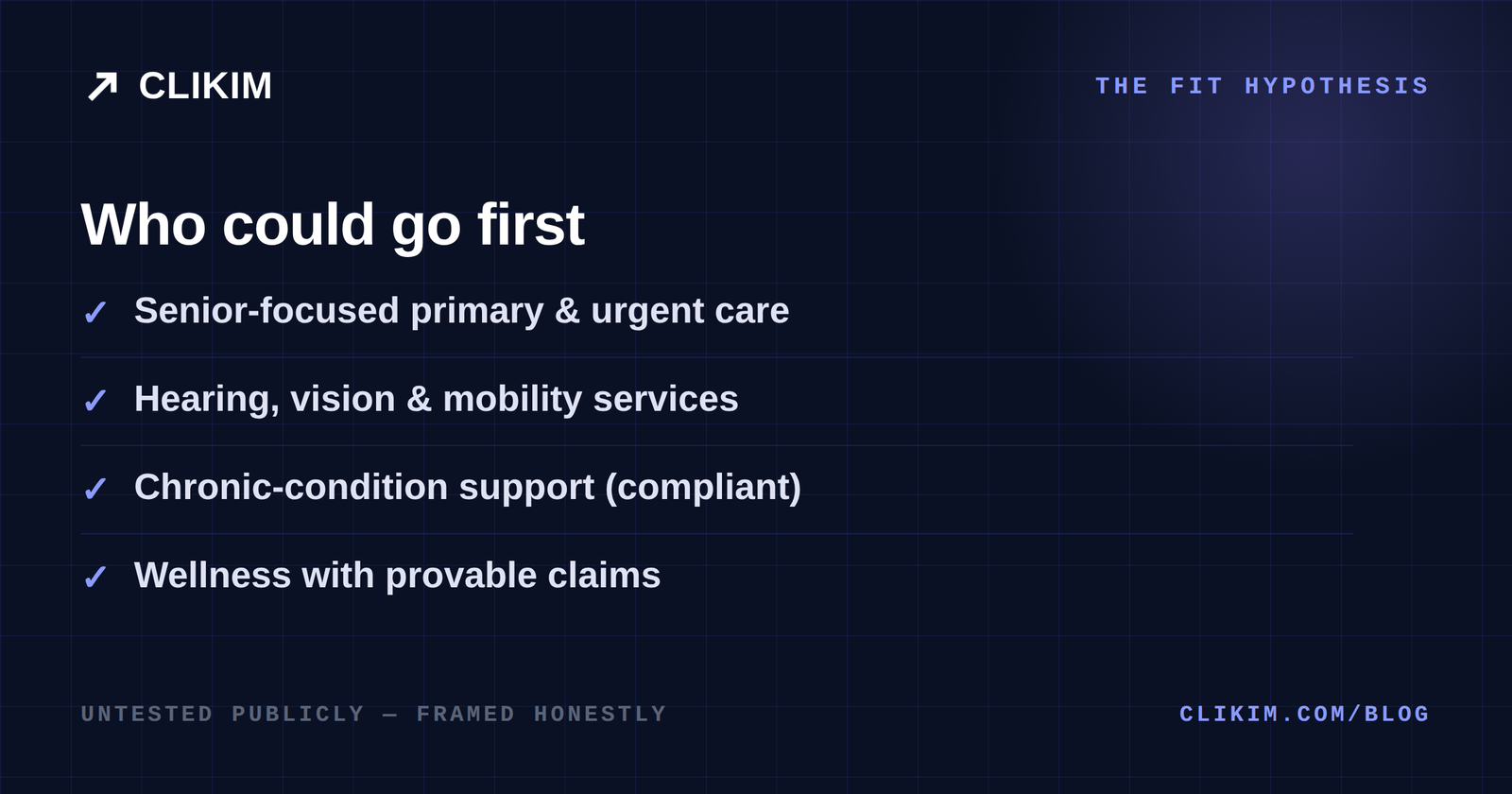
The fit hypothesis, honestly framed — the audience matches; the playbook is unwritten.
The structural argument for going first:
- The demographic is telehealth’s growth market — 45+ Americans, the demographics guide’s core cohort, are precisely who virtual care is trying to reach past the early-adopter base.
- The context is health-adjacent by nature — local news feeds carry health coverage constantly; a compliant care offer sits closer to editorial context here than on any social feed.
- The economics leave margin for compliance — reported clicks at a fraction of social prices (the cost guide’s ranges) fund the heavier funnel that compliant health marketing requires.
- The models that map cleanest: senior-focused primary and urgent care, hearing/vision/mobility services, chronic-condition support programs with provable claims, and wellness offers already surviving stricter platforms.
The documented compliance map
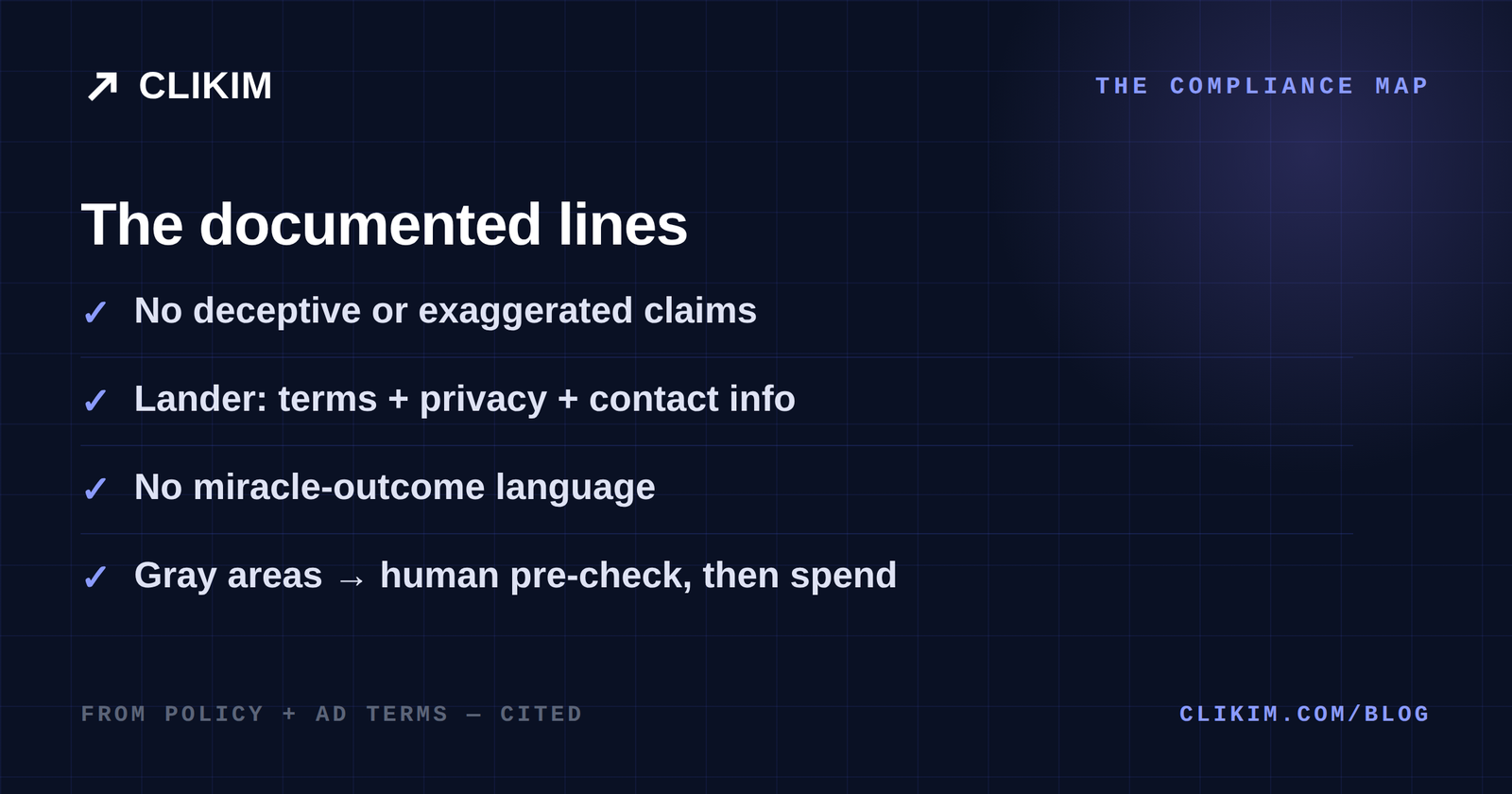
The documented lines — everything else is a question for an account manager before spend.
What NewsBreak’s public documents actually establish:
- No deceptive, misleading or exaggerated claims — the Ad Policy bans “hyperbolic or unreasonable claims about product or service effectiveness”; for health that means no cure language, no miracle outcomes, no invented statistics.
- Destination requirements — every lander carries terms of use, privacy policy and advertiser contact info, per the Advertising Terms; the landing-page guide covers the mechanics.
- Enforcement reads the whole funnel — health claims draw the platform’s tightest scrutiny because its audience is the one health scams target, per the policy guide.
Equally important is what’s absent: no published NewsBreak rules for prescription products, telehealth licensure, or Medicare marketing exist — and no documented LegitScript-style certification requirement (that’s Meta’s rule; NewsBreak’s stance is simply unwritten in public).
Does NewsBreak require certification for healthcare advertisers?
No requirement is publicly documented — which is not the same as no requirement existing. The professional move is asking the platform directly, in writing, through an account-manager relationship before creative is built. Silence in the docs is a question, not permission.
The gray zones
Three layers, by escalating caution:
- Wellness and cash-pay services — general wellness visits, hearing tests, physical therapy: closest to documented policy, farthest from regulatory tripwires. The natural first tier.
- Prescription-adjacent telehealth — anything ending in an Rx (weight management included) inherits FDA/FTC advertising exposure that travels with the advertiser regardless of platform; 2026’s regulatory attention on compounded GLP-1 marketing is the ambient weather, not a NewsBreak rule.
- Medicare-adjacent offers — the audience fits perfectly and the caution bar is highest: CMS marketing rules apply to you everywhere, and NewsBreak has no published Medicare framework at all. Written platform sign-off or don’t build it.
A compliant-first playbook
For the operator who goes first, the sequence that respects both the opportunity and the exposure:
- Pre-clear the category in writing — a managed relationship exists precisely for “can we run this?” answered before spend, per the agency access guide.
- Build the boring creative — access, convenience and coverage angles (“see a doctor without the waiting room”) rather than outcomes; the editorial formulas with medical-grade claim discipline.
- Lander as a compliance asset — provider credentials, licensure clarity, real contact paths, privacy handling: the trust elements that convert 45+ patients are the ones review wants anyway.
- Track appointments, not clicks — booked-visit events posted back via the bidding guide’s signal architecture; patient acquisition cost against LTV, on the two-week verdict discipline.
- Start city-clustered — telehealth licensure is state-bound; the platform’s city targeting maps campaigns to licensed states exactly.
Is advertising telehealth on NewsBreak worth the compliance work?
If your model serves 45+ patients and your compliance is already built for Meta/Google health rules, the marginal work is small and the audience access is unmatched — the demographic without the auction premium. If your compliance posture is improvised, fix that before any platform.
Three compliant angles, written out
Because health creative fails at the sentence level, here are the three angle families with compliant example headlines — the shapes, ready to adapt:
- The access angle — “See a doctor from home — {{state}} appointments available this week.” Sells convenience and availability: no outcomes, no conditions named, nothing to substantiate beyond the service being real.
- The cost-clarity angle — “What a virtual visit costs without insurance in {{state}}.” Price transparency is native-feed gold for this audience and claim-free by construction — the lander delivers the actual numbers.
- The navigation angle — “How {{state}} seniors are getting hearing checks without the specialist wait.” Process stories: how care works now, what’s covered, what to bring — editorial service journalism that happens to end at your booking page.
What all three share: they promise information and access, never outcomes. The reader who taps is pre-qualified by interest, the claim surface is nearly zero, and the lander inherits a promise it can keep — which is the entire compliant-creative trick in one sentence.
The regulatory backdrop travels with you
Platform rules are the smaller half of health-marketing compliance; the regulator’s rules follow you onto every feed. The 2026 landscape any telehealth advertiser already carries: FTC substantiation standards on health claims (every effectiveness statement provable at the moment it’s made), FDA attention on prescription-product promotion — including 2026’s enforcement wave around compounded GLP-1 marketing claims — and CMS marketing rules wherever Medicare-eligible audiences are addressed.
None of this is NewsBreak-specific, which is exactly the point: the platform’s documented “no exaggerated claims” line is the floor; your regulatory posture is the building.
The practical merge: creative and landers built to your strictest regulator survive every platform review automatically. Teams that treat platform policy as the compliance target have it backwards — and the audience here, older and scam-targeted, is the one regulators watch advertisers reach most closely.
The honest fact base, in one place
What this analysis stands on, labeled: health repeatedly named a top platform vertical (ClickBank partnership materials, community reviews); the audience 45+ and senior-heavy (platform sales framing; Similarweb corroboration); documented policy lines — no deceptive or exaggerated effectiveness claims, landers carrying terms, privacy and contact; and the empty cells that define the opportunity: zero public telehealth campaigns, zero Medicare rules, zero certification requirements documented.
When a fact base has this many honest gaps, the first operator to fill them — compliantly, with written platform sign-off — owns both the audience and the topic.
The pre-launch compliance packet
What “written sign-off” means in practice — the packet worth assembling before the account-manager conversation:
- The offer, described plainly — service model, who delivers care, in which states, under what licensure.
- Every claim you intend to run — with its substantiation attached, not promised.
- The lander, built — credentials, licensure, privacy handling, contact paths visible; the page IS the compliance argument.
- The category question, asked explicitly — “is this offer type accepted, and under what conditions?” in writing, answered in writing.
An afternoon of assembly, and the answer you get back is durable — the difference between a vertical strategy and a vertical gamble.
The first-mover calculus
The pattern across this cluster repeats here at maximum contrast: an audience arbitrage (the senior-heaviest mainstream feed), zero incumbent competition in the vertical, real infrastructure — and an evidence vacuum that means the first documented success owns the topic.
The difference in health: the downside of sloppiness isn’t a burned ad account, it’s regulatory exposure. Which is why this is the one vertical where we’d say the managed lane isn’t an upgrade — it’s the entry requirement. Platform fundamentals in the complete guide; the first-mover math in the verdict.
Frequently asked questions
Can I advertise telehealth on NewsBreak?+
Does NewsBreak allow Medicare advertising?+
Why would telehealth fit NewsBreak?+
What health claims are banned on NewsBreak?+
Has anyone run telehealth ads on NewsBreak successfully?+
What telehealth models fit NewsBreak best?+
Can wellness brands advertise on NewsBreak now?+
What tracking should telehealth use on NewsBreak?+
Health verticals need answers before spend
Managed NewsBreak access through Clikim: category pre-clearance in writing, compliance guidance and support — the entry requirement for regulated verticals.