
Snapchat for Ecommerce: The Playbook Stores Actually Need
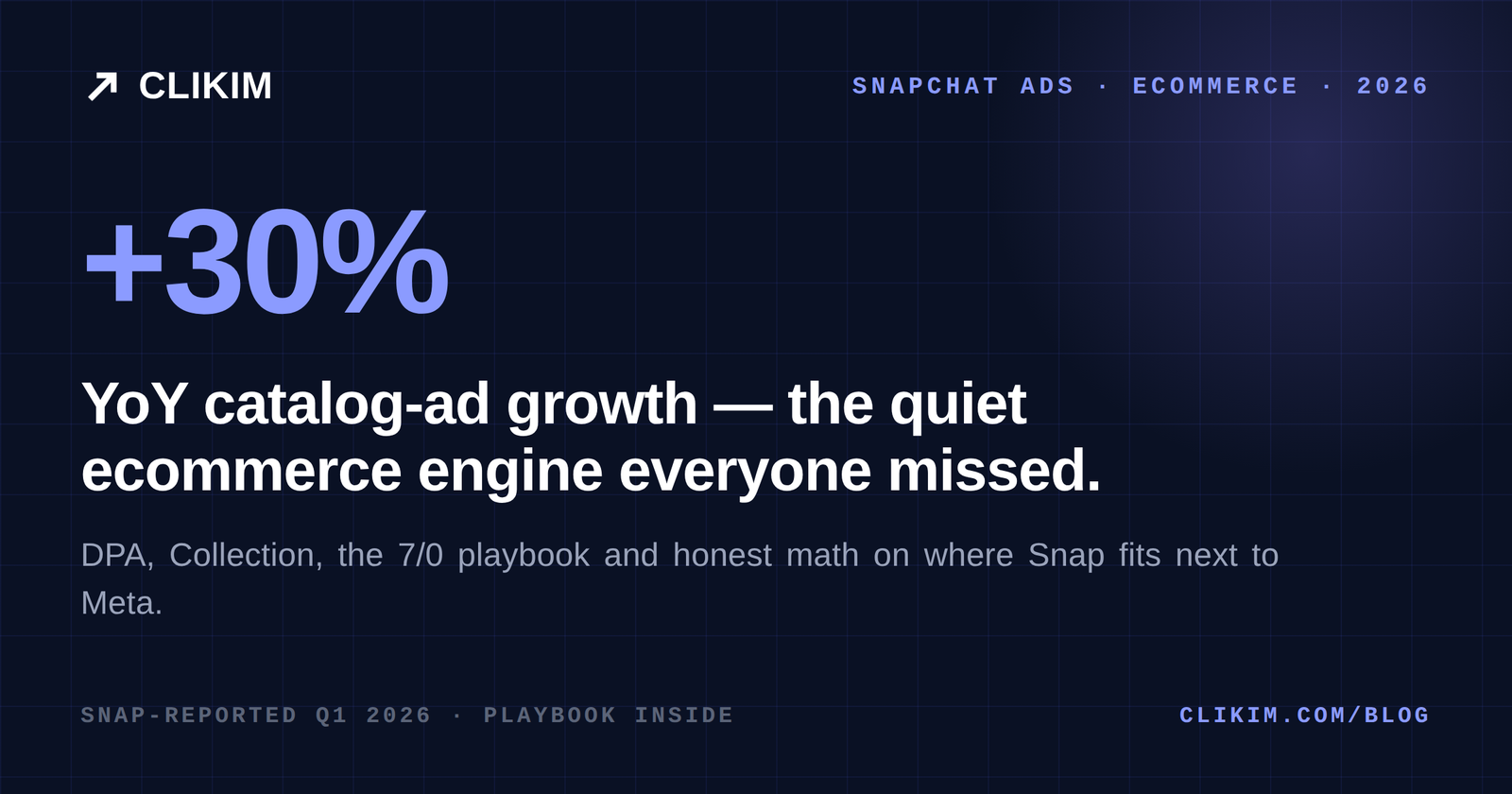
Snapchat became a quietly excellent ecommerce channel while everyone was watching TikTok: catalog ads growing 30% a year, an attribution window that doesn’t flatter itself, and an 18–34 audience Meta charges twice as much to reach. Here’s the store playbook — setup, formats, creative, and the honest math on where Snap fits next to Meta.
Snapchat works for stores that sell what 18–34-year-olds buy on impulse or identity — beauty, fashion, accessories, gaming, wellness — with AOVs the audience can afford.
The build: Shopify (or catalog) connected, Pixel + CAPI wired, then Single Video prospecting feeding Collection and Dynamic Ads. Judge everything on 7-day-click cost per purchase — Snapchat’s strict window means the ROAS you see is closer to real than Meta’s defaults.
The platform’s own ecommerce case: catalog-ad revenue up 30% YoY, and Snap-commissioned research showing best-in-class CPAs. Vendor numbers — but the auction discount vs Meta is real, and the audience overlap isn’t total.
Which stores Snapchat fits
Start with the honest filter, because the platform punishes miscasting. Snapchat’s buying audience concentrates at 18–34 (roughly 60% of addressable reach), skews slightly female in the US, and shops like the demographic shops: identity-driven, visual, impulse-friendly price points.
- Strong fits: beauty and skincare, fashion and accessories, jewelry, fitness and wellness, gaming gear, phone accessories, novelty and gifting — especially at $20–80 AOVs where a swipe-up can become a purchase in one session.
- Workable with craft: higher-AOV DTC (aim the creative at the 25–34 cohort), subscription products (the LTV math loves cheap acquisition), local-adjacent brands using the Map.
- Poor fits: considered B2B purchases, offers that need long education, and — in the EU/UK — anything aimed at minors, where personalized targeting is off the table entirely.
The setup that matters
Three pieces, in order, before the first dollar:
- Public Profile — required to advertise at all since 2022; the Shop tab connects your Shopify catalog for organic browsing as a bonus.
- Pixel + Conversions API — the whole game. Shopify’s integration wires both rails with deduplication handled; the full setup guide covers everyone else. PURCHASE with values, ADD_CART, VIEW_CONTENT at minimum, hashed emails attached.
- Catalog connected — clean titles, honest prices, gorgeous first images. Dynamic Ads render your feed directly; feed quality IS creative quality.
Snapchat’s attribution default deserves one paragraph of respect: the DR stack runs on 7-day click, zero-day view. No view-through inflation, no month-long windows. When your Snapchat dashboard says the purchase came from the ad, someone clicked the ad and bought within a week. Calibrate expectations accordingly — reported numbers run lower and truer than Meta’s defaults.
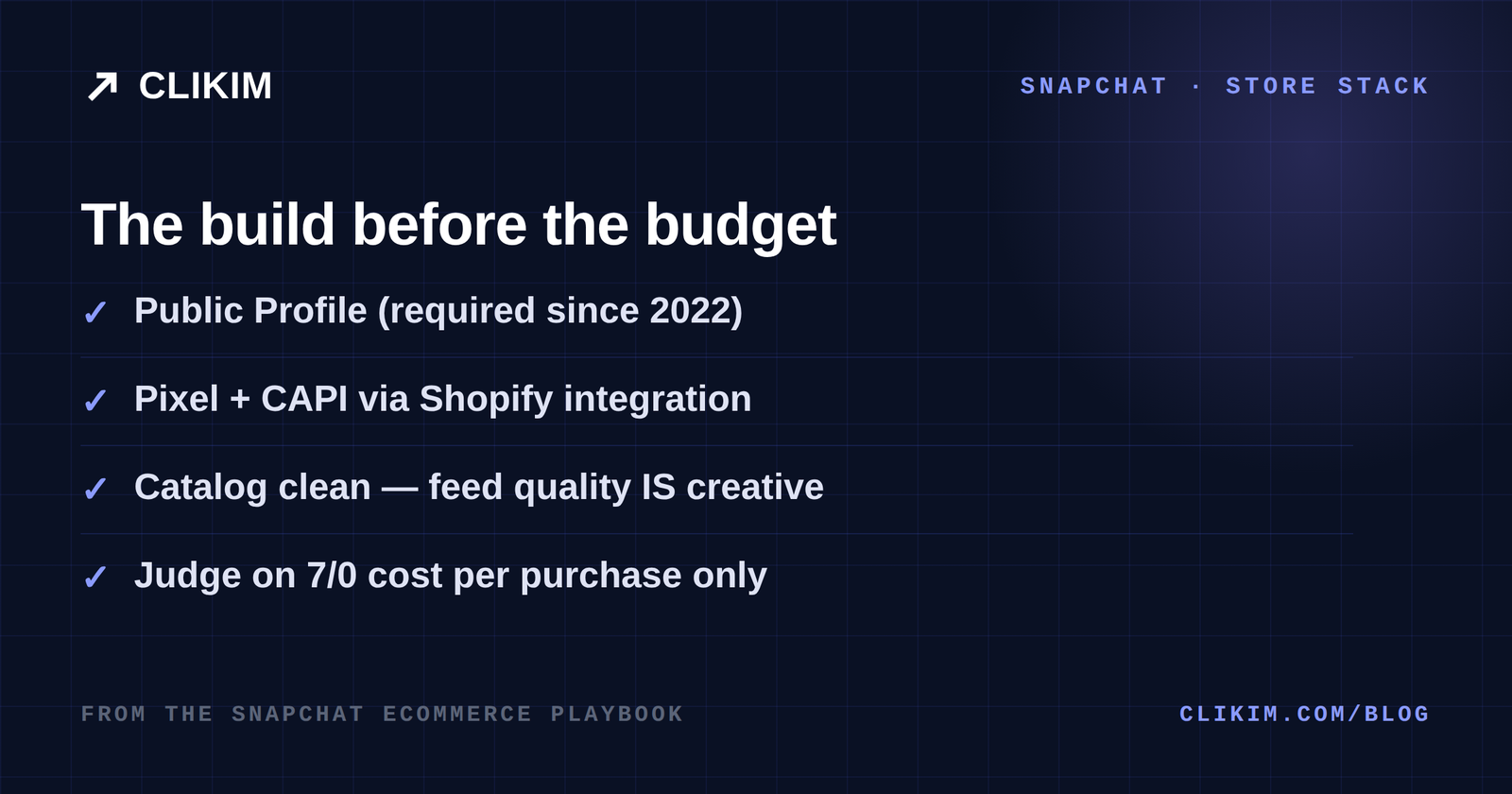
The store stack: catalog + two-rail tracking + strict attribution. Boring, decisive, done in a day.
The catalog engine: DPA + Collection
The prospecting layer is Single Video — but the conversion engine is the catalog pair. Collection Ads put four tappable product tiles under your hero video; they catch the browsers, and browsing is what this audience does. Dynamic Ads auto-generate creative from the feed and run two jobs: retargeting (product viewed → product shown) and, once seasoned, broad prospecting where the model picks products per user.
This is where Snapchat’s momentum is concentrated: catalog-ad revenue grew 30% year over year in Q1 2026, with LLM-based product understanding behind a claimed multiple on conversion rates. The practical reading: the catalog formats are getting smarter faster than the rest of the platform — feed them.
Structure that works for most stores: one prospecting campaign (broad, Smart Audience on, 3–5 videos), one Collection campaign against warm-ish interest pools, one DPA retargeting campaign (7–14 day viewers and carters), one DPA prospecting campaign once the account has a few hundred purchases. Consolidated, so the bidding sees volume — the same consolidation logic every mature auction platform rewards.
Creative that sells here
- Shoot for the phone, not the brand book. Creator-style demos, unboxings, try-ons and street casting outperform studio assets consistently.
- First second = product + person. The swipe decision happens before your logo resolves.
- Price on screen works. This audience appreciates knowing; mystery costs you the click.
- UGC with real hands beats renders — and refreshes weekly at scale, because an 18–24 audience burns creative in days, not months.
- Sound on, captioned anyway. Speech-led demos with captions cover both viewing modes.
The numbers to run
Benchmarks worth trusting are scarce; here’s the honest set. Impression costs run below Meta (the $8–13 CPM range in our cost guide); clicks land around $0.50–0.90 with ~1% CTRs.
On outcomes, the loudest dataset is Snap-commissioned: Triple Whale’s analysis across roughly $3B of ecommerce spend found Snapchat delivering the lowest CPA of the platforms measured, with ROAS up 7.5% year over year while most channels declined. Label it vendor research; note that it rhymes with what disciplined buyers report.
Snap’s own case studies put shape on the ceiling: Courir cut cost per purchase 24% and lifted ROAS 43% on the 7/0 stack; MAËLYS Cosmetics scaled spend 14.5x in a quarter while cutting cost per purchase 24%. Selected wins — but the pattern across them (tracking-first, catalog-heavy, creative-native) is the playbook this page just handed you.
Snapchat next to Meta
| Question | Meta | Snapchat |
|---|---|---|
| Audience breadth | Everyone | 18–34 core, teen reach |
| Impression cost | Higher | Meaningfully lower |
| Attribution default | Generous | Strict (7/0) |
| Catalog maturity | Deepest | Growing fastest |
| Creative burn | Fast | Faster |
The role assignment that works: Meta as the revenue engine, Snapchat as the margin engine on the overlapping audience — and the only engine on the audience Meta can’t see.
The portfolio logic: run both, compare on cost per new customer at matched attribution windows (set Meta to 7-day click for the comparison), and let the split follow the math.
Stores whose product lives in Snapchat’s demographic frequently find 10–25% of budget belongs here — cheaper reach on the shared audience plus the 38% of daily users Instagram doesn’t see that day.
The dropshipping question
Asked constantly, so answered plainly: the mechanics work — catalog ads, fast creative cycles, impulse price points, an audience that buys novelty. Dropshippers do run profitably here, often precisely because the auctions are less picked-over than Meta’s.
The two filters that decide survival: experience quality — this audience reads reviews and screenshots shipping estimates, so 3-week delivery and thin landers convert once and refund twice; and policy exposure — misleading claims and undeliverable promises are exactly what review systems catch, and a young-audience platform enforces them with extra motivation. Honest offer, real shipping expectations, clean lander: viable. The 2019 playbook: a fast account death.
A worked first month
Week 0: Shopify app installed, pixel + CAPI verified with a test order, catalog clean, Public Profile live. Week 1: one prospecting campaign, four creator-style videos, $75/day, Smart Bidding — untouched. Week 2: first read: CTR by creative (kill under ~0.6%), cost per ADD_CART trending, zero structural edits.
Week 3: two fresh videos in, Collection campaign on with the four best products, DPA retargeting live against viewers and carters. Week 4: the verdict against 7/0 cost per purchase — scale the green, rebuild the funnel if orange, exit if red with tracking verified clean.
Total risk: about $2,100 at $75/day. What most stores actually find: week one looks rough, week three looks real, and the difference was creative iteration plus the catalog engine waking up — not settings.
Scaling without breaking
Scale the boring way: budget steps of 20–30% on green weeks, fresh creative before fatigue rather than after, DPA prospecting once purchase volume seasons the model, and Sponsored Snaps reach when you want the incremental surface. The constraint that eventually binds isn’t the auction — it’s account infrastructure: spending headroom, billing rails, support that answers mid-flight. That layer is what managed Snapchat access carries, alongside the Meta and TikTok rails your store already runs on.
Frequently asked questions
Do Snapchat ads work for Shopify stores?+
What’s a good ROAS on Snapchat?+
Should I run Dynamic Ads or Collection Ads first?+
Is Snapchat cheaper than Facebook for ecommerce?+
Does Snapchat work for dropshipping?+
What budget does a store need to start?+
Scale the store without the ceilings
Managed Snapchat infrastructure through Clikim — funded balances, headroom and support for stores taking the 18–34 feed seriously, next to your Meta and TikTok rails.