
Are Snapchat Ads Worth It in 2026? The Honest Scorecard
Yes for a specific advertiser, no for plenty of others — and the difference is knowable before you spend a dollar. Here’s the case for, the case against, the scorecard by advertiser type, and the one-month test that turns opinion into a decision.
Worth it if: you sell to 18–34s (or teens outside the EU/UK), your creative can feel native, and you’ll wire tracking before spending. The auction is cheaper than Meta, the audience is partly un-duplicated, and the attribution is honest.
Not worth it if: your buyer is 45+, your funnel needs long consideration, or you want set-and-forget delivery — Snapchat punishes lazy creative harder than any major platform.
The tiebreaker: a $1,500–3,000 one-month test on the playbook below settles it with your own numbers.
What Snapchat is in 2026
Strip the nostalgia and the platform in front of you is: 493 million daily users (growing 5% a year, almost all internationally), an ad business doing roughly $5 billion annually inside a company fighting hard for performance budgets, a young-adult audience with real teen reach, and a 2025-vintage AI stack — Smart Bidding, Smart Budget, catalog ads growing 30% a year — that finally competes with the big two’s automation.
It is also: a platform whose North American user count is drifting down, whose CTRs run half of TikTok’s, and whose EU/UK inventory excludes personalized targeting of minors entirely — with a Digital Services Act proceeding hovering over that regime. Both lists are true. The question is which list touches your business.
The case for spending here
- The auction discount is real. Impression costs run meaningfully under Meta (the $8–13 CPM band in our cost data) for heavily overlapping 18–34 inventory.
- Part of the audience exists nowhere else that day. Snap’s GWI research claims 38% of daily US users aren’t on Instagram the same day. Vendor-framed, directionally credible, and at cheap CPMs the incrementality is nearly free to test.
- The attribution is honest. The 7/0 default (7-day click, no view-through) means Snapchat flatters itself less than any major competitor. What it reports, you can mostly bank.
- The catalog engine is compounding. DPA revenue +30% YoY with LLM product understanding — the ecommerce product is improving faster than the platform’s reputation.
- New surfaces still have early-mover pricing. Sponsored Snaps opened the chat feed — 50M+ daily US impressions with a third of reach incremental — and most of your competitors haven’t shown up.
- Support exists. A platform fighting for budgets answers tickets. Buyers coming from Meta’s appeal queues notice.
The case against
- Wrong audience, no mercy. If your buyer is 45+, no bidding strategy rescues you — the users aren’t there in force.
- Creative burden is heavy. Native-feeling vertical video, refreshed weekly at scale. A brand that can’t feed that pipeline will read the platform as “expensive” when the problem is a 0.3% CTR.
- Low CTRs are structural. ~1% link CTRs mean cheap impressions convert to moderately-priced clicks; thin funnels feel it.
- Reported numbers look worse than Meta’s — because they’re stricter. Teams that grade channels on platform-reported ROAS without normalizing windows will underrate Snap mechanically.
- EU/UK youth plans don’t transfer. No personalized ads to minors there, and regulatory pressure points tighter, not looser.
- US inventory isn’t growing. Stable, not shrinking — but plan reach expansion internationally.
Both columns are true. The scorecard below tells you which one weighs more for your offer.
The scorecard by advertiser type
| Advertiser | Verdict | Why |
|---|---|---|
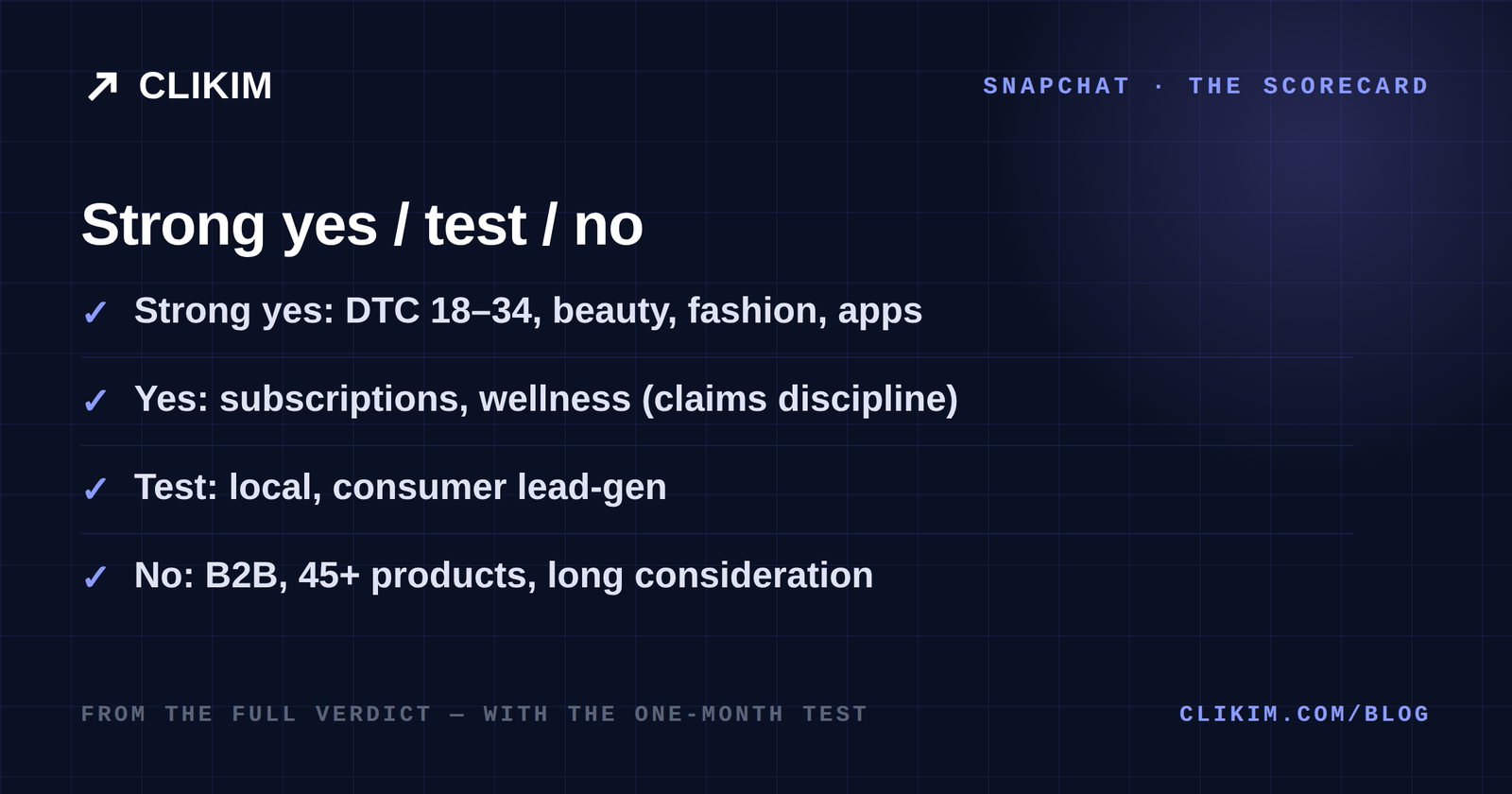
| DTC ecommerce, $20–80 AOV, 18–34 product | Strong yes | Catalog engine + auction discount + native audience |
| Beauty / fashion / accessories | Strong yes | The platform’s home verticals; AR try-on bonus |
| Mobile apps & gaming | Yes | App Power Pack, young installers, cheap installs |
| Subscription / wellness | Yes, with claims discipline | LTV math loves cheap acquisition; health claims are watched |
| Local & regional consumer | Test | Map + geofilters work; depends on local density |
| Lead gen (consumer) | Test | Lead forms exist; quality varies by vertical |
| High-AOV considered purchases | Weak | Session-based impulse platform; long funnels leak |
| B2B | No | Wrong room |
| 45+ audience products | No | The users aren’t there; NewsBreak or Meta instead |
Nine profiles, three honest answers. “Test” means the one-month protocol below, not indefinite hope.
The one-month test
Opinion is cheap; the test costs $1,500–3,000 and ends the argument. Week 0: Pixel + CAPI wired and verified (guide) — non-negotiable. Weeks 1–2: one Single Video campaign, 3–5 native-feeling creatives, $50–100/day, Smart Bidding, untouched. Weeks 3–4: cut losers, feed two fresh creatives weekly, add Collection/DPA if purchases flow.
Read the verdict like an operator: 7/0 cost per purchase within 1.5x of target — scale it (the pillar playbook covers the ramp). CPA at 2–3x with healthy CTR — your funnel, not the platform; fix and retest. CTR under 0.5% across all creatives — your creative didn’t earn the room, decide if it can. Weak everything with clean tracking — the audience isn’t yours; spend elsewhere without guilt.
What buyers actually report in 2026
Filter the community chatter for accounts with wired tracking and the pattern is consistent. The good: cheaper CPMs than Meta on the same-aged audience, DPA that “woke up” after a few hundred purchases, chat-feed inventory converting above expectations, and support that responds like a company that wants the budget.
The bad: creative fatigue on a one-to-two-week cycle at scale, reported ROAS that looks 20–30% worse than Meta until you match attribution windows, and learning phases that punish impatient editing.
The recurring mistake: porting Meta assets and Meta grading habits unchanged, concluding “Snap doesn’t work,” and leaving before the catalog engine seasons. The platform’s failure stories are overwhelmingly tourist stories; its quiet wins belong to operators who treated it as its own country for one full month.
The incrementality question
The sharpest version of “worth it” isn’t CPA — it’s would these customers have arrived anyway? Two practical probes, no data-science team required: geo splits — run Snapchat in half your matched metros for 4–6 weeks and compare blended new-customer cost across halves; and the overlap read — survey post-purchase (“where did you first see us?”) and watch what share names Snapchat in covered regions.
Why bother: Snapchat’s strongest structural claim is the un-duplicated slice of its audience. If your geo test shows covered metros acquiring cheaper blended customers, the channel is additive and deserves budget beyond what last-click grants it. If blended costs match everywhere, Snap was harvesting demand Meta already created — useful information at exactly the moment you’d otherwise scale it.
The verdict
Snapchat in 2026 is a specialist platform that rewards operators and punishes tourists. For the right advertiser — young-skewing product, real creative pipeline, tracking-first discipline — it’s one of the best value auctions in paid social, with genuinely incremental reach and reporting you can trust. For the wrong advertiser it’s a slow leak with a fun camera.
You now know which one you are — or you know it costs about $2,000 and four weeks to find out. That’s cheaper than a year of wondering, and either answer compounds: a yes becomes a channel, a no becomes budget you stop diluting.
Frequently asked questions
Are Snapchat ads worth it for small businesses?+
Why did my Snapchat ads not work?+
Is Snapchat better than TikTok for ads?+
Do Snapchat ads work in 2026?+
What ROAS should I expect from Snapchat?+
Passed the test? Scale it properly
Managed Snapchat infrastructure through Clikim — funded balances, headroom and a rep who answers — for advertisers the one-month test convinced.