
How Long Do Facebook Ads Take to Work?
Three different clocks: delivery (hours), statistical truth (days), compounding performance (weeks). Most 'Facebook ads don't work' verdicts are rendered inside the noise window — here's the honest timeline.
Delivery: within hours. Meaningful results: 3–7 days. A fair verdict: 4–6 weeks. Meta's learning phase needs ~50 conversions per ad set per week to stabilize — until then costs run 20–40% above where they'll settle, and every edit resets the clock. Speed it up by budgeting 5–10x your target CPA daily, optimizing to an event with real volume, and consolidating ad sets. Month-two typically beats week-one by 30–50% with zero changes — pixel signal and retargeting pools compound. Judge creative at day 3–5 (CTR), campaigns at week 2, the channel at week 6.
The real answer: three different clocks
"Take to work" means three different things, on three different clocks. Delivery starts within hours — review typically clears in minutes to a few hours and impressions follow. Statistically meaningful results take roughly 3–7 days at adequate budgets, because Meta's learning phase needs ~50 conversion events per ad set per week to exit exploration and stabilize performance. A fair verdict on the channel takes 4–6 weeks, because pixel signal, retargeting pools and creative learnings compound — month-two performance on the same account is routinely 30–50% better than week-one performance with nothing changed but time.
Most disappointment lives in the gap between clock one and clock two: ads that are "live but expensive" on day 2 are not failing — they're exploring. Costs during learning routinely run 20–40% above where they settle.
The week-by-week reality
The single most expensive habit in Facebook advertising: judging campaigns during the learning phase and editing them back to day zero.
What actually speeds it up (and what doesn't)
Speeds it up: budgets sized so each ad set can reach ~50 conversions/week (daily budget ≈ 5–10x your expected CPA); optimizing to an event with real volume — if purchases are rare, optimize to Add to Cart until data accumulates; consolidated structure (fewer ad sets = signal concentrates instead of fragmenting); and a warmed, trusted ad account — fresh accounts carry spending limits and extra review friction that stretch every one of these clocks. Doesn't speed it up: editing mid-learning (resets it), duplicating the campaign hourly (splits signal), toggling budgets (re-triggers learning), or panic-switching objectives on day three. The system rewards exactly one behavior during learning: patience.
If week two arrives and results are still poor, diagnose in order: creative first (weak CTR means the ad, not the algorithm), then offer and landing page, then structure. Our relevance diagnostics guide covers the triage.
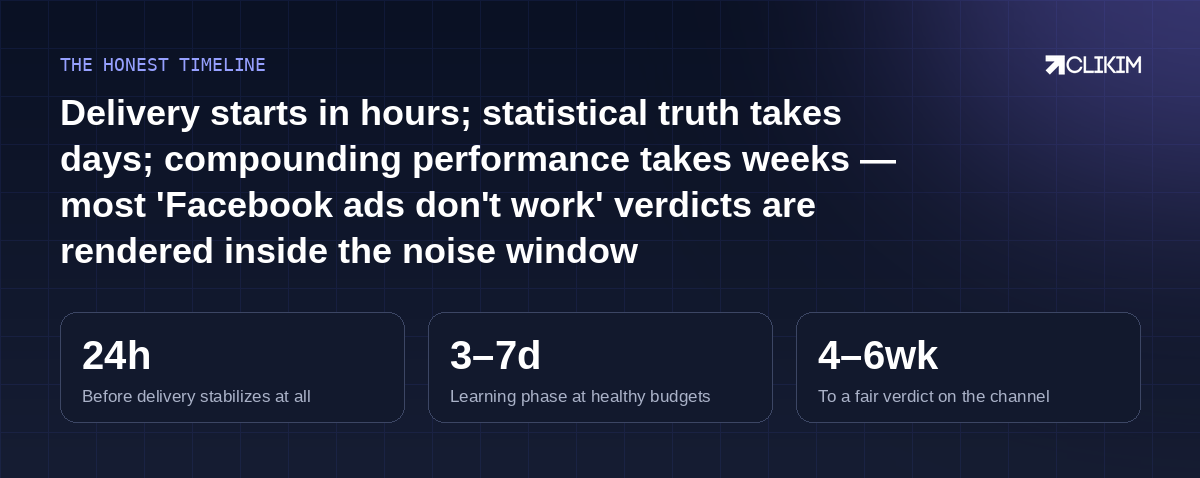
Hours to deliver, days to learn, weeks to compound — judge each clock by its own standard.
Frequently asked questions
Why are my Facebook ads not getting results after 3 days?+
How long does the Facebook learning phase last?+
Does editing my ads reset the learning phase?+
How much budget do I need for ads to work quickly?+
When should I kill an ad that isn't working?+
Do new ad accounts take longer to get results?+
Why did my results get worse after week one?+
Every clock runs slower on a cold account
Whitelisted infrastructure starts with trust and headroom built in — no warm-up weeks, no spending-limit crawl.