
How to Scale NewsBreak Campaigns: The Sourced Playbook
Scaling on NewsBreak has an unusual property: the platform’s own team and its tracker-vendor ecosystem have published most of the playbook. Here it is assembled — structure, budget cadence, kill rules, geo expansion — with every number attributed to who actually said it.
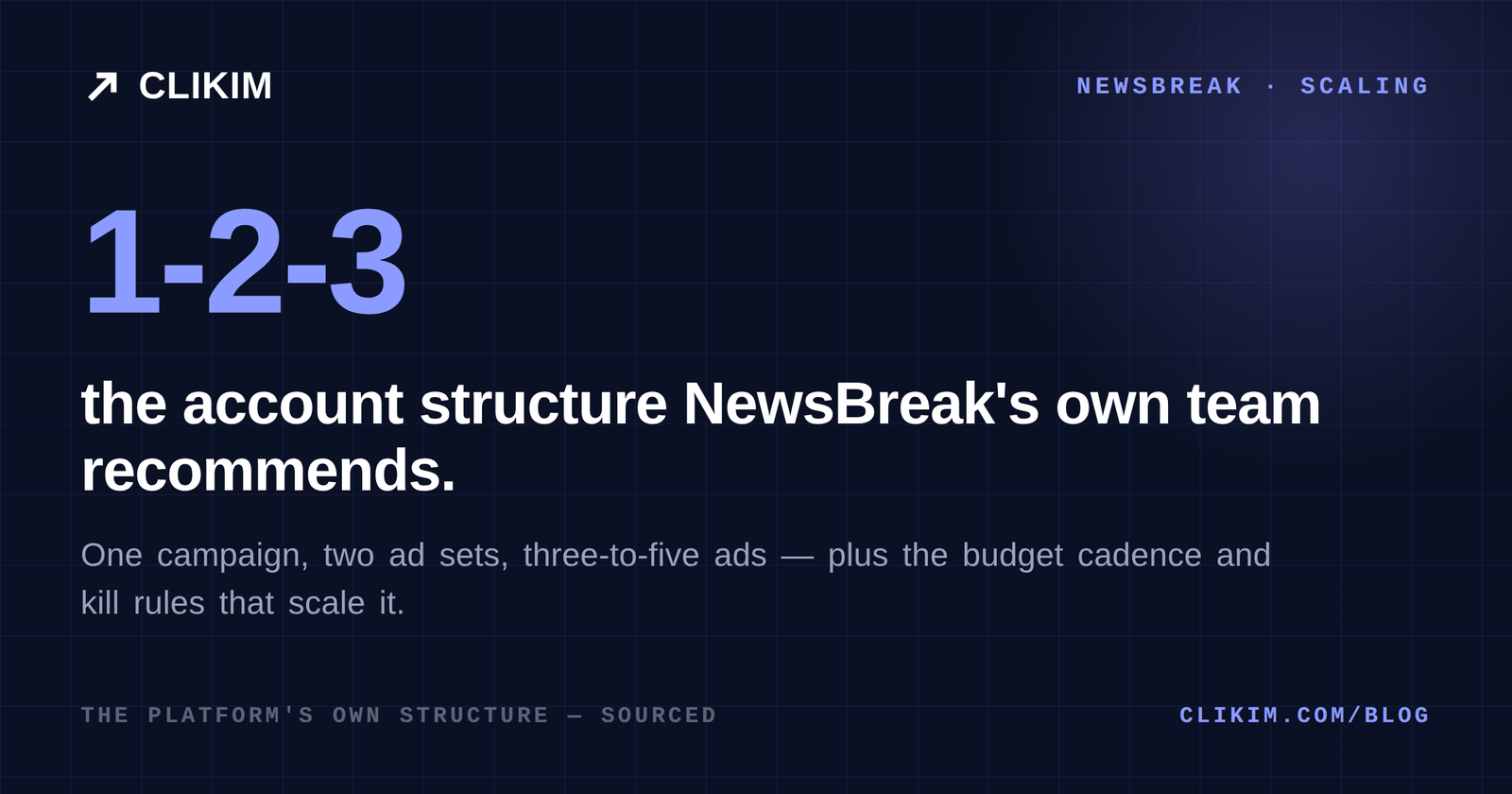
The structure comes from NewsBreak’s own team: 1 campaign, 2 ad sets, 3–5 ads — and broad targeting over segmentation.
The cadence comes from the tracker-vendor playbooks: open with Maximize Conversions at a daily budget 5–10× your CPA goal, feed ~20 conversions in the first 3–4 days, step budgets +30–50% every 48 hours, and switch to Target CPA at roughly 10× budget once stable.
The guardrails: pause anything at $200 spend over 3 days with zero conversions, give angles 800–2,500 clicks before verdicts, run separate ad accounts per vertical, and rotate creative before fatigue. All community-published numbers — attributed inside, and worth re-testing in your own account.
The 1-2-3 structure
The account shape comes from the platform itself. NewsBreak’s ads team publicly recommends what buyers call the 1-2-3 structure: one campaign, two ad sets, three to five ads per ad set — echoed almost verbatim by TheOptimizer’s scaling guide, which adds the warning against “flooding a new network with variants.”
Two principles travel with it:
- Broad beats segmented — the platform’s own guidance, matching its Nova engine’s design: give the first-party behavioral model room to find converters instead of fencing it into micro-audiences.
- Consolidation feeds learning — the same signal-density logic as every modern platform: five $10 ad sets learn nothing; one $50 ad set learns fast. The cost guide’s budget math applies at every scale step.
The budget cadence
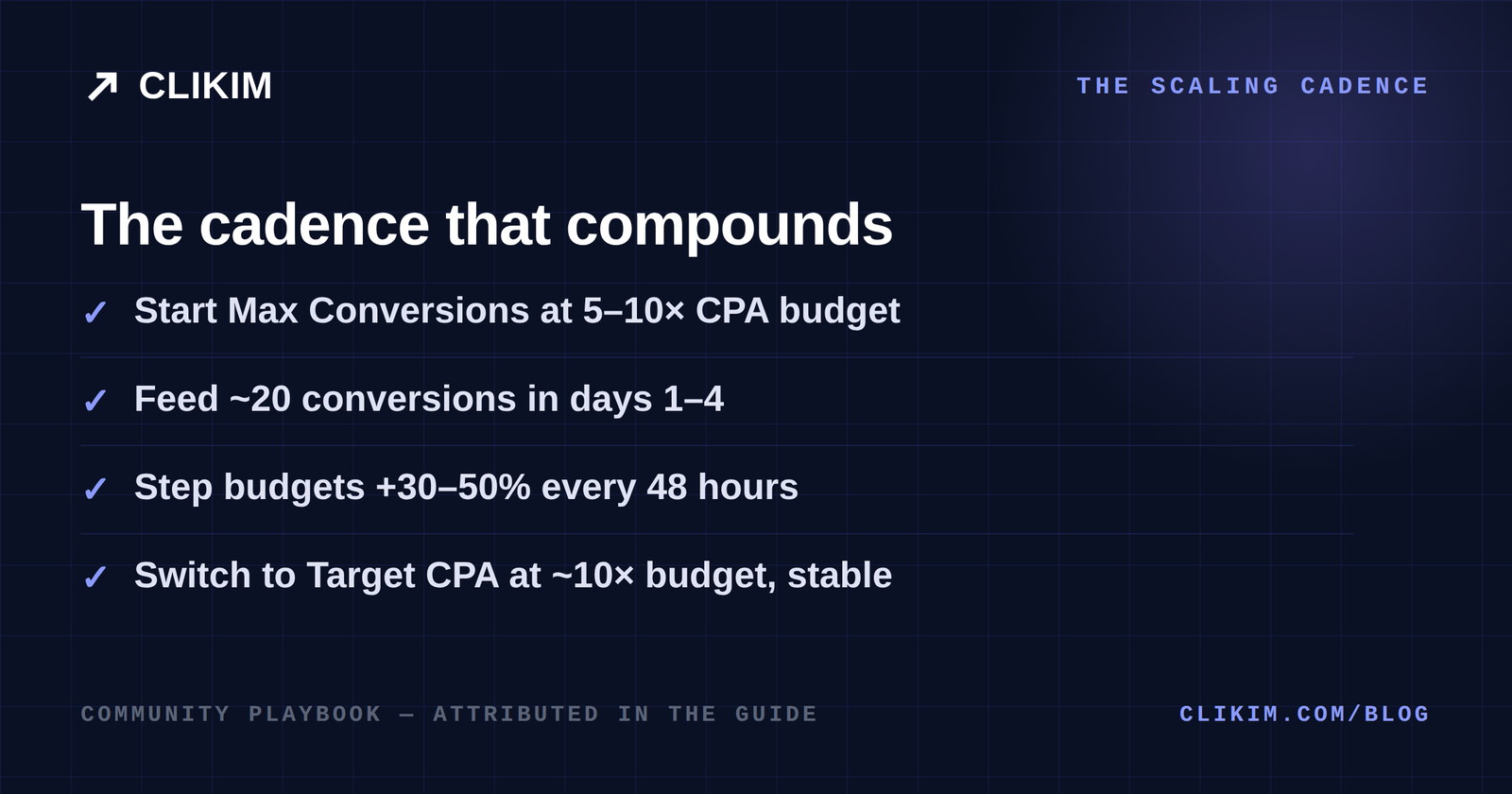
The tracker-community playbook, step by step — attribution and caveats in the guide.
The published consensus from ClickFlare and TheOptimizer — the two most detailed public playbooks — runs:
- Open on Maximize Conversions with a daily budget 5–10× your CPA goal — which is also NewsBreak’s official budget guidance, not just community lore.
- Feed ~20 conversions in the first 3–4 days — the learning diet that gets smart bidding past guessing.
- Step budgets +30–50% every 48 hours while CPA holds — aggressive by Meta standards, but repeatedly published as sustainable here.
- Switch to Target CPA at ~10× budget once stable — the stabilizer phase; the published beauty case ran a 70/30 Max Conversions/tCPA blend instead of a hard switch.
Label these honestly: third-party playbooks, not laws of physics. The 48-hour step is the piece most worth re-testing in your own account — the bidding guide covers what each strategy is doing underneath.
How fast can I raise NewsBreak budgets without resetting learning?
The published community cadence is +30–50% every 48 hours on Maximize Conversions while CPA holds. No official reset threshold is documented — which argues for stepping, watching a 48-hour window, and stepping again, rather than doubling on a good Tuesday.
Kill rules and verdicts
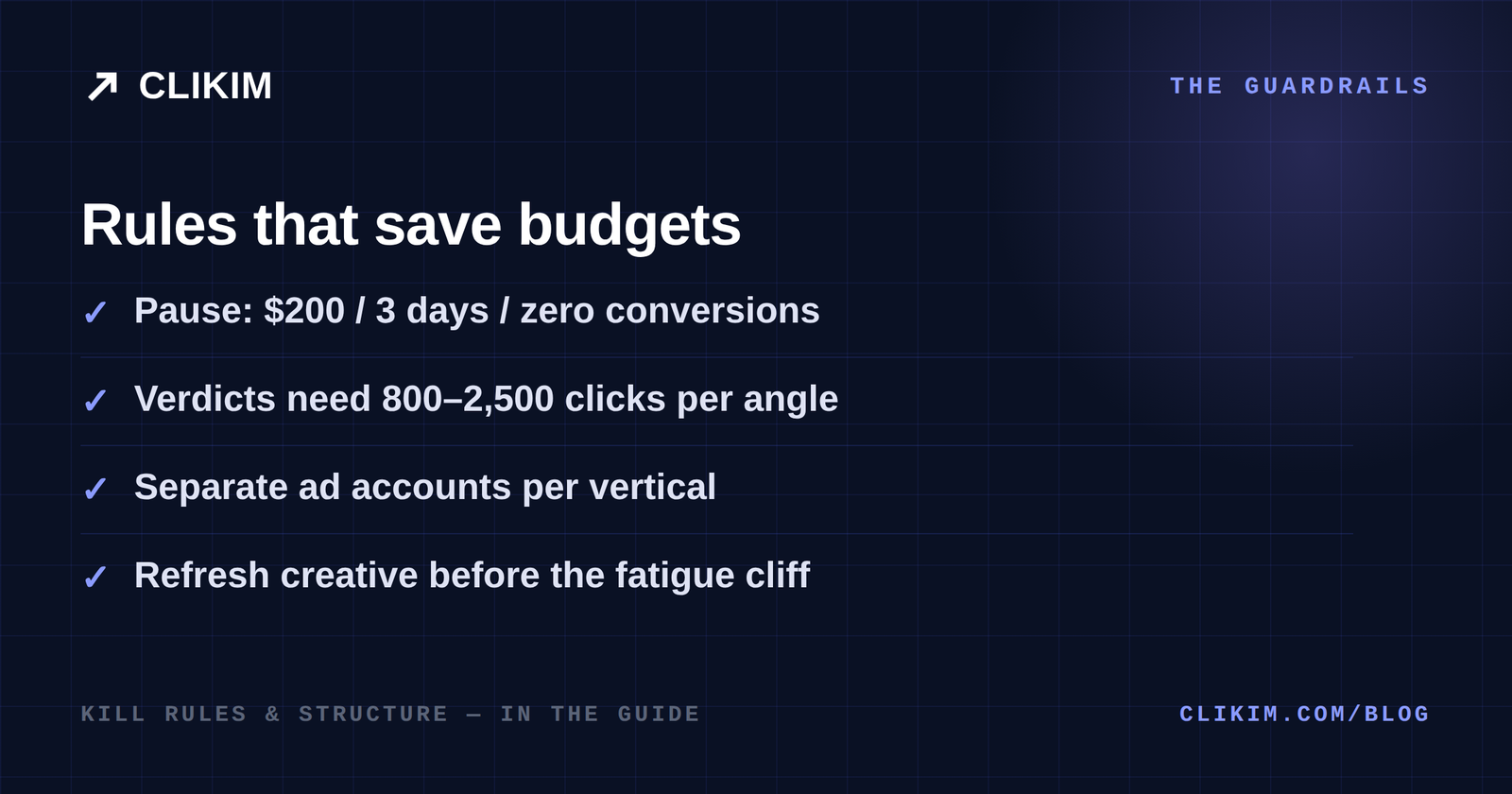
Scaling is mostly not dying — the guardrails that keep budgets honest.
Scaling is mostly not dying. The published guardrails:
- The $200/3-day rule — TheOptimizer’s example automation: pause anything that spent $200 over three days with zero conversions. Adjust the dollar figure to your CPA; keep the shape.
- 800–2,500 clicks per angle before verdicts — Daily Intel Service’s testing floor; below it you’re grading coin flips.
- Don’t kill smart bidding mid-learning — the most common self-inflicted wound: pausing Maximize Conversions on day two reads as failure what was actually calibration.
- Practical floor $50/day — the platform sells $10 entry, but the community’s working floor for real reads is higher; the $10 tier is for validating tracking, not judging offers.
Account architecture: the anti-Meta move
The most surprising published recommendation, from ClickFlare: run separate ad accounts per vertical or offer — the algorithm reportedly learns faster on clean, single-purpose signal. That’s the opposite of Meta consolidation doctrine, and worth flagging precisely because operators arrive with Meta habits.
The operational consequence: multi-offer operations end up managing account portfolios — provisioning, billing and standing across several accounts. That’s self-serve friction at small scale and a structural reason volume buyers move to managed agency access, where multi-account architecture is the product.
Geo expansion
NewsBreak’s city-level targeting makes geography the platform’s native scaling axis:
- Prove a cluster, then widen the ring — start with metros you can service or where carriers write, prove CPL, expand to adjacent DMAs.
- Read city splits weekly — CPL spreads across cities are wide; the winners national averages hide are your next budget increment.
- Localize as you expand — the “{city} homeowners” pattern from the creative guide keeps relevance while the map grows; vertical-specific geo tactics live in the home-services and insurance playbooks.
Creative rotation at scale
No NewsBreak-specific fatigue timeline is published — the honest baseline is general native experience: winners burn faster than social, refresh on a cadence tied to spend (weekly at high spend, biweekly-to-monthly lower). The operating rules:
- Watch the winner’s CTR, not the calendar — a declining CTR on a proven ad is the refresh alarm.
- Variation-test the winning angle before inventing new concepts — 3–5 fresh executions of what works beats five new guesses.
- Port winners across formats — a winning in-feed angle becomes the 9:16 video, per the format guide.
How much can you actually spend on NewsBreak?
No public account-level spend caps are documented, and no one publishes daily-spend numbers — the platform itself reports ~100,000 monthly ad campaigns across 40M+ monthly users (self-reported), so the inventory is real. The practical ceilings buyers hit are operational: card billing, account provisioning, and support latency — the self-serve ceiling below.
The scaling numbers, in one place
The cadence sheet, sources labeled:
- Structure: 1 campaign / 2 ad sets / 3–5 ads — NewsBreak’s own team.
- Budget: 5–10× CPA goal — official guidance.
- Learning diet: ~20 conversions in 3–4 days — tracker-community consensus.
- Steps: +30–50% per 48 hours while CPA holds — ClickFlare / TheOptimizer.
- tCPA switch at ~10× budget, or a 70/30 blend — published case.
- Kill rule: $200 / 3 days / zero conversions — TheOptimizer example.
- Verdict floor: 800–2,500 clicks per angle — Daily Intel Service; practical daily floor $50.
Every number is a published playbook, not physics — re-derive them in your account before trusting them at real spend.
Automation rules worth setting on day one
The published kill rule ($200/3 days/zero conversions) is one instance of a broader habit: encode your discipline as rules before emotions meet data. The starter set worth configuring — in your tracker or an optimizer layer, since native automation is thin:
- The zero-conversion kill — spend threshold scaled to ~5× your CPA over three days; pause, don’t delete, so learnings survive.
- The CPL ceiling alert — notify (not pause) at 1.5× target CPL over a 72-hour window; alerts preserve judgment where auto-pauses destroy learning phases.
- The budget-step scheduler — pre-authorize the +30–50% step only when the 48-hour window closes green; the rule exists to prevent the good-Tuesday double.
- The city-split review — a standing weekly export of CPL by city; the reallocation decisions come from this table, not from the blended dashboard.
The principle underneath: every rule fires on a window long enough to mean something. Automation that reacts to single bad days re-creates the impatience mistakes it was meant to prevent — the machine should embody the two-week discipline, not undermine it faster than a human could.
The 30-day scaling calendar
| Days | Move | Gate to pass |
|---|---|---|
| 1–4 | Max Conversions at 5–10× CPA; hands off | ~20 conversions banked; tracking verified live |
| 5–8 | First +30–50% step; kill clear losers only | CPA within 1.5× target and stable |
| 9–14 | Second and third steps; first creative refresh | CPA holds through each 48h window |
| 15–21 | Introduce tCPA (switch or 70/30 blend); open city-split review | Stable conversion flow at ~10× budget |
| 22–30 | Geo ring expansion; port winner to second format | Blended CPA still pays at the new spend level |
The calendar’s real function is preventing improvisation: every budget move waits for its gate, every gate is a number, and a missed gate means hold — not retreat. Print it, annotate it with your CPA, and the month runs itself.
When scaling stalls: the diagnostic
Three stall patterns cover most cases. CPA rising with each step — the auction is repricing you: hold budget, refresh creative, and mine city splits for cheaper pockets before stepping again. Spend refusing to pace up — bids or budget hitting auction reality in your geo: widen the ring or raise bids one notch, never both at once.
Volume up, quality down — the algorithm found cheaper humans who aren’t buyers: tighten the conversion event you optimize on (qualified lead, not raw lead) and let Nova relearn against the stricter signal. Each pattern has a first move; none of them is “double the budget and hope.”
The self-serve ceiling
Everything above works on a self-serve account until the operation outgrows it: invoicing unlocks only through an account manager, multi-account architecture multiplies billing overhead, and review questions ride a queue exactly when scaled spend makes hours expensive.
That’s the boundary where agency access becomes the scaling tool: funded balances, invoicing, provisioned account portfolios and a human on the other end. The platform-wide fundamentals stay in the complete guide — and the failure modes that end scaling runs early are cataloged in the mistakes guide.
Frequently asked questions
What campaign structure works best on NewsBreak?+
How do I scale a winning NewsBreak campaign?+
When should I kill a NewsBreak campaign?+
Should I use one NewsBreak account or several?+
Are there spending limits on NewsBreak accounts?+
How often should I refresh NewsBreak creative?+
What daily budget do I need to scale seriously on NewsBreak?+
Can I run the same offer in multiple NewsBreak accounts?+
Scale past the self-serve ceiling
Managed NewsBreak agency accounts: multi-account architecture, funded balances, invoicing and a rep — the infrastructure scaling actually runs on.