
Every Snapchat Ad Format in 2026 — And What to Run First
Snapchat runs one screen — full-screen vertical, sound on — and nine meaningfully different ways to buy it, from the $5/day auction workhorse to chat-feed Sponsored Snaps to generative AI Lenses. This guide maps every format to the job it’s actually good at, with the first-buy order for a performance budget.
Nine formats, one screen: everything on Snapchat is 1080×1920, full-screen, sound-on.
For direct response, the order that earns budget: Single Image/Video first, Collection and Dynamic Ads once purchase signal flows, Story Ads for sequential selling, Sponsored Snaps for scale on the chat feed. Commercials and takeovers are brand tools; AR and AI Lenses are engagement plays that went self-serve.
Same auction, same $5/day floor for nearly everything — the format decision is about the job, not the price of entry.
The format map
| Format | Where it runs | Job | Entry |
|---|---|---|---|
| Single Image/Video | Between Stories & content | DR workhorse | $5/day auction |
| Collection | Same, + product tiles | Shoppable browsing | $5/day auction |
| Dynamic (DPA) | Auto-placed | Catalog retargeting/prospecting | $5/day auction |
| Story Ads | Discover tile → 3–20 snaps | Sequential selling | $5/day auction |
| Sponsored Snaps | Chat feed | Reach + DR on the core surface | Auction / reserved |
| Commercials | Curated shows | 6s non-skippable brand | Auction / rate card |
| AR Lenses | Camera carousel | Engagement, try-on | $5/day auction |
| Sponsored AI Lenses | Camera, front slot | Selfie engagement at volume | Via Ads Manager |
| Filters / Promoted Places | Camera overlays / Snap Map | Local moments, foot traffic | ~$5+ geofence / reserved |
One screen, nine jobs. Price of entry is nearly uniform — pick by job.
The performance four
Single Image or Video Ads are where every performance budget should start: the biggest inventory pool, the fastest feedback loop, and the format the bidding models know best. Three to five creatives, 5–20 seconds each, hook in the first second — that’s the whole brief. Everything you learn here transfers to every other format.
Collection Ads add four tappable product tiles under the hero asset — Snapchat’s answer to shoppable browsing. They earn their place the moment your catalog is connected and your pixel reports purchases; the tiles convert browsers who’d never swipe up on a straight video.
Dynamic Ads generate creative from your product feed and place it automatically — retargeting first (viewers of product X see product X), then broad prospecting once the model learns. This is Snapchat’s growth engine right now: catalog-ad revenue grew 30% year over year, and Snap credits LLM-based product understanding with multiplying conversion rates on some campaigns. Feed hygiene decides everything — titles, images and prices as clean as your best product page.
Story Ads put a branded tile in Discover that opens a 3–20 snap sequence. They’re the sequential-selling tool: problem → product → proof → offer, each snap one beat. CPMs run cheap because the intent filter is real — the user chose to tap in.
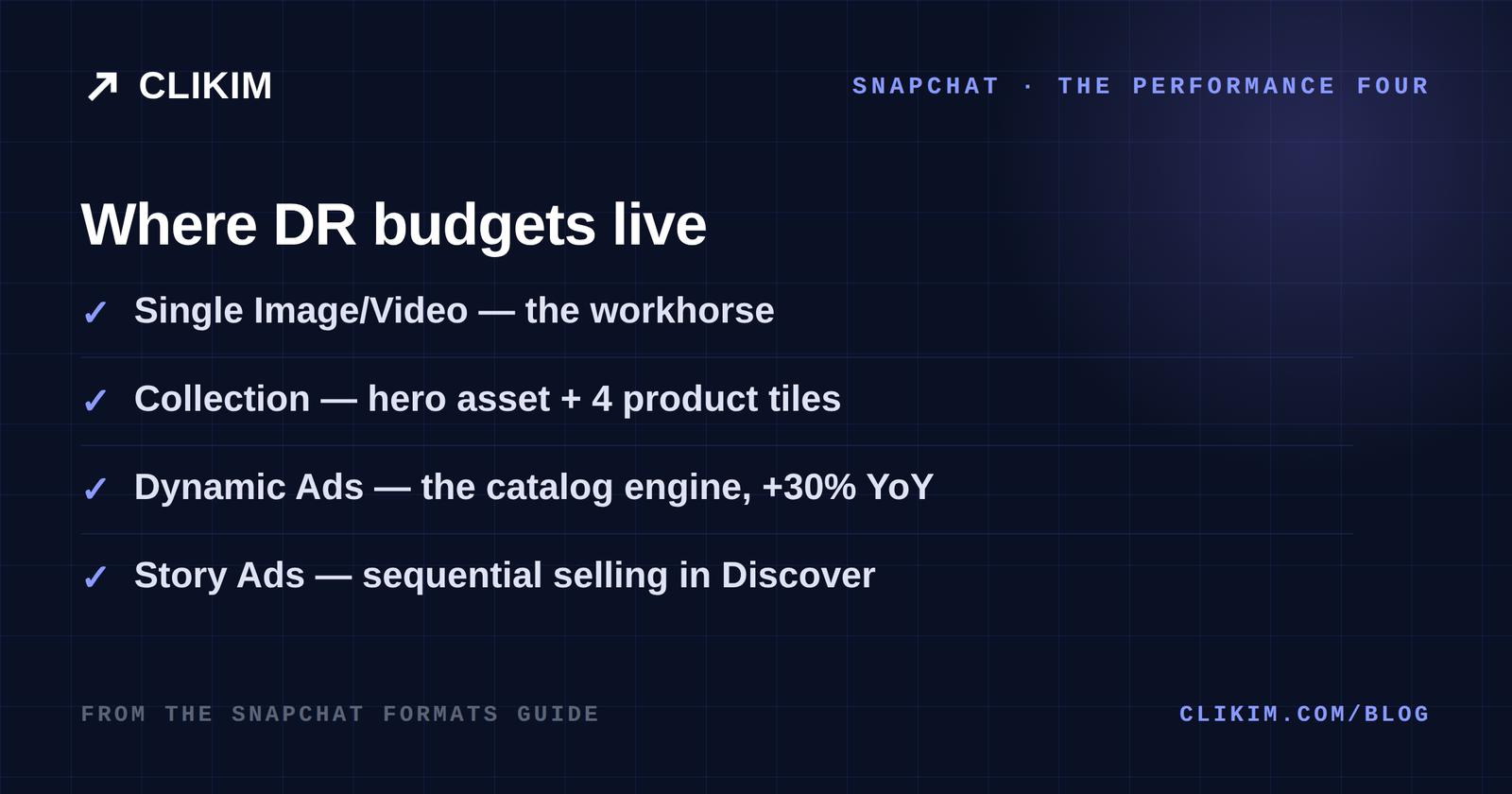
The performance four. Master the workhorse before renting the exotics.
Sponsored Snaps and the chat feed
The chat feed is where Snapchat actually lives — 950 billion chats a quarter — and since late 2024 it takes ads: Sponsored Snaps, full-screen Snaps delivered into the feed, no push notification, visually distinct from friends’ messages. Users can tap through or reply.
The numbers Snap reports are the strongest of any new surface in years: 50M+ average daily US impressions, per-impression click-through up 226% from launch quarter, 7-day conversion volume up 59%, and roughly a third of reach incremental to every other placement — with their own framing claiming ~20% lower CPAs than other inventory. Vendor numbers, but the mechanism is believable: it’s the one surface every user checks daily.
Two operational notes: creative that reads like a message (“we made something for you”) outperforms recut feed ads here, and frequency discipline matters more than anywhere else — the chat feed is personal space, and the platform curates hard. The frontier version, AI Sponsored Snaps (alpha since April 2026), opens a conversation with an advertiser-run AI agent — watch it, don’t build a plan on it yet.
Commercials and takeovers
Commercials are the only non-skippable inventory: six locked seconds (extendable to 180 total) inside curated Discover content. They’re a brand product — reach and recall, priced accordingly, with rate-card options through sales. Nielsen-measured work like Subway’s shows the honest use case: incremental reach on top of TV, not direct response.
Takeovers — First Lens, First Snap — buy the first impression of a surface for a day, at country rate cards through Snap sales. Launch-day tools for brands with launch days. Everyone else: the auction versions of the same surfaces cost $5/day and teach you more.
AR Lenses, AI Lenses and Filters
AR is Snapchat’s signature, and the 2024–25 shift made it buyable like everything else: Sponsored Lenses run self-serve from the same $5/day floor, with takeover placements as the premium tier. The honest performance framing: Lenses are engagement and brand-lift tools with occasional DR magic (try-on for beauty and eyewear genuinely converts) — not a first dollar for most direct-response budgets.
Sponsored AI Lenses (late 2024) changed the economics: generative selfie Lenses need no 3D production, and the front-of-carousel placement drives 25–45% more impressions in a day, per Snap. Early adopters were Uber, Tinder and Coldplay — reach plays. Filters and Promoted Places round out the local kit: geofenced overlays from about $5, and sponsored pins on Snap Map that chains like McDonald’s use for foot traffic.
Specs and safe zones
- Canvas: 1080×1920 (9:16), MP4/MOV for video, 3–180s depending on placement; images JPG/PNG.
- Safe zones: keep text, logos and CTAs out of the top ~150px and bottom ~460px — the UI lives there, and rejections or occluded CTAs follow when you ignore it.
- Sound: on by default — use it, but stay legible muted with captions.
- Attachments: website, app install, lead form or call attachments swipe up from any full-screen format.
Mapping formats to the funnel
The format menu becomes a plan when you assign each layer of the funnel a surface and a job:
| Funnel stage | Format | Judge it on |
|---|---|---|
| Cold reach | Single Video, Sponsored Snaps | CPM, hook rate, incremental reach |
| Consideration | Story Ads, Collection | Engaged sessions, product views |
| Conversion | DPA retargeting, Collection | 7/0 cost per purchase |
| Loyalty / launch moments | Sponsored Snaps, AR | Repeat rate, earned shares |
One job per stage. A format asked to do two jobs does neither at a price you’ll like.
Budget shape for a store at steady state: roughly 50–60% on the prospecting workhorses, 25–30% on catalog conversion, the remainder experimenting on the newest surface — which in 2026 means the chat feed. Rebalance monthly on 7/0 cost per new customer, and resist the urge to fund AR from the performance line; it’s a brand investment with brand math.
The mistake this table prevents: judging a reach format on purchases (“Sponsored Snaps didn’t convert day one”) or a conversion format on scale (“DPA won’t spend more”). Each surface has a native metric; grade it there, then look at the blended account.
The first-buy order
For a performance budget entering cold: (1) Single Image/Video with tracking wired (the setup guide), (2) Collection + Dynamic the week purchase signal flows, (3) Story Ads when you have a story worth three beats, (4) Sponsored Snaps when you’re scaling and want the incremental surface, (5) AR when engagement is a goal with a budget of its own. Costs and the month-one plan live in the cost guide; the full platform map is the pillar.
Frequently asked questions
What ad formats does Snapchat have in 2026?+
Which Snapchat ad format is best for sales?+
What are Sponsored Snaps and do they work?+
How much do Snapchat AR Lenses cost now?+
Are Snapchat Commercials worth it for small advertisers?+
What are the Snapchat ad safe zones?+
Every format, without the ceilings
Managed Snapchat infrastructure through Clikim — funded balances, headroom across every placement, and a rep who answers while you scale what works.