
Advantage+ Shopping Campaigns (ASC): A Practical Guide
ASC hands targeting and optimization to Meta's models and asks you to win on creative instead. Here's what it automates, how it differs from CBO, when it's the right tool, how to launch one well, and why creative and tracking are everything.
Advantage+ Shopping Campaigns (ASC) are Meta's automated ecommerce campaign type: you provide creative and budget, and Meta handles broad AI targeting, placements, budget split and creative testing toward purchases. Use ASC to scale an ecommerce brand with a real catalog and varied creative; keep a lean manual or CBO campaign alongside for control. With ASC, your creative is your targeting.
What Advantage+ Shopping Campaigns are
Advantage+ Shopping Campaigns (ASC) are Meta's heavily-automated campaign type for ecommerce. Instead of building out audiences, placements and dozens of ad sets, you hand Meta your creative and budget and let its machine learning do most of the targeting and optimization toward purchases. For many DTC brands it's become a workhorse — not because automation is magic, but because at scale Meta's models often allocate better than manual micromanagement. The trade-off is control, which is the theme running through everything below.
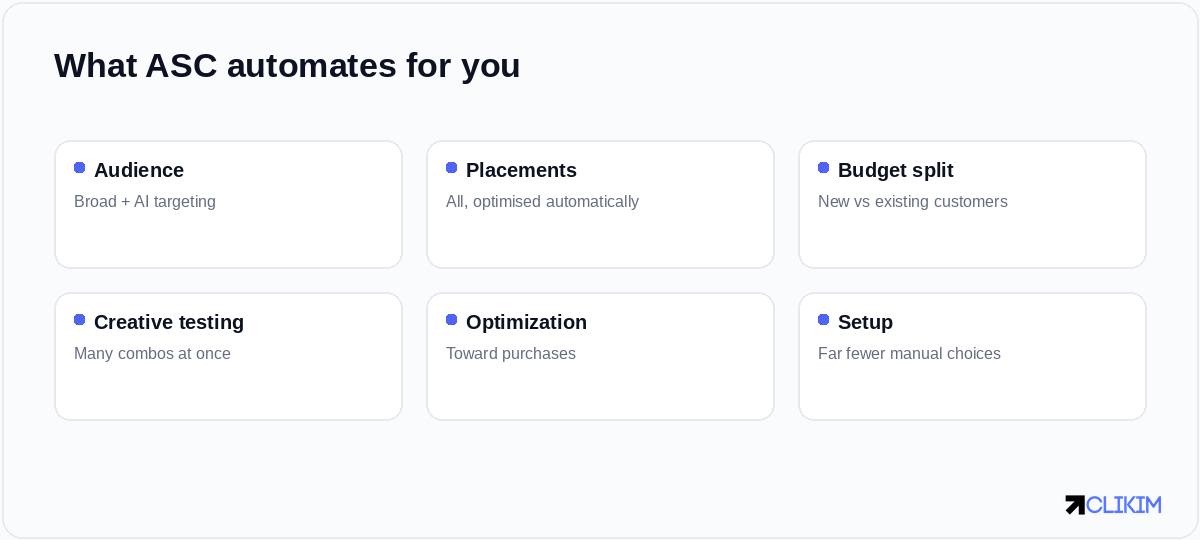
ASC automates the parts that used to eat hours — targeting, placements, budget split and creative testing.
How ASC differs from manual campaigns
A traditional sales campaign asks you to define audiences, choose placements, and structure ad sets. ASC collapses most of that. You feed it a pool of creative, set a budget, and optionally cap how much goes to existing customers versus new ones. Meta handles targeting (broad, AI-driven), placements (all of them, optimised), and which creative combinations to show. It's a step beyond CBO: where CBO automates budget allocation but keeps your audience structure, ASC automates the audiences too. You're trading granular control for the model's reach.
When to use it (and when not to)
ASC tends to shine for ecommerce brands with a real catalog, a decent volume of conversions to learn from, and a stock of varied creative. It's less suited to lead gen, tiny budgets that can't generate enough purchase signal, or brands that need tight control over audience exclusions. A common, effective structure is to run ASC as your scalable core and keep a lean manual or CBO campaign alongside it for specific tests or audiences ASC can't isolate.
How to launch one well
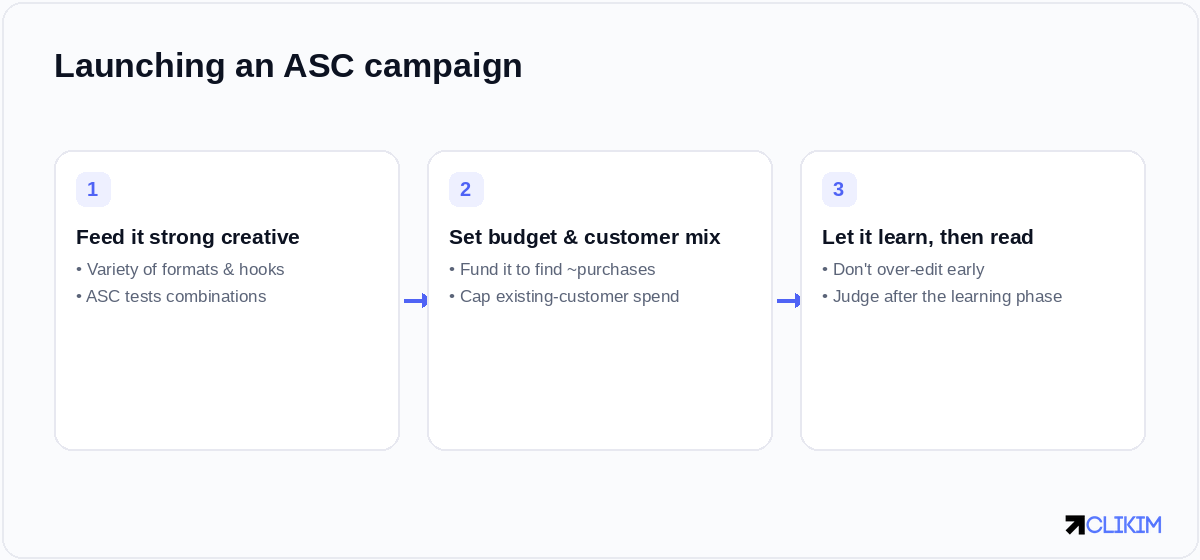
Feed ASC varied creative, set a budget that can find purchases, then let it learn before you judge it.
- Feed it strong, varied creative. ASC's main lever is creative, because it tests combinations for you. Give it a range of formats, hooks and angles rather than three near-identical ads.
- Set a budget that can find purchases, and use the existing-customer cap to control how much spend goes to people who'd convert anyway versus net-new buyers.
- Let it learn before judging. Resist over-editing in the first days; ASC needs conversion volume to stabilise, and constant changes reset that.
Creative is the real lever
Because ASC automates targeting, your creative is your targeting. Winning with ASC is mostly a creative-volume-and-quality game: the brands that do best feed it a steady stream of fresh, varied concepts and let the system find which resonate. If creative is your bottleneck, our roundup of the best ad creative tools is a good starting point, and a clean pixel matters more than ever here — if conversions are mis-tracked, ASC optimises toward the wrong people, so rule out pixel problems first.
Why tracking and data quality matter most here
Automated campaigns live or die on signal. ASC is only as smart as the conversion data you feed it; if your pixel is leaking events, the model optimises on a distorted picture and your results suffer in ways that are hard to diagnose. This is why serious ASC users invest in clean, server-side-backed tracking before they pour budget in — it's the unglamorous foundation that makes the automation actually work.
Why the account underneath still matters
ASC can scale aggressively, which is wonderful until your account can't keep up. Automated campaigns that ramp spend fast are exactly the kind of activity that strains low-trust accounts and trips spend caps. Running ASC on managed whitelisted infrastructure with no preset cap means the campaign can scale at the model's pace, not your account's ceiling — and a rep is there if aggressive scaling ever draws a flag, which is the same reason it underpins scaling without bans.
Frequently asked questions
What are Advantage+ Shopping Campaigns?+
How is ASC different from a manual campaign?+
How is ASC different from CBO?+
When should I use Advantage+ Shopping?+
What's the most important factor for ASC success?+
Should I edit an ASC campaign frequently?+
Let automated campaigns scale without a ceiling
Run ASC on managed whitelisted infrastructure with no preset spend cap — scale at the model's pace, with a rep if aggressive scaling draws a flag.