
What Is a Good CTR on Facebook Ads? Benchmarks by Vertical & Season
"What's a good CTR?" is the most-asked question in paid social — and the honest answer is "it depends." This guide gives you the real numbers: what CTR means, the all-industry average, how it splits across verticals like fashion, telehealth and insurance, and how the calendar quietly reshapes it.
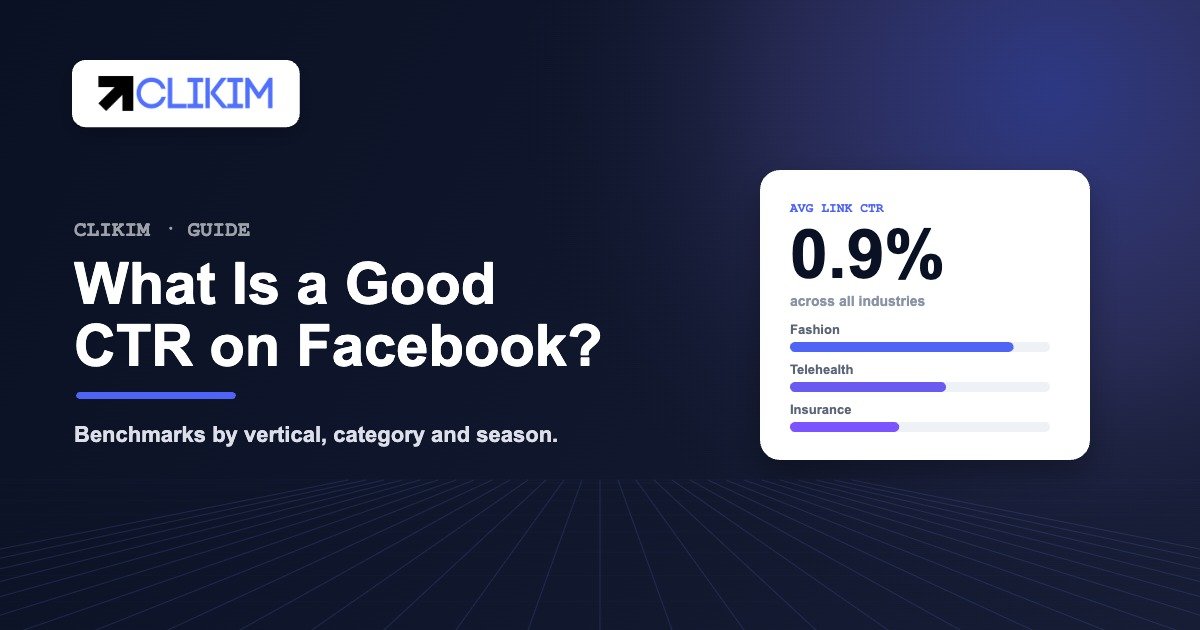
A good link CTR on Facebook ads is around 1% or higher, against an all-industry average commonly cited near 0.9%. But "good" depends heavily on your vertical: fashion and e-commerce often run 1–2.5%, while insurance, finance and legal sit lower at 0.4–1.1%. Season matters too — CTR climbs into Q4 and peaks around Black Friday. The benchmark that actually matters is your own CTR trending upward.
What is CTR — and how is it measured?
CTR, or click-through rate, is the percentage of people who click your ad after seeing it. The math is simple: clicks ÷ impressions × 100. If 1,000 people see your ad and 12 click, that's a 1.2% CTR. It's the clearest single signal of whether your creative and offer are resonating with the audience you're paying to reach.
One thing trips up most beginners: Facebook reports two different CTRs, and they tell very different stories.
- CTR (all) counts every click — including likes, comments, shares, and clicks to expand the image. It looks flattering but mixes engagement with intent.
- CTR (link click-through rate) counts only clicks that go to your destination — your landing page or product. This is the number that matters for performance, because it reflects intent to actually visit your offer.
When someone quotes a CTR, ask which one. The benchmarks in this guide refer to link CTR, the more conservative and meaningful figure. A 3% "CTR (all)" can hide a 0.7% link CTR.
What counts as a "good" CTR?
Across all industries, Facebook ad link CTR is commonly cited at around 0.9%. So as a rough rule, anything at or above ~1% is healthy, and consistently above 1.5–2% is strong. Below ~0.5% usually signals a creative, offer or targeting problem worth fixing before you scale.
But that all-industry average is a blended number, and blending hides the truth. It averages scroll-stopping fashion ads together with dry insurance ads, so it describes almost no real campaign accurately. A 1.1% CTR could be mediocre for apparel and excellent for a finance product. That's why the only benchmark you should truly optimize against is your own historical CTR for the same offer and audience — is it going up or down? Everything else is context.
It's also worth remembering why CTR matters at all: it directly lowers your cost per click, which feeds your cost per acquisition. We unpack that chain in our guide to CPM vs CPA — CTR is one of the two multipliers that turn impression cost into conversion cost.
CTR benchmarks by vertical
Here's where the all-industry average breaks apart. Different verticals live in genuinely different CTR worlds, driven by how visual the product is, how much intent the audience has, and how strict the ad policies are.
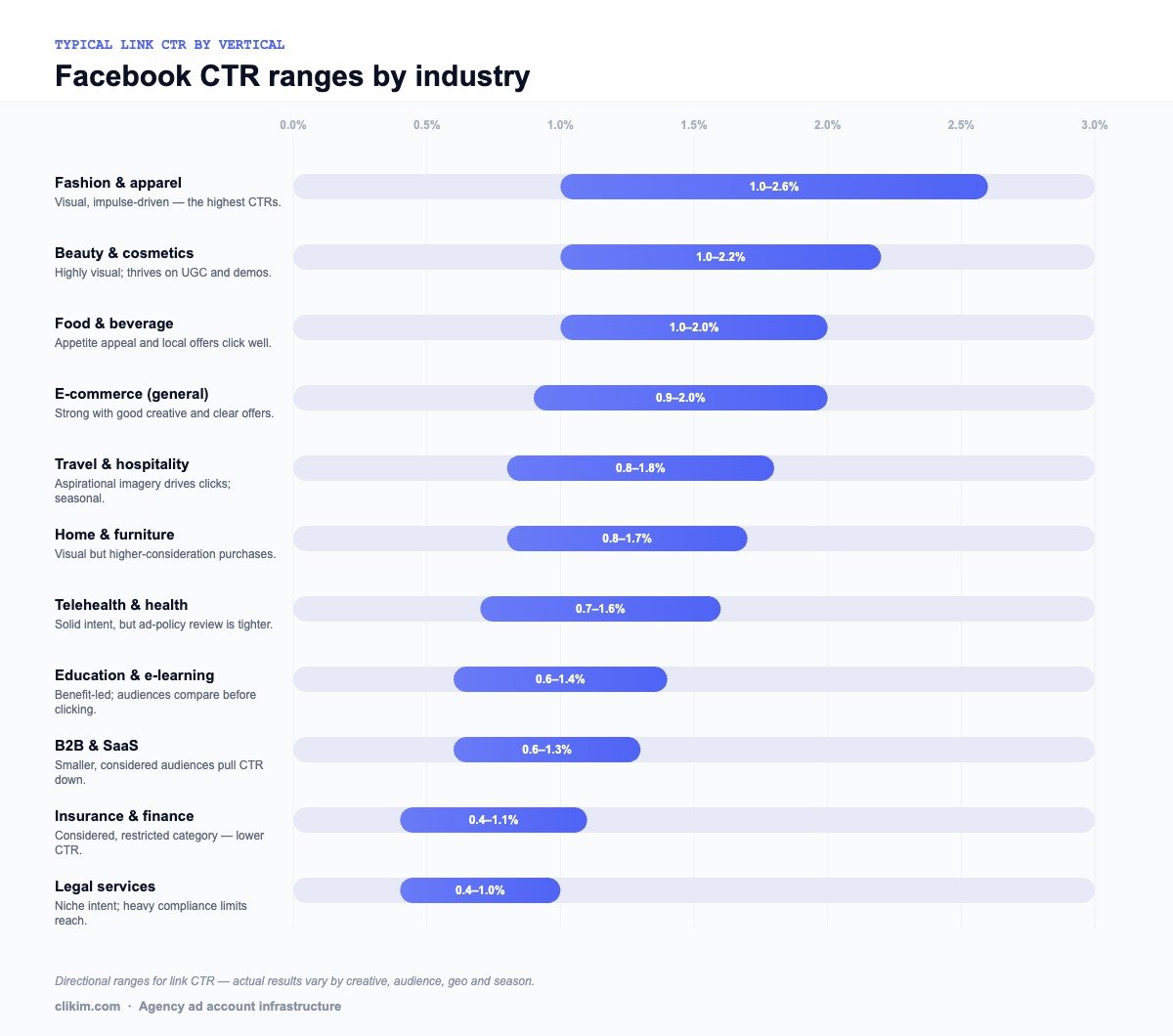
Directional link-CTR ranges by vertical — actual results vary by creative, geo and season.
The pattern is consistent: visual, impulse-driven categories sit at the top, and considered or regulated purchases sit at the bottom. Fashion, beauty, food & beverage and general e-commerce thrive because the product sells itself in a visual feed — a great image is the pitch. Travel and home & furniture sit in the upper-middle on aspirational imagery, while education and e-learning land mid-pack as audiences compare options before clicking. B2B, insurance and legal sit lower because their audiences are smaller, more deliberate, and governed by stricter ad policies that limit aggressive creative. Neither end is "better"; a 0.9% CTR insurance campaign can be far more profitable than a 2% CTR fashion campaign if the economics are right.
Plotted side by side, the spread across categories is striking — the top verticals click at roughly double the rate of the bottom ones:
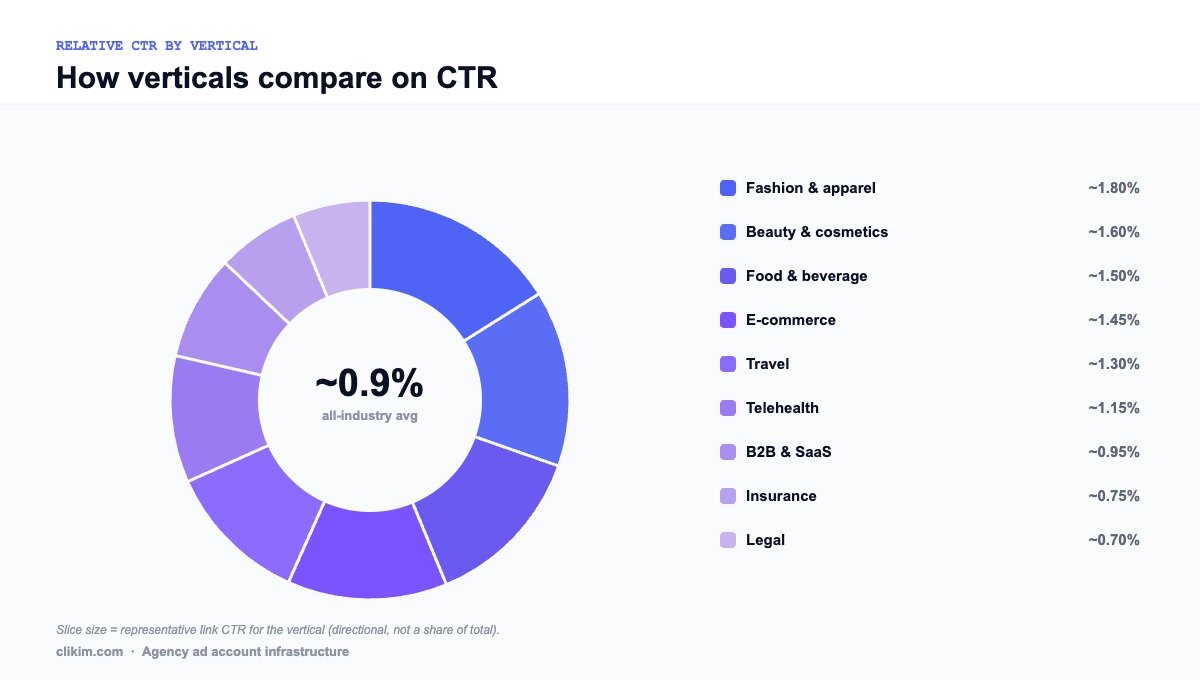
Representative CTR by vertical, against the ~0.9% all-industry average.
A closer look: fashion, telehealth & insurance
Three verticals show the spread especially well — and each plays by its own rules.
Fashion & apparel — the high-CTR end (≈1.0–2.6%)
Fashion is about as good as Facebook CTR gets. The feed is a visual medium, and clothing, accessories and lifestyle imagery are inherently scroll-stopping, so the product does the persuading before any copy is read. Impulse intent is high, audiences are broad, and policy friction is low. To push toward the top of the range, fashion advertisers lean on lifestyle and user-generated content, model the product in motion via video and carousels, and pair it with a clear offer or seasonal hook. The risk isn't low CTR — it's creative fatigue, since high-performing fashion ads burn out fast and need constant refreshing.
Telehealth & health services — the middle (≈0.7–1.6%)
Telehealth sits in an interesting spot: intent is genuinely high because people are actively seeking solutions to real problems, which lifts CTR — but ad policy is tight. Health-related claims, personal-attribute language ("Do you suffer from…"), and before/after framing are heavily restricted, which constrains the most clickable creative angles. The winners focus on empathetic, benefit-led messaging, social proof, and a frictionless next step (a quick assessment or consultation), rather than the bold claims that would be policy-flagged. Because health is also a category where accounts get scrutinized more closely, account stability matters — a disabled account mid-flight is costly, which is why many health advertisers run on higher-trust agency ad accounts.
Insurance & finance — the considered end (≈0.4–1.1%)
Insurance is the classic low-CTR, high-value vertical. It's a considered, regulated purchase: people research carefully, rarely buy on impulse, and the category carries strict advertising policies. A CTR near or above 1% is genuinely strong here. The economics are different too — a single conversion can be worth a great deal, so a 0.6% CTR with a solid conversion rate can be highly profitable. Finance advertisers win with trust signals (licensing, ratings, guarantees), specific and quantified benefits ("cut your premium by up to 30%"), and tightly-qualified audiences so they're not paying for clicks from people who'll never convert. Because finance is a restricted vertical that platforms watch closely, running inside a trusted Business Manager — like a Platinum HiVA BM2500 — reduces the odds of a sudden restriction derailing a profitable campaign.
How season changes CTR
CTR isn't static across the year. Audience mood, shopping intent and competition all shift with the calendar, and they move CTR with them.
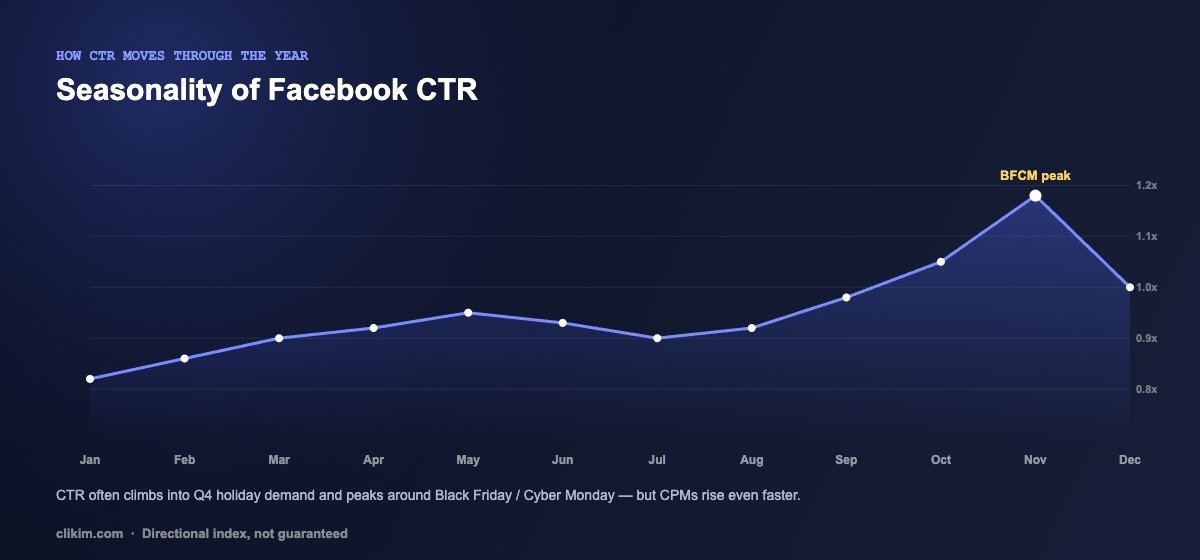
CTR tends to climb into Q4 and peak around BFCM — but CPMs rise even faster.
- Q4 (Oct–Dec). Holiday shopping intent builds through the quarter, lifting CTR for most retail and gift-friendly verticals, and peaking around Black Friday and Cyber Monday. The catch: every advertiser knows this, so auction competition spikes and CPMs often rise faster than CTR — a higher click rate doesn't guarantee a cheaper result.
- January. Post-holiday fatigue and tightened wallets usually mean a CTR dip — though "new year, new me" verticals like fitness, health and finance can buck the trend as resolutions kick in.
- Spring & summer. Generally steadier and cheaper. Lower competition can make this a quietly efficient window, even if raw CTR is a touch lower than the Q4 peak.
- Vertical-specific spikes. Telehealth and insurance often see CTR lifts during open-enrollment and new-year windows; fashion peaks around seasonal drops and holidays. Always map CTR expectations to your category's calendar, not the generic curve.
What actually moves your CTR
Vertical and season set the backdrop, but within any campaign these are the levers that decide whether you land at the top or bottom of your range:
- Creative and hook. By far the biggest factor. The first second of a video or the thumbnail of an image decides whether anyone stops scrolling.
- Offer strength. A compelling, specific offer lifts CTR more than any clever wording — people click on value, not adjectives.
- Ad-to-audience relevance. The closer the message matches the viewer's situation, the higher the CTR. Broad, generic ads to broad audiences underperform.
- Format. Video and carousels often out-click static images in feed; placements matter too (feed vs Stories vs Reels behave differently).
- Frequency. The more times the same person sees an ad, the lower the CTR drifts. Watch frequency and refresh before fatigue sets in.
How to improve your Facebook ad CTR
If your CTR is below where you want it, work in this order — biggest levers first:
- Fix the hook. Rewrite the first line and remake the opening frame. Lead with the benefit, a pattern interrupt, or the single most clickable idea.
- Sharpen the offer. Make it specific and quantified. "Save up to 30%" beats "great value" every time.
- Tighten relevance. Match creative to audience segments instead of running one generic ad to everyone.
- Test formats and angles. Run video against static, UGC against polished, and several distinct angles — then let data, not opinion, pick the winner.
- Refresh before fatigue. Rotate creative on a schedule so rising frequency never quietly erodes your CTR.
CTR in context: clicks aren't profit
One closing caution: CTR measures interest, not money. A scroll-stopping ad with a 3% CTR and a broken landing page still loses money. CTR's real job is to lower your cost per click, which then feeds into your cost per result — the number your P&L actually cares about.
That's why experienced buyers read CTR alongside conversion rate, CPM and CPA, not in isolation. It's also why the account you run on matters: platforms reward relevant, high-quality accounts with better delivery, and a low-quality or repeatedly-flagged account can quietly suppress reach and inflate costs no matter how good the creative is. New to this idea? Start with what an agency ad account is and how a higher-trust setup supports more efficient delivery — on Meta and TikTok alike. And for more breakdowns like this one, browse the Clikim blog.
Frequently asked questions
What is a good CTR on Facebook ads?+
What is the average CTR for Facebook ads?+
How is CTR calculated on Facebook ads?+
Why does CTR vary so much by industry?+
What is a good CTR for fashion ads?+
What is a good CTR for telehealth ads?+
What is a good CTR for insurance ads?+
Does CTR change with the season?+
How can I improve my Facebook ad CTR?+
Does a high CTR always mean a profitable campaign?+
Great creative deserves a stable account
Run your highest-CTR campaigns on whitelisted Meta and TikTok infrastructure — high-trust delivery, 0% top-up fees, and a rep who answers in minutes.