
CPM vs CPA: What They Mean and How to Lower Both
Two of the most-quoted numbers in paid advertising — and two of the most misunderstood. Here's what CPM and CPA actually measure, how they're mathematically linked, and the practical levers that bring each one down.
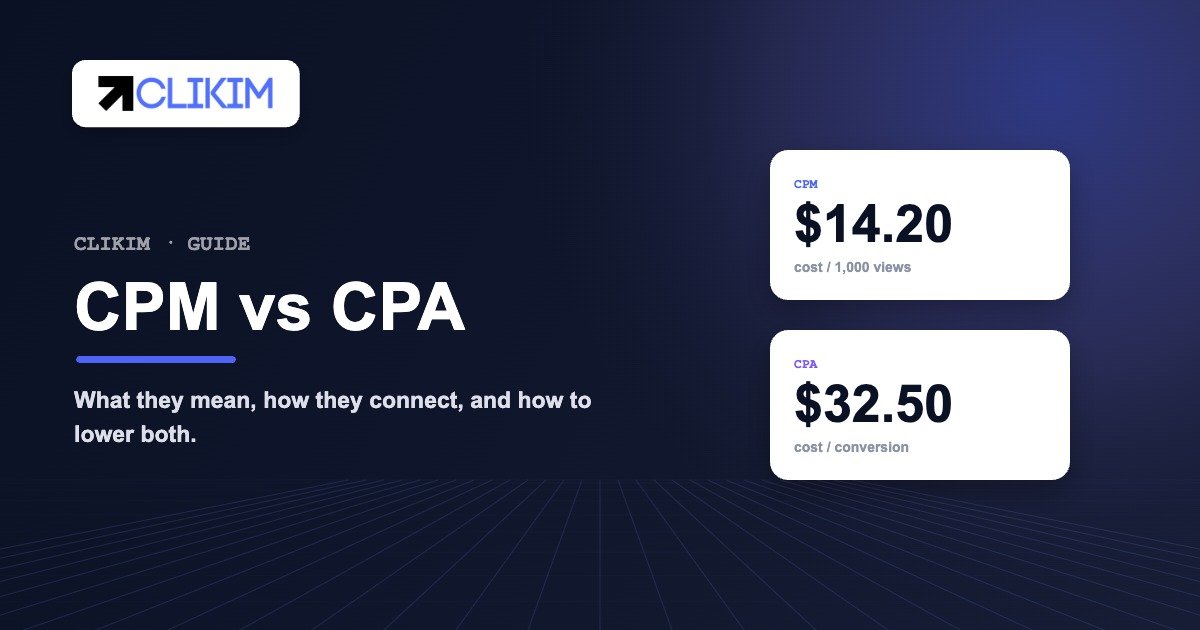
CPM (cost per mille) is what you pay for 1,000 ad impressions — a measure of media cost. CPA (cost per acquisition) is what you pay for one conversion — a measure of results. CPM sits at the top of the funnel; CPA is the outcome at the bottom. They're linked: CPA = CPM ÷ 1,000 ÷ CTR ÷ CVR, so lowering CPM or lifting your click and conversion rates both reduce CPA.
What is CPM?
CPM stands for cost per mille — Latin for thousand — so it's the cost of 1,000 ad impressions. It answers one question: how expensive is it to put your ad in front of people? The formula is simple:
CPM = (total spend ÷ impressions) × 1,000. Example: $200 spent for 20,000 impressions = a $10 CPM.
CPM is a media-cost metric. It doesn't care whether anyone clicked or bought — only what it cost to be seen. That makes it useful for comparing how expensive different audiences, placements or times of year are to reach, but useless on its own for judging whether a campaign is profitable. It's also the number most affected by where your account sits — more on that below.
What is CPA?
CPA stands for cost per acquisition (sometimes cost per action). It's what you pay for a single conversion — a sale, a lead, a signup — whatever you've defined as the goal. The formula:
CPA = total spend ÷ conversions. Example: $500 spent for 20 purchases = a $25 CPA.
CPA is the number most tied to profitability, because it measures cost per actual result rather than cost per view. If your product earns you $80 in margin and your CPA is $25, you're making money. CPA is the metric your P&L cares about.
CPM vs CPA: the real difference
The simplest way to hold them apart: CPM is an input, CPA is an outcome. CPM measures the cost of attention at the top of the funnel; CPA measures the cost of a result at the bottom. You can have a cheap CPM and a terrible CPA (lots of cheap views, no sales) or an expensive CPM and a great CPA (pricey views that convert beautifully). It's the same distinction media buyers weigh when they choose where to run — see what an agency ad account is for how the account layer fits in.
That's why optimizing for the wrong one burns money. Chase the lowest CPM and you might buy floods of cheap, low-intent impressions that never convert. The goal is almost always a profitable CPA — with CPM used as a diagnostic to understand why that CPA is moving.
How CPM and CPA connect
CPM and CPA aren't separate worlds — one flows into the other through two conversion steps: your click-through rate (CTR) and your conversion rate (CVR).
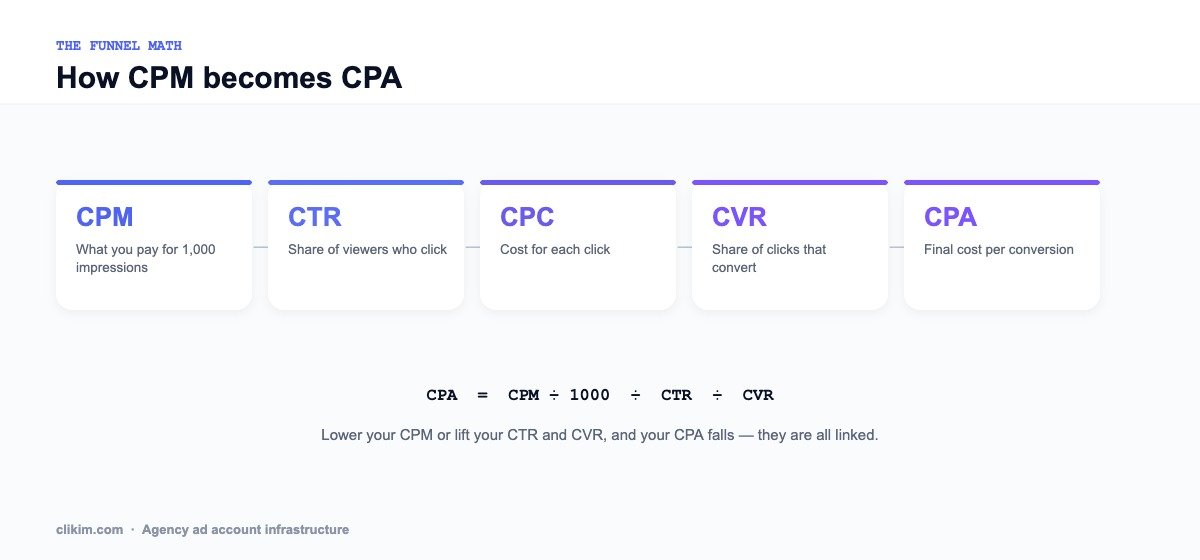
CPM becomes CPA through CTR and CVR.
Walk it down the funnel: you pay a CPM to get impressions. A percentage of those viewers click — that's your CTR — which turns CPM into a CPC (cost per click). A percentage of clickers then convert — that's your CVR — turning CPC into your CPA. Put together:
CPA = CPM ÷ 1,000 ÷ CTR ÷ CVR. A $10 CPM, 2% CTR and 5% CVR gives a CPA of $10 ÷ 1,000 ÷ 0.02 ÷ 0.05 = $10.
This is the most important takeaway in the whole guide: you can lower CPA from three directions — cut the CPM, lift the CTR, or lift the CVR. Most advertisers fixate on CPM alone and ignore the two levers that often move CPA far more.
What's a "good" CPM or CPA?
Here's the honest answer most articles dodge: there is no universal benchmark. Both numbers swing dramatically with platform, country, industry, audience, objective and season.
- CPM can range from a couple of dollars in cheap geos and broad awareness campaigns to $30+ during competitive windows like Q4 and Black Friday. A "good" CPM is one that's trending stable or down for your account, not a figure copied from someone else's.
- CPA is only "good" relative to your unit economics. A $40 CPA is excellent for a $300 product and ruinous for a $25 one. The right way to set a target is to work backward from your margin and customer lifetime value, then optimize toward that ceiling.
Define your maximum profitable CPA from your own margins first. Then judge every campaign against that number — not against an industry average that doesn't know your business.
Why your CPMs are high
If your CPM has crept up, it's usually one of these:
- Auction competition. More advertisers chasing the same audience — especially seasonally — bids up the price of impressions in the ad auction.
- Weak relevance. Low CTR and poor engagement signal low relevance, and platforms charge more to show ads people ignore.
- Narrow or saturated audiences. Tiny audiences and high frequency drive CPMs up as you exhaust the cheap inventory.
- Objective and placement. Conversion-optimized delivery and premium placements cost more per impression than broad reach.
- Account quality. Low account-quality and feedback scores can quietly inflate effective CPMs — covered below.
How to lower CPM and CPA
Because CPA depends on CPM, CTR and CVR together, the most efficient accounts pull every lever rather than obsessing over one. These are the moves that actually shift the numbers:
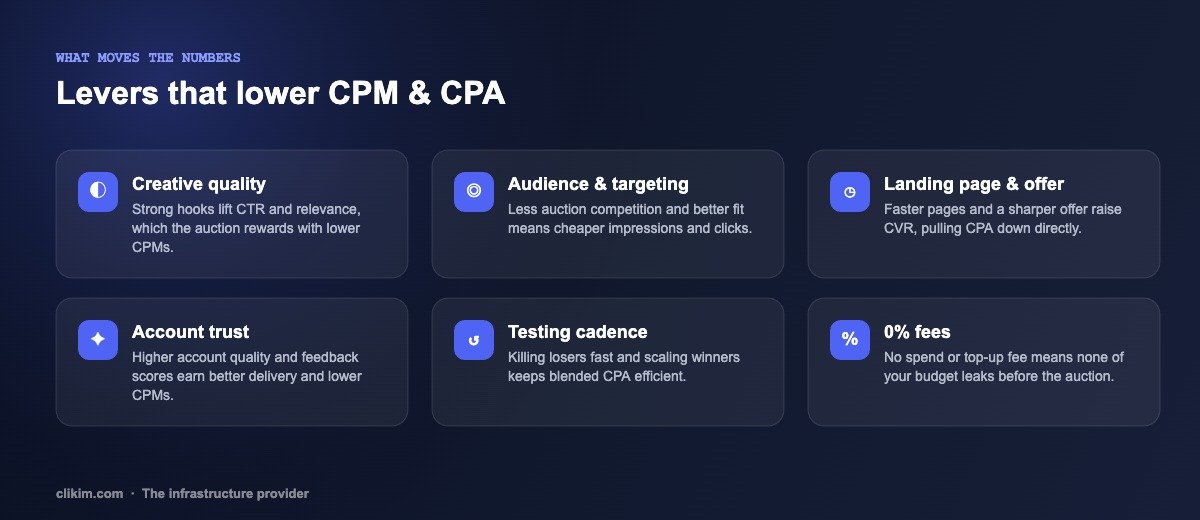
The levers that move CPM and CPA.
To lower CPM
- Stronger creative. Better hooks lift CTR and relevance, and the auction rewards relevant ads with cheaper impressions. This is the highest-leverage CPM lever there is.
- Smarter targeting. Avoid hyper-narrow or burnt-out audiences; give the algorithm room and reduce direct competition for the exact same users. On Meta, accounts from a trusted Business Manager also tend to deliver more efficiently.
- Manage frequency. Refresh creative before fatigue sets in so you're not paying rising CPMs to nag the same people.
To lower CPA
- Raise conversion rate. A faster, clearer landing page that matches the ad often moves CPA more than any CPM tweak. Fix the page before blaming the traffic.
- Sharpen the offer. A stronger offer lifts both CTR and CVR at once — the two multipliers in the CPA formula.
- Test and cut ruthlessly. Kill losers fast, scale winners, and keep blended CPA efficient instead of subsidizing dead ad sets.
How account trust quietly affects your CPMs
One factor rarely discussed in CPM guides: the account itself. Ad platforms reward relevant, compliant, high-quality accounts with better delivery — and penalize low-quality or frequently-flagged accounts with worse delivery and higher effective CPMs. A poor account-quality or feedback score doesn't just risk a ban; it can make every impression more expensive.
This is part of why media buyers run on agency ad accounts. A whitelisted account inside an established, high-trust Business Manager tends to deliver more efficiently than a cold or repeatedly-restricted one — and on Clikim's accounts, 0% spend and top-up fees mean none of your budget leaks before it ever reaches the auction. For TikTok specifically, verified high-spend entities are associated with better CPMs and approval rates.
Frequently asked questions
What is the difference between CPM and CPA?+
What is CPM and how is it calculated?+
What is CPA and how is it calculated?+
Should I optimize for CPM or CPA?+
What is a good CPM?+
What is a good CPA?+
How do I lower my CPM?+
How do I lower my CPA?+
Does account quality affect CPM?+
Keep more of every dollar in the auction
Run on whitelisted Meta and TikTok infrastructure with 0% spend and top-up fees, high-trust delivery, and a rep who answers in minutes.