
Do Facebook Ads Work for Small Businesses?
Yes — conditionally, and the conditions are checkable before you spend: margin, offer, patience. The five-signal test, the playbook that works at $20/day, and the honest cases where you should skip.
Yes — if three preconditions hold: gross margin 60%+ (or real repeat purchases), a genuinely differentiated offer, and 4–6 weeks + $500–1,500 of validation patience. Small advertisers pay the same CPMs as enterprises and $10–20/day buys real distribution. The playbook: pixel installed, ONE conversion goal, one broad ad set, 3–4 phone-shot authentic creatives, judged at week 4–6 against your industry's benchmarks — not at day 3. Thin margins with no LTV, no testing budget, or 'sales this week' pressure = skip for now; the failure stories all start there.
Yes — conditionally, and the conditions are knowable upfront
Facebook remains the most accessible paid channel a small business can touch: $10–20/day buys real distribution, targeting does the aiming a media buyer used to, and the auction charges small advertisers the same CPMs as enterprises. But "works" has preconditions that no targeting hack replaces: margin (a $50 product with 65% margin can pay $15–20 to acquire a customer; a 35%-margin product cannot), a real offer (ads amplify differentiation — they can't manufacture it), and patience with a testing budget (the first $500 buys learning, not profit). Small businesses that clear those three do well at surprising rates. The ones that don't produce the "boosted posts for six months, nothing happened" folklore.
The five-signal check
The pattern in every 'ads don't work for small business' story is on the right-hand column — and none of it is Facebook's algorithm.
The small-business playbook that works
Start with the pixel and one goal. Install the pixel, pick the one action that means money (purchase, lead, booking), and optimize to it — or one step up-funnel if volume is thin (details in our daily budget guide). One campaign, one ad set, broad, 3–4 creatives. Local businesses: radius targeting plus broad demographics; let creative do the selecting. Make the creative do the work. Phone-shot video of the actual product/service beats stock photography every time at this level — authenticity is the small-business creative advantage, not a limitation. Judge on the right clock: creative at day 3–5, the channel at week 4–6, with expectations set by your vertical's benchmarks. Then scale what works — 20–30% budget raises, retargeting layered once traffic exists.
When the answer is genuinely no
Skip Facebook ads (for now) if margins are thin with no repeat-purchase story, if you can't fund a real test without operational pain, or if your buyer genuinely isn't reachable there (rare — but some B2B niches close on relationships ads can't start). And if the business case is solid but the account is the bottleneck — new-account spending caps, a ban from a past life — that's an infrastructure problem with an infrastructure answer: agency ad accounts exist precisely for operators whose ambitions outrun their account status.
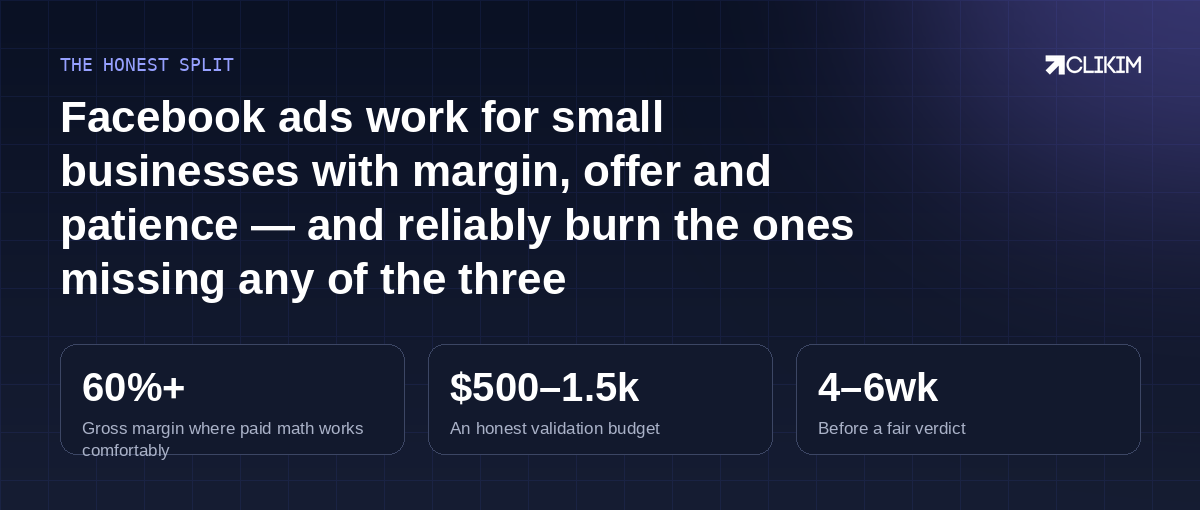
Margin, offer, patience — two of three isn't enough, and all three is most of the outcome.
Frequently asked questions
How much should a small business spend on Facebook ads to start?+
Why did boosting posts not bring me any customers?+
Do Facebook ads work for local businesses?+
What's a realistic return for a small business?+
Should I hire an agency or run ads myself at my size?+
What's the biggest mistake small businesses make with ads?+
My new ad account has a tiny spending limit — why?+
The business case works — give it a real account
Whitelisted infrastructure: no new-account caps, no warm-up weeks, replacement cover included.