
Snapchat Ads in 2026: The Complete Operator’s Guide
Snapchat quietly became a half-billion-daily-user platform with a performance stack that finally competes — chat-feed ads, AI bidding, and an attribution philosophy stricter than Meta’s. This guide is the full operator’s map: who’s actually on Snapchat, which formats earn budget, what it costs, and how the buyers winning here structure their accounts.
Snapchat in 2026: 493 million daily users, entry from $5/day, and a direct-response stack built around full-screen vertical creative and 7-day-click attribution.
The audience skews young but not as young as the meme says — 18–34 is the bulk of ad reach, and Snap’s own claim is 75% of 13–34-year-olds in 25+ countries. The formats that matter for performance: Single Image/Video, Collection and Dynamic Ads for commerce, and Sponsored Snaps in the chat feed — the platform’s fastest-growing surface.
Win condition: wire the Snap Pixel + CAPI first, feed the 7/0 optimization real purchase signal, and treat creative like content, not commercials.
The state of Snapchat in 2026
The platform most media buyers wrote off in 2022 posted 493 million daily active users in Q2 2026 (up 5% year over year, against 971 million monthly), $5.93 billion in 2025 revenue, and — the part that matters to advertisers — a direct-response product line that’s been rebuilt around AI bidding and a new premium surface: ads inside the chat feed.
Two structural facts should frame every plan. First, growth is international: North American daily users have drifted down to 92 million while Rest-of-World runs at 303 million — US inventory is stable, not expanding.
Second, Snap’s ad revenue grew 9% in Q2 2026 while total revenue grew 19%; the difference is subscriptions, including an ad-free tier. The auction is healthy, but this is a platform fighting for advertiser budgets — which keeps clicks cheaper than Meta and support more responsive than you’d expect.
Who is actually on Snapchat
The demographic reality beats the stereotype. Snap’s own claims: 75% of 13–34-year-olds in 25+ countries, and 90% of 13–24-year-olds in the US. But the ad-audience center of gravity is older than the brand’s image: roughly 35% of addressable users are 18–24 and another 25% are 25–34 (DataReportal’s modeling of Snap’s own planning tools). This is a young-adult platform with teenage reach, not a teenage platform.
- Where the users are: India is the largest ad-reach market (~213M), the US second (~105M) — and the US audience skews female (~55%). Saudi Arabia is the standout high-ARPU surprise: ~90% of Saudis aged 13–34 use the app.
- What they do: messaging first — over 950 billion chats were sent in Q1 2026 alone. That messaging gravity is why the chat feed became the platform’s premium ad surface.
- Who they aren’t: duplicated Instagram users. Snap-commissioned GWI research finds 38% of daily US users aren’t on Instagram the same day — the incremental-reach argument, from the vendor but directionally credible.
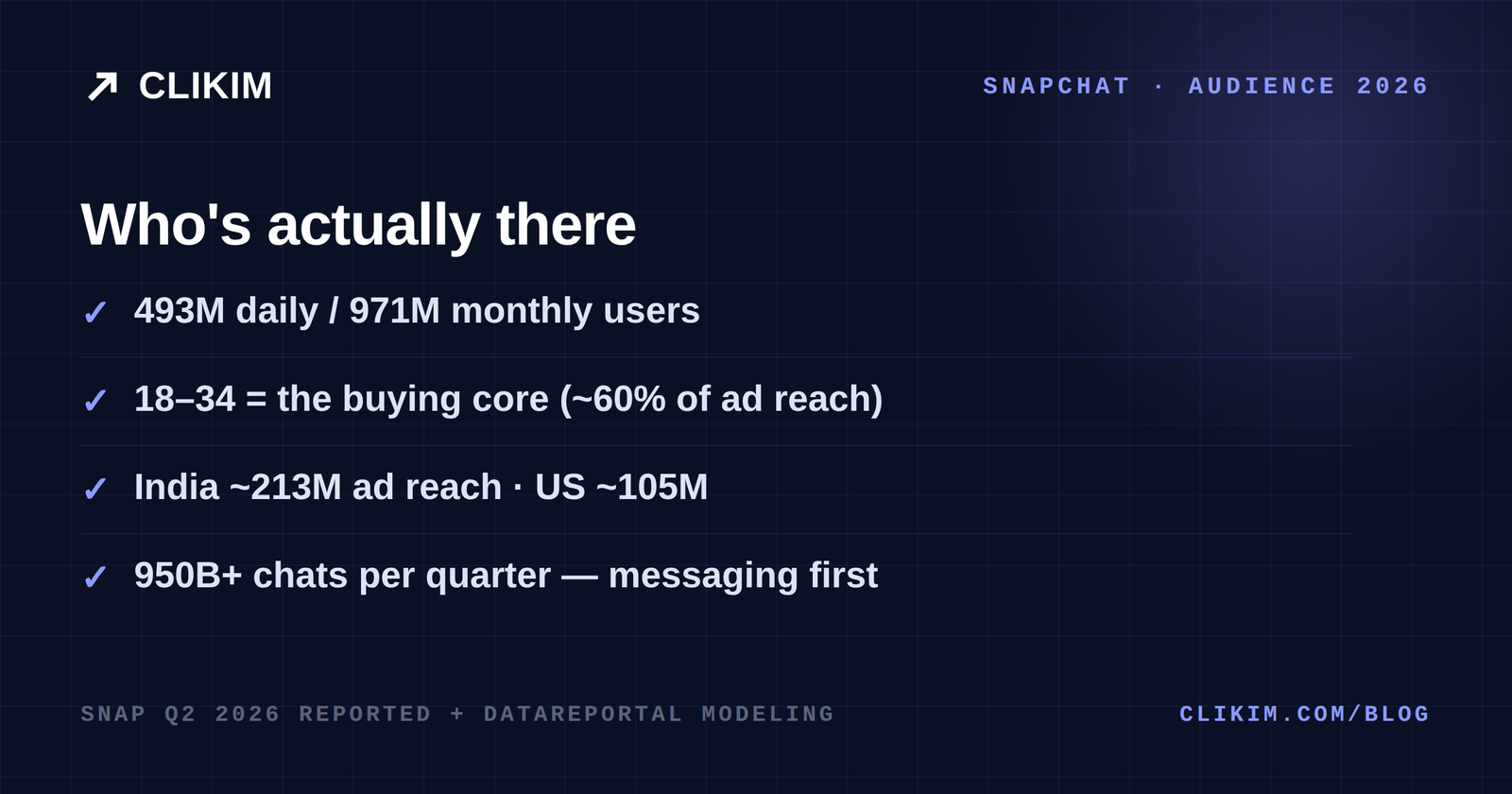
Half a billion daily users; the buying core is 18–34, not the teenage meme.
The ad formats that matter
| Format | What it is | Use it for |
|---|---|---|
| Single Image/Video | Full-screen vertical between content | The DR workhorse — start here |
| Collection Ads | Hero asset + 4 tappable product tiles | Ecommerce browsing behavior |
| Dynamic Ads (DPA) | Catalog-driven, auto-generated | Retargeting + prospecting at scale |
| Story Ads | Branded tile opening 3–20 snaps | Sequential storytelling, Discover intent |
| Sponsored Snaps | A Snap in the chat feed | Reach + DR on the platform’s core surface |
| Commercials | 6s non-skippable in curated content | Brand; awareness bursts |
| AR Lenses / AI Lenses | Camera experiences | Engagement; now self-serve from $5/day |
The 2026 lineup. The deep comparison — with specs and first-buy recommendations — is in the formats guide.
The strategic shift of the last 18 months is Sponsored Snaps: full-screen ads delivered into the chat feed, where Snapchat’s actual daily habit lives. Snap reports 50M+ average daily US impressions, per-impression click-through up 226% since launch quarter, and roughly a third of its reach incremental to other surfaces.
Dynamic Ads are the other mover — catalog revenue up 30% year over year with LLM-based product understanding behind it. Both are Snap’s own numbers; both match what buyers report directionally.
Buying, budgets and bidding
Self-serve runs from $5/day — the lowest credible floor of any major platform. Auction pricing only; there’s no official rate card for standard inventory (takeover products like First Lens price off country rate cards through sales). Payment is card or PayPal, with prepay in select markets and invoicing at managed tiers — the access structures are covered in our managed Snapchat guide.
Bidding matured sharply in 2025: Smart Bidding (set a CPA goal, the system works toward it), Smart Budget (auto-reallocation across ad sets), and Smart Audience (ML audience expansion, +8.8% conversions in Snap’s Q3 2025 measurement). The stack now behaves like Meta’s Advantage suite two years ago: trust it with clean signal, constrain it with structure when it wanders. Costs and honest budget math live in the cost guide.
Tracking and measurement
Snapchat’s attribution philosophy is stricter than its peers, and it’s the platform’s quiet virtue. The DR stack optimizes to 7/0 — seven-day click, zero-day view — so reported conversions are people who acted on your ad, not people who scrolled past it. Snap credits the 7/0 program with large measured gains (their number: purchase-related conversions up over 75% year over year at rollout), and Target Cost bidding with a median 32% cut in cost per purchase.
The build itself is Snap Pixel + Conversions API v3, deduplicated by event ID, with Advanced Conversions handling iOS aggregate measurement. It’s an afternoon of work and it is not optional — the complete walkthrough is in the Pixel + CAPI guide.
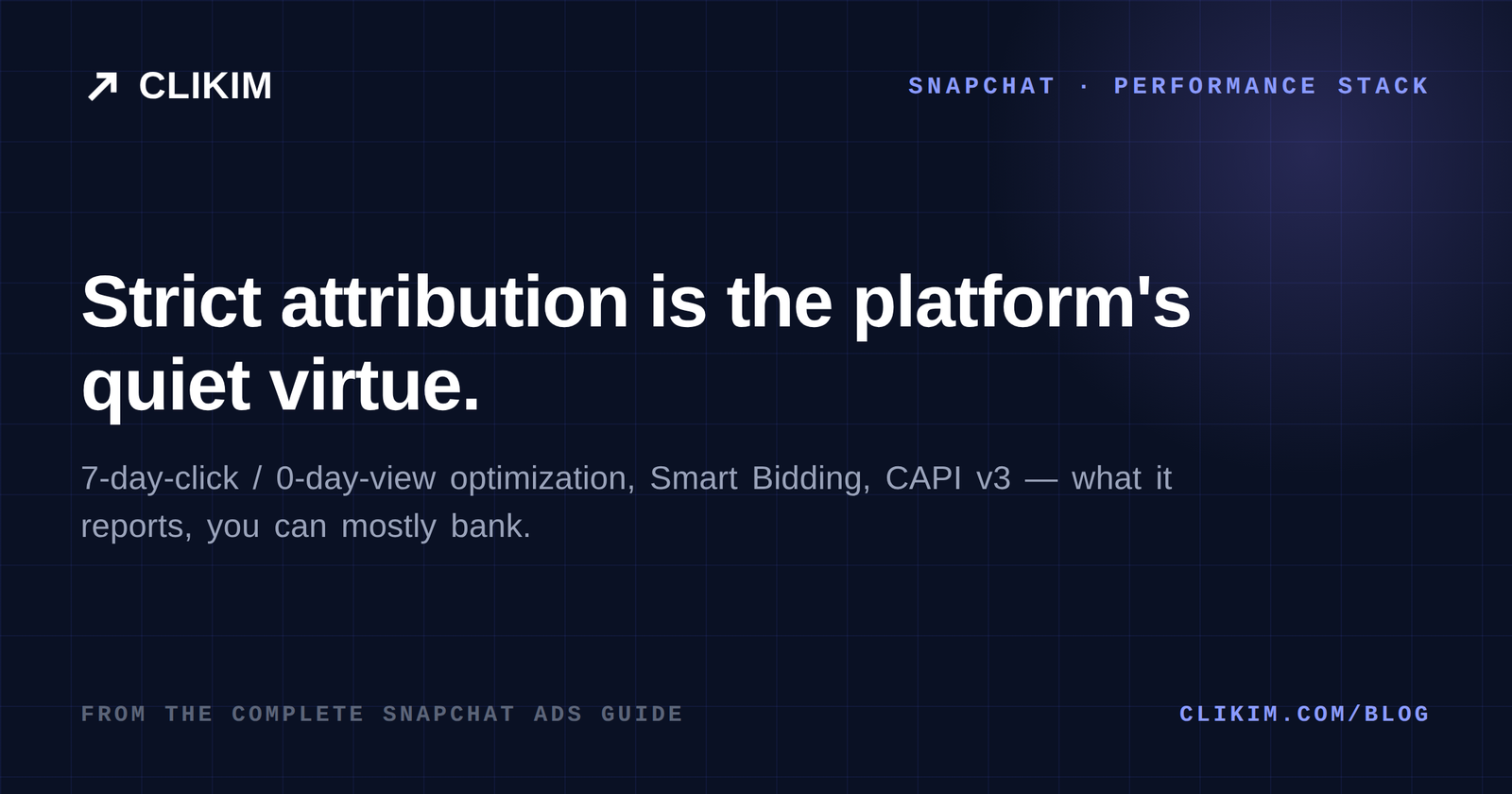
The 2026 performance stack: strict attribution, AI bidding, server-side signal. Wire it before spending.
Creative that survives the swipe
Everything on Snapchat is full-screen 9:16 with sound on, and everything is skippable in under a second — except the first 6 seconds of Commercials. The craft rules that follow from those two facts:
- The first second is the ad. Open on the product, the face, or the claim — never on a logo resolve.
- Native beats polished. Creator-style, camera-forward footage consistently outperforms television assets recut to vertical.
- Design for the safe zones — keep text and CTAs out of the top ~150px and bottom ~460px, where the UI lives and rejections happen.
- Sound on, but legible without it. Speech drives it; captions insure it.
- Refresh weekly at scale. A young audience burns creative fast; the winners run creative pipelines, not campaigns.
Policy and the EU caveat
Standard restricted-category rules apply (alcohol age-gated, gambling licensed, health claims scrutinized) — and two things genuinely distinguish Snap. First, political ads are allowed, human-reviewed, with a public ads library — a real difference from TikTok’s outright ban.
Second, the constraint that matters for European buyers: no personalized advertising to under-18s in the EU and UK — minors there are reachable only contextually, and a 2026 EU Digital Services Act proceeding over minors’ protections means that regime is more likely to tighten than loosen. If your plan leans on EU teens, redesign the plan.
The operator’s playbook
The sequence that works, condensed: (1) Public Profile created (required to advertise), pixel + CAPI wired and verified. (2) Launch Single Image/Video prospecting at $50–100/day on Smart Bidding with broad-ish targeting — let the model hunt. (3) Add Collection/DPA the moment purchase signal flows. (4) Judge on 7/0 cost per purchase over two-week windows, never on day-two ROAS.
(5) Scale winners 20–30% at a time, add Sponsored Snaps reach once the funnel converts, and keep the creative pipeline fed weekly.
Buyers coming from Meta usually find their instincts transfer at about 80% — the remaining 20% is stricter attribution, faster creative burn, and an auction that still rewards early movers in most verticals.
The Snapchat library: every guide in this cluster
Each subsystem gets its own deep guide — written for operators, kept current, linked back here.
Frequently asked questions
How many people use Snapchat in 2026?+
How much do Snapchat ads cost?+
Is Snapchat only for teenagers?+
What’s the best Snapchat ad format to start with?+
What are Sponsored Snaps?+
Do Snapchat ads work for ecommerce?+
Do I need a Public Profile to run Snapchat ads?+
Serious Snapchat spend needs serious rails
Managed Snapchat infrastructure through Clikim — funded balances, real headroom and a rep who answers, alongside the Meta and TikTok infrastructure your media plan already runs on.