
Taboola for Affiliates: The Playbook That Keeps Accounts Alive
Native traffic built half the affiliate industry, and Taboola is still its biggest faucet — but the platform now audits exactly the tricks the old guides taught. Here’s the 2026 playbook: the policy lines that actually end accounts, the tracker plumbing with its sharp edges, funnel architecture that converts and complies, and the verticals where the math still works.
Taboola remains one of the best affiliate traffic sources on the open web — for affiliates who run it like advertisers, not like 2016.
The non-negotiables: no cloaking or split-destination URLs, advertorials labeled (“Sponsored by X”) at the top, no “winner stories” in creative or landers even when true, and pre-approval for affiliate investment lead-gen and Gold IRA. Finance has a prohibited list; crypto runs only in ~40 allowlisted countries; health claims have documented limits.
The working stack: S2S postbacks into RedTrack/Voluum-class trackers (event names lowercase, matching exactly), advertorial bridge pages, and site-level blocking as a daily discipline.
Why native still prints for affiliates
Search traffic knows what it wants; social traffic is interrupt-driven but profiled to death and priced accordingly. Native sits in the profitable middle: readers in a lean-back editorial mindset, reachable at CPCs social stopped offering years ago, on premium mastheads that lend your advertorial their credibility. For offers that need a story before a sale — the entire affiliate canon — that combination is structural, not nostalgic.
What changed is the tolerance. Taboola sells its publishers’ trust (Yahoo doesn’t rent its feed to get burned), runs real-time ad compliance in the Realize platform, and documents its affiliate rules in writing. The affiliates thriving in 2026 are the ones who read those documents as an operating manual instead of an obstacle course.
The policy lines that end accounts
- No cloaking, no split-destination URLs. The reviewed page must be the served page, for everyone, always. This is the fastest account-killer on the platform.
- Advertorials must be labeled — “Sponsored by [brand]” at the top of the page, visibly. The advertorial itself is legal and encouraged; pretending it’s journalism is not.
- No “winner stories” in creatives or landers for affiliate campaigns — even if true. The testimonial-jackpot format is banned as a class.
- Finance: binary options, credit repair, get-rich-quick, NFTs, penny stocks, pyramid structures — prohibited outright. Affiliate investment lead-gen and Gold IRA require written pre-approval. Crypto runs only in an allowlist of ~40 countries.
- Health: weight-loss claims capped (nothing beyond 2 lbs/week), mandatory diet-and-exercise disclosure, substantiation linked on the lander; no prescription plays outside gated pharmacies.
The meta-rule underneath: Taboola’s enforcement targets deception patterns, not affiliate marketing. A labeled advertorial with honest claims and a real product clears review indefinitely.
The account graveyard is populated by cloakers and fake-testimonial artists who assumed 2016 rules still applied.
The tracker stack, wired right
Affiliate measurement here is pixel + server-to-server postback, and the S2S rail is the one your business runs on:
- Tracker integrations are first-class: RedTrack and Voluum ship documented Taboola templates (Voluum’s arrives with the postback URL pre-built); AnyTrack and ClickBank publish their own guides for the network→tracker→Taboola loop.
- The sharp edge that costs people weeks: Taboola accepts conversion event names in lowercase only, and names must match exactly between your postback and the platform. “Purchase” ≠ “purchase” here.
- Pass the click ID through everything — Taboola’s click ID into your tracker, your click ID into the network’s postback — so conversions land back on the exact click, campaign and site that produced them. Site-level conversion truth is what makes the blocking discipline below possible.
- Test one conversion end-to-end before spending. Fire a test lead through the full chain and watch it arrive in Realize. Ten minutes; saves a blind week.
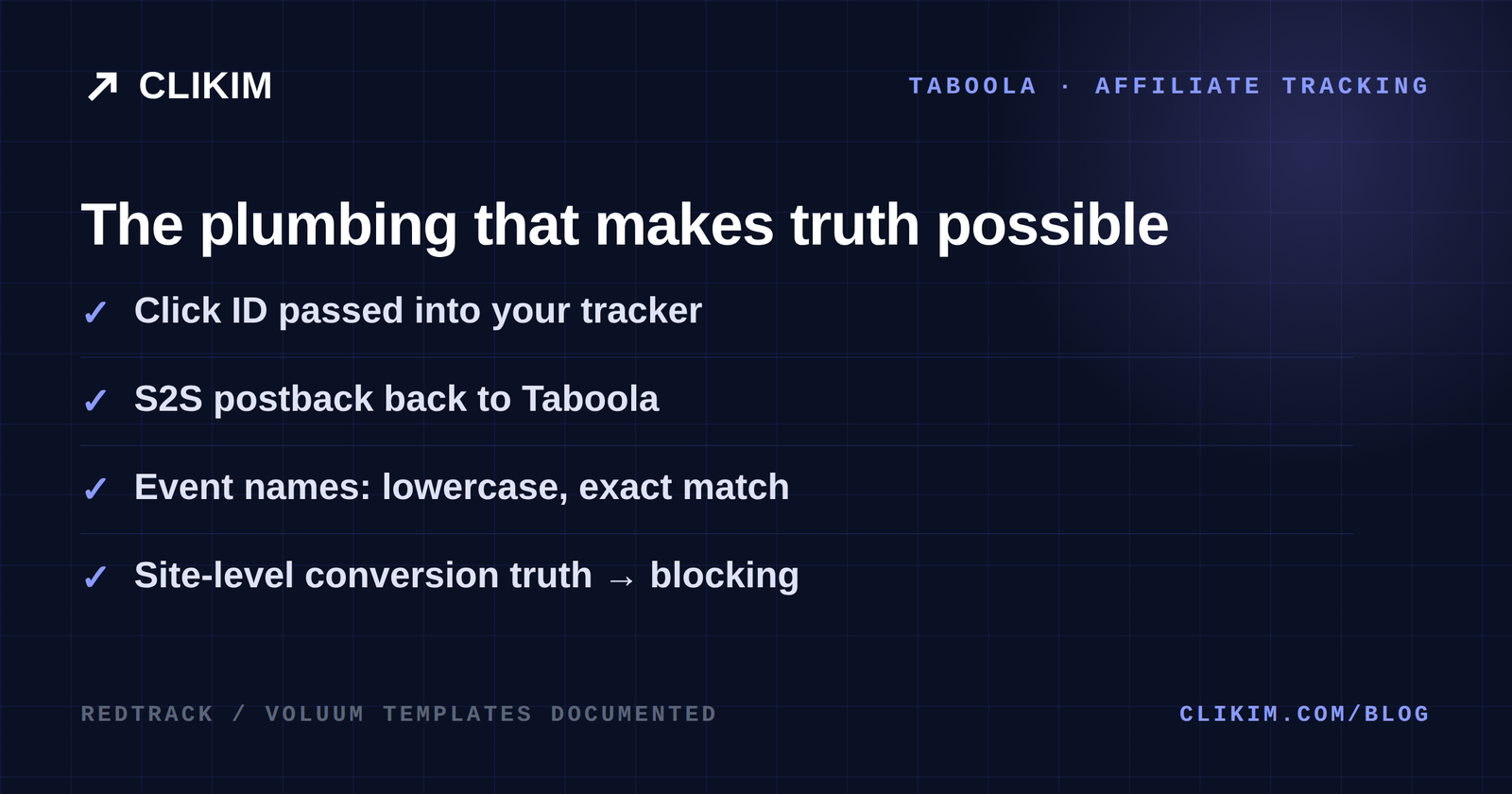
Click ID in, postback out, lowercase event names — the plumbing that makes site-level truth possible.
Funnel architecture that converts
The native funnel that works in 2026 is the honest version of the classic: feed card → labeled advertorial → offer page. Each stage has one job. The card sells the click with curiosity plus substance (“The $12 habit cardiologists keep mentioning” — intrigue with a real referent, not a bait-and-switch).
The advertorial manufactures intent: a story structure — problem lived, discovery made, mechanism explained, proof shown — that turns a cold reader into a warm visitor. The offer page closes what the advertorial opened.
Craft notes that move numbers: write the advertorial in editorial register (first-person or reported, not brochure voice); one idea per paragraph, mobile-first; place the first offer link after the mechanism explanation, not in the opening; and match the ad’s promise to the advertorial’s headline verbatim — scent-matching is conversion infrastructure, and its absence is also a policy flag.
Quiz funnels are the high-performing variant for lead-gen verticals: each question qualifies and commits, and completion rates embarrass long-form landers.
Speed is part of the funnel: native clicks carry zero patience, and a 4-second advertorial load quietly deletes a third of your paid traffic before the story starts.
Verticals: what works in 2026
| Vertical | Status | Notes |
|---|---|---|
| Home services / solar leads | Working | Older homeowner audience is native’s home turf |
| Insurance (auto, life, final expense) | Working, watched | Claims discipline; licensed-entity landers |
| Health & supplements | Working within limits | The 2-lbs/week ceiling and substantiation rules are real |
| Finance lead-gen | Pre-approval required | Investment lead-gen and Gold IRA need sign-off first |
| Ecommerce / DTC via advertorial | Working | The Bombas-style playbook, affiliate edition |
| Crypto | Allowlist only | ~40 countries; check before building |
| Binary options, credit repair, NFTs | Prohibited | Not gray — gone |
The 2026 vertical map. “Working” assumes the compliant funnel above — none of these survive cloaking.
Daily operations
The affiliate day on Taboola is a loop, not a launch: morning — site-level report, block everything below breakeven with real spend (native’s long tail leaks by default); midday — creative rotation, two fresh card variants against fatigue, kill CTR losers.
And weekly — GEO and device splits reviewed, bids stepped 10–15% where conversions support it, advertorial variants tested against each other. The full optimization system — SmartBid ladder, blocking heuristics, scaling rhythm — is its own guide: Taboola optimization.
Scaling and account structure
Scaling native is horizontal before vertical: new GEOs, new placements and new advertorial angles beat doubling budgets on a single campaign, because CPC auctions punish concentration.
Past a few hundred dollars a day, the constraints move to the boring layer — billing increments, credit terms, campaign review speed, and having a human to call when a false positive lands mid-scale. That layer is what managed Taboola access through Clikim carries: funded balances, invoicing instead of card roulette, and support that answers — the difference between an affiliate operation and an affiliate experiment.
Frequently asked questions
Does Taboola allow affiliate marketing?+
Can I direct-link affiliate offers on Taboola?+
What tracker works best with Taboola?+
What affiliate verticals work on Taboola in 2026?+
Why did my Taboola account get banned?+
How much budget do I need for affiliate offers on Taboola?+
Built for the buyers doing volume
Managed Taboola access through Clikim — funded balances, invoicing, compliance-aware support and a rep who answers — the infrastructure under serious native spend.