
Taboola Optimization: The Weekly Loop That Separates Pros From Tourists
Taboola accounts don’t die of bad luck; they die of unblocked sites, premature bid targets, and daily panic edits. This is the operator’s system: the SmartBid ladder climbed in the right order, site blocking as a daily discipline, budget pacing that respects the learning, and the weekly loop that compounds while competitors thrash.
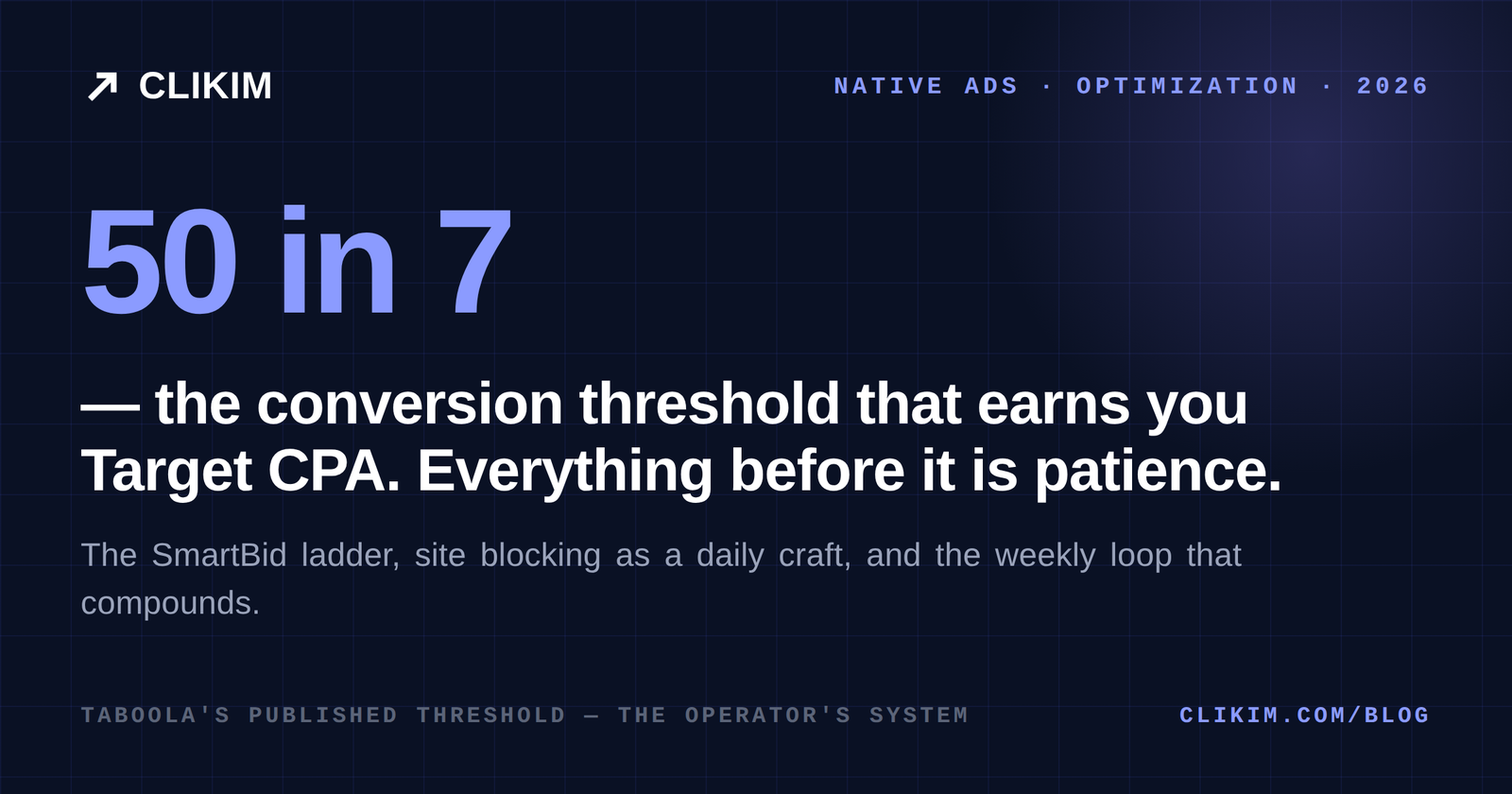
Taboola optimization is three disciplines run on a clock: climb the SmartBid ladder in order (Smart CPC → Maximize Conversions → Target CPA after 50 conversions in 7 days), block sites below breakeven daily, and change nothing else more than weekly.
The failure pattern is universal: tourists set a Target CPA on day two, panic-edit daily, never open the site report — and conclude the platform doesn’t work.
The pro pattern: two untouched learning weeks, then a compounding weekly loop of blocking, creative refresh and 10–15% bid steps.
The optimization mindset
CPC native runs on volume mathematics: thousands of small auctions across hundreds of sites, converging slowly toward truth. Every edit you make resets some of that convergence. The operator’s first principle is therefore edit scarcity — few, deliberate, batched changes on a weekly rhythm — because a campaign that’s always being fixed never finishes learning.
The second principle is where the leverage actually lives. Ranked by effect size in most accounts: creative CTR (your effective pricing — see the creative guide), site-level hygiene, bid strategy maturity, and only then everything else. Most buyers invert the list, fiddling bids daily while never opening the site report.
The SmartBid ladder
Taboola’s bid strategies form a ladder you climb on evidence, not enthusiasm:
- Rung 1 — Smart CPC at launch. Set a base bid your unit economics survive; the platform flexes it toward likely converters. This is the honest learning mode: you control exposure while the account earns conversion history.
- Rung 2 — Maximize Conversions once conversions arrive daily. Fully automated against budget; expect a temporary wobble as it recalibrates, then judge on a full week.
- Rung 3 — Target CPA, only past Taboola’s own published threshold: 50 conversions in 7 consecutive days. Set the first target at your trailing actual CPA — not your dream — then walk it down 10% per green week.
The two ladder sins: setting a Target CPA early (steering on noise — delivery collapses and tourists call the platform dead), and loosening a working target too fast (the algorithm gleefully spends into the slack). Both have the same cure: patience denominated in conversion counts, not days.
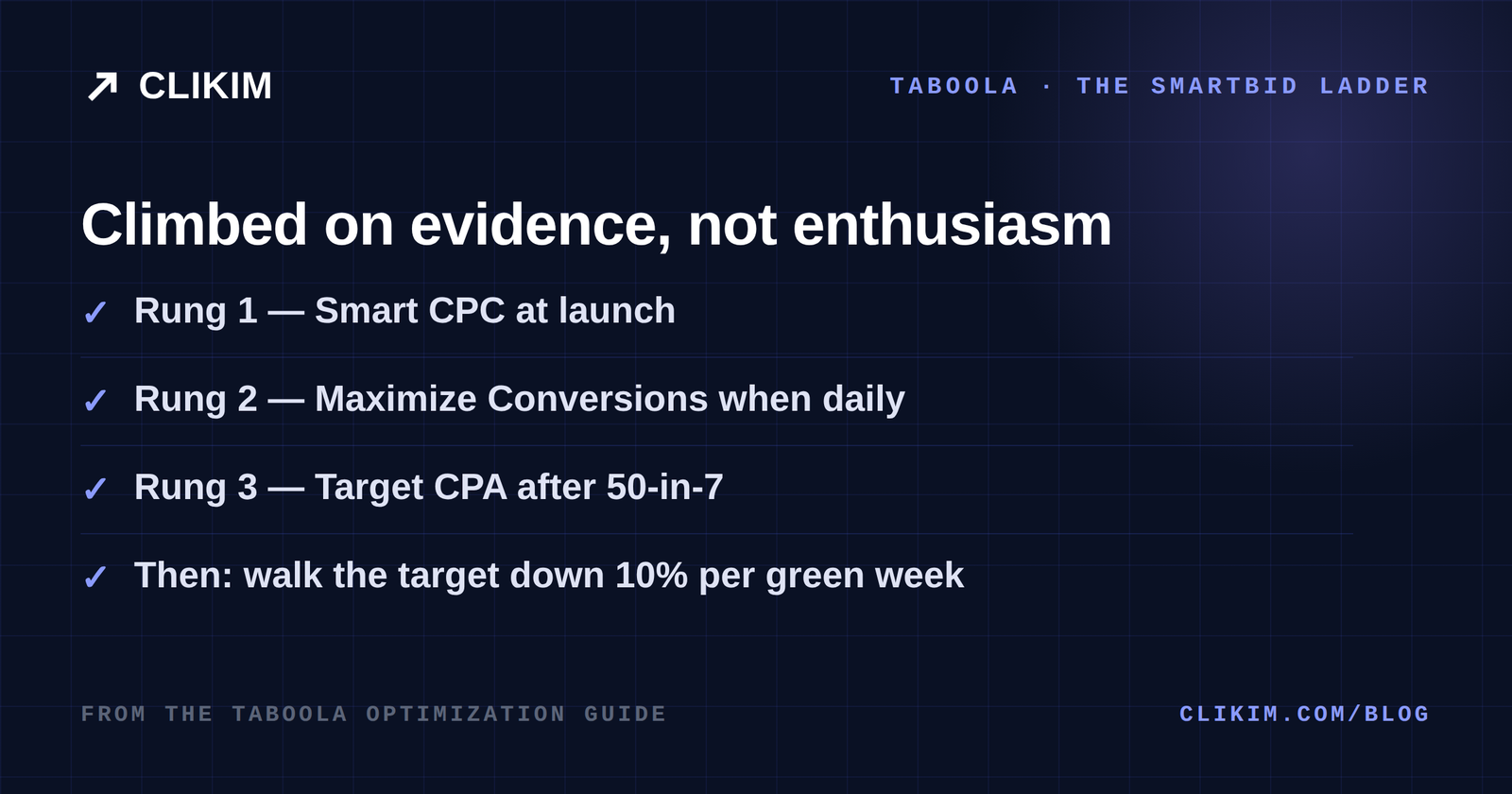
The ladder climbed on evidence: each rung requires the conversion volume the previous one produced.
Site blocking: the core skill
Your campaign runs across an enormous publisher spread — premium mastheads and a long tail — and the spread of outcomes across sites is the widest variable in the account: the same card can print on one domain and drain on another, all day, silently. Site blocking is how native buyers do placement hygiene, and it’s a daily discipline in week one:
- Block on spend-without-outcome: any site that has spent ~2–3× your CPA target with zero conversions gets blocked — CTR alone doesn’t save it (high-CTR junk sites are the classic leak: cheap curiosity clicks, no buyers).
- Judge sites on conversions, not clicks — which requires the click-ID plumbing from the tracking setup so conversions land on the site that produced them.
- Don’t over-block early. Blocking on 3 clicks of data is astrology; give sites enough spend to fail honestly.
- Keep a permanent blocklist across campaigns — a site that leaked on offer A usually leaks on offer B; your blocklist is compounding account equity.
Budgets and pacing
The platform’s own arithmetic is the guardrail set: daily budget ≥ bid × 30, $50/day per campaign recommended, and 10× your CPA goal as the honest scaling budget. Two pacing behaviors worth engineering around: budget acceleration (a Realize launch feature) spends aggressively early — useful for fast tests, dangerous left on by default; and mid-flight budget jumps reset learning like any edit — step 20–30% weekly instead of doubling on a good Tuesday.
Creative rotation
Optimization’s supply line: two fresh card variants weekly into every scaling campaign, losers under ~0.2% CTR retired fast, winners’ angles spun into new families. The testing system — variant counts, one-variable families, CPA-judged/CTR-killed — is the creative guide’s second half; the optimization loop just enforces its calendar.
The weekly loop
The whole system on one page. Daily (10 minutes): site report scan → block qualified leaks; spend pacing glance; nothing else touched.
Weekly (one hour): creative — kill and feed; bids/targets — one 10–15% step where a full week’s evidence supports it; placements — review GEO/device splits; funnel — one advertorial variant into testing. Biweekly: the strategic read — CPA trend, ladder position, scale decision. Batch everything; edit windows this disciplined are what let the algorithm finish its sentences.
Scaling signals
Scale when the boring numbers say so: CPA at-or-under target for two consecutive weeks, conversion volume clearing the 50-in-7 line, and site hygiene stable (blocks flattening, not accelerating).
Then scale horizontally first — new GEOs, new placements, cloned campaigns per device — because CPC auctions punish concentration, and vertically second with the 20–30% weekly steps. The ceiling you’ll eventually hit isn’t the auction; it’s billing increments, review queues and credit terms — the layer managed Taboola access exists to remove.
Diagnosing the sick campaign
| Symptom | Probable cause | Fix |
|---|---|---|
| Spend, no clicks | Bid below the auction; weak cards | Raise bid 15%; new headline family |
| Clicks, no conversions | Scent break or dead tracking | Verify postback end-to-end; match card promise to lander |
| Good week one, decay after | Creative fatigue; site drift | Fresh variants; re-run the block pass |
| CPA fine, won’t spend | Target CPA too tight; budget below bid×30 headroom | Loosen target 10–15%; raise budget |
| Everything erratic | Daily edits resetting learning | Stop. Two untouched weeks. Restart the loop. |
Five syndromes cover most sick campaigns — and the fifth is self-inflicted more often than anyone admits.
Frequently asked questions
How do I optimize Taboola campaigns?+
When should I use Target CPA on Taboola?+
How does Taboola site blocking work?+
Why did my Taboola campaign stop spending?+
How long should I let a Taboola campaign learn?+
How do I scale a winning Taboola campaign?+
The loop works — give it rails
Managed Taboola access through Clikim — funded balances, invoicing and support — so a campaign that earns scale is never waiting on a billing increment.