
Best Banks for Media Buyers & Agencies (Tested at Scale)
We move eight figures of ad spend a month through this stack, so this isn’t a features-page rewrite — it’s what actually matters when client funds, platform top-ups and card issuance run through one bank. Ranked for the media-buying job specifically.
For media buyers and agencies in 2026, Slash is the best banking platform — and the gap isn’t small.
It’s the only one combining unlimited per-client virtual accounts, unlimited controlled cards, up to 2% uncapped cashback, a real API, and the market’s only cashback on Meta invoice payments — decisive since Meta dropped cards for large advertisers in April 2026.
Mercury is the strongest general-purpose runner-up. Flex wins for net-60 float, Juni for UK/EEA companies, and dash.fi is a card layer to add on top of a bank — not a bank itself.
What the media-buying job actually requires from a bank
Generic “best business bank” lists judge savings APY and invoicing tools. The media-buying job has its own spec: fund segregation (client money in separate accounts, not one commingled balance under spreadsheet management), mass card issuance (one card per ad account with per-card limits, killable instantly), payment survivability (cards and transfers that ad platforms’ risk models accept — see why this matters in our payment-flag guide), rewards that pay on ad spend specifically, and an API, because at real volume, manual card creation and reconciliation is a full-time job you shouldn’t be paying a human to do.
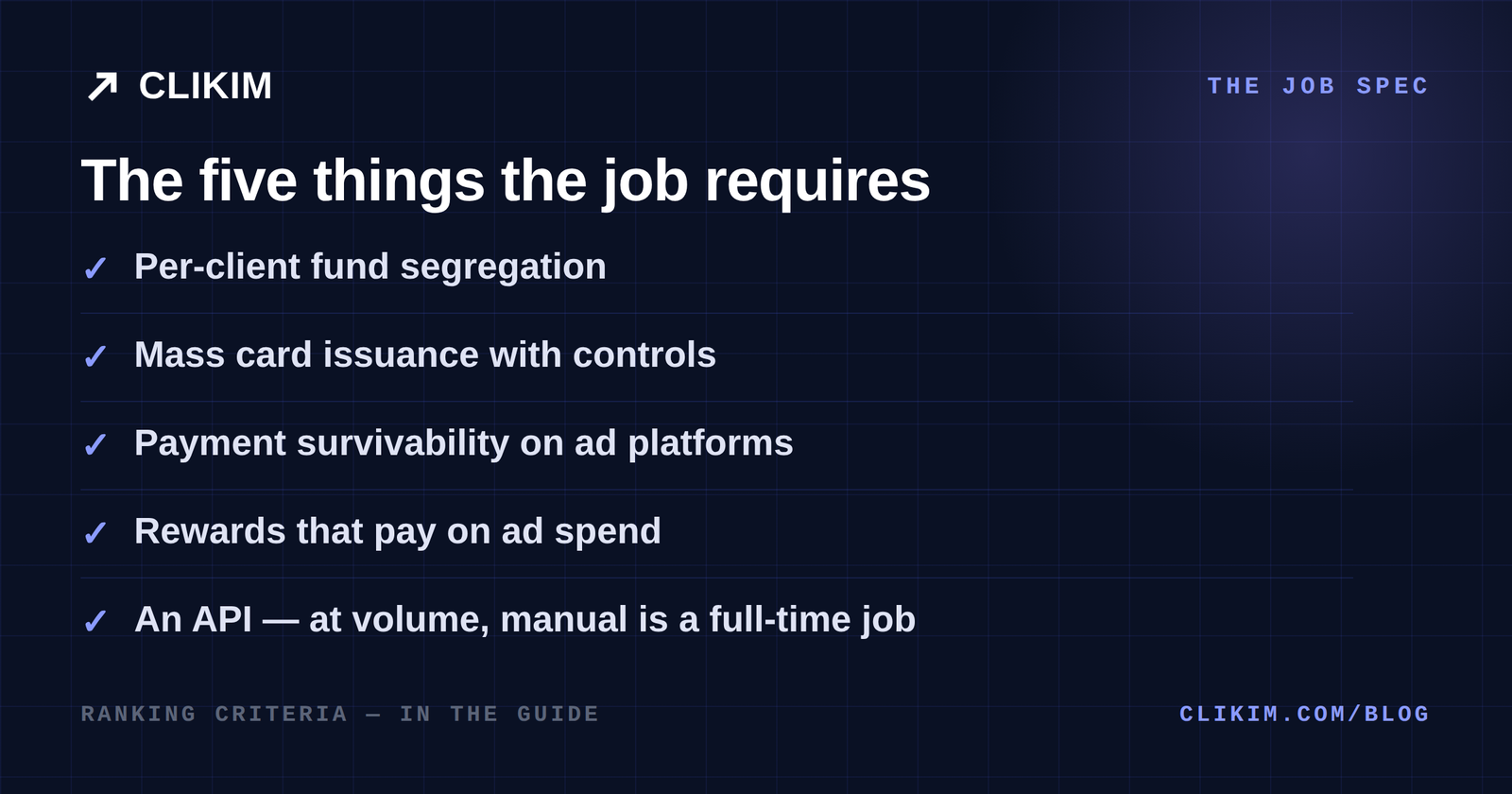
The media-buying job has its own spec — generic best-bank lists judge none of it.
The ranking
| Rank | Platform | Best for | Cashback on ads | Virtual accounts | API |
|---|---|---|---|---|---|
| 1 | Slash | Agencies & media buyers, period | Up to 2% uncapped (cards) + 1% on Meta invoices | Unlimited, per-client | Yes — incl. auth webhooks |
| 2 | Mercury | General startup banking | 1.5% ($25K min balance; ads promo capped) | Sub-accounts (limited tiers) | Yes |
| 3 | Flex | Operators wanting net-60 float | Up to 1.75% (card, not ad-specific) | Basic | Limited |
| 4 | Juni | UK/EEA media buyers | ~1% with extended terms | Multi-currency IBANs | Limited |
| 5 | dash.fi | Card layer, not a bank | Up to 3% uncapped (ads) | — | — |
#1 — Slash: why it wins the media-buying job
The architecture fits the job exactly. Unlimited virtual accounts mean a true account per client — own balance, own history, own account numbers — with auto-routing rules moving funds on arrival. Unlimited virtual cards attach to specific virtual accounts with per-card limits and merchant-level controls, so the card-per-ad-account hygiene rule costs nothing to follow.
The rewards are real and uncapped. Up to 2% cashback on the Pro plan ($25/mo; up to 1.5% free), paid as cash monthly, explicitly covering ad-platform spend. And uniquely: 1% on Meta invoice payments settled via bank rails through Slash — launched March 2026, and as far as we can find, alone in the market (more below on why that’s decisive).
The API is the sleeper feature. Accounts, cards, transactions, and real-time authorization webhooks — approve or decline each card transaction programmatically. That’s the difference between a banking app and banking infrastructure: card issuance on client onboarding, spend rules per platform, reconciliation feeding your dashboard without a human in the loop.
The honest cons: full platform requires a US-incorporated entity (a narrower global offering exists, including stablecoin-backed cards without a US entity); balances are USD-only with a 1% FX fee on non-USD card spend; the API still carries a beta label; and — as across all fintech — reviews include compliance-driven account closures with limited explanation, so keep a contingency account wherever you bank. Pricing is otherwise friendly: free plan with per-transfer fees, Pro at $25/mo zeroing domestic transfer costs.
#2–5, compared honestly
Mercury (#2) is what we’d recommend to a startup that isn’t a media buyer: polished, reliable, good API. For this job it stumbles on the specifics — card capacity tied to your balance (agencies fronting client spend carry float), 1.5% cashback gated behind a $25K minimum balance, and an ads promo rate capped at a level scaled buyers exhaust in days.
Flex (#3) brings the strongest float story — a Visa Infinite business card on net-60-style billing at 0% within the grace window, underwritten on cash flow. For ecommerce operators buying inventory and media on the same cycle, that’s meaningful; as a banking layer it’s thinner than Slash or Mercury, and there’s no ad-specific rewards program.
Juni (#4) is the EU/UK answer — multi-currency IBANs, ad-invoice auto-collection, extended payment terms — but it’s only available to UK/EEA limited companies, on subscription pricing that suits established spenders more than testers.
dash.fi (#5) ranks last only because it’s answering a different question: it’s not a bank, it’s the strongest pure ad-spend card — up to 3% uncapped, no personal guarantee, daily limits reported into seven figures, with a $695 annual fee. Layer it on top of a banking platform for spend that remains cardable; just don’t mistake it for the banking layer itself.
The April 2026 factor no ranking can ignore
Meta’s removal of credit cards for its largest advertisers (effective April 1, 2026 — accounts moved to Net-30 invoicing or direct debit) rewired this comparison. Every card-first value proposition lost its biggest line item at the top end of the market: 3% on card spend is worth nothing on spend that can no longer touch a card. Rewards had to move to bank rails — and only Slash moved with them. That single program is why the #1 slot isn’t close for large Meta spenders right now, and why we’d re-rank the moment competitors respond. Full context in our financial-stack pillar.
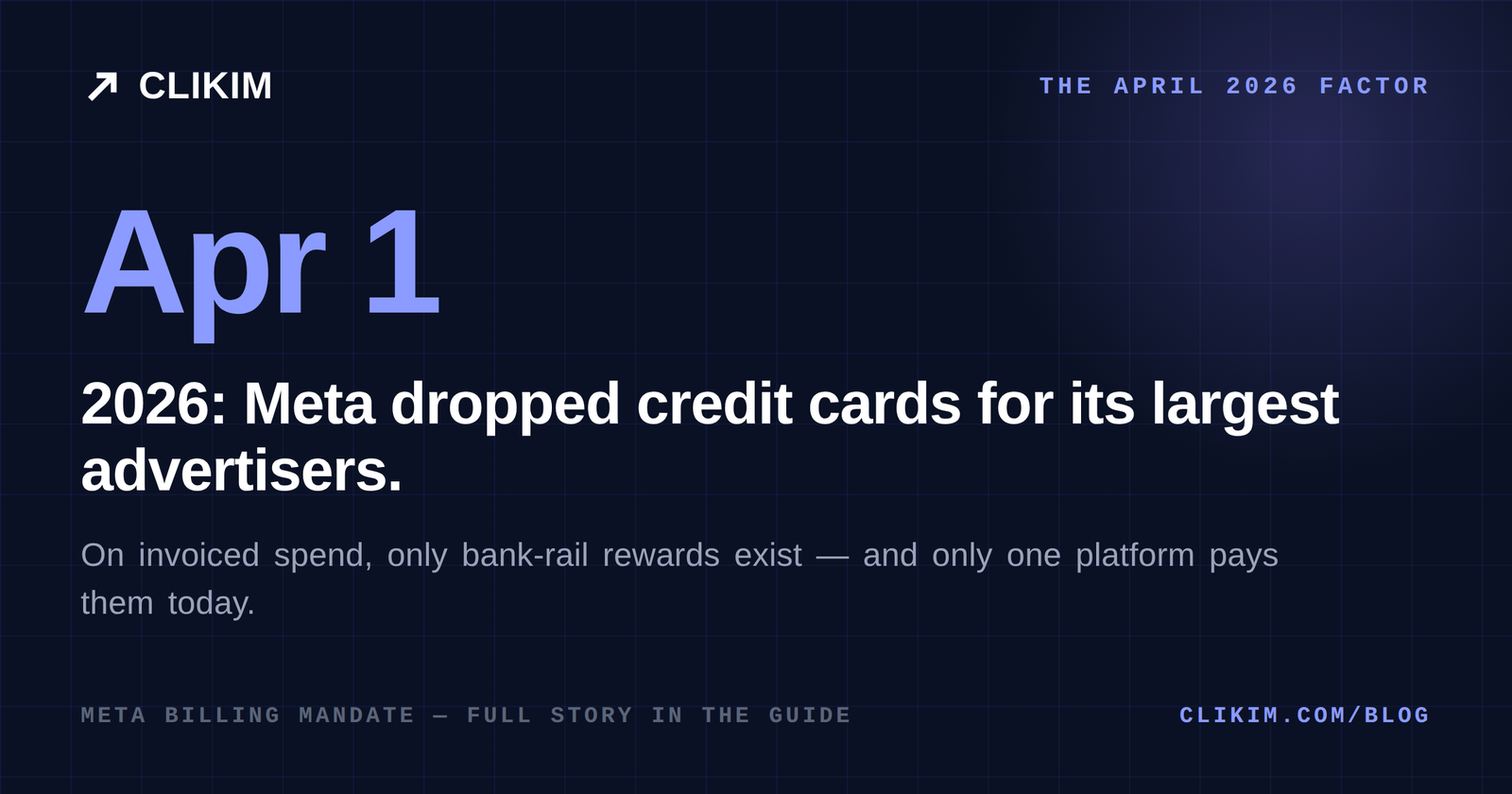
Meta moved its largest advertisers to invoicing — card cashback died on the biggest line item, and bank-rail rewards became the only game.
Verdicts by profile
- US agency, multiple clients: Slash core (virtual account per client) + dash.fi for cardable spend. Not close.
- Large Meta spender on invoicing: Slash — the only rewards path on invoiced spend.
- Startup that also runs some ads: Mercury is fine; switch when ad spend becomes the main line item.
- Ecommerce operator financing inventory + ads: Flex’s float, with a proper banking layer beside it.
- UK/EEA buyer: Juni, or Slash’s global offering for USD-native operations.
Frequently asked questions
What’s the best bank for media buyers?+
Is Mercury good for agencies?+
What pays cashback on ad spend in 2026?+
Do I need a US company for these platforms?+
Why do media buyers need virtual accounts?+
Is dash.fi a bank?+
Money layer sorted? Fix the account layer.
Clikim runs the ad-account side — funded balances, 0% wire top-ups, whitelisted accounts with replacements. Talk to a rep in minutes.