
“Suspicious Payment Activity”: Google’s Most Common Suspension
It hits legitimate advertisers constantly, often within days of opening an account, with a verdict that names no specific offense. Here’s what the payment-risk machine is actually scoring, separated into what Google documents and what the reinstatement industry reports — and how to build the one appeal that tends to work.
“Suspicious payment activity” is the catch-all verdict of Google’s payment-fraud model — the notice never names the specific trigger.
The consistent causes: card/country mismatches, a payment method reused from another account, virtual or prepaid cards, repeated failed charges, and spend spikes on new accounts. Every trigger has an innocent twin, which is why legitimate advertisers get hit constantly.
The fix is documentary: make your business registration, verification identity and payment method agree exactly — then appeal once, with the paperwork attached.
What the policy actually says
Google’s billing-and-payments suspension policy lists four grounds: promotional code abuse, requesting a chargeback, suspicious payment activity, and unpaid balance. Three are specific. The fourth is deliberately vague — “activity that poses a risk” — because it’s the catch-all output of a fraud-scoring model, and publishing its rules would hand fraudsters the test answers. The result: the most common suspension on the platform is also the least explained, and the suspension notice will not tell you which signal fired.
The real trigger list — documented vs reported
| Trigger | Status | Detail |
|---|---|---|
| Prepaid cards on automatic payments | Documented | Google’s payment-methods documentation excludes prepaid cards from automatic payments outright — using workarounds to attach one is itself a flag. |
| Chargebacks | Documented | A separate named ground; bank-side disputes read as near-instant suspensions. |
| Card country ≠ business/operating country | Reported, heavily corroborated | The single most-cited trigger by reinstatement specialists — billing geography disagreeing with account or verification geography. |
| Card reused across accounts | Reported, heavily corroborated | Especially a card previously attached to a suspended account — payment methods are among Google’s strongest account-linking signals. |
| Virtual cards / low-trust BINs | Reported | Google doesn’t distinguish virtual cards at policy level, but VCC-heavy profiles are consistently reported as higher-flag — card metadata (funding type, issuer, country) is visible on every transaction. See our BIN deep-dive for how that layer works. |
| Repeated failed charges / billing-detail errors | Reported | Declines, wrong billing names or addresses, rapid card swapping — instability itself is the signal. |
| Spend spikes on new accounts | Reported | A cold account jumping to aggressive daily spend matches the exact shape of threshold-account abuse, and gets scored like it. |
Why so many legitimate advertisers get hit
Because every trigger above has an innocent twin. A founder abroad running ads for their US LLC produces a card/country mismatch. An agency operator pays for a client’s account with the agency card — reuse across accounts. A modern finance stack issues virtual cards by default. A funded launch spends aggressively in week one. None of that is fraud; all of it is what fraud looks like to a model trained on threshold abuse and stolen-card patterns. Understanding that the machine is scoring pattern similarity, not intent is the key to both fixing it and never triggering it again.
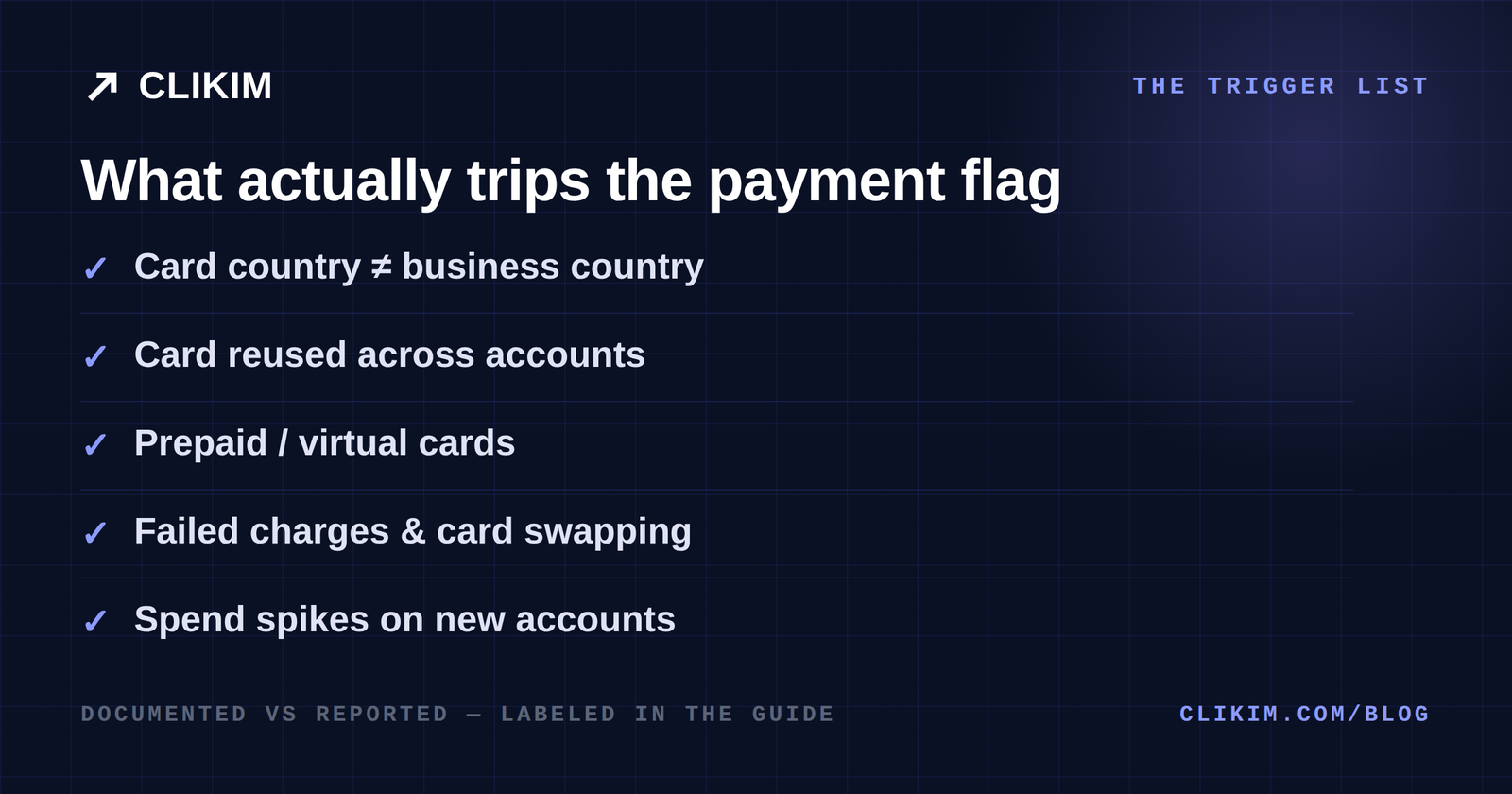
The consistent, community-corroborated trigger list — geography, reuse and card type lead it.
The fix, step by step
- Diagnose your own trigger first. Walk the table above against your account honestly. In most cases one row obviously applies — that’s what your appeal must address with documents, not assurances.
- Align the identity triangle. Business registration, advertiser verification identity, and payment method must agree: same entity name, same country, coherent address. If your operating reality is legitimately cross-border, the payment method should belong to the verified entity, not to a person in a third country.
- Replace the payment method if it’s the problem. A clean business card or bank account from the entity’s own country, never used on another Google Ads account. Bank accounts (direct debit where supported) carry stronger trust than cards.
- Settle everything outstanding. Any unpaid balance must be cleared before appealing — an appeal with open debt is dead on arrival.
- Then appeal once, with the file.
Writing the appeal that reverses it
Payment suspensions are the most reversible category — because the cure is documentary. The appeal that works is short prose plus strong attachments: business registration certificate; a bank statement or card statement showing the payment method belongs to that entity; the verification identity matching both; one paragraph naming the original mismatch and what changed. What kills appeals: emotion, volume (identical resubmissions), and appealing before the underlying profile actually changed — the model re-scores the same inputs and returns the same verdict. One well-documented appeal, then patience; a follow-up on the same thread after a week if silent.
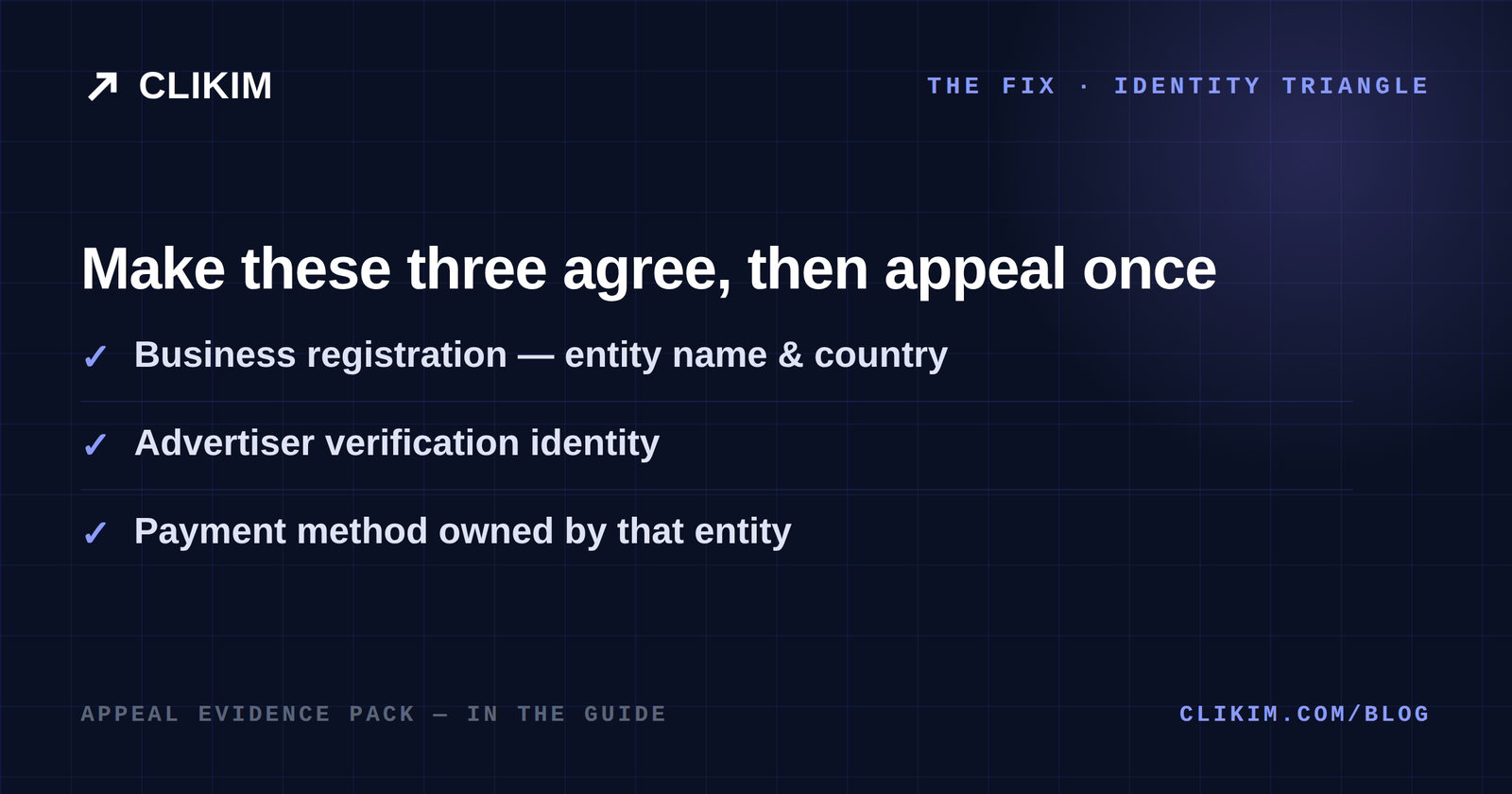
Registration, verification identity and payment method must agree — documents do the arguing.
Payment hygiene that prevents it
- One entity, one profile, one boring payment method — matching countries end to end, never shared across accounts.
- Verify before you’re forced to — completed advertiser verification retroactively strengthens every payment signal.
- If you run client accounts, structure like it — proper manager-account architecture with per-client billing, not one card fanned across many accounts. This is precisely where agency structures earn their fee: the billing history and architecture already exist.
- Ramp spend on any young account — the trust ladder is real on Google exactly as it is on Meta’s billing thresholds.
- Never dispute a charge with your bank. Ever. Resolve inside the platform.
Frequently asked questions
What does ‘suspicious payment activity’ mean on Google Ads?+
Can I fix a suspicious payment activity suspension?+
Does Google Ads accept prepaid cards?+
Why was I flagged when I used my own real card?+
How long does the appeal take?+
Will a new account solve it?+
Do virtual cards get Google Ads accounts banned?+
Payment profile keeps tripping the machine?
Run on structures where billing history already exists — established accounts, funded balances, and a rep in minutes.