
The Cheapest Times to Run Facebook Ads
Seasons move CPMs 2–3x; hours move them barely at all — and the cheap hours convert worse anyway. The four time layers ranked, and the calendar play that actually saves money.
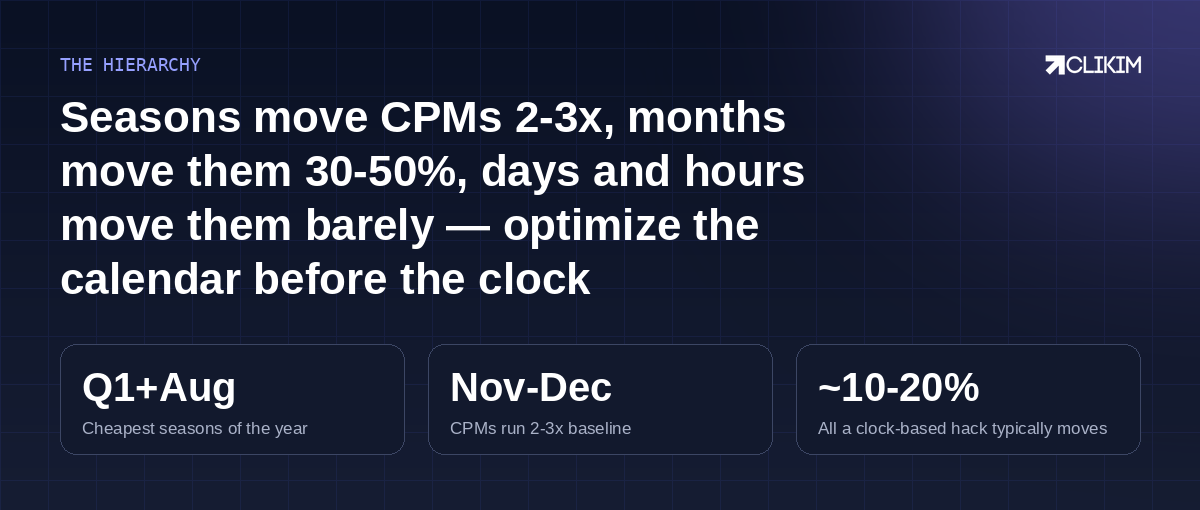
Optimize the calendar, not the clock. Seasons are the big lever: Nov–Dec CPMs run 2–3x baseline; January–February and August are the year's bargains. Days/hours barely matter — overnight CPMs are lower but so is conversion intent (cheap CPM ≠ cheap CPA), and conversion delivery already optimizes hours better than a schedule. Dayparting earns its keep only for call-based businesses, offer-bound timing, or a dead zone proven in 500+ of YOUR conversions. The playbook: test heavily in cheap months (August = Q4's supply chain), scale into September–October, harvest with proven creative in Q4 — never discover creative at 3x prices.
The honest hierarchy: seasons beat clocks
The question usually means "what hour should I schedule ads?" — but the auction's price moves are wildly lopsided across time layers. Seasonality is enormous: November–December CPMs run 2–3x baseline as retail floods the auction, while January–February and late summer (August especially) are the year's bargain windows. Monthly texture is real but modest. Days and hours are mostly noise: overnight impressions cost less, but the people awake at 3am convert less too — the auction prices attention efficiently, and CPM discounts at dead hours are usually CPA-neutral or worse. So the actionable version: plan the calendar, mostly ignore the clock. Test heavily in cheap seasons (your August testing budget buys 2-3x the verdicts of a November one), enter Q4 with proven creative rather than discovering it at peak prices, and let delivery optimize the hours — it already does, better than a schedule.
The four layers, priced
The auction prices attention by demand. Overnight impressions cost less AND convert less — cheap CPM is not cheap CPA.
When dayparting IS worth it
Scheduling ads to specific hours (dayparting, via lifetime budgets) earns its complexity in a few real cases: businesses that can only respond during hours — call-based lead gen where a 9pm lead is a dead lead by morning; demonstrated conversion windows in YOUR data — if 500+ conversions show a real dead zone, excluding it is rational (but verify it's not just delivery already avoiding it); and offer-bound timing — lunch promos, event countdowns. Everyone else is usually re-implementing, worse, what conversion optimization already does hour by hour. If costs are your real concern, the levers that actually move CPA live elsewhere: creative engagement, audience width and account quality — the full breakdown is in why is my CPM so high.
The cheap-season playbook
What strong operators do with this: January–February — aggressive creative testing while CPMs are soft and Q4 winners still have juice; August — the pre-Q4 supply chain: test angles and stock the creative bench at discount prices; September–October — scale proven winners and build retargeting pools BEFORE auction pressure arrives; November–December — harvest with proven assets only (never discover creative at 3x prices). That calendar quietly outperforms any hour-of-day optimization by an order of magnitude — and it pairs with account headroom, because a spending-limited account can't actually execute a scaling season (budget math here).
August tests, October scales, December harvests — the calendar is the discount code.
The 2026 cost benchmarks — the Q4 tax, quantified: +20–50% CPMs and the $30 Black Friday week.
Frequently asked questions
What time of day are Facebook ads cheapest?+
What's the cheapest month to run Facebook ads?+
Should I pause my ads at night?+
Do weekends perform better or worse?+
Should small budgets avoid Q4 entirely?+
How do I set up dayparting if I genuinely need it?+
Cheap-season testing needs room to run
Uncapped, whitelisted infrastructure — test wide in August, scale hard in October, no spending-limit stalls.