
Facebook Advertising Policies: What to Avoid, the Main Culprits & What's Strictly Blackhat
Most ad rejections and account bans come down to a short list of policy mistakes — and a smaller list of things you should never do at all. This in-depth guide breaks down the do's and don'ts with real examples, what counts as strictly blackhat, and how to advertise sensitive categories like health and GLP-1 medications the compliant way.
To stay inside Facebook's advertising policies, make honest, provable claims and match your ad to your landing page. Don't use celebrities, before-and-after images, personal attributes ("Are you overweight?"), sexual or shocking content, or aggressive fake-urgency tactics. Never do blackhat — cloaking, sneaky redirects, fake reviews, or recycling banned assets. For health and GLP-1 ads, you need LegitScript certification plus Meta's written authorization, with no outcome claims.
This is practical guidance, not legal advice, and Meta's policies change frequently. Always confirm specifics against Meta's official Advertising Standards before you launch — especially in regulated categories.
The do's and don'ts at a glance
Before the deep dive, here's the whole philosophy in one frame. Meta's review systems reward ads that are honest, clear and consistent with their destination — and penalize anything that misleads, pressures or shocks. Almost every rule below is a specific application of that single idea.
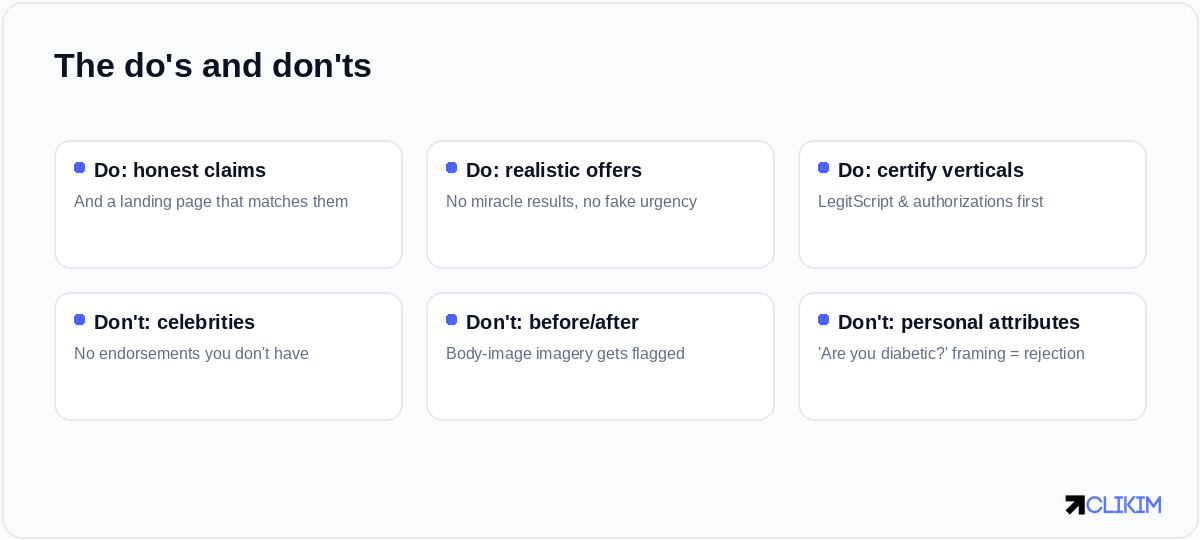
The cheat sheet — most rejections are a violation of one of these.
Keep one mental test handy: would this ad, and the page it leads to, look honest and appropriate to a human reviewer seeing them side by side? If yes, you're usually fine. If you're relying on a trick, a shock, or a claim you can't prove, you're in risky territory. Now let's get specific.
The main culprits behind rejected ads
If you've had ads disapproved, the cause is almost always one of a handful of repeat offenders. In rough order of how often they trip advertisers up:
- Misleading or unrealistic claims — promising results you can't substantiate.
- Personal attributes — implying you know something about the viewer's body, health, finances or identity.
- Before-and-after imagery — and any "idealized result" framing, especially in health and beauty.
- Unauthorized celebrities or public figures — borrowed credibility you don't have rights to.
- Aggressive sales pressure — fake urgency, implausible discounts, all-caps shouting.
- Sexual, shocking or sensational content — anything designed to provoke rather than inform.
- Restricted products without certification — running health, finance or other gated verticals before you're authorized.
- Ad-to-page mismatch — a landing page that doesn't deliver what the ad promised.
The next sections take the trickiest of these one at a time, with examples of what gets flagged and what passes. A deeper look at why Meta's systems flag accounts (and how account-quality scores feed into it) lives in our guide to what to do when a Facebook ad account is banned.
Celebrities & unauthorized endorsements
You cannot use a celebrity or public figure's name, face, or implied endorsement without authorization. This is both a Meta policy issue and an intellectual-property one, and fabricated celebrity endorsements are one of the fastest routes to enforcement because they're treated as deceptive content.
✗ Don't: "[Famous actor] swears by this supplement" with their photo. ✓ Do: feature a real, consenting customer or your own spokesperson, with a claim you can back up.
This extends to "as seen on" claims you can't prove, fake media logos, and look-alike or AI-generated likenesses of real people. If you don't have explicit, documented rights to use someone's identity, don't.
Aggressive sales tactics
Meta wants ads that inform, not ones that corner people with manufactured pressure. Genuine offers are completely fine — it's the fakery and exaggeration that get flagged.
- Fake urgency. "Only today!" on an evergreen campaign, or countdown timers that reset on refresh.
- Implausible discounts. Steep, unbelievable claims (think extreme blanket "up to 60–90% off everything") read as low-quality or deceptive, especially without a credible reference price.
- Shouting. ALL-CAPS, excessive punctuation!!!, and spammy symbols.
- False scarcity. "Only 2 left!" when stock is unlimited.
✗ Don't: "🔥 TODAY ONLY — 80% OFF!!! HURRY, ALMOST GONE!" ✓ Do: "Save 25% on your first order this week." A real, believable offer with honest framing.
Before/after imagery & personal attributes
These two rules cause more confusion in health, fitness and beauty than anything else — and they're strict.
No before-and-after (or "idealized result") imagery
Before-and-after images are not allowed, and neither is content that zooms in on an idealized or unexpected outcome. This is enforced hardest in weight loss, dieting, hair loss and cosmetic categories, because such imagery sets unrealistic expectations. Split-screen transformations, dramatic weight-loss collages, and hairline "regrowth" comparisons all get flagged.
No implying personal attributes
You also can't imply that you know personal characteristics about the viewer — their weight, health condition, age, financial situation, race, religion or sexual orientation. The tell is usually the word "you" pointed at a sensitive trait.
✗ Don't: "Are you overweight and over 40? See your before & after!" (personal attribute + before/after). ✓ Do: "A doctor-designed program for healthy, sustainable habits." Speak to the offer, not the individual's perceived flaw.
The compliant pattern across both rules: show the product or service in use and describe the benefit generally, without implied transformation or pointing at someone's perceived problem.
Sexual, shocking & sensational content
Ads must not contain nudity, sexually suggestive or explicit content, or imagery designed to shock or disgust. This covers obvious adult content, but also subtler things: suggestive poses, excessive skin framed provocatively, and "shock" creative (graphic medical images, gore, fear-bait). Sensationalism that exploits crises or tragedies is likewise prohibited.
✗ Don't: a suggestive close-up or a shocking medical photo used purely to stop the scroll. ✓ Do: a clean, clear product or lifestyle image that represents the offer honestly.
What's strictly blackhat — never do this
Everything above is about staying on the right side of the rules. This section is different: these tactics deliberately deceive Meta's systems, and they typically result in immediate, often permanent bans — not a polite disapproval. They also tend to take every linked asset down with them.
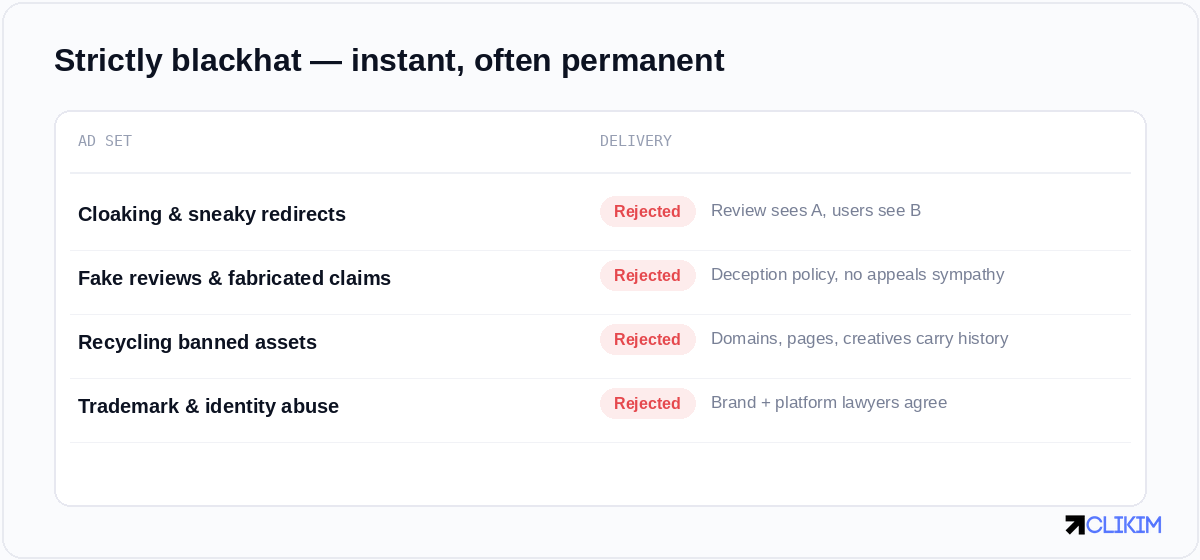
Blackhat tactics end accounts, not just ads.
- Cloaking. Showing Meta's reviewers one (compliant) page while sending real users to a different one. This is the textbook deceptive practice and a permanent-ban trigger.
- Sneaky redirects. Bouncing a click through to an undisclosed or unrelated destination.
- Fake reviews & fabricated claims. Invented testimonials, made-up statistics, and fake endorsements.
- Recycling banned assets. Re-using pages, pixels, profiles or accounts after enforcement, or spinning up new ones on the same identity to evade a ban.
- Misrepresenting compounded drugs as branded. Marketing a compounded medication as if it were the branded product (more on this below).
- Trademark & identity abuse. Misusing brand names, logos, or stolen/celebrity images.
There's no "growth-hack" framing that makes these safe. They're the difference between an ad that gets rejected and an account — and often a whole business manager — that gets shut down. If a tactic depends on Meta not seeing what you're really doing, it's blackhat.
Health, GLP-1 medications & LegitScript
Health is the most heavily regulated mainstream vertical on Meta, and it's where good advertisers most often get blindsided — because the rules involve certification, not just creative. The surge in demand for weight-loss medications has made this especially relevant.
You need LegitScript certification (and Meta authorization)
Meta requires online pharmacies and telehealth providers to be actively certified with LegitScript, and then to obtain written authorization from Meta, before advertising prescription drugs. LegitScript independently verifies your licensing, medication sourcing and advertising accuracy, and its certification is recognized across Google, Meta and other major platforms. Without it, prescription-drug ads are rejected and accounts can be restricted.
Advertising GLP-1s like semaglutide & tirzepatide
GLP-1 weight-loss medications — semaglutide, tirzepatide, and branded names like Ozempic, Wegovy and Zepbound — sit squarely inside Meta's Drugs and Pharmaceuticals policy. Advertising them requires LegitScript certification and Meta's prior written permission, and even then the creative rules are tight.
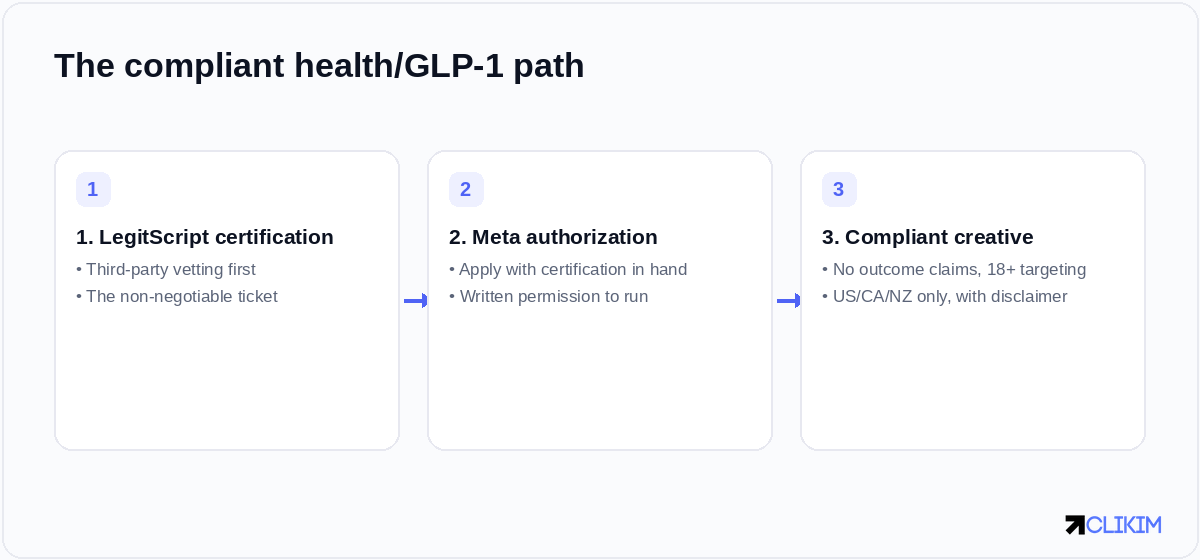
The compliant path for GLP-1 advertising on Meta.
Once authorized, keep the creative clean:
- No outcome claims, no before/after. Effective GLP-1 advertising doesn't require results claims at all — awareness is already high. Lead with access, cost, the clinical experience and telehealth convenience instead of pounds lost.
- Compounded is not branded. Compounded GLP-1 medications are not the same as branded versions and may not be marketed as replacements for them. Conflating the two is non-compliant and, under evolving FDA guidance, a fast track to enforcement.
- Targeting & disclaimers. Run only in eligible countries (the United States, Canada or New Zealand), target only people 18 and over, and include a disclaimer to consult a licensed health professional or obtain a valid prescription.
- Mind domain classification. Creative compliance and domain-level classification are separate systems — a health domain can be classified in a restricted category that affects pixel/event tracking even when an individual ad is approved. Plan both.
Health is a category where accounts get scrutinized closely and a single disable mid-campaign is costly. That's a big reason telehealth and weight-loss advertisers run on stable, high-trust Facebook agency ad accounts — certification gets you eligible, but a resilient account keeps you live.
Other restricted & prohibited verticals
Health isn't the only gated category. Each of these has its own rules, and several require their own certifications or prior authorization:
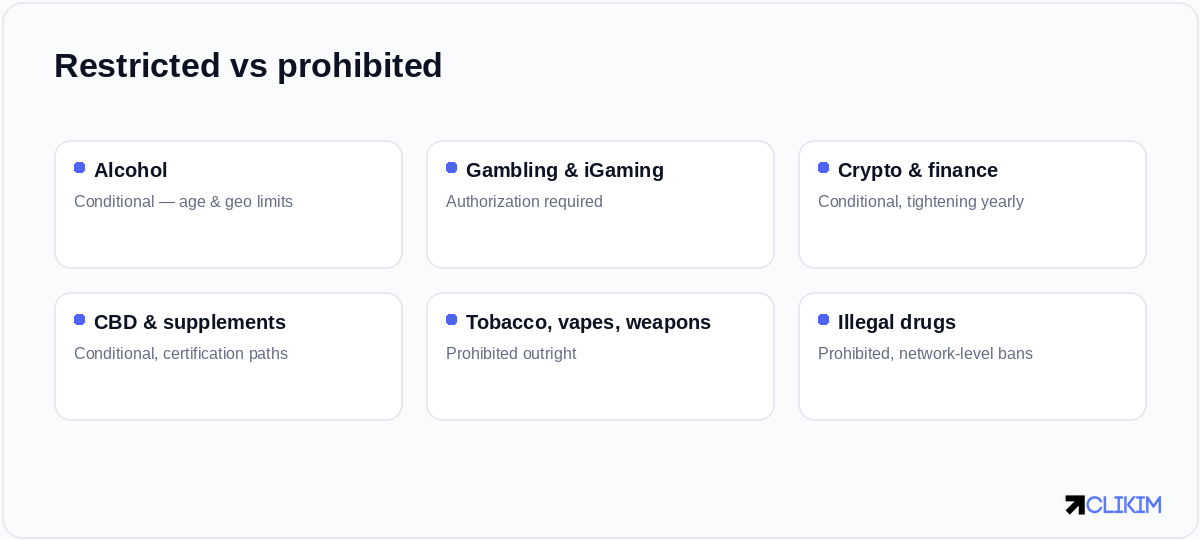
Conditional vs prohibited categories — confirm the specific policy before launching.
- Alcohol — allowed with strict age and country targeting and local-law compliance.
- Gambling & iGaming — permitted only with prior written authorization.
- Cryptocurrency & financial products — restricted; many require licensing or written permission, and "get-rich-quick" framing is prohibited.
- CBD & related products — limited and conditional, and also require LegitScript certification in supported regions.
- Prohibited outright — illegal products, recreational/illicit drugs, weapons and explosives, tobacco and most vaping, and unsafe supplements.
The pattern: if a product is age-gated, licensed or controversial in the real world, assume Meta gates it too — and check the specific policy before you build the campaign.
Building ads that pass — and stay live
Pulling it together, compliant advertising is a system, not a single check. The advertisers who rarely get rejected do these things by default:
- Write claims you can prove. Specific, substantiated, no exaggeration.
- Align ad and landing page. Same offer, same look, no cloaking, fast and functional page.
- Skip the banned shortcuts. No celebrities, before/after, personal attributes, fake urgency, or shock.
- Certify before you run restricted verticals. LegitScript and Meta authorization for health; the right permissions for finance, gambling and the rest.
- Keep creative fresh and on-policy. Maintain a pipeline of compliant variations so you can move fast when one is flagged.
- Run on a high-trust account. Platforms reward quality accounts with smoother approvals; a low-quality or repeatedly-flagged account makes every review harsher.
That last point is the one advertisers underrate. Compliant creative gets you approved; a stable, trusted agency ad account keeps you approved at scale — with a rep who can escalate a wrongful rejection in minutes rather than days. New to the model? Start with what an agency ad account is, and browse more playbooks on the Clikim blog.
Frequently asked questions
What are the main Facebook advertising policies advertisers break?+
Can you use celebrities in Facebook ads?+
Why are before-and-after images not allowed?+
What counts as aggressive sales tactics?+
What is considered blackhat in Facebook advertising?+
Do I need LegitScript certification to advertise health products?+
Can you advertise GLP-1 medications like semaglutide or tirzepatide?+
Can compounded GLP-1s be advertised as the branded versions?+
How do I stop my ads from getting rejected?+
Compliant ads deserve a compliant-friendly account
Run your whitehat campaigns on whitelisted Meta and TikTok infrastructure — high-trust delivery, rep-led appeals for wrongful rejections, and 0% top-up fees.