
Meta Credit Lines vs Card Billing: The 2026 Shift, Decoded
On April 1, 2026, Meta pulled credit cards out from under its largest advertisers and moved them to invoice billing. It’s the biggest change to how ad money moves since iOS 14 changed how it’s measured. Here’s exactly what happened, who it hits, and the adaptation playbook.
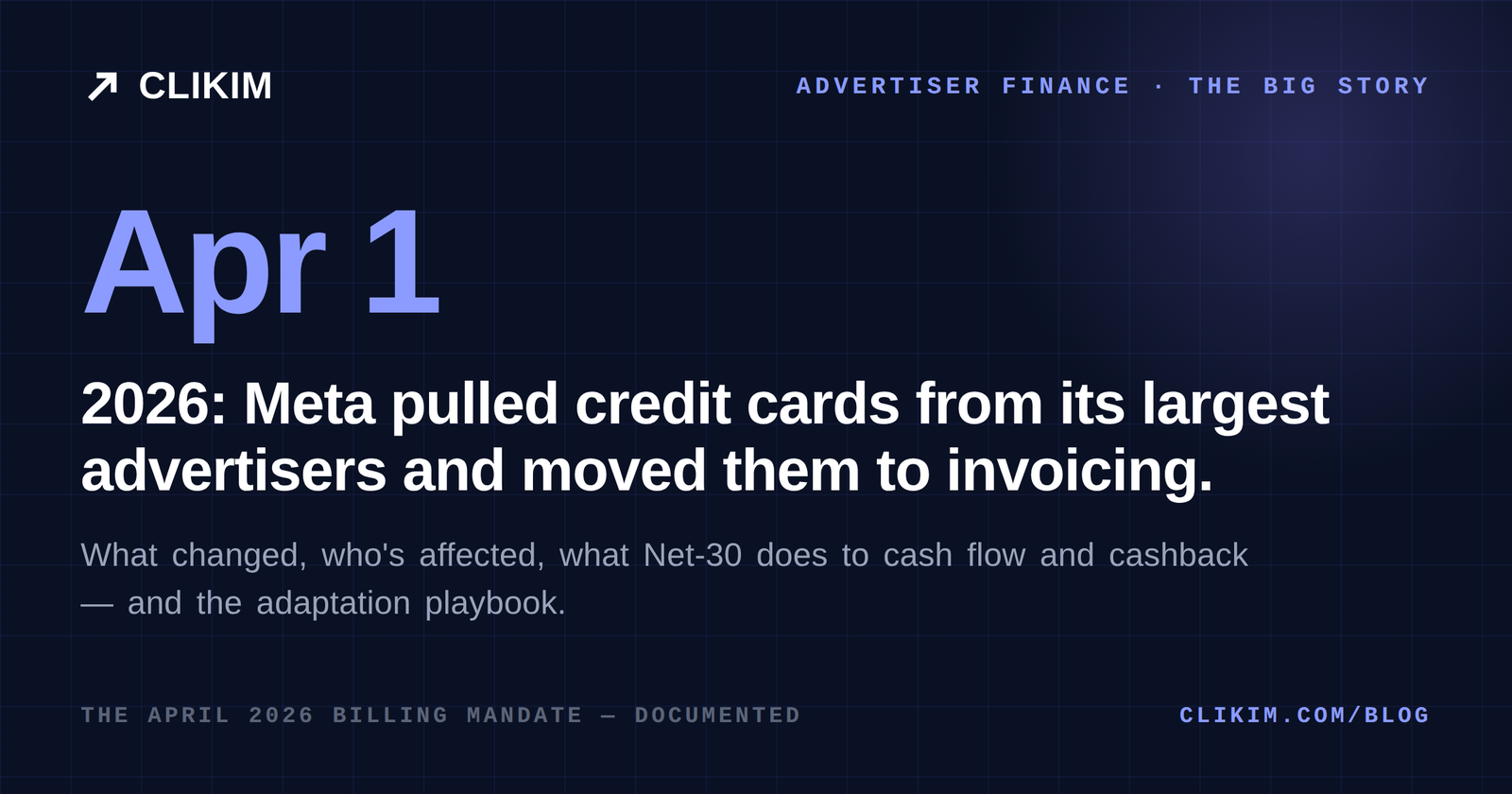
On April 1, 2026, Meta removed credit cards for its largest advertisers — moving them to monthly invoicing (Net-30) or direct debit.
No universal threshold was published; reporting converges on roughly $50K+/month accounts, notified individually. The stated drivers: card processing costs and billing reliability.
The consequences run deep: card cashback died on mandated spend (only bank-rail programs touch it now), Net-30 float became real working capital for those who manage it, and credit-line discipline became an advertiser competency overnight. The playbook below covers all of it.
What exactly changed
Meta notified qualifying high-spend advertisers that credit card payments would be discontinued for their ad accounts effective April 1, 2026, with two sanctioned paths forward: monthly invoicing — Meta extends a credit line, bills Net-30, and the advertiser pays by bank transfer — or direct debit where supported (US bank accounts, SEPA in Europe). Accounts that didn’t transition faced paused delivery. This wasn’t a policy suggestion; it was a billing migration with a deadline — third-party coverage across payments and fintech press documented the rollout through Q1 2026.
Who’s affected (and the ambiguity that matters)
Meta published no universal spend threshold. Reporting and observed notifications converge on accounts around $50K+/month, but the mandate arrived account-by-account via notification, and the practical boundary behaves like Meta’s other trust systems: spend level, history and structure all appear to matter. Three operational implications: advertisers below the line keep card billing (and card cashback) for now; advertisers near the line should plan as if the notification is coming; and multi-account structures may see mandates arrive unevenly across their portfolio — a coordination problem for agencies especially (mixed billing modes across client accounts under one management structure).

No universal threshold was published — reporting converges on roughly $50K+/month, delivered account by account.
Why Meta did it
The stated logic is straightforward economics: card processing on enormous ad spend costs real percentage points (industry card fees run 1.5–3.5%), and card billing fails in ways bank rails don’t — declines, expiries, disputes — creating both revenue leakage and the enforcement noise documented in our payment-failure guide. Moving whales to invoicing converts Meta’s messiest billing cohort to its cleanest. Worth naming the mirror image: what Meta gains in processing costs, advertisers lose in card float and rewards — the mandate is, among other things, a value transfer from advertiser card programs to Meta’s margin. That’s not a complaint; it’s the context for why the adaptation playbook below is worth real effort.
The cash-flow and cashback math, before and after
| Dimension | Card billing (before) | Invoicing (after) |
|---|---|---|
| Payment timing | Charged at billing thresholds — effectively continuous | Net-30 invoices — a real float improvement, if managed |
| Rewards | 1–3% card cashback on everything | Zero on cards; bank-rail programs only — currently Slash’s 1% on Meta invoices paid through them (see our ranking) |
| Failure modes | Declines, expiries, card flags | Credit-line limits, late-payment consequences, invoice reconciliation errors |
| Discipline required | Card hygiene | Treasury hygiene: AP processes, payment scheduling, line monitoring |
Two honest observations on that table. The float is genuinely valuable — Net-30 on seven-figure monthly spend is meaningful working capital versus threshold-charged cards. And the rewards story flipped from a card competition to a rails competition overnight: at $500K/month of mandated spend, the only cashback that exists is what your bank rails pay, which is why the bank-rail programs got our attention across this cluster.
The adaptation playbook
- If notified: transition before the deadline, not at it. Credit-line setup involves review; paused delivery during BFCM-grade weeks because paperwork sat in a queue is an unforced error.
- Route invoice payments through rails that pay you back. Card cashback is gone on mandated spend; bank-rail cashback (Slash’s Meta-invoice program is the one we’ve verified — subject to its balance tiers) is the remaining rewards lever. Details in the stack pillar.
- Build AP discipline now. Net-30 punishes sloppiness differently than cards: a missed invoice doesn’t decline quietly, it jeopardizes the line. Calendar the cycle, reconcile line-items against delivery, dispute errors through the platform.
- Keep cardable spend organized. Sub-mandate accounts, other platforms, tools — that spend still earns at card rates (the category leader reviewed here). Don’t let the mandate’s shadow kill rewards on spend it doesn’t cover.
- Agencies: normalize the mixed estate. Some client accounts mandated, some not — billing mode now belongs in client onboarding checklists and reconciliation logic, per account.
- Preserve optionality on account structure. Funded-balance and managed-billing arrangements through agency infrastructure sidestep parts of this complexity by design — one of the quieter reasons that model grew this year.
What to watch next
Three open questions worth tracking. Does the threshold creep down? Billing migrations that start with whales rarely end with them. Do other platforms follow? Google already runs opt-in invoicing at scale (its version documented in our billing guide) — a mandatory turn would rhyme. Does the rewards market respond? One bank-rail program exists today; if competitors match it, the rails competition becomes a real market. We’ll keep this piece updated as each answer lands.
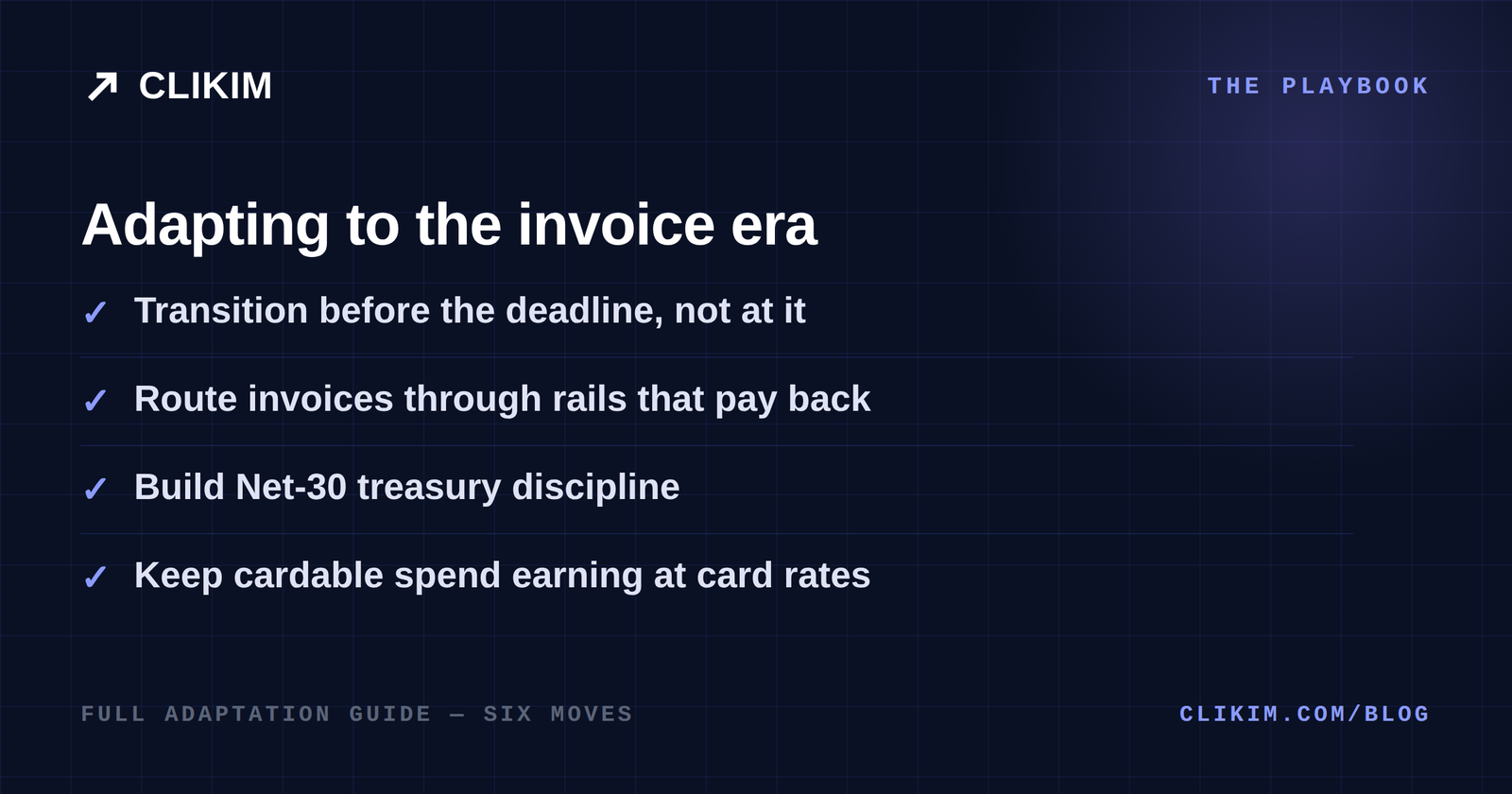
Six moves that turn the mandate from disruption into float — and keep rewards alive on the rails.
Frequently asked questions
Did Meta really remove credit cards for advertisers?+
What spend level triggers Meta’s invoicing mandate?+
What is a Meta credit line?+
Can I still earn cashback on Meta ad spend?+
Is Net-30 invoicing better or worse than card billing?+
Will Google Ads force invoicing too?+
Billing mandate landed on your accounts?
Talk to us about funded-balance infrastructure and managed billing — the complexity handled, a rep in minutes.