
Event Deduplication That Actually Passes the Test
Pixel plus CAPI means two copies of every conversion by design — the merge is yours to wire. The four dedup keys in match order, the order-ID golden rule, your platform's version of the classic failure, a video walkthrough, and the verification moment that makes 'done' a fact instead of a feeling.

Meta deduplicates pixel+CAPI copies using event_name + event_id first (then fbp, then external_id) within a ~48-hour window. Golden rule: derive event_id from the ORDER ID so both sides compute the same value independently — separately-generated UUIDs are valid, unique, and match nothing. Verify with one test purchase in Test Events: one merged row with browser+server icons = done; then confirm dedup rate 95%+ in Events Manager (under 80% = double-counting reaching reports AND optimization). Classic real-world breakage: a forgotten second sender — legacy theme snippets, parallel apps. Re-verify after every checkout/app/plugin change.
• Meta merges pixel+CAPI copies of an event using event_name + event_id first (then fbp, then external_id) inside a ~48-hour window. • The golden rule: derive event_id from the order (order ID/transaction ID) so both sides compute the same value independently — random per-side UUIDs are the classic silent failure. • Verification is a moment, not a vibe: one test purchase → Test Events shows a single merged row with browser+server icons → dedup rate 95%+ in Events Manager. • Dedup failure cuts both ways: unmatched copies double-count (inflated results, corrupted optimization); missing server events under-count (signal loss). • Most real-world breakage is a forgotten second sender — legacy theme snippets and parallel apps — not the primary integration. • Re-verify after ANY checkout, app or plugin change; tracking rots at the speed of updates.
How the merge actually works
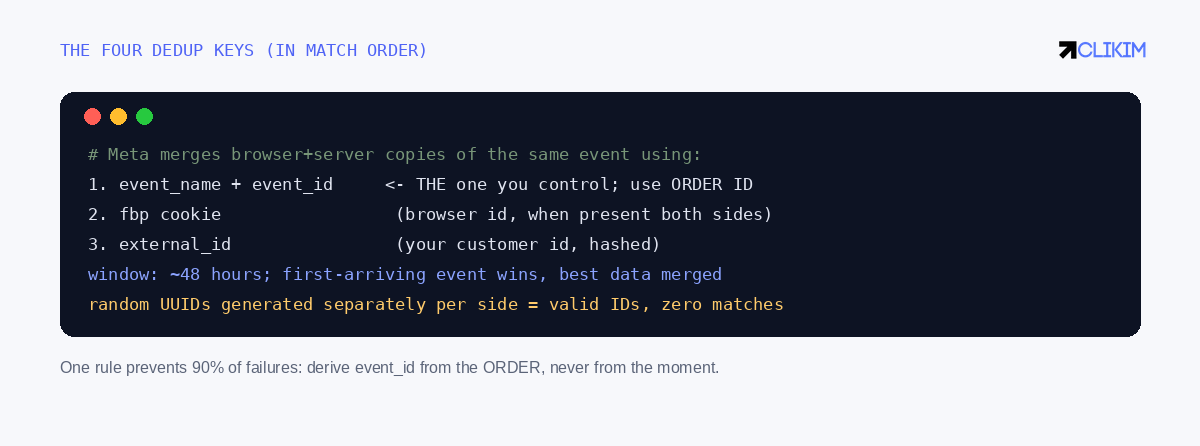
Four keys, one window, one rule — the mechanics behind every dedup rate you'll ever read.
Running the pixel and the Conversions API together means Meta receives two copies of every conversion by design — the browser's version and your server's. The merge that turns two copies into one counted event checks, in order: event_name + event_id (the pair you control — identical values on both sides collapse into one event, with the richer data kept), then fbp (the browser cookie, when your server event carries it), then external_id (your hashed customer identifier). The window is roughly 48 hours; the first-arriving copy establishes the event. Meta's developer documentation covers the parameters exhaustively, but the entire practical craft compresses to one sentence: derive event_id from something the order already owns — the order ID — so browser and server compute identical values without ever coordinating. Every elegant failure we've audited generated valid, unique, beautiful UUIDs… separately, per side, matching nothing.
Your platform's version of the same mistake
Every platform's failure is the same failure wearing different clothes: two senders, two ID schemes, zero matches.
The visual walkthrough
For the click-by-click version — pixel setup, event_id wiring, and the Test Events verification — this walkthrough covers the full 2026 flow:
Conversions API + event_id + deduplication, walked through end to end.
The verification loop (the part everyone skips)
Code shipping is the midpoint, not the finish. The loop: (1) Events Manager → your dataset → Test Events tab, test code active on your site session. (2) Buy something cheap — a real test order, not a pageview stare. (3) Watch for the moment that matters: one Purchase row wearing BOTH browser and server icons, dedup indicated. Two rows = IDs aren't matching (log both payloads; find the scheme mismatch). One row, one icon = a side isn't firing (blocked pixel or dead server call). (4) Production check 24–48h later: the event's dedup rate in Events Manager — 95%+ is healthy, under 80% means real double-counting is reaching reports and optimization (the exact inflation anatomy from the Meta-vs-Shopify guide). (5) Re-run the single test purchase after ANY change to checkout, apps, themes or plugins — the audits we see fail were all "verified once, in 2024."
Why this is worth an afternoon: the two-sided tax
Broken dedup taxes in both directions at once. Unmatched double-fires inflate reported results 30–100% on the affected event — which doesn't just embarrass reconciliations, it trains delivery on fiction: optimization learns conversions are cheap and plentiful, bids accordingly, and spends into audiences that never earned it. Meanwhile, running pixel-only to "avoid duplicate risk" — a genuinely common panic response — trades the inflation for under-counting: 30–50% of conversions lost to blockers, iOS and consent, with delivery starved of exactly the signal it needs. The only correct posture is both senders, matched IDs, verified merge — an afternoon of work that most accounts recoup inside the month, in steadier CPAs and dashboards that survive audits.
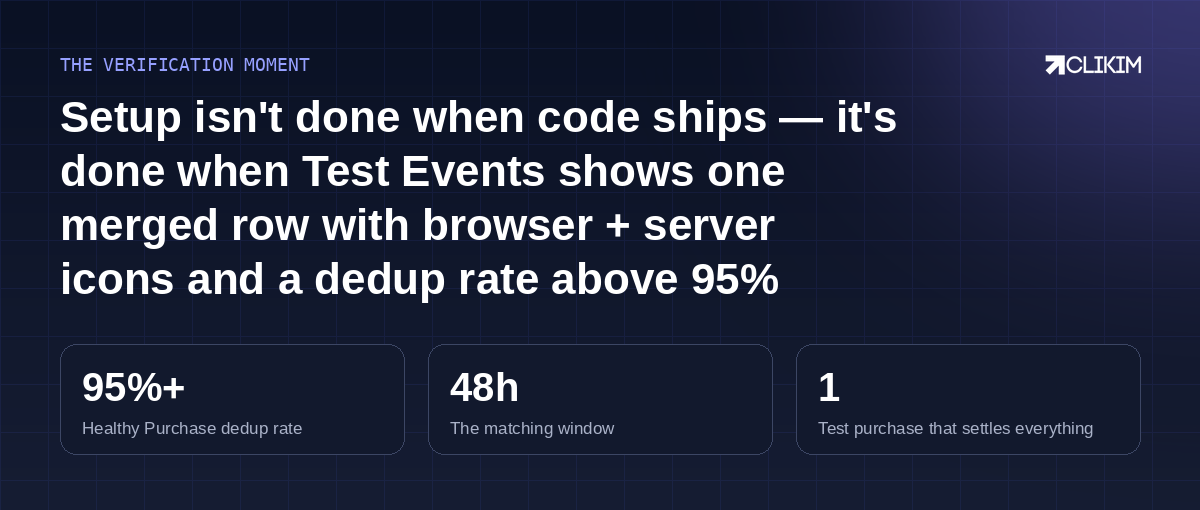
One test purchase, one merged row, one number above 95% — deduplication is the rare tracking problem with a definite done-state.
Frequently asked questions
What should I use as the event_id?+
Where do I see my deduplication rate?+
What does 'missing deduplication parameter' mean in Events Manager?+
Why do I see two Purchase rows in Test Events?+
Does deduplication happen across different event names?+
What happens if only my pixel fires (no CAPI)?+
Can duplicate events affect optimization, not just reporting?+
Shopify handles this automatically — am I safe?+
The WooCommerce plugin keeps breaking my dedup — options?+
Is there a dedup window — can late server events still merge?+
Do I need external_id if event_id is set up correctly?+
How often should I re-verify?+
Clean events deserve clean accounts
Whitelisted infrastructure — stable, history-rich rails under your newly-honest signal.