
NewsBreak Newsletter Ads: The Placement Nobody Covers
Inside NewsBreak lives a second ad platform: local email digests with millions of subscribers, a separate auction, its own minimums — and, remarkably, zero independent advertiser reviews anywhere. Here’s everything documented, who the placement logically fits, and an honest map of what’s unknown.
NewsBreak newsletter ads run in local email digests under their own rules: $100/day minimum budget, floor bids of $2 CPM per 1,000 email OPENS and $0.20 CPC, creative of a 1200×600 image plus your logo, scheduled two days in advance.
The per-open pricing is the detail that matters: you bid on opens, not sends — a stricter, more honest denominator than most email advertising.
The honest status: brand sponsors like Uber and LendingTree have used it, but zero independent advertiser reviews or open-rate figures exist anywhere. It’s a placement for advertisers who’ve already won the feed and want a second, email-native surface — with test budgets they can afford to learn on.
What the placement actually is
NewsBreak’s local newsletters are daily email digests — town-level news, weather and alerts — that the platform says reach “millions of daily subscribers.” Newsletter ads place your creative inside those emails: an image, your logo, and a click-through, selected as a placement at the ad-set level in the same Ad Manager as everything else.
Structurally it’s a second platform sharing your login: separate inventory (inboxes, not feeds), separate minimums, separate floors, and a scheduling rhythm all its own. The brand names NewsBreak’s own materials associate with it — Uber, LendingTree, FoxSports — signal how it’s been sold so far: a reach product for established advertisers, not an affiliate playground.
The complete spec sheet
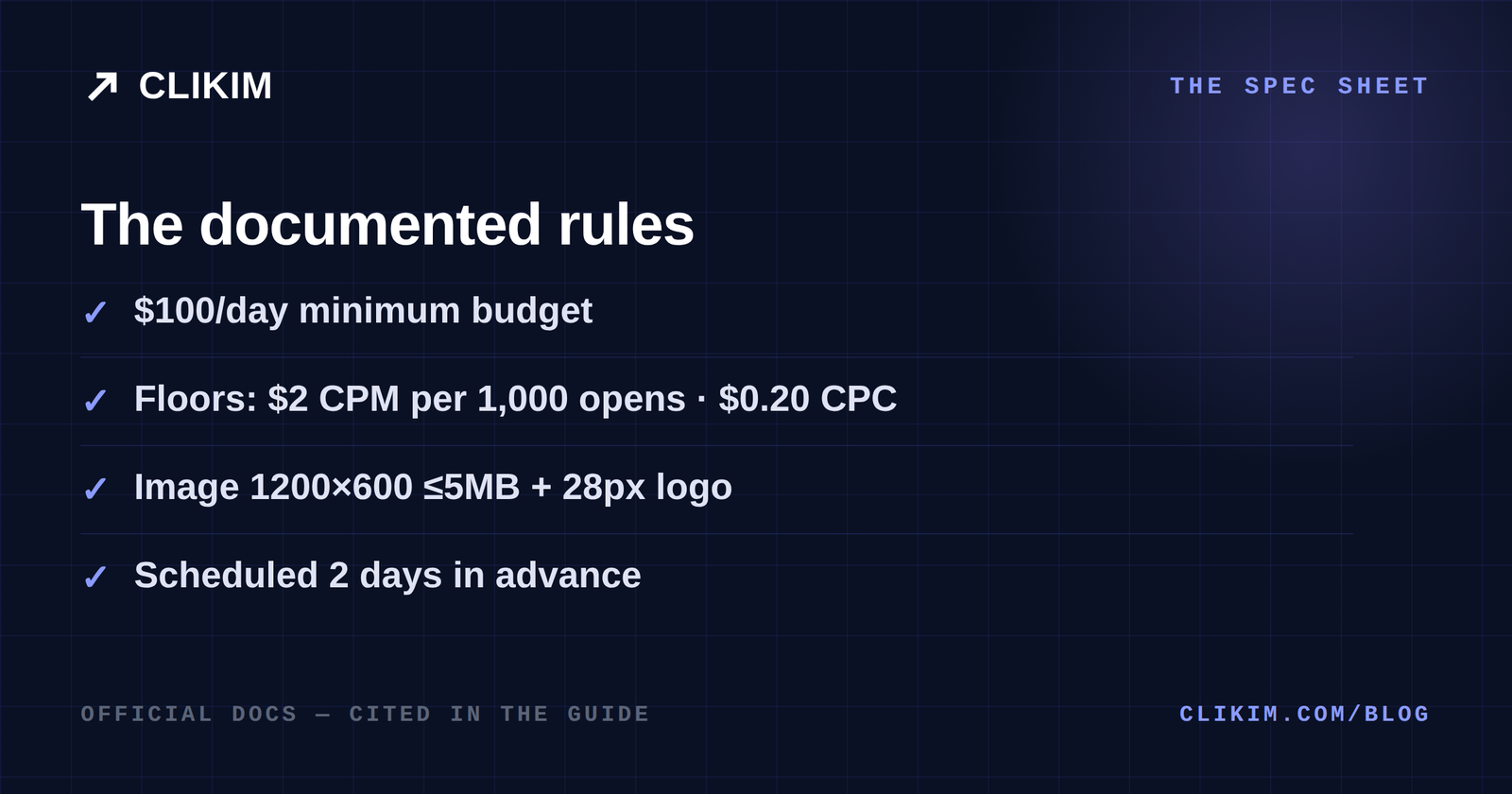
The complete documented spec sheet — everything else about this placement is unwritten.
Everything NewsBreak’s newsletter documentation commits to:
| Rule | Value |
|---|---|
| Minimum daily budget | $100 (vs $10 for feed campaigns) |
| Floor bids | $2 CPM per 1,000 email opens · $0.20 CPC |
| Image | Ideally 1200×600px, max 5MB |
| Logo | 28px height, max 200px width |
| Scheduling | Campaigns and changes apply 2 days in advance |
| Placement selection | “Newsletter” at the ad-set level |
The two-day scheduling lag deserves respect in practice: no same-day launches, no same-day fixes. Newsletter campaigns are planned media, not performance knobs — build creative you’re confident in before committing the window.
Why per-open pricing matters
The spec’s quiet star: the $2 CPM floor is priced per 1,000 opens, not sends. Most email advertising bills on delivery, making the open rate your risk; here the open already happened before you pay the impression.
That makes the placement’s real economics unusually honest — and it reframes creative priorities: everyone who costs you money has already opened a local-news email and is scanning it. Your image is competing with headlines they chose to read, which points creative straight back to the editorial rules in the creative guide — with one twist: the 1200×600 image carries the whole message, since there’s no headline-card structure around it.
What does $2 CPM per 1,000 opens actually mean?
You pay (at floor) two dollars for a thousand opened emails containing your ad — the reader already opened before the impression counts. Compare that with feed CPMs where viewability is the platform’s claim, and the newsletter floor is one of the more honestly-denominated prices in digital media.
Who it logically fits
With no public performance data, fit reasoning comes from structure:
- Local and regional advertisers — the inventory IS local; a metro home-services brand or regional insurer lands in the exact towns it serves, per the home-services geo playbook.
- Brand-plus-response hybrids — the Uber/LendingTree precedent: recognizable offers that benefit from trusted-context repetition.
- Feed winners seeking a second surface — advertisers whose in-feed economics already work, buying the same audience in a different attention mode.
- Email-native offers — subscriptions, newsletters, loyalty programs: an audience that demonstrably reads email daily.
Who it doesn’t fit: first-time testers (the $100/day minimum makes it an expensive classroom — learn on the $10 feed first), and pure-performance affiliates without the patience for two-day cycles.
Newsletter vs feed: the split decision
| Feed campaigns | Newsletter | |
|---|---|---|
| Minimum | $10/day | $100/day |
| Pricing floor | Auction (no published floor) | $2 CPM/opens · $0.20 CPC |
| Iteration speed | Same-day | Two-day lag |
| Attention mode | Scroll discovery | Chosen email session |
| Evidence base | Cases + community reports | None public |
The sensible sequence: prove the feed first (the setup guide path), then test the newsletter as a second channel at 10–20% of spend, judged on the same cost-per-lead yardstick over two-week windows — the cost guide’s discipline, applied to a slower-moving surface.
Is the newsletter placement worth testing?
If your feed campaigns already work and your offer is local or email-native: yes, at 10–20% of budget — the audience is real and the pricing is honestly denominated. If you’re new to the platform: no — learn on the $10/day feed first.
The brand-response hybrid play
The sponsor roster (Uber, LendingTree, FoxSports) hints at the placement’s most interesting use: the brand-response hybrid, where the newsletter builds familiarity that the feed converts. The mechanics: run the newsletter as a steady presence in your proven metros — same brand, same visual system, message-level creative — while feed campaigns carry the direct-response load in the same towns. The reader who’s seen your brand in their morning digest three times taps the feed ad differently.
Measurement for the hybrid is honest but indirect: watch feed CPL in newsletter-covered metros against uncovered control metros over 4–6 weeks. A widening gap in the covered towns is the halo, priced; no gap after six weeks means the placement isn’t earning its minimums for you. Either answer is worth the test’s cost to an advertiser already spending five figures monthly on the feed — and it’s a study literally no one has published, which makes the finding itself an asset.
Geo strategy for the inbox
The newsletter inherits the platform’s town-level structure — these are local digests — which makes geography the placement’s sharpest lever and its least discussed one:
- Local advertisers buy their exact towns — a metro contractor or regional insurer lands in the digests of precisely the ZIP codes they serve; no other email channel sells that granularity at self-serve prices.
- National advertisers should still cluster — testing the placement across three known-good metros (your feed campaigns’ city-split winners) reads cleaner than a national buy, and the $100/day minimum stretches further against clustered inventory.
- Localize the image where volume justifies it — the same “{{city}}” relevance that powers feed creative works harder in an email whose subject line is the town’s name; at minimum, localize per state.
The sequencing implication: your feed campaigns’ geography report is the newsletter’s targeting brief. Towns that convert in the feed are the towns whose newsletter readers — the same population in a higher-trust context — justify the placement’s premium minimums. Run the fortnight test there first, and let the geo data you already own de-risk the surface you don’t know yet.
Designing for the inbox: the 1200×600 problem
Newsletter creative inverts the feed’s rules. In-feed, the headline carries the message and the image earns the glance; in the inbox, the image IS the ad — there’s no headline-card structure around it, just your 1200×600 and a logo. The working principles:
- Put the message in the image — a clear benefit statement rendered large and legible at phone width, editorial in tone, never more than a dozen words.
- Design for the email context — the reader is scanning a town digest between headlines about road work; calm, local-feeling creative belongs, banner-blindness bait doesn’t.
- Logo placement earns trust — the 28px logo is small; make the brand legible inside the image too, because inbox trust converts this audience.
- One variant per window — the two-day scheduling lag makes spray-testing impossible; ship your best, learn, iterate next window.
A $1,400 two-week test plan
The minimum honest experiment the placement allows: $100/day for fourteen days, one geo cluster where your offer is strongest, one image concept per week (the lag permits exactly two iterations), judged on cost per lead against your feed campaigns’ CPL over the same fortnight.
Wire the same postback events, tag newsletter traffic distinctly, and write down the verdict thresholds before launch — beats feed CPL by any margin: scale it; lands within 2×: iterate creative once more; worse than 2×: the placement isn’t your channel, and the $1,400 bought a definitive answer nobody else has published.
The honest unknowns
Zero independent reviews exist — early testers are writing the playbook everyone else will read.
Mapping what nobody can tell you — so you don’t mistake silence for answers:
- No open-rate figures exist — NewsBreak publishes none, and no third party has measured them. Don’t trust anyone who quotes one.
- No independent advertiser reviews exist — not on affLIFT, not in tracker blogs, nowhere indexed. The placement has brand sponsors, not published case studies.
- No CTR or conversion benchmarks — every performance expectation you form should come from your own two-week test.
Which is the opportunity in disguise: the first operators to publish newsletter results will own the topic — the same early-mover math that applies to the platform generally, per our verdict. Volume newsletter programs — multiple markets, funded budgets, invoicing — run best through managed agency access; the platform fundamentals live in the complete guide.
Frequently asked questions
What are NewsBreak newsletter ads?+
How much do NewsBreak newsletter ads cost?+
What are the newsletter ad specs?+
Why is newsletter pricing per open important?+
Are NewsBreak newsletter ads worth it?+
Can affiliates use the newsletter placement?+
Can I A/B test newsletter creatives?+
Do newsletter ads use the same tracking as feed ads?+
Test the placement with real backing
Managed NewsBreak agency accounts: funded balances and invoicing that make $100/day placements a test, not a gamble.