
Triple Whale vs Northbeam vs Hyros: They Disagree By Design
Same store, same day: Meta says 4.2x, Triple Whale 2.8x, Northbeam 2.1x, Hyros 3.3x. Nothing is broken — methodology is the product, and every vendor comparison is written by a contestant. Here's the neutral version: which bias serves which decision, and the $0 stack that arbitrates.
The three tools disagree on purpose — methodology is the product.
Triple Whale reads close to platform numbers, Northbeam normalizes channels down so nothing sums past real revenue, and Hyros stretches windows for long sales cycles.
“Which is accurate?” is the wrong question. Ask which decision you’re funding — then pick the bias that fits it.
DISAGREE BY DESIGN TW ≈ PLATFORM-SIDE NB: −30–50% VS META HYROS: LONG WINDOWS
Why the numbers can't agree (and were never going to)
The scene repeats in every ecom Slack: same day, same store — Ads Manager says 4.2x, Triple Whale says 2.8x, Northbeam says 2.1x, and someone’s Hyros trial says 3.3x. The operator concludes something is broken.
Nothing is. Each system watched the same journeys and applied a different theory of credit:
- Meta grades its own homework under its own windows.
- Triple Whale models deliberately, staying legible against platform numbers.
- Northbeam enforces multi-touch normalization — all channels together can’t claim more than actual revenue, so every channel’s number deflates.
- Hyros follows clicks through email and phone identity across windows long enough to catch the webinar buyer who converts on day 40.
Four theories, four numbers, zero referees — because the counterfactual truth (“would this sale have happened without the ad?”) isn’t observable at the per-purchase level by anyone. That’s not cynicism; it’s the honest foundation for buying well.
The comparison, vendor-neutral
All four look at the same customer journeys and produce different numbers ON PURPOSE — methodology is the product. The scandal isn't that they disagree; it's that vendors sell the disagreement as accuracy.
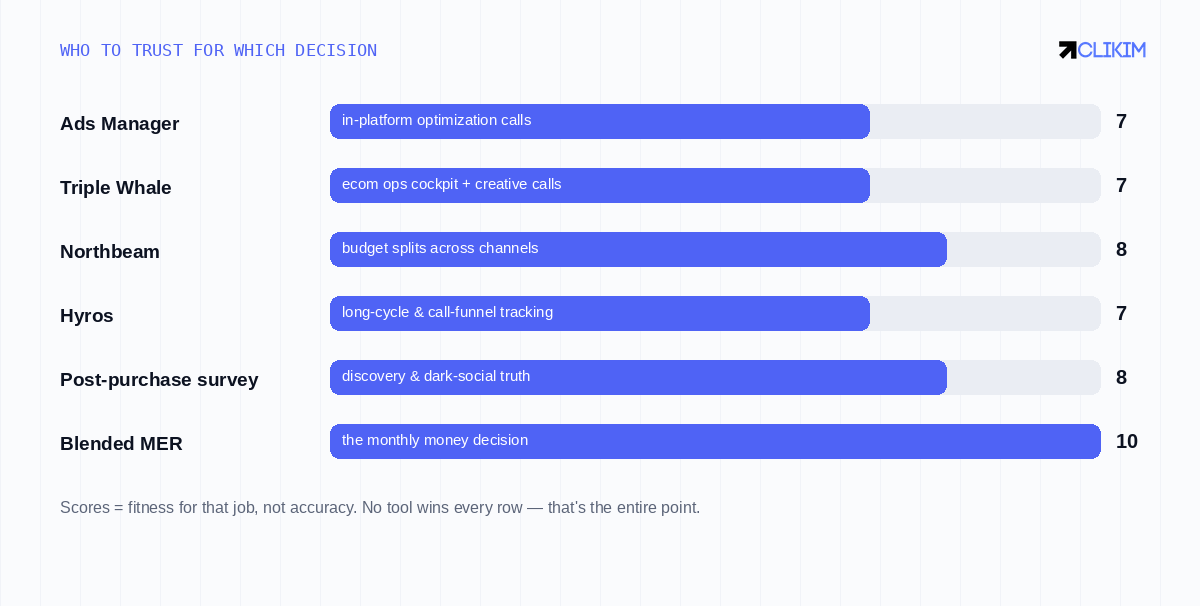
Fitness-for-decision, not accuracy — the only scoring that makes sense once you accept the methodologies differ on purpose.
The $0 stack you owe yourself before any invoice
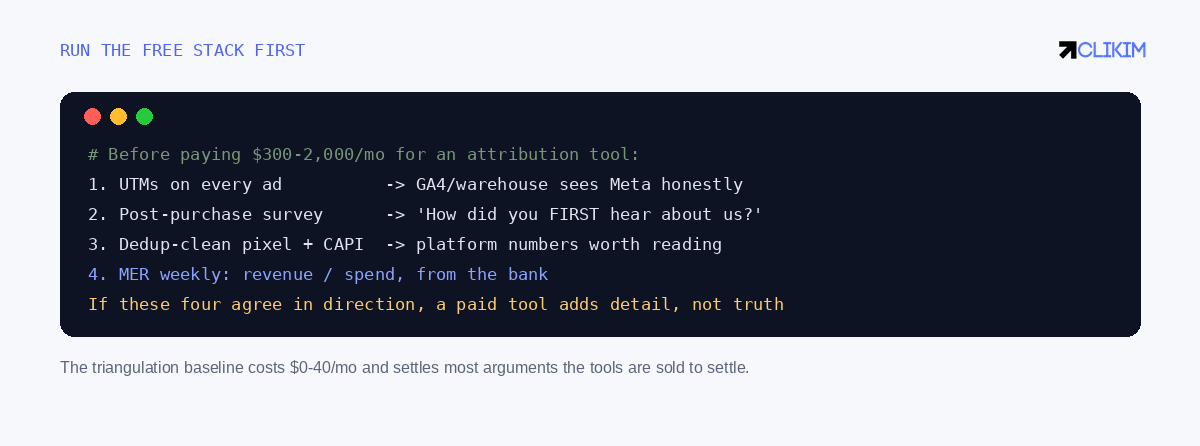
Four free witnesses that triangulate what no single tool can adjudicate.
Most attribution-tool purchases are bought to settle an anxiety the free stack settles better. Four free witnesses:
- Disciplined UTMs — an ad-platform-independent view of Meta traffic in your analytics.
- A post-purchase survey (“How did you first hear about us?”) — catches what every pixel misses: dark social, podcast mentions, the TikTok your customer saw three weeks ago. It consistently reveals platform over- and under-claiming in both directions.
- Dedup-clean platform data (the event_id work) — makes Ads Manager worth reading at all.
- MER — revenue over spend, from the bank — arbitrates everything monthly.
When these four agree in direction, a paid tool adds resolution, not revelation. When they disagree, you’ve found a real question — and now you know which paid methodology would actually answer it.
Choosing, if you're choosing
Buy Triple Whale — the ecommerce cockpit
When the job is an operating hub: Shopify-native blended dashboards, creative-level analytics, cohort views — attribution included as a feature rather than the whole promise. It’s the lowest-friction, most-adopted option, and its numbers stay legible against Meta’s — which your media buyer will appreciate and your skeptic should note.
Buy Northbeam — when channel allocation is the decision
When you carry enough spend across Meta/Google/TikTok that shifting 10% between channels pays the four-figure fee. Its deflationary normalization is the closest thing this market has to institutional honesty — and it will make Meta look worse than Meta says. That’s the design, not a bug.
Buy Hyros — when money closes late and off-site
Phone sales, webinars, high-ticket coaching, 30–90 day cycles — its identity-stitched long windows see what everyone else’s week-long memory forgets.
Buy nothing below roughly $20–30k/month
At that spend, the free stack plus a disciplined read of native numbers outperforms a tool subscription you’ll consult weekly and trust never.
In every case: run the new tool alongside your witnesses for a full month before it touches a budget decision — you’re learning its bias, not testing its truth.
A worked disagreement (read along with your own numbers)
A $60k/month Shopify brand, Meta-dominant with a growing TikTok line, sees this exact spread in one week: Ads Manager 3.8x, Triple Whale 3.1x, Northbeam 2.2x, MER 2.6x.
Panic translation: “somewhere between great and barely breakeven.” Methodology translation:
- Ads Manager is claiming view-through and modeled credit the others discount.
- Triple Whale is shaving the platform premium but staying legible.
- Northbeam has redistributed a slice of Meta’s claimed revenue to TikTok, email and organic — its whole job.
- MER — which can’t be argued with — says the blended machine returns 2.6x.
Decisions fall out cleanly once each number does its job:
- The creative decision (which ads to scale) uses Ads Manager / Triple Whale relative rankings, where the bias is constant across ads and therefore harmless.
- The channel decision (feed Meta or TikTok next month) uses Northbeam’s deflated-but-consistent split.
- The money decision (can we afford more total spend) uses MER against contribution margin.
Nobody had to crown a winner. And the only expensive mistake available — cutting Meta because Northbeam’s 2.2x “felt low” — dies the moment you remember deflation is the methodology, not a verdict.
The disclosure vendors can't make (and we can)
Every comparison you’ll find on the first page of results is written by one of the contestants — Triple Whale reviewing Northbeam, Northbeam explaining why deflation is wisdom, Hyros case-studying itself.
This one’s written by an ad-infrastructure company with no attribution product to sell you. Our stake is that your measurement stays honest enough to keep scaling — operators who trust a broken yardstick either quit Meta (bad for us) or scale into losses (worse for them).
The same neutrality note applies to what tools can’t fix: attribution software reads events; it doesn’t create them. An account with thin, modeled, signal-poor data feeds every tool the same fog — plumbing first, philosophy second.
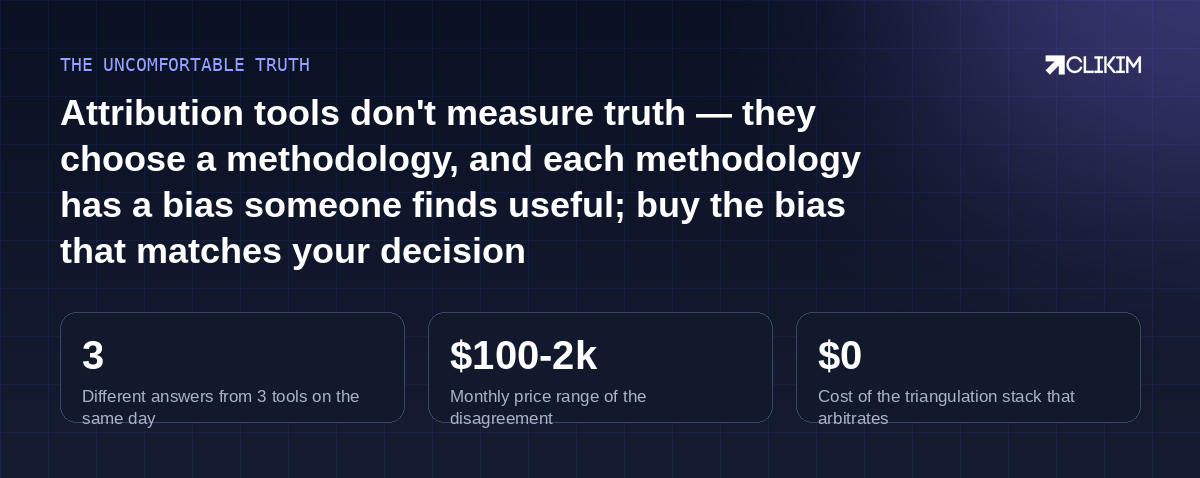
Buy the bias that matches your decision — and make every vendor's number audition against the free witnesses first.
Frequently asked questions
Which attribution tool is the most accurate for Meta ads?+
Why does Northbeam show my Meta ROAS so much lower than Ads Manager?+
Is Triple Whale just repeating what Meta tells it?+
Who is Hyros actually for?+
What's the minimum spend where these tools make sense?+
Can I just use post-purchase surveys instead of an attribution tool?+
Do these tools fix iOS/tracking signal loss?+
Should the tool's number replace Ads Manager for optimization?+
How do I evaluate a tool during a trial without fooling myself?+
Triple Whale vs Northbeam directly — which one for a Shopify brand?+
Are there cheaper alternatives that do the same job?+
Why do all the comparison articles recommend the site publishing them?+
What did the 2026 Meta attribution changes do to these tools?+
Does account structure or trust affect what these tools see?+
What's the one-sentence recommendation?+
Can I negotiate pricing with these vendors?+
Measurement debates need stable ground
Whitelisted infrastructure — history-rich, signal-dense containers that make every attribution stack more readable.