
UGC Ads on Facebook: The Practical Guide
UGC is the dominant performance-creative format on Facebook because it looks like content, not an ad. Here's why it outperforms polished video, the formats that convert, how to source and brief creators, why the hook is everything, and how to test like a pro.
UGC (user-generated content) ads are creator- or customer-style videos made to look like organic content rather than polished commercials. They win because they're native to the feed, build trust, and can be produced cheaply in high volume — which matters because modern Facebook is a creative-testing game. The hook (first ~3 seconds) decides most performance, so test many hooks per concept; on broad audiences, the creative is the targeting. Brief creators with talking points but keep their authentic voice.
• UGC ads are creator- or customer-style videos that look like organic content, not polished commercials. • They win because they're native to the feed, build trust, and can be produced in high volume cheaply. • The hook (first ~3 seconds) decides most of the performance — test many hooks per concept. • On broad audiences, creative is the targeting — UGC is how you reach the right people. • Brief creators with hooks and talking points, but leave room for authenticity. • Diagnose with hook rate → hold → CTR → CPA; each metric points to a different fix. • Creative volume only pays off on an account that stays live to run it at scale.
What UGC ads are
UGC — user-generated content — ads are videos (and sometimes images) made to look like authentic content from a real person rather than a brand. Think a creator talking to their phone camera, an unboxing, a casual tutorial, a genuine-feeling testimonial. The defining trait isn't who literally filmed it; it's that the ad looks like organic content in the feed instead of a glossy commercial. That native quality is the whole point.
UGC has become the dominant performance-creative format on Facebook and Instagram for a simple reason: people scroll past things that look like ads and stop for things that look like content. A well-made UGC ad earns a few seconds of genuine attention before the viewer realises they're being sold to — and those few seconds are where conversions are won or lost.
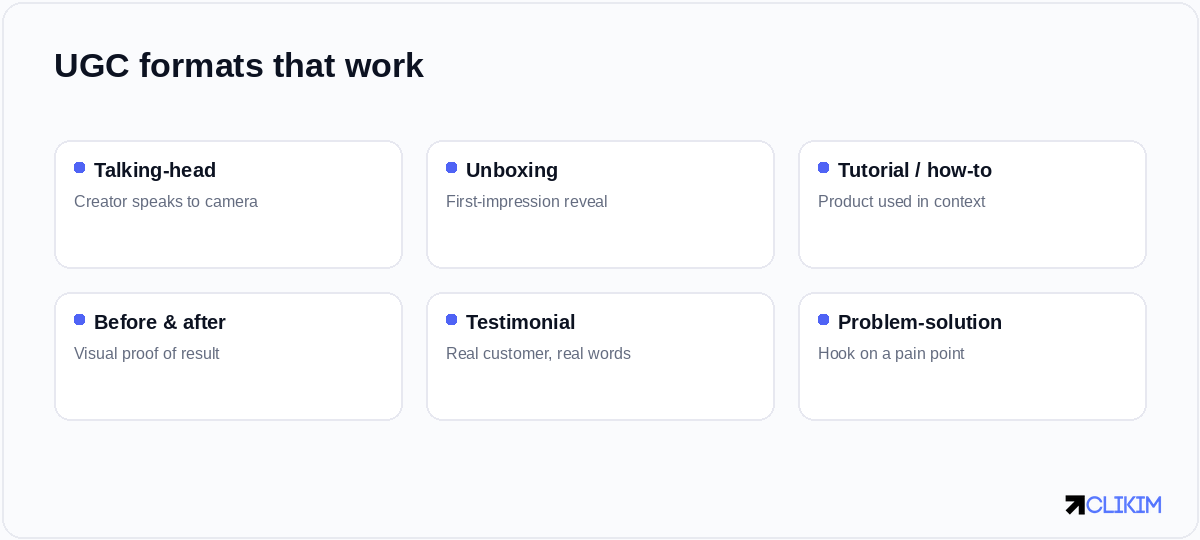
UGC spans many formats — talking-head, unboxing, tutorial, testimonial — each suited to a different angle.
Why UGC outperforms polished ads
Three forces make UGC work. First, native feel: it blends into a feed of friends' posts and creator content, so it interrupts less and gets watched more. Second, trust: a real-seeming person vouching for a product is more persuasive than a brand talking about itself — social proof is built into the format. Third, economics: you can produce many UGC variants for the cost of one studio shoot, which matters enormously for testing.
UGC isn't 'cheaper studio' — it's a different category that blends into the feed and earns attention before it sells.
That last point is the quiet superpower. Modern Facebook performance is a volume game — you need lots of creative to find winners and to replace them as they fatigue. UGC's low cost per asset is what makes that volume affordable, so it's not just that any single UGC ad performs well; it's that the format lets you run the testing machine that finds winners in the first place.
On broad audiences, creative is the targeting
This is the strategic shift that makes UGC central rather than optional. As covered in our account structure guide, modern Facebook works best with broad audiences and Advantage+ signals — which means you're no longer hand-picking who sees your ads. So how does the right person get reached? Through the creative. A UGC ad that opens with "if you struggle with X" effectively targets people who struggle with X, because they're the ones who stop scrolling.
In other words, the targeting lever has moved out of the audience settings and into the hook. This is why creative volume and quality now matter more than audience research — and why UGC, which lets you cheaply test dozens of hooks and angles, has become the primary way advertisers "target" on a broad-audience platform.
The hook is (almost) everything
If you take one thing from this guide: the first three seconds decide the fate of a UGC ad. Most viewers who scroll past do so in that window, so the hook — the opening line, visual and motion — carries a wildly disproportionate share of performance. A brilliant product demo with a weak hook will be seen by almost no one; a mediocre demo with a great hook can go viral.
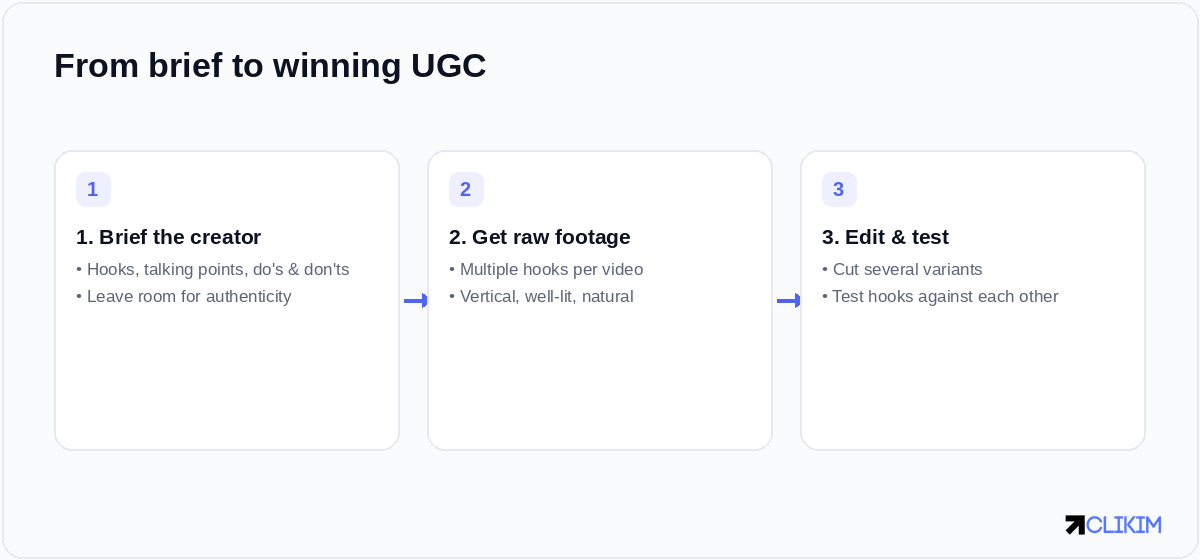
Winning UGC is a process: brief the creator, capture multiple hooks, then edit and test variants against each other.
The practical implication is to treat hooks as the main testing variable. Film several different openings for the same core video, cut them as separate variants, and let them compete. Often the same body footage with a new hook is the difference between a loser and your best ad of the quarter — which is why experienced buyers test hooks relentlessly and cheaply.
UGC formats that convert
There's no single "UGC look" — the format flexes to the angle. Talking-head videos suit testimonials and problem-solution pitches; unboxings create first-impression excitement; tutorials and how-tos show the product in real use; before-and-afters give visual proof; and day-in-the-life or "things I wish I knew" styles work for softer, story-led selling. The best accounts run a portfolio across formats rather than betting on one.
Match the format to what you're trying to prove. If the obstacle is "does it work," show a before-and-after or a demo; if it's "is this for me," use a relatable talking-head problem-solution; if it's "is it legit," lean on testimonial. Choosing the format by the objection it overcomes turns UGC from random content into deliberate persuasion.
How to source UGC
You don't need a studio, but you do need a pipeline. There are a few routes, and most brands blend them.
Most brands blend sources — paid UGC creators for volume, real customers for trust, founder content for voice.
Paid UGC creators (briefed, on demand) give you scalable volume with control; real customers give you unbeatable authenticity but less control; founder or in-house content nails brand voice. A healthy creative operation pulls from all three — creators for the testing engine, customers for trust, and founder content for the angles only an insider can deliver.
Briefing creators without killing authenticity
The art of the creator brief is giving enough direction to stay on-message without scripting the life out of it. Over-script and you get a stilted "creator reading a brand's words" video that viewers instantly distrust; under-brief and you get charming content that never mentions your actual value proposition. The sweet spot is providing hooks, key talking points and clear do's and don'ts, then letting the creator phrase it in their own voice.
Give creators multiple hook options to film and encourage them to add their own, because creators often know what stops their audience better than you do. The goal is content that feels like the creator genuinely uses and likes the product — which only happens when their authentic voice survives the brief intact.
Testing UGC the right way
UGC is made for systematic testing. Run new concepts in a testing campaign where each gets a fair shot, identify winners by performance, and graduate them into your scaling campaigns. Because assets are cheap, you can afford to test broadly — many concepts, many hooks — and let the data, not your taste, decide what scales.
Resist the urge to judge UGC by whether you like it; your taste and your customer's are often different. Let the metrics rule, kill underperformers quickly, and double down on the angles that win. The accounts that succeed with UGC aren't the ones with the best instincts — they're the ones with the best testing discipline.
Reading UGC metrics
Diagnose UGC ads top-down, because each metric points at a different part of the video.
Diagnose UGC top-down: hook rate first, then hold, then CTR, then cost — each metric points at a different fix.
If hook rate is low, the opening is failing — rework the first three seconds. If hold rate drops off, the middle is boring — tighten it. If CTR is weak despite good watch time, your call-to-action or offer isn't landing. And if everything looks good but CPA is high, the problem is downstream (landing page, offer). Reading metrics this way turns "this ad didn't work" into a specific, fixable diagnosis.
Fighting creative fatigue with volume
Every winning ad eventually fatigues as the audience sees it too often and performance decays. The only durable answer is a steady supply of fresh creative — which, again, is why UGC's low production cost matters so much. A brand that can ship new UGC variants every week stays ahead of fatigue; one that relies on a single hero video watches it slowly die with no replacement ready.
Build a creative pipeline, not a one-off shoot. Plan for continuous output, keep a backlog of tested-and-ready variants, and rotate them in as winners fade. Treating creative as an ongoing production line rather than a project is what separates accounts that scale from accounts that stall.
Creative volume needs an account that stays live
All this creative firepower is wasted if the account it runs on keeps falling over. A high-output UGC strategy needs to spend consistently and at scale to find and exploit winners — exactly the conditions under which fragile, low-trust accounts get throttled or banned. Every restriction interrupts your testing machine and resets the learning you'd built.
That's why advertisers serious about creative-led growth pair it with a stable, high-trust agency ad account that can absorb real spend without dropping out from under them. Great UGC and a stable account are two halves of the same strategy: make the creative that wins, and run it somewhere that lets you scale it.
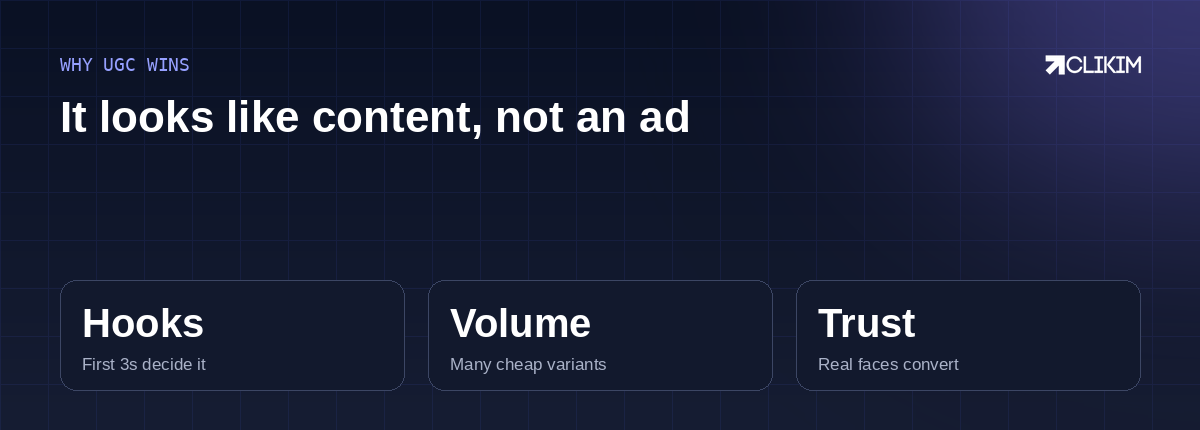
UGC's edge is volume and native feel — but it only compounds on an account stable enough to run it at scale.
Frequently asked questions
What are UGC ads?+
Why do UGC ads perform better?+
Do I need real customers to make UGC?+
What makes a good UGC hook?+
How long should UGC ads be?+
How do I brief a UGC creator?+
How many UGC variants should I test?+
How do I know if a UGC ad is working?+
Why does my UGC stop working after a while?+
Is UGC better than polished studio ads?+
How does UGC fit broad-audience targeting?+
Does a high-volume creative strategy need a special account?+
Make winning creative — and run it somewhere stable
A high-output UGC strategy needs to spend at scale without interruptions. Run on managed whitelisted infrastructure that won't throttle your testing machine. Operated on BM2500 infrastructure.