
How to Structure a Facebook Ad Account for Scale
Account structure is the unglamorous discipline that separates advertisers who scale smoothly from those who plateau in a tangle of half-working ad sets. Here's the three-level model, the modern consolidated approach, audience strategy, and how to separate testing from scaling.
Structure a Facebook account around three levels — campaign (objective), ad set (audience, budget, placement), ad (creative). Use the modern consolidated approach: broad audiences and a few well-funded ad sets, not dozens of thin ones. Separate testing (ABO) from scaling (CBO), keep retargeting in its own campaigns, and adopt a consistent naming convention. Over-segmentation starves ad sets of the data they need to learn.
• A Facebook account has three levels: campaign (objective), ad set (audience/budget/placement), ad (creative). • Modern structure is consolidated: broad audiences, fewer well-funded ad sets — not dozens of thin ones. • Separate testing (ABO) from scaling (CBO) so the two don't contaminate each other. • A consistent naming convention is the cheapest sanity you'll ever buy at scale. • Over-segmentation starves ad sets of the ~50 events/week they need to learn. • Retargeting belongs in its own campaigns, segmented by intent. • Structure can't outrun a capped account — scaling needs both clean architecture and headroom.
Why structure matters more than you think
Account structure is the unglamorous discipline that separates advertisers who scale smoothly from those who plateau in a tangle of half-working ad sets. Get it right and the account is legible: you can see what's working, feed it more, and cut what isn't without breaking anything else. Get it wrong and you end up with dozens of fragmented ad sets, none with enough data to optimise, a budget spread too thin to learn, and a dashboard so chaotic you can't tell signal from noise.
The good news is that good structure isn't complicated — it's a handful of principles applied consistently. This guide walks through the three levels, the modern consolidated approach, how to separate testing from scaling, and the naming and hygiene that keep an account manageable as it grows. Master this and most of your "why isn't this working" problems disappear before they start, because you'll be able to actually see what your account is doing.
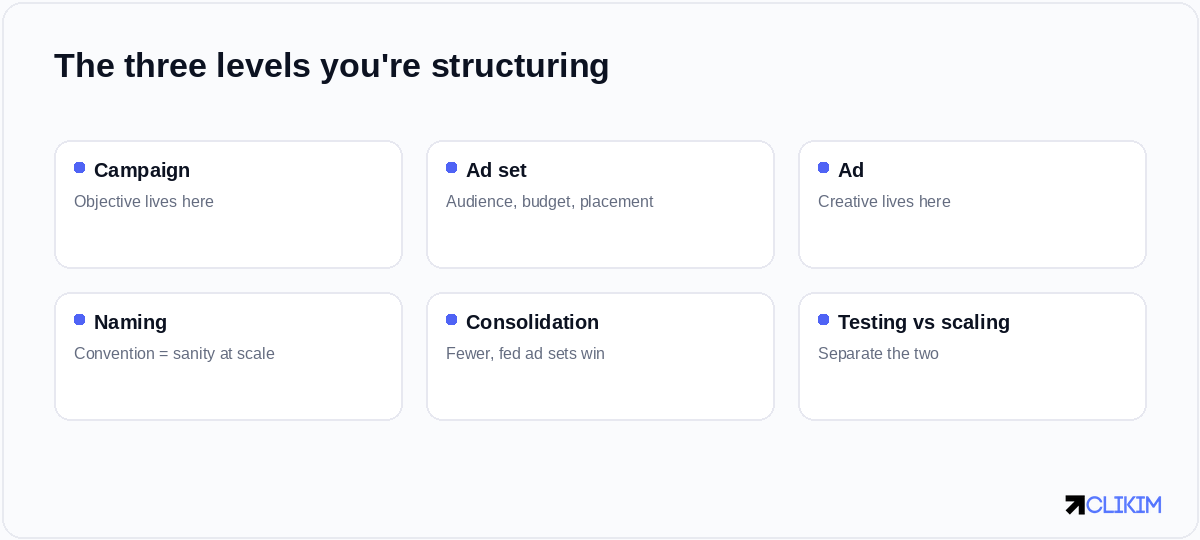
Everything you build sits at one of three levels — and most mistakes come from confusing them.
The three levels, explained
Every Facebook account is built from three nested levels, and each has exactly one job. The campaign holds your objective (sales, leads, traffic) and, if you use Campaign Budget Optimization, the budget. The ad set holds your audience, placements, schedule and — under ABO — the budget. The ad holds the creative. That's it.
Each level has one job — most structural problems come from doing a level's job at the wrong level.
Almost every structural problem comes from trying to do one level's job at the wrong level. When something's off, ask "which level owns this?" — a delivery problem is usually an ad-set issue, a creative problem is an ad issue, and a budget-allocation problem is a campaign issue. Diagnosing at the right level is half of fixing it, and it stops you from, say, blaming creative for what's really an audience problem.
Start with the right objective
Before structure comes the objective, because it shapes everything beneath it. Choosing "sales" (conversions) tells Meta to optimise for purchases and find buyers; choosing "traffic" tells it to find cheap clicks, which are often the wrong people. The single most common beginner mistake is running a traffic objective and wondering why all those cheap clicks never convert. Pick the objective that matches the action you actually want, and let the rest of the structure serve it.
For most performance advertisers that means a sales/conversions objective optimising for your key event — and that choice, in turn, has budget implications, because you need enough of that event to feed the learning phase. Objective, event and budget are a chain; get the first link wrong and the rest can't compensate.
The modern approach: consolidate
For years, the conventional wisdom was hyper-segmentation: a separate ad set for every interest, lookalike and age band, on the theory that tight targeting wins. That era is over. Meta's machine learning now does better with broad audiences and consolidated ad sets than with manual micro-targeting, because the models find your buyers across a wide net more efficiently than you can carve them out by hand.
Meta's models reward consolidation — broad audiences and fewer, better-fed ad sets beat hyper-segmentation.
The practical implication is counter-intuitive but consistent: fewer, better-fed ad sets beat many starved ones. Consolidating budget into a handful of broad ad sets gets each one to the learning threshold faster, reduces audience overlap (where your own ad sets bid against each other), and cuts the admin overhead of babysitting dozens of tiny campaigns. When in doubt, merge.
Audience strategy in 2026
Consolidation extends to how you think about audiences. The modern default is broad targeting — often just a country and age range — plus Advantage+ audience signals, letting the algorithm find buyers wherever they are. Narrow interest stacking, once the bread and butter of media buying, now mostly just raises your CPM and starves the learning phase without improving results.
That doesn't mean targeting is dead — it means the lever has moved from the audience to the creative. On broad audiences, your creative effectively does the targeting: the right hook attracts the right people. This is why creative volume and quality now matter more than audience research, a shift worth internalising if you learned media buying in the interest-stacking era.
Separate testing from scaling
One of the highest-leverage structural decisions is keeping your testing and your scaling in separate campaigns. Testing campaigns use ABO (ad-set budgets) so each new angle, audience or creative gets a fair, equal shot — you can't compare ideas if one is starved of budget. Scaling campaigns use CBO and contain only proven winners, letting Meta pour budget toward the best performers.
This separation matters because the two activities have opposite goals. Testing wants controlled, even conditions; scaling wants ruthless allocation to winners. Mixing them in one campaign means your tests get starved while an early leader hogs the budget — the worst of both worlds. Graduate winners from testing into scaling, and keep the two cleanly apart.
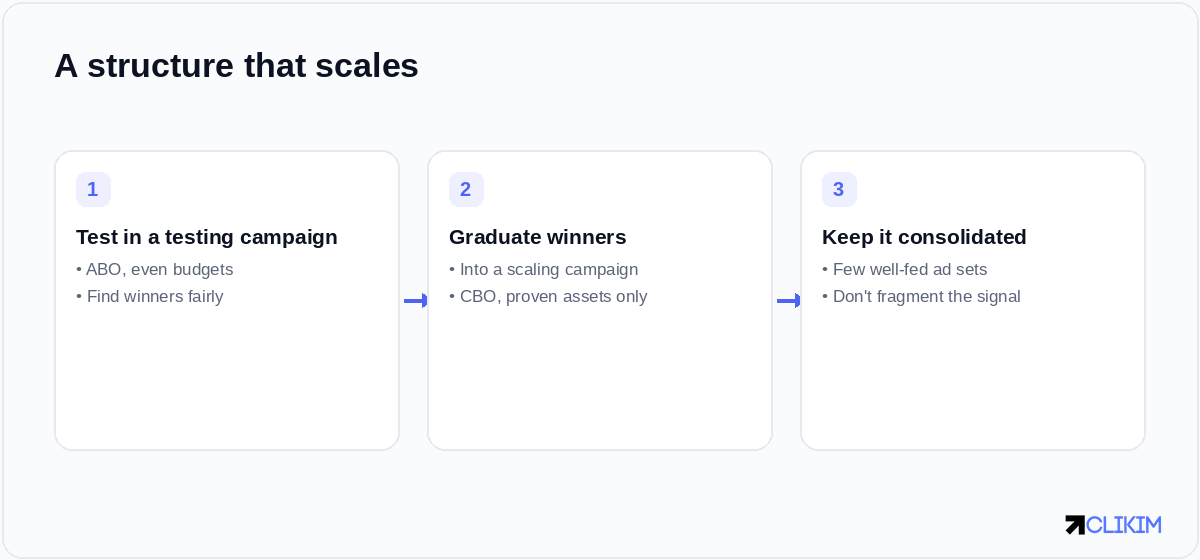
The core loop: test fairly in ABO, graduate winners into a consolidated CBO scaling campaign.
What a clean account looks like
A well-structured account is immediately readable. At a glance you can see a prospecting-testing campaign, a prospecting-scaling campaign, and one or two retargeting campaigns segmented by recency or intent — not forty near-identical ad sets with cryptic names. The structure tells a story: here's where we find new things, here's where we scale them, here's where we re-engage warm audiences.
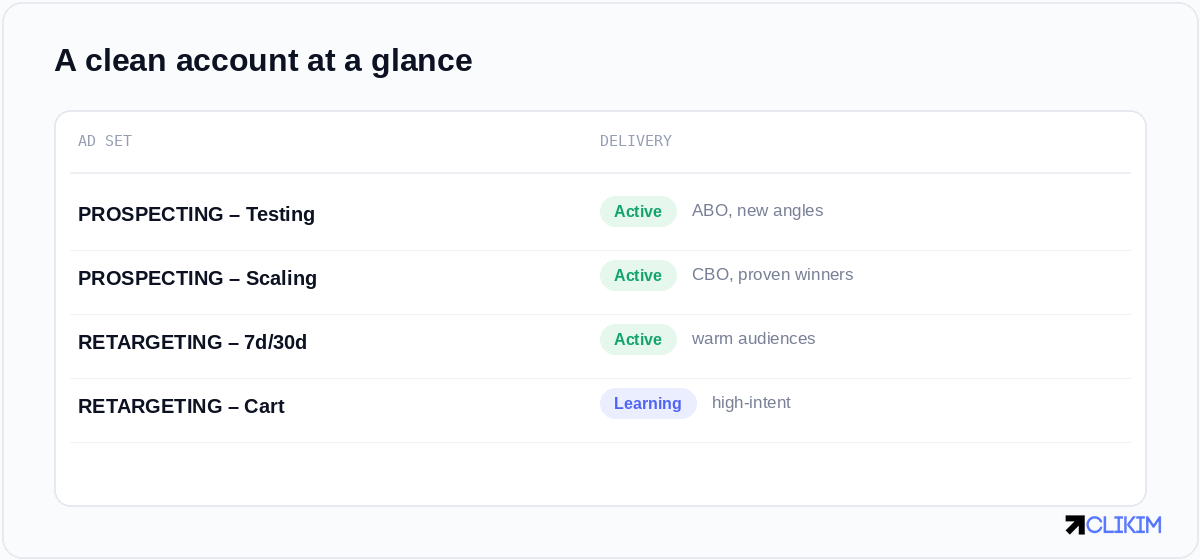
A legible account: testing, scaling and retargeting cleanly separated — not forty cryptic ad sets.
Where retargeting fits
Retargeting deserves its own campaigns, segmented by intent and recency — recent cart abandoners are a different audience from 180-day site visitors and should be treated differently. Keep these separate from prospecting so you can see and control how much you spend re-engaging warm audiences versus finding new ones.
A common structure is one prospecting stack plus a retargeting campaign with a few intent-based ad sets. Don't let retargeting's flattering ROAS fool you into over-allocating to it — it recycles existing demand and can't scale your business on its own. It's the closer, not the engine.
Naming conventions: cheap sanity
This sounds trivial and is anything but. At three ad sets, naming doesn't matter; at three hundred, a consistent convention is the difference between an account you can navigate and one you can't.
A token-based naming convention turns a chaotic account into one you can read and analyse at scale.
Adopt a simple token-based pattern and use it religiously across campaigns, ad sets and ads. Future-you, trying to find which version of which audience is winning during a busy scaling push, will be grateful — and so will anyone who inherits the account after you.
Structural hygiene as you grow
Structure isn't set-and-forget. As the account grows, prune dead ad sets rather than leaving them to clutter the view, consolidate overlapping audiences, and resist the urge to launch a new campaign for every idea — fewer, well-organised campaigns scale better than a sprawl. Avoid constant edits to live ad sets, which reset the learning phase and destabilise delivery. A tidy account is a diagnosable account, and a diagnosable account is one you can actually scale.
Where Advantage+ fits the structure
Meta's Advantage+ shopping campaigns change the structural conversation, because they deliberately collapse much of the segmentation you'd otherwise build by hand. Instead of separate prospecting and retargeting ad sets, an Advantage+ campaign blends audiences and lets Meta decide the split, with budget and creative as your main levers. For many ecommerce accounts this has become the core scaling vehicle, sitting alongside a leaner manual structure rather than replacing it entirely.
The sensible 2026 pattern is a hybrid: run Advantage+ as your primary consolidated scaling engine, and keep a small manual ABO campaign for deliberate testing of new angles before you feed the winners in. This gives you the algorithm's efficiency where it shines and human control where you still need it. The key is not to rebuild hyper-segmentation inside Advantage+ — that fights the very automation you're paying for.
Common structural mistakes
Most messy accounts share the same handful of mistakes. Over-segmentation is the big one — dozens of thin ad sets, each starved of events, none ever exiting learning. Close behind is duplicating winners into new ad sets to "scale," which fragments the signal and triggers audience overlap where your own ad sets compete in the auction. Then there's the habit of editing live, stable ad sets for minor reasons, resetting learning and reintroducing the instability you'd finally escaped.
The cure for all of them is restraint: consolidate rather than split, scale by raising budget on existing winners rather than cloning them, and leave stable ad sets alone. A boring, stable structure with a handful of well-fed campaigns will out-perform a busy, constantly-rebuilt one almost every time — and it's far easier to diagnose when something does go wrong.
Structure meets infrastructure
Here's the ceiling no amount of clever structure can break through: the account itself. You can build the most elegant testing-and-scaling architecture in the world, but on a new account capped near $250/day, your scaling campaign has nowhere to go. Structure organises spend; it can't create headroom the account doesn't have.
Serious scaling pairs clean architecture with an account that can actually absorb it — a whitelisted agency ad account with no preset cap — so your structure has room to do its job. For the safe ramp itself, see scaling without getting banned.
Frequently asked questions
How should I structure a Facebook ad account?+
What are the three levels of a Facebook campaign?+
Should I use many narrow ad sets or a few broad ones?+
What objective should I use?+
Should testing and scaling be in the same campaign?+
Is interest targeting still worth it in 2026?+
How should I structure retargeting?+
Why does a naming convention matter?+
Does over-segmenting hurt performance?+
Can good structure fix a low-spending account?+
How often should I restructure my account?+
Give your structure room to scale
A clean account still needs headroom. Run on managed whitelisted infrastructure with no preset cap, so your scaling campaign isn't throttled at $250/day. Operated on BM2500 infrastructure.