
Meta's 2026 Attribution Overhaul: Why Your Conversions "Dropped"
Two dated changes — January 12 and March 3 — shortened Meta's measurement yardstick and erased 15–40% of reported conversions in some accounts while actual sales didn't move. Here's exactly what changed, the three-way diagnosis before you touch budgets, and how to rebaseline every comparison that crosses the line.
Two dated changes rewrote Meta reporting this year. January 12 removed the 7-day-view and 28-day windows — long-consideration accounts lost 30–40% of attributed conversions overnight. March 3 made “clicks” mean link clicks only. Delivery didn’t change; the yardstick did. So rebaseline your targets — and don’t panic-cut budgets over a definition change.
JAN 12: WINDOWS REMOVED MAR 3: CLICKS REDEFINED −15–40% REPORTED DELIVERY UNCHANGED
What actually changed (and when)
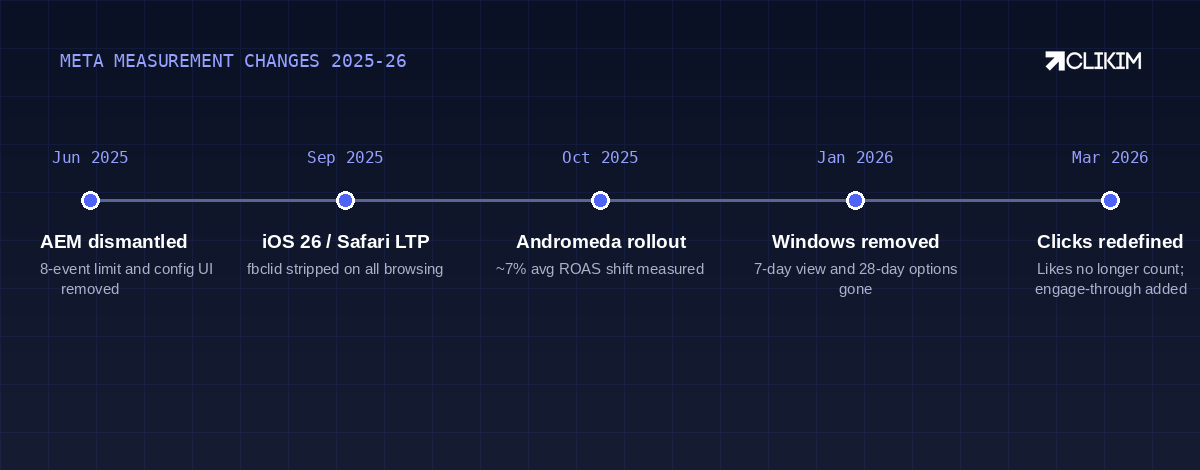
Five platform changes in ten months — the two January and March changes are the ones rewriting your reports.
Neither change touched delivery or the auction. Both changed which conversions get counted next to your spend — which is why the bank account disagrees with the panic.
The mechanics matter because they predict exactly who got hurt.
January 12 removed the long windows: a conversion that happens 12 days after a click simply stops being attributed to the ad — it still happens, still lands in Shopify, but Ads Manager no longer claims it. Accounts selling considered purchases had 30–40% of their attributed conversions living in days 8–28; their dashboards fell off a cliff while their revenue didn’t move.
March 3 then rewrote the click itself: for years, Meta counted any ad interaction — a like, a share, a save — as a “click” for click-through attribution, something most advertisers never knew until the change was announced. From March, only link clicks count; the social interactions moved into a new engage-through bucket with a 1-day window (alongside 5-second video views, down from 10).
Meta’s own documentation for the new buckets is in the Business Help Center, but the practical translation is simpler: the yardstick got shorter, twice.
Did Meta really count likes as clicks before March 2026?
Yes — for click-through attribution, any ad interaction (reactions, shares, saves) counted, which most advertisers only discovered when the change was announced. Post-March, “click” means link click, and reported click-through conversions fell accordingly — by definition, not by delivery.
Why your conversions "dropped" — the honest arithmetic
Post-January reporting removed every 8–28-day conversion from your columns. Post-March reporting removed every conversion that had been credited to a like or a share. Stack both and the reported drop runs 15–40% depending on your consideration cycle and how engagement-heavy your creative is — with zero change in actual sales.
You can verify this in your own account in ten minutes: pull the same date range in Shopify (or your CRM) and compare against the bank statement — if blended MER (total revenue ÷ total ad spend) held steady while attributed ROAS fell on a change date, you’re looking at measurement, not performance.
One more wrinkle explains a mystery that filled forums in Q1: advertisers swearing their attribution settings “reset themselves.” They didn’t hallucinate — Meta migrated settings platform-wide as the old options were retired, and campaigns using removed windows were mapped onto the new defaults. Check your ad sets’ attribution settings once, note them, and move on.
The three-way diagnosis (before you touch budgets)
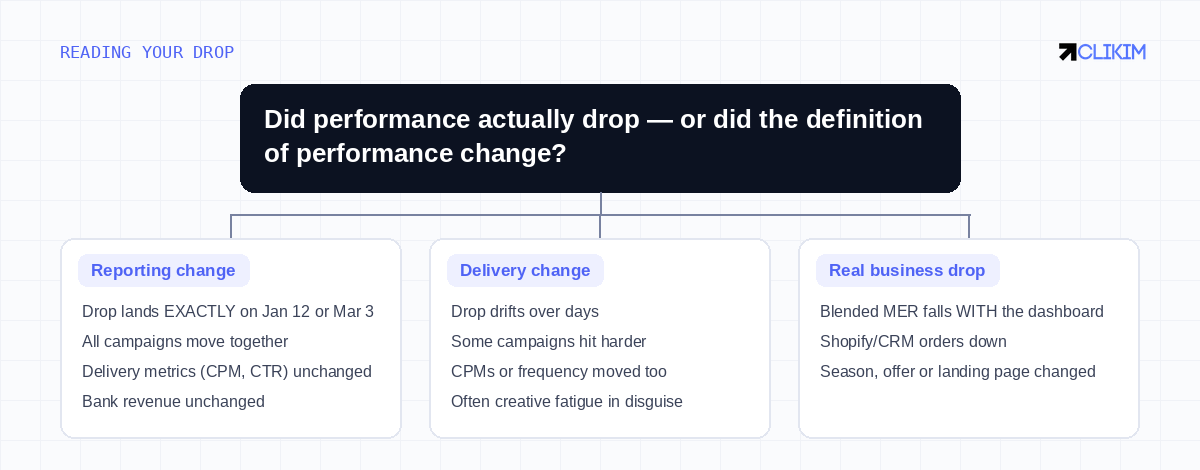
The shape of the drop tells you which case you're in — date-aligned and uniform means the yardstick moved, not the ads.
- Case one — reporting change: the drop lands exactly on January 12 or March 3, hits all campaigns proportionally, and your delivery metrics (CPM, CTR, frequency) plus your bank revenue are unmoved. Action: rebaseline (below), change nothing in the account.
- Case two — delivery change: the drop drifts across days, hits some campaigns harder than others, and CPMs or frequency moved with it — that’s ordinary account life (fatigue, auction pressure, a learning reset) wearing suspicious timing. Diagnose it with the usual toolkit.
- Case three — real business drop: MER falls with the dashboard and your store’s order count confirms it; then the problem was never attribution and the fix lives in offer, creative or season.
The Q1 forums were full of case-one accounts receiving case-two surgery — budget cuts, campaign rebuilds, learning-phase resets — which then created the case-two problem they were treating. Don’t join them.
Rebaselining: how to compare 2026 to 2025 honestly
Every year-over-year comparison that crosses January 12 is now apples-to-oranges by default. The clean method:
- In Ads Manager, use Compare Attribution Settings columns to view historical periods under 1-day and 7-day click only — that’s the nearest to the new reality the old data can get.
- Recompute your target CPA/ROAS against a post-March baseline month, not against 2025 numbers that included view-through and social-interaction credit.
- Shift the “source of truth” one level up: platform numbers for in-platform optimization decisions, blended MER for budget decisions.
- If you report to clients or a CFO, annotate the two dates in every chart that crosses them; future-you will thank present-you every quarter.
And where the 8–28-day window genuinely carried your economics — high-ticket, B2B — the honest fix isn’t mourning the lost columns; it’s feeding CRM outcomes back via the Conversions API and letting blended measurement carry the long tail.
How do I explain the drop to my boss or clients?
Annotate January 12 and March 3 on every chart that crosses them, show store revenue vs attributed revenue for the same window (flat vs fallen = measurement), and restate targets under the new yardstick. One honest slide beats a quarter of defending numbers that changed meaning.
Worked example: the same account, three yardsticks
Numbers make the rebaselining concrete. A B2B SaaS advertiser spends $30,000 in a month and books 200 trial-starts in the CRM, steady across Q4 2025 and Q1 2026.
Under 2025 reporting (7-day click + 1-day view, 28-day available in analysis), Ads Manager attributed 150 of those trials — $200 CPA against a $250 target: comfortably green.
Post-January, the 38 trials that converted in days 8–28 vanish from the columns: 112 attributed, $268 CPA — suddenly “failing” against the same target. Post-March, another 9 trials that had been credited to saves and shares move to engage-through: 103 attributed under the strict click definition, $291 CPA on the dashboard.
Same spend, same 200 real trials, same business — and a 46% “CPA increase” composed entirely of definitions. The rebaselined target for this account isn’t $250 anymore; it’s roughly $185 under the new yardstick — or better, a CRM-side cost-per-trial target of $150 that no future reporting change can touch. Every account crossing these dates needs this arithmetic done once, deliberately, before anyone reviews Q1 performance.
Engage-through: the new bucket, honestly appraised
The March change wasn’t purely subtractive — conversions credited to a like, a save, or a 5-second video view now live in the engage-through column instead of silently padding “clicks.” Treat it the way sophisticated buyers treat view-through: directional evidence, not currency.
It’s useful for comparing creative (a video whose engage-through conversions dwarf its click-throughs is stopping people without convincing them), and it’s dangerous as a performance claim (engagement-heavy audiences convert anyway — the incrementality question applies with full force). If a report leads with click+engage-through combined, someone is selling you the old inflated yardstick under a new name.
The infrastructure footnote most explainers skip
Every measurement tightening lands hardest on accounts that were already signal-poor: thin pixels, no pixel or Conversions API signal, short history, fresh containers. A trusted, warmed account with server-side events and dense conversion history gives Meta’s modeling more to work with exactly when the explicit windows shrink — which is part of why the same January change hit some accounts at 15% and others at 40%.
If your infrastructure is the fragile part — new accounts, spend ceilings, one-review-from-zero setups — that’s a fixable layer: managed whitelisted infrastructure comes with the trust and history baked in, so platform changes move your yardstick without also shaking the table it sits on.
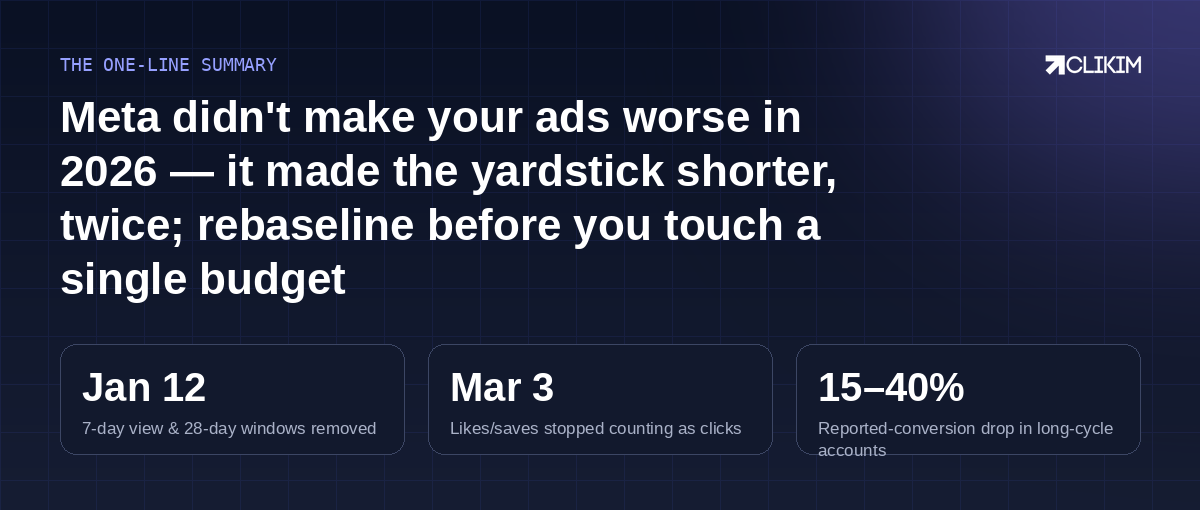
Rebaseline first, then decide — the accounts that panicked in Q1 converted a reporting change into a real one.
Frequently asked questions
Why did my Facebook conversions drop in January 2026?+
What is engage-through attribution on Meta?+
How much did reported conversions drop from these changes?+
Should I change my attribution settings after the update?+
Is 7-day click still available?+
My ROAS target was 3x — is it still valid after the changes?+
Do these changes affect how Meta optimizes delivery?+
What happened to view-through attribution?+
Is Andromeda part of these attribution changes?+
What should long-consideration businesses do about the lost 28-day window?+
Will Meta bring the longer windows back?+
Does account quality change how hard these updates hit?+
Platform changes shouldn't shake your infrastructure too
Whitelisted infrastructure with trust and history built in — so when Meta moves the yardstick, the table under it doesn't wobble.