
“My ROAS Dropped and I Changed Nothing” — The Diagnostic
You probably didn't change anything — the platform did, five times in ten months. Here's the change timeline to pin your drop against, the 20-minute audit that separates measurement from delivery from real, and the treatment for each — because the panic response caused more damage in 2025-26 than the changes themselves.
Diagnose by shape before touching anything. A cliff on a known date, hitting all campaigns, with flat CPMs and steady store revenue? Measurement change — rebaseline. A drift over weeks, uneven across campaigns, with delivery metrics moving? Performance — now go fix it. The expensive mistake is treating one as the other.
CLIFF = MEASUREMENT DRIFT = PERFORMANCE CHECK BANK REVENUE REBASELINE, DON’T REBUILD
Start with the shape, not the feeling
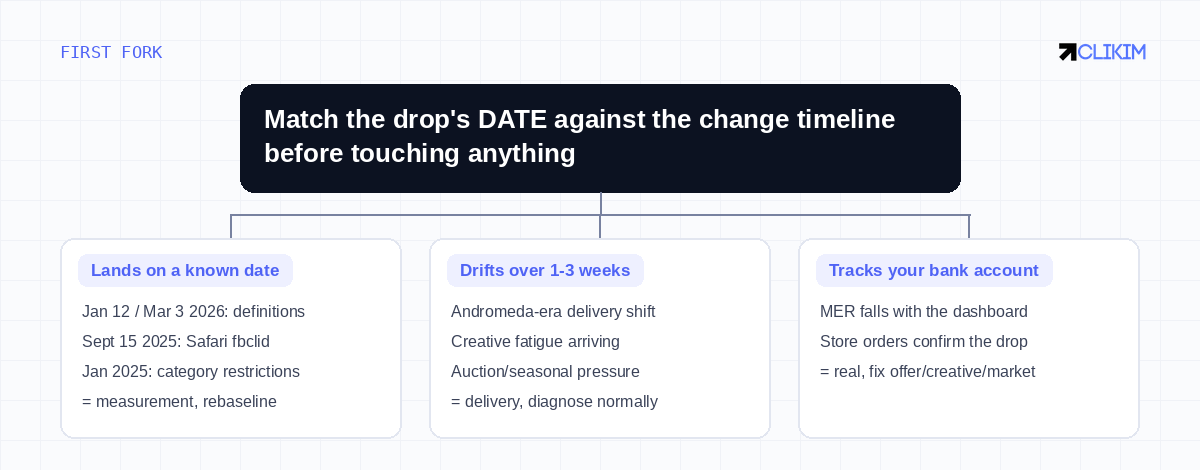
Three shapes, three completely different treatments — the date is your first and best witness.
Every week of 2025-26, some forum filled with the same post: "ROAS tanked, I changed nothing, is my account cursed?" The honest answer is that "nothing changed" stopped being possible in this era — the platform itself changed five times in ten months, and each change left a distinctive fingerprint on reports. Your job in the first twenty minutes isn't fixing anything; it's reading the fingerprint. Three shapes cover nearly every case: cliff on a known date (measurement — the definition of your numbers moved), drift over one to three weeks (delivery — the auction, your creative, or Andromeda-era ranking), and a drop your bank account can see (real — and precious time is being wasted staring at Ads Manager instead of the offer).
The change timeline (pin your drop against it)
Four of six changes moved the yardstick, not the ads. The two real delivery changes (restrictions, Andromeda) have their own signatures — category flags and creative-variety sensitivity respectively.
Details for each live in dedicated guides: the January and March 2026 definition changes (the biggest reported-number movers), the iOS 26 fbclid stripping (Safari-share dependent), the AEM cleanup (mostly cosmetic), and Andromeda — the one genuine delivery overhaul in the set. Two details worth pinning: Andromeda's measured effect (~7% average ROAS movement across thousands of ecom accounts) hides huge variance — accounts running one tired winner got hit far harder than accounts feeding creative variety, because the new ranking system explicitly rewards fresh, diverse creative pools. And the January 2025 category restrictions are the sleeper: brands flagged as health or finance lost lower-funnel events entirely — if your drop coincides with an Events Manager warning about restricted events, nothing in campaign settings will fix a policy-layer problem.
The 20-minute audit, expanded
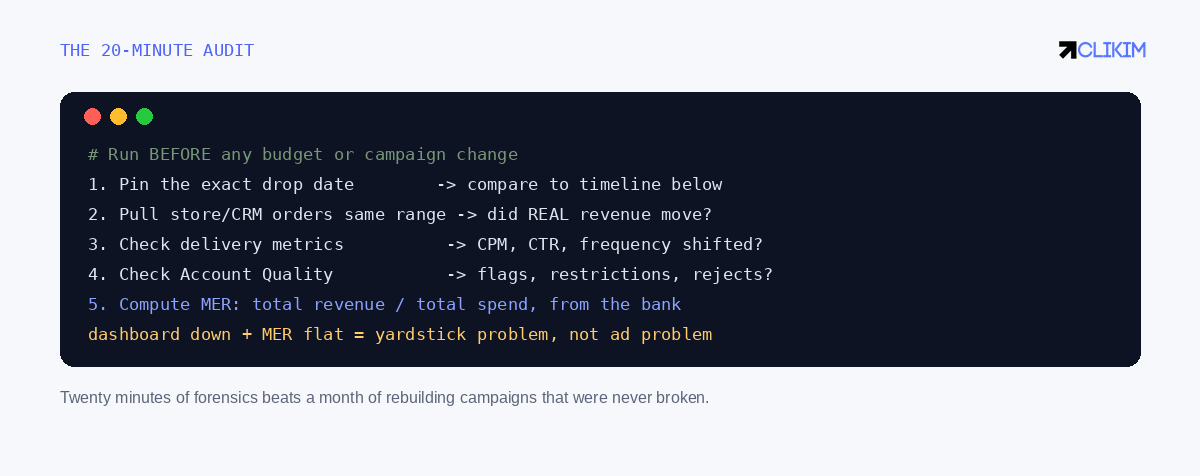
Five checks, twenty minutes, zero regret — the order matters because each step rules out a family of causes.
1. Pin the date precisely. Daily-granularity charts, account level. A one-day cliff is a definition or an enforcement event; organic decay doesn't do cliffs. 2. Pull ground truth. Same date range in Shopify/CRM and the bank: if real orders held while attributed orders fell, you've already solved the case — measurement. 3. Delivery metrics next. CPM, CTR, frequency: definitions don't move these; auctions, fatigue and Andromeda do. A reported-conversion drop with perfectly flat delivery metrics is the yardstick signature. 4. Account Quality check. Thirty seconds: flags, restricted events, rejected ads, feedback-score warnings — the policy layer explains drops that campaign analysis never will (our Account Quality guide covers every panel). 5. MER, from the bank. Total revenue over total ad spend, monthly: the one number every platform change leaves untouched. Only after all five do you earn the right to change anything — and by then you'll know exactly what kind of change is warranted.
Treatment, by diagnosis
Measurement case: rebaseline targets against post-change data, annotate the dates on every chart, brief stakeholders once — and change nothing in the account. The rebaselining method takes an afternoon. Delivery case: now the classic toolkit applies — frequency and fatigue first, then auction pressure, then structure; the relevance diagnostics guide and kill criteria are the working documents. Andromeda-specific: widen the creative pool before touching budgets — variety is the new ranking currency. Real case: leave Ads Manager alone entirely; the fix lives in offer, price, landing page, season or market, and every hour spent duplicating campaigns is an hour the actual problem compounds. The forbidden move in all three cases: panic surgery — budget slashes, mass campaign rebuilds, attribution-setting churn — which resets learning phases and converts whatever you had into a genuine delivery problem. Q1 2026's forums are a museum of accounts that did exactly this to a reporting change.
Two case files (composites, both from Q1 2026)
Case file one — the definition drop treated as a delivery drop. A supplements DTC brand, $40k/month, sees attributed ROAS fall from 2.9x to 2.1x in mid-January. The buyer reacts inside 48 hours: budgets cut 40%, two campaigns rebuilt, attribution setting switched "to test." Three learning phases reset; February delivery is genuinely worse — now CPMs are up too, because spend dropped below stable-delivery levels. Ground truth, checked later: Shopify orders in January were flat; MER never moved. The original "drop" was the January 12 window removal doing exactly what it did to everyone — this account's real Q1 damage was 100% self-inflicted, and recovery took five weeks. The 20-minute audit would have cost twenty minutes.
Case file two — the delivery drop hiding behind the definition excuse. An apparel brand sees ROAS slide 20% through late February and — having read about the January changes — annotates it as measurement and moves on. But the shape was wrong: the slide drifted over two weeks, CPMs rose 18%, frequency crossed 3.2, and MER fell right along with the dashboard. This was textbook creative fatigue on an Andromeda-sensitized account running one eight-week-old winner. A five-asset refresh in March recovered it inside ten days. The lesson cuts both ways: "it's just the platform changes" is as expensive a misdiagnosis as panic surgery — the shape, not the vibe, decides.
Making the next one boring
Accounts that sailed through 2025-26 shared three habits: a dated platform changelog kept next to reporting (every chart crossing a change date gets an annotation — five minutes a quarter); dual-track measurement — platform numbers for in-platform decisions, blended MER for money decisions, so no single yardstick change can panic anyone; and infrastructure that absorbs shocks — dense first-party signal (CAPI with real match keys) that keeps modeling steady through browser-policy changes, and account foundations that aren't one review away from zero. That last one is the quiet variable: a measurement scare on a fragile, capped, single-account setup triggers desperate moves; the same scare on warmed, replaceable infrastructure with a backup structure is a Tuesday. You can't control Meta's changelog — you control whether your operation reads it calmly.
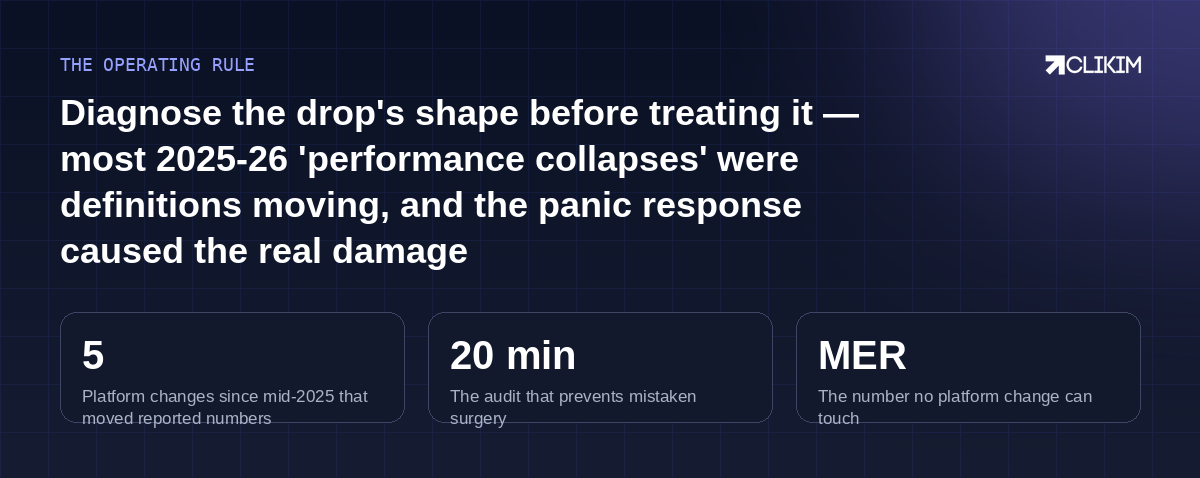
Date, ground truth, delivery metrics, policy layer, MER — twenty minutes of order beats a quarter of panic.
Frequently asked questions
Why did my Facebook ROAS drop overnight with no changes on my end?+
What was Andromeda and did it hurt my account?+
How do I tell a measurement drop from a real performance drop?+
What's the 20-minute audit exactly?+
My CPMs and CTR are flat but conversions fell — what does that mean?+
Should I pause or cut budgets while I investigate?+
Could a policy flag cause a sudden drop without a ban?+
How do I know if Andromeda specifically hit me?+
What is MER and why does every guide keep invoking it?+
My agency says 'iOS killed tracking' — is that still the story in 2026?+
How should I report a definition-change drop to a client or CFO?+
Does creative fatigue still explain drops in this era?+
What changelog should I actually keep?+
Does account infrastructure change how these shocks land?+
Is there a fast way to check whether OTHER advertisers saw the same drop?+
Shocks happen — wobbling is optional
Whitelisted infrastructure with history, headroom and replacement cover: platform changes become annotations, not emergencies.