
When to Kill a Facebook Ad (and When You're Just Impatient)
More money dies to impatient killing than to bad creative. Here are the pre-committed rules: spend gates before any verdict, the top-down funnel read that finds where an ad fails, and the three verdicts — kill, iterate, keep — that replace gut feelings.
Give every ad a spend gate of 1–3× your target CPA and 48–72 hours — and never judge mid-learning-phase — before any verdict. Then read the funnel top-down: low hook rate → kill or re-hook; good hook but low CTR → iterate the close; good CTR but no conversions → fix the landing page, not the ad. Use three verdicts (kill, iterate, keep), pre-commit the rules before launch, log every kill, and leave steady winners untouched.
• Give every ad a spend gate of 1–3× target CPA and 48–72h before any verdict. • Never judge mid-learning phase — early costs are noise by design. • Read the funnel top-down: hook rate → CTR → CVR. Where it fails decides what dies. • Good CTR + no sales = landing-page problem. Don't shoot the ad for the page's crime. • Three verdicts, not two: kill, iterate, or keep — partial winners get surgery, not funerals. • Pre-commit kill criteria before launching; decide with rules, not moods. • Impatience is the expensive habit: killing at $15 spend on a $30 CPA target is coin-flipping.
The most expensive habit in media buying
More money is lost to impatient killing than to bad creative. The pattern is universal: launch Monday, panic Tuesday at $20 spend and no sales, kill everything, launch new ads Wednesday, repeat. The account never accumulates learning, no test ever concludes, and — statistically — several of those "failures" were winners executed before their data arrived. At a $30 target CPA, an ad with a true 100%-of-target performance still shows zero conversions after $20 of spend about half the time. Killing there isn't decisiveness; it's flipping coins and paying for the privilege.
The opposite failure is rarer but real: riding an obvious loser to $400 because "it might turn around". It won't — not without a reason. What separates professionals from panickers isn't intuition; it's pre-committed rules: gates an ad must clear before earning any verdict, and a diagnostic order that decides which verdict it gets. This guide is those rules.
Step 1 — Has the ad earned a verdict yet?
An ad hasn't earned a verdict until it clears the gates — before that, killing is coin-flipping.
The spend gate does the heavy lifting. 1× target CPA is the earliest defensible check-in — an ad that spent one full CPA with nothing to show is behind, but only at 2–3× with zero results is "this doesn't work" statistically fair. Pair it with time (a 48–72h cycle catches attribution lag and day-of-week effects) and the learning phase caveat: costs during learning run high and choppy by design, so a verdict passed mid-learning is a verdict on noise.
Write your gates down before launching — "each ad gets $75 or 3 days, whichever comes second" — and enforce them mechanically inside your ABO testing campaign, where fixed budgets make the gates comparable across every cell. Rules made in advance are cheap; decisions made at 11pm staring at a red dashboard are not.
Step 2 — Read the funnel top-down
Once an ad clears its gates, don't ask "is it working?" — ask "where does it fail?" Every ad is a chain: stop the scroll (hook rate: 3-second views ÷ impressions), earn the click (CTR), convert the click (CVR on your page). Reading the chain in order turns a vague disappointment into a specific diagnosis, and the diagnosis decides the verdict.
Where the funnel fails tells you what to kill: the ad, one element of it, or something that isn't the ad at all.
Two rows deserve emphasis. Good hook, weak CTR is not a dead ad — it's a working attention asset with a broken close; new copy or CTA on the same video is a ten-minute fix that regularly rescues "failures". And good CTR with no conversions means the ad already did its job: the click happened, interest was real, and the leak is your page speed, message match or offer — the diagnosis chain in our creative playbook and CVR benchmarks. Killing the ad there just hides the evidence.
Step 3 — Kill, iterate, or keep (three verdicts, not two)
The binary keep/kill frame wastes the most valuable output of testing: partial winners. An ad with a 32% hook rate and weak everything else has already solved the hardest problem in Facebook advertising — attention. Its verdict is surgery: keep the first three seconds, rebuild the pitch. An ad with strong CTR and marginal CPA gets a landing-page test before any funeral. Reserve the actual kill for concept-level misses: every stage weak, gates fully cleared, nothing worth salvaging.
And when you kill, log the learning. "Price-led hook died at 12% hook rate; problem-led hook hit 29%" is a sentence that makes every future creative brief smarter. Accounts that keep a kill log stop re-testing the same dead angles every quarter — the compounding advantage nobody sees in the dashboard.
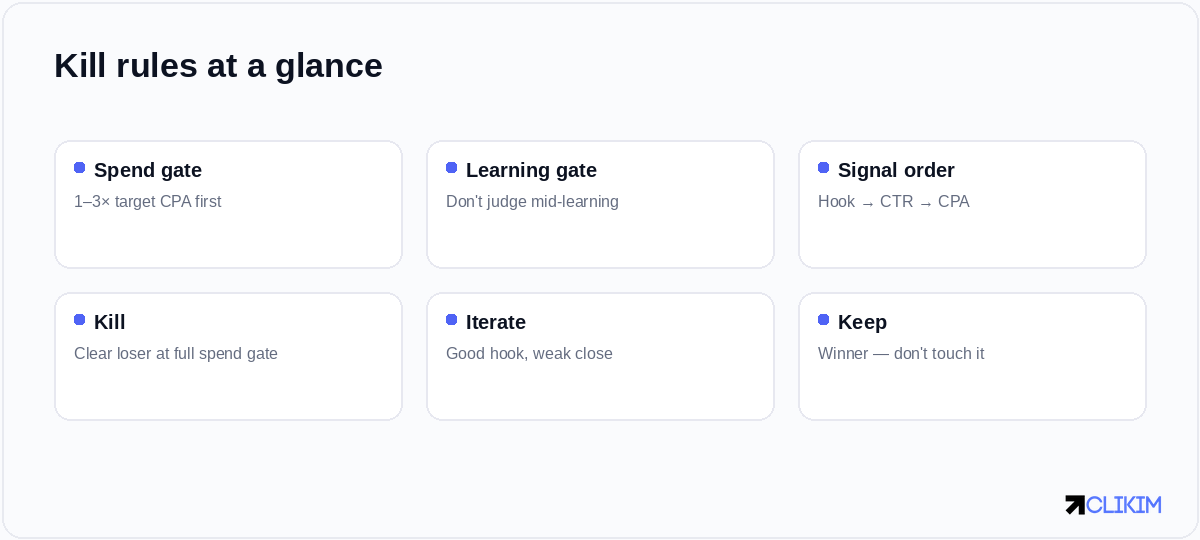
Gates first, funnel second, then one of three verdicts — the whole discipline on one card.
The hardest rule: leave winners alone
Kill discipline has a mirror image: keep discipline. The same impatience that executes ads early also can't resist "improving" winners — a budget nudge here, a copy tweak there — and every significant edit risks resetting learning and destabilising the thing that was working. A steady 2.4× ROAS ad is not an invitation to fiddle; it's an instruction to feed it via the proper scaling mechanics and otherwise keep your hands in your pockets.
Watch winners for decay, not perfection: rising frequency, softening hook rate, creeping CPA over a 7-day window. Those are the signals a winner is aging — the cue to have its successor already tested and ready, not to perform emergency surgery on the incumbent.
Context adjusts the gates
Context sets the gates: new signal environments deserve more patience, proven elements less.
The table's logic is signal quality. A fresh account with a cold pixel produces noisier early data, so verdicts need bigger samples — double the gates and be genuinely patient (and fix tracking first, or you're judging ads on undercounted results). Meanwhile a proven video meeting a new audience carries retired creative risk; if it hasn't moved by 1.5× CPA, the mismatch is usually real. Volatile seasons deserve looser cost tolerance — a 20% CPA spike in late November is the auction, not your ad.
Killing inside CBO: mostly, don't
Everything above assumes your testing lives in ABO, where budgets are fixed and verdicts are yours. Inside a CBO scaling campaign the calculus changes: the algorithm already deprioritises weak ads by starving them, which is a soft kill with none of your effort. Manually deleting a low-spend ad in CBO rarely helps and occasionally hurts — it removes an option the system was keeping for specific auctions and can nudge the campaign back into learning.
In CBO, judge the campaign, prune only genuinely dead weight (weeks of near-zero spend), and do your real killing where it belongs — in testing, before anything graduates. The clean pipeline is: strict gates in ABO, only winners promoted, gentle pruning in CBO.
The psychology tax (and how to stop paying it)
Every early kill has the same anatomy: a red number triggers loss-aversion, the buyer converts anxiety into action, and the action feels like management. It isn't — it's paying a psychology tax with the ad account. The antidote is boring and works: decide before you spend. Written gates transform Tuesday's panic into a non-event ("it hasn't reached $60 yet — no verdict") and turn Friday's review into arithmetic instead of mood.
Two habits reinforce it. Check testing campaigns on a schedule (once daily, same hour), not compulsively — intraday data is the most misleading data Facebook produces. And phrase verdicts out loud in gate terms: "cleared 2.5× CPA with a 9% hook rate — kill" survives scrutiny; "it feels dead" doesn't. Teams that adopt the phrasing discover half their historical kills wouldn't have passed the sentence test.
The one-screen version
Before launch: write the gates (spend = 1–3× target CPA, 48–72h, past learning) and the funnel thresholds you'll accept. At the gate: read hook rate → CTR → CVR, in that order, against your own baselines. Verdict: kill concept-misses, iterate partial winners (new hook or new close, one variable at a time), keep and feed proven ads without touching them. Always: log what died and why.
Run that loop weekly inside the routine from our optimization checklist and killing stops being an emotional event — it becomes the boring, profitable maintenance it should be.
Patience needs an account that allows it
One structural note: kill discipline assumes your account gives ads room to clear their gates. On a fresh account pinned by the $250/day cap, five test ads can't each get $75 of honest spend alongside your existing campaigns — so buyers on capped accounts systematically under-fund tests and then kill on garbage data. Restrictions make it worse: every interruption resets learning and invalidates in-flight verdicts.
A stable, uncapped agency ad account is what makes patient, gate-driven testing affordable in the first place — enough headroom to run real tests at real budgets, and no resets wiping out the evidence mid-verdict.
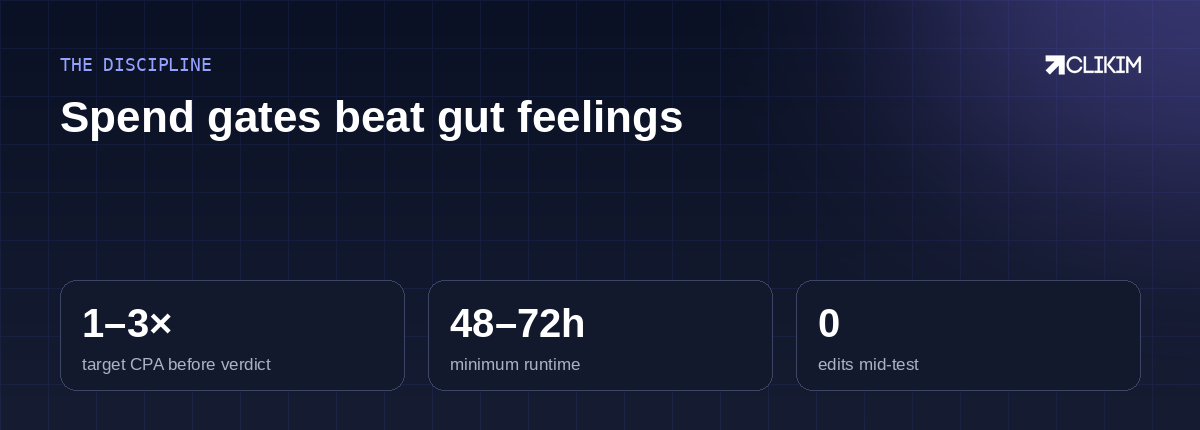
Gates, funnel, verdict — decided before launch, executed without mood.
Frequently asked questions
How long should I run a Facebook ad before judging it?+
How much should I spend before killing a Facebook ad?+
Should I kill an ad during the learning phase?+
My ad gets clicks but no sales — should I kill it?+
What is a good hook rate on Facebook?+
What's the difference between killing and iterating an ad?+
Should I delete underperforming ads inside a CBO campaign?+
Why shouldn't I edit a winning ad?+
How do I know a winning ad is starting to die?+
Do kill rules change on a new ad account?+
Should I kill ads faster in Q4?+
What should I record when I kill an ad?+
Test with patience, kill with rules
Gate-driven testing needs headroom — managed whitelisted infrastructure with no preset cap gives every ad room to earn its verdict. Operated on BM2500 infrastructure.