
Does Meta Steal Credit From Your Email and Organic?
The 'credit bandit' debate, settled with published lift-test numbers instead of thread vibes: retargeting over-claims 40–70%, view-through is the weakest slice, ~38% of default-attribution purchases test non-incremental — and meanwhile Google quietly books the branded-search demand Meta creates. Both thefts are real. Here's the evidence, and three tests to run on your own account.

Yes and no — with numbers: Meta over-claims warm-audience credit, and is under-credited for the demand it creates.
Yes: lift tests consistently find retargeting incremental ROAS 40–70% below reported, with ~60% of claimed retargeting conversions non-incremental — and one large 2025 analysis put 37.7% of purchases attributed under default settings as non-incremental. The over-claiming concentrates in warm audiences and view-through.
No: Meta measurably creates branded-search and direct demand that Google/GA4 book — credit theft runs both directions.
Test yours: ghost-audit view-through share (1 hour), pause one retargeting slice for 2–3 weeks and watch total orders, then Meta’s Incremental Attribution or lift studies. Posture: cap retargeting at 5–15% frequency-capped, grade warm channels on new customers, reinvest in prospecting.
- Yes — Meta over-claims warm-audience credit: lift tests repeatedly find retargeting iROAS 40–70% below reported, and one large analysis found ~38% of default-attribution purchases weren’t incremental.
- Also yes — Meta is under-credited elsewhere: it demonstrably creates branded-search and direct demand that Google and GA4 book. The theft runs both directions.
- The over-claiming concentrates in retargeting and view-through; cold prospecting survives testing far better.
- Don’t argue — test: ghost-audit (1 hour) → pause test (2–3 weeks) → real holdout via Meta’s Incremental Attribution or lift studies.
- Practical budget posture: cap retargeting spend/frequency, grade warm channels on new-customer volume, and judge total spend on MER.
- Email vs Meta retargeting is mostly two channels claiming the same warm fish — dedupe the credit before crediting either.
The accusation, stated fairly
The X-thread version: “Meta is a credit bandit — it tags everyone my email was already going to convert, fires a view-through claim when they buy, and my dashboard calls it 8x ROAS.”
The defense’s version: “GA4 says Meta barely converts, yet every time we cut spend, branded search and ‘direct’ revenue sag within two weeks.”
Both camps are describing real mechanics. This guide puts numbers on each, because the published lift-testing record is far more specific than the vibes. Aggregated experiments — hundreds of them, run by incrementality platforms and Meta’s own lift tooling — consistently find:
- Retargeting incremental ROAS 40–70% below its reported figure.
- Roughly 60% of claimed retargeting conversions non-incremental in typical tests.
- One widely-cited 2025 analysis: 37.7% of purchases attributed under default attribution settings (7-day click + 1-day view) were non-incremental overall.
The same record shows cold prospecting surviving tests far better — and Meta ads measurably lifting branded-search volume that Google then books as its own conversion. Credit theft is real. It’s also mutual.
Does Meta really drive branded search Google gets credit for?
Measurably: scaled Meta campaigns lift branded-search volume and “direct” traffic within days, and cuts show the reverse within weeks — a halo GA4 hands to Google and organic. Any honest credit accounting adds a slice back for Meta.
Where the over-claiming concentrates
The consistent pattern across published tests: prospecting under-appreciated, retargeting over-credited, view-through weakest, branded-search halo uncounted. Argue with the magnitudes, not the direction.
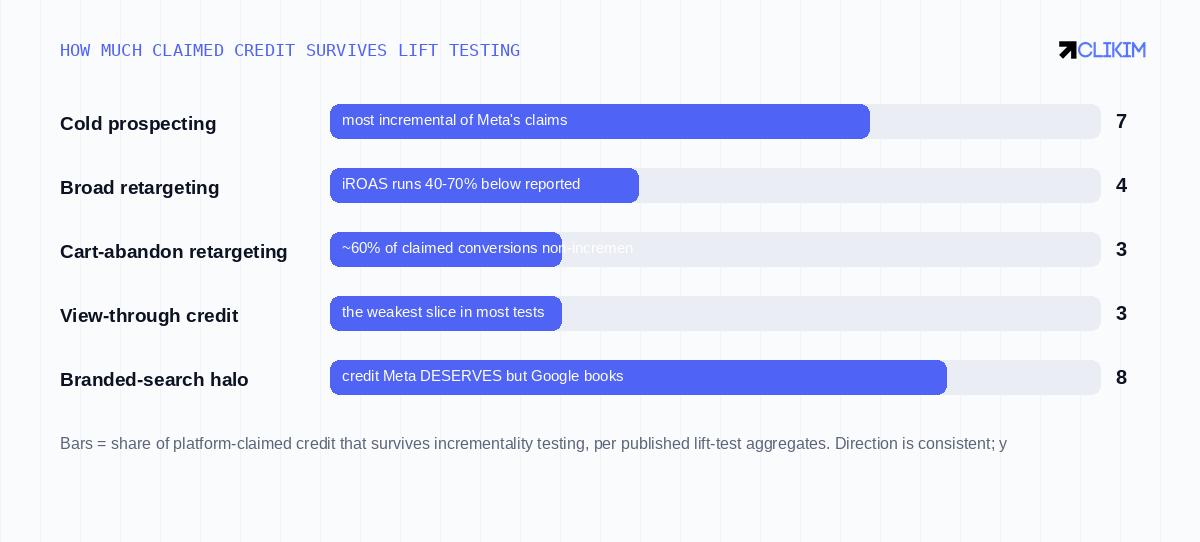
Published lift-test aggregates, summarized — prospecting earns most of its claim; warm-audience credit shrinks under testing everywhere.
Why the machine over-claims warm audiences (no villainy required)
Attribution rewards presence at conversions, and nothing is more reliably present than an ad following people who were already going to buy. Retargeting pools are built FROM intent — cart abandoners, recent visitors, engaged followers — so ads shown there collect credit at spectacular rates whether or not they changed anyone’s mind.
View-through stretches the same logic to a glance. And your email list is the same warm pool wearing a different channel’s name, which is why email marketers and media buyers each sincerely believe the other is stealing: both channels fish where the fish already are, and both count the catch.
None of this requires Meta to cheat; the measurement design does the flattering automatically. It’s also why the 2026 removal of 7-day view made dashboards more honest by subtraction — the weakest credit slice got smaller.
So is my email program stealing Meta’s conversions, or vice versa?
Both, structurally: retargeting audiences and email lists are the same warm pool, and each channel claims the catch under its own attribution. The clean referee is new-to-business customer volume per channel — the one number warm harvesting can’t fake.
Test it in your own account (three rungs)
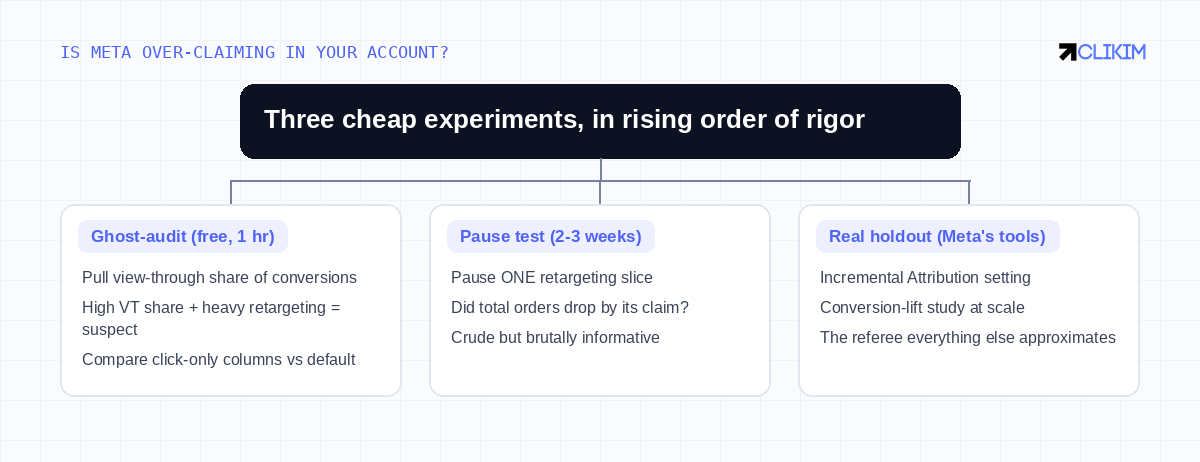
An hour of column work, a fortnight of nerve, or a real holdout — each rung buys another level of certainty.
Rung one — the ghost-audit (free, today)
In Ads Manager, add the click-only comparison columns and pull view-through’s share of claimed conversions per campaign. A retargeting campaign whose credit is heavily view-through, at frequency 8+, aimed at last-7-day visitors, is presumptively harvesting.
Rung two — the pause test (2–3 weeks)
Pause one retargeting slice (say, 0–7-day site visitors) and watch total business orders, not platform numbers. If the campaign claimed 120 monthly conversions and total orders drop by 30, you’ve just priced its real contribution — crude, confounded by seasonality, and still the most clarifying $0 experiment in paid social.
Rung three — real holdouts
Meta’s own Incremental Attribution reporting setting (shipped April 2025) re-scores campaigns against modeled holdouts, and formal conversion-lift studies remain the gold standard at scale. A full walkthrough of holdout design and Meta’s lift tooling is coming later this summer in our incrementality deep-dive.
Worked example: pricing a "5.4x" retargeting campaign
A DTC skincare brand runs an always-on retargeting campaign — 0–14-day site visitors, $4,500/month, dashboard ROAS a heroic 5.4x ($24,300 claimed).
The ghost-audit finds 41% of its credit is view-through and average frequency is 9.1: presumptively harvesting. The pause test follows: three weeks dark, everything else steady. Total store orders drop by $6,800/month versus baseline — not the $24,300 the dashboard implied. Real contribution: roughly 1.5x incremental ROAS, hiding inside a 5.4x costume — squarely inside the 40–70% overstatement band the published tests predict.
The response wasn’t killing the campaign: it was right-sizing it to $1,500/month with a frequency cap of 3/week — keeping most of the incremental $6,800 at a third of the cost — and moving $3,000/month into prospecting, which the same month’s numbers showed converting new customers at breakeven that compound into next quarter’s warm pool.
Dashboard ROAS fell. Contribution profit rose. That trade, run honestly, is this entire debate resolved in one account.
The budget posture that follows
What the evidence supports, translated into settings:
- Keep retargeting, shrink its ego — a modest always-on slice (5–15% of spend, frequency-capped) captures the genuinely incremental warm conversions without paying 8x-dashboard prices for recycled intent.
- Grade every warm channel — retargeting AND email — on new-to-business customers, the one metric neither can harvest.
- Report click-only for reconciliations, letting view-through inform creative analysis only.
- Re-invest the recovered budget in prospecting, where lift tests say Meta’s claims are most honest — and where your clean-signal setup feeds delivery the truthiest data.
And when someone in the channel-credit war invokes GA4 as the final judge, route them through the three-job framework — because the honest answer to “does Meta steal credit?” is: from your email program, somewhat; from your prospecting line, no; and Google steals Meta’s branded-search halo every single day.
Budget accordingly — and expect the reallocation to feel wrong for a month. Dashboards celebrate harvest and undercount discovery, so the account will LOOK worse precisely while its contribution profit and new-customer volume improve. That lag between honest numbers and comfortable ones is where most operators lose their nerve; the ones who hold it own next quarter’s warm pool outright.
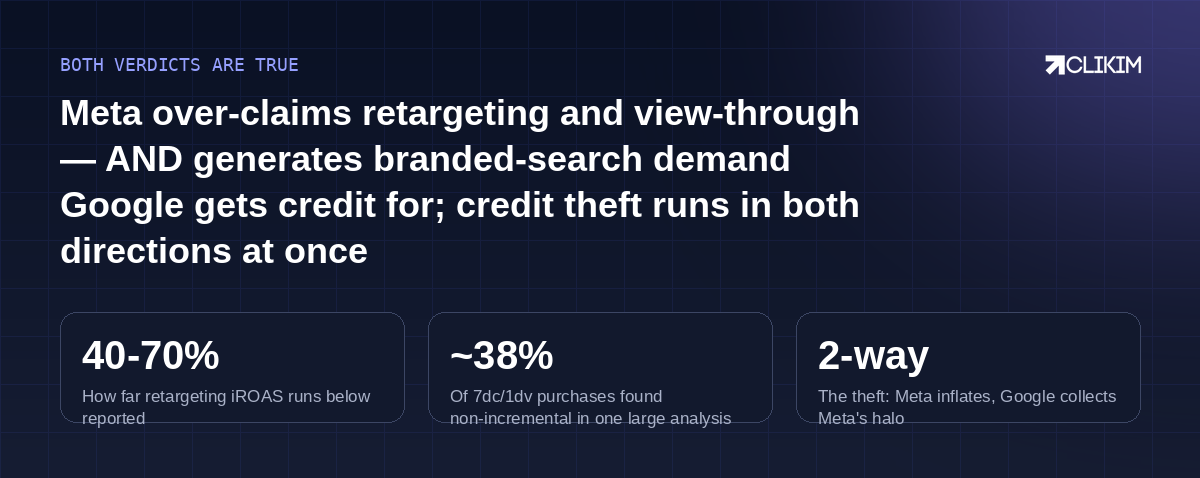
Over-claimed AND under-credited — the mature posture caps the harvest, funds the discovery, and lets tests settle what threads can't.
Frequently asked questions
Is Facebook retargeting ROAS fake or inflated?+
What share of Meta's attributed conversions are actually incremental?+
Does view-through attribution mean anything at all?+
How do I run the pause test without wrecking performance?+
What is Meta's Incremental Attribution setting?+
Should I just kill retargeting entirely?+
Why did my retargeting look worse after the 2026 attribution changes?+
What frequency cap keeps retargeting honest?+
Can attribution tools (Northbeam etc.) settle the credit war?+
How does this affect how I judge creative?+
What's the single most damning stat for over-attribution?+
What should agencies tell clients about this?+
Do these findings apply to TikTok and Google retargeting too?+
How often should I re-run the pause test?+
Fund discovery, not just harvest
Uncapped, whitelisted infrastructure — headroom for the prospecting that lift tests keep vindicating.