
Meta Ads vs GA4: Which Number Do You Trust?
Ads Manager says 240, GA4 says 71, and the monthly argument writes itself. Both are 'right' under their own rules — Meta over-claims by design, GA4 undercounts by design. Here's the three-job framework that ends the debate, the GA4 leaks worth fixing first, and a full worked reconciliation.
Stop electing a winner — route each decision to the tool whose bias can’t hurt it. Creative and audience calls: Ads Manager, because its inflation is constant across your ads. Channel budget splits: GA4 plus a survey, because platforms shouldn’t grade their own homework. Overall health: MER. The dashboards disagree because they measure different things.
CREATIVE → ADS MANAGER BUDGETS → GA4 + SURVEY HEALTH → MER BOTH ARE “RIGHT”
The gap, quantified honestly
Every operator meets this moment: Ads Manager reports 240 conversions for the month; GA4 credits Meta with 71. Someone concludes Meta is lying, someone else that GA4 is broken, and a third person is already screenshotting for Reddit.
The boring truth: on typical accounts, Meta reports ~26% above neutral third-party baselines (view-through credit, self-graded windows, generous iOS modeling), while GA4 undercounts paid social by 18–35% (consent rejections, Safari’s cookie caps, ad blockers, and Meta’s in-app browser dropping referrers so sessions land in direct or unassigned).
Add the date-logic mismatch — Meta books conversions on the click’s date, GA4 on the purchase’s — and day-level comparison is dead on arrival. The seven structural causes:
Which is more accurate, Meta or GA4?
Neither owns “accurate” — they answer different questions under different rules. Meta is the better instrument for comparing YOUR ads against each other (constant bias); GA4 is the better single referee ACROSS channels (consistent undercounting); the bank statement outranks both for money decisions.
Seven structural reasons the numbers were never going to match. None of them is a bug; all of them are decisions each vendor made about whose question to answer.
The decision framework (the part every causes-list skips)
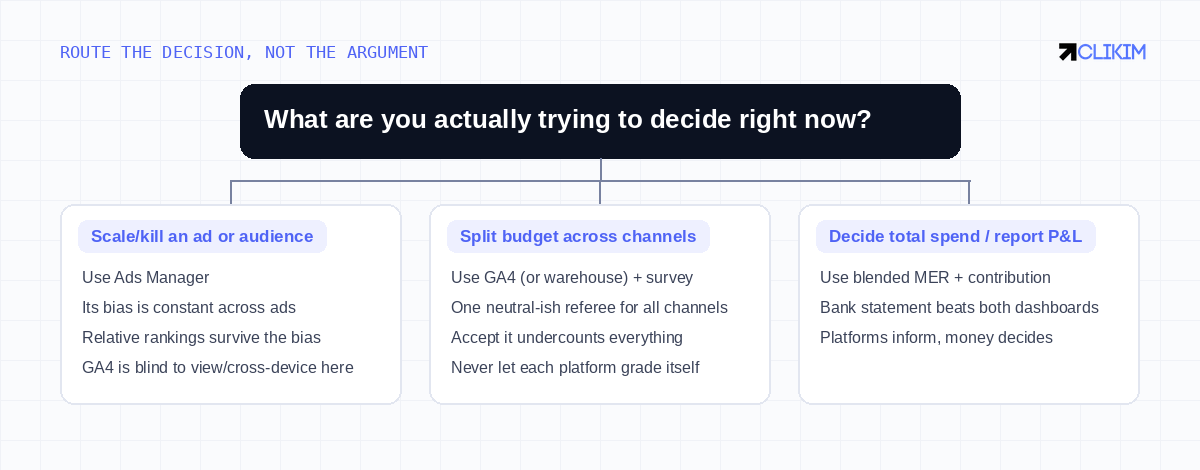
Route the DECISION to the instrument whose bias can't poison it — the argument about 'which is right' never needs to happen.
Job one — scale/kill decisions inside Meta: use Ads Manager
Its inflation is roughly constant across your ads, so relative rankings are honest even when absolute numbers flatter: the ad showing 2x the ROAS of its sibling really is stronger, whatever the true multiplier. GA4 is the wrong referee here — it’s blind to view-through and cross-device journeys, precisely the things that differ between your ads the least.
Job two — channel allocation: one neutral referee
Never let each platform grade itself (they’ll happily sum to 300% of your revenue). One neutral-ish referee — GA4 or your warehouse — applied equally to all channels, cross-examined by a post-purchase survey or attribution tool at scale. Accept the referee undercounts everyone; consistency, not accuracy, is what allocation needs.
Job three — total-spend and P&L decisions: the bank
Blended MER and contribution margin, from the bank. Neither dashboard votes here. Write the three jobs down, share them with whoever keeps reopening the debate, and the monthly argument becomes a quarterly reconciliation.
Should I cut Meta spend if GA4 shows it barely converts?
That’s the classic five-figure mistake — GA4 structurally cannot see much of Meta’s contribution (view-through, cross-device, blocked traffic, lost referrers). Before any verdict: fix UTMs and consent mode, check the post-purchase survey, and compare MER with Meta on vs. scaled-down. Many “GA4 proved it” cuts un-prove themselves expensively.
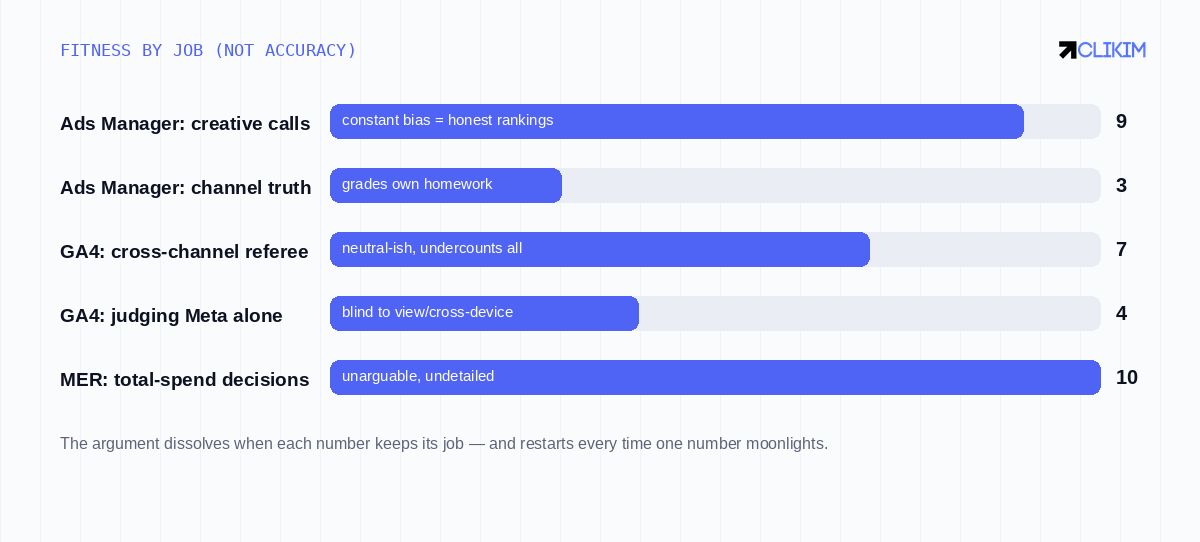
Score the instruments by job and the 'which is right' fight dissolves — each is excellent somewhere and indefensible somewhere else.
Before judging Meta in GA4: fix the leaks
A chunk of the gap is repairable, and repairing it changes verdicts:
- UTMs on every ad — dynamic parameters, correctly placed, with utm_medium values GA4’s channel grouping recognizes as paid — reclassify traffic that otherwise lands in the wrong bucket (GA4’s channel-grouping rules are strict and case-sensitive).
- The in-app browser handoff silently strips referrers when users bounce from Meta’s webview to their real browser; UTMs survive where referrers don’t, which is most of the cure.
- Consent-mode configuration decides whether GA4 models consent-rejected conversions or drops them entirely — EU-heavy accounts see wildly different Meta credit depending on this one setting.
Run these three fixes and GA4’s Meta number typically rises 20–40% — same ads, better witness. The remaining gap is structural (view-through, cross-device, date logic) and permanent: annotate it once instead of re-investigating it monthly.
Installing the framework on a team (the political part)
The technical framework fails without the organizational half, because the Meta-vs-GA4 fight is usually a proxy war: the media buyer’s bonus reads Ads Manager, the analyst’s dashboard reads GA4, and the founder reads whichever number was screenshotted last. Three installs make it stick:
- Assign the jobs in writing — one page, three lines, pinned wherever reporting lives: creative decisions cite Ads Manager, channel decisions cite the referee, money decisions cite MER. Any argument that starts must first name which job it’s about.
- Build the reporting template around the jobs, not the tools — a monthly sheet with three sections makes it structurally impossible to compare the numbers head-to-head, which is where every fight starts.
- Schedule the reconciliation quarterly and ban it otherwise: the worked-month exercise below takes one afternoon, produces the annotation everyone cites for three months, and its absence is why teams re-litigate the same 240-vs-71 mystery every four weeks.
Teams that install all three report the strangest outcome of all: the debate simply stops occurring, and the hours go back into creative and offers — the places where numbers actually get made.
Worked month: 240 vs 71, reconciled
The composite from the intro, dissected. Ads Manager: 240 purchases. GA4: 71 credited to paid social.
Step one — leak repair: a UTM audit finds 30% of active ads carrying no parameters (a relaunch had skipped them); after fixing, GA4’s next-month Meta credit rises to 104.
Step two — definitional accounting: click-date vs purchase-date shifts ~9 conversions across month boundaries; view-through and engage-through explain ~70 of Meta’s claim (visible in its own attribution columns); cross-device journeys GA4 can’t stitch account for an estimated 25–35 more (the identity-graph premium).
Step three — the referee check: the store’s post-purchase survey attributes ~38% of new customers to “Facebook/Instagram ad,” implying ~130 of the month’s 345 total orders — sitting, as it usually does, between the two dashboards.
Verdict: Meta’s honest contribution is likely 120–140, GA4’s repaired 104 is a floor, Meta’s 240 a ceiling, and the store’s MER of 2.4x pays for the whole channel regardless. One footnote the reconciliation surfaced as a bonus: eleven of Meta’s claimed conversions were repeat customers the email program had already engaged that week — channel dashboards claim customers, but businesses share them. Time to produce this once: an afternoon. Time saved on future arguments: all of them.
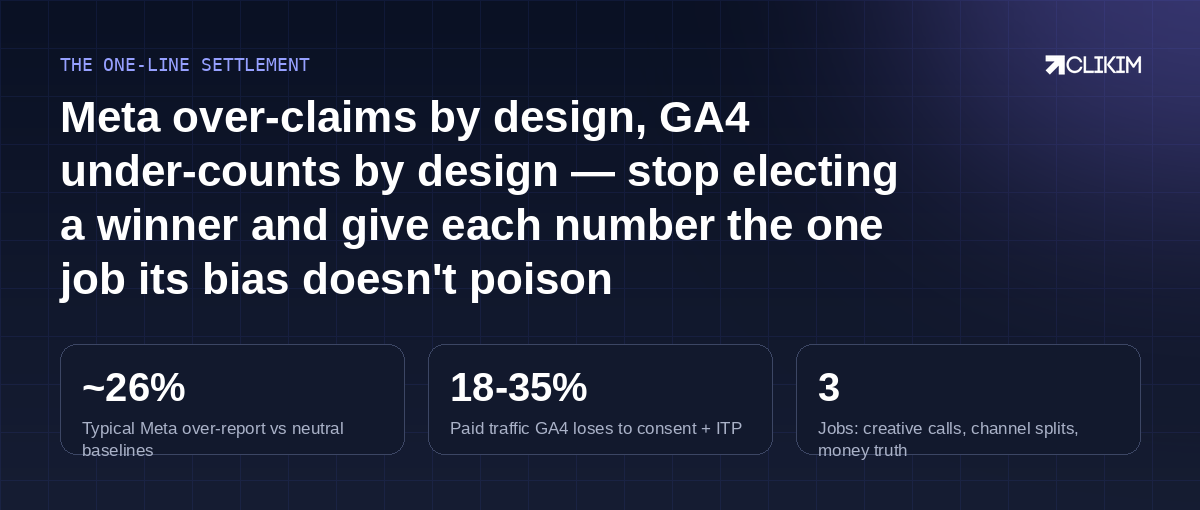
Both dashboards are witnesses with agendas — the framework cross-examines instead of electing.
Frequently asked questions
Why does GA4 show so many fewer conversions from Facebook than Ads Manager?+
Why does GA4 put my Facebook traffic in direct or unassigned?+
What UTM settings make GA4 classify Meta as Paid Social?+
How big a gap between Meta and GA4 is normal?+
Does GA4's data-driven attribution fix this?+
Which number do I put in board/client reports?+
Does the same framework apply to TikTok vs GA4?+
Do I still need GA4 if I trust Ads Manager for optimization?+
How did Meta's 2026 attribution changes affect the GA4 comparison?+
Can server-side tracking (CAPI, sGTM) close the gap?+
Is a data warehouse the grown-up answer?+
What's the fastest way to end this argument on my team?+
Where do post-purchase surveys fit in this fight?+
My GA4 and Meta numbers matched last year — why did the gap change?+
Is there a quick sanity check I can run this week?+
Stable accounts make cleaner witnesses
Whitelisted infrastructure — history-rich, signal-dense, and steady under every measurement framework you run.