
First vs All Conversions: Why Meta Shows 400 Leads and Your CRM Shows 320
Ads Manager counts events; your CRM counts people — and the 20–25% gap between those nouns quietly understates your CAC by the same margin. What the settings actually do, what 'first' really means, and the 15-minute monthly reconciliation that ends the argument.
Meta’s default (All Conversions) counts EVENTS — your CRM counts PEOPLE.
One prospect filling your form three times = 3 Leads in Ads Manager, 1 contact in the CRM. Typical lead-gen inflation runs 20–25%, which understates reported CAC by the same margin — a $30 “CPL” is really $37.50, and downstream CAC math can flip scale/don’t-scale decisions.
“First Conversion” dedupes per EVENT TYPE per person per window (a Lead and a Purchase still count once each), and the 2026 conversion-count breakdown shows first-vs-repeat without switching settings.
The discipline: optimize on platform events, but price CPL/CAC on CRM-deduped uniques — reconciled monthly in 15 minutes.
- Ads Manager counts events; your CRM counts people — the 400-vs-320 gap is mostly the same humans converting more than once.
- For lead gen, All Conversions typically inflates counts 20–25%, which means your reported CAC is understated by the same margin.
- “First conversion” means first per event type per person per window — a Lead and a Purchase from one person still count once each.
- The 2026 conversion-count breakdown shows first-vs-repeat inside your existing reports — measure your own inflation before changing anything.
- Optimization can stay on the default; reporting and CAC math should use first-conversion or CRM-deduped numbers.
- Monthly discipline: reconcile ad-platform lead counts against CRM unique contacts, and price CAC off the CRM.
The gap, dissected
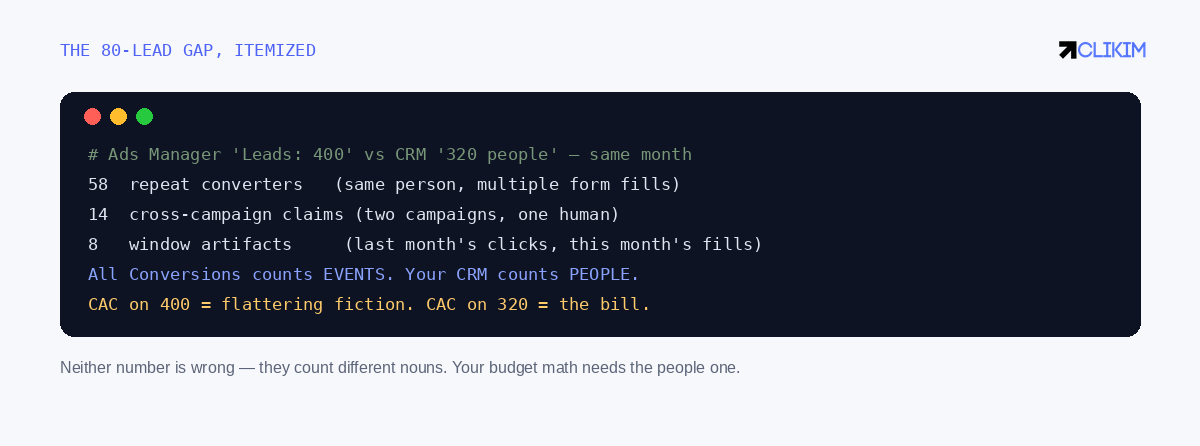
One month, one account — where 80 phantom leads actually come from.
The lead-gen version of the numbers-don’t-match complaint has a specific anatomy. Meta’s default All Conversions counting logs every qualifying event: the prospect who fills your form on Tuesday, returns Thursday via a retargeting ad and fills it again, and downloads a second lead magnet next week just produced three Leads from one human. Your CRM, deduping on email, records one contact.
Multiply across a month and typical lead-gen accounts carry 20–25% event inflation — 400 reported, ~320 humans — before anyone’s done anything wrong.
Add two smaller leaks: cross-campaign double-claims (two campaigns touched the same person inside their windows) and boundary artifacts (conversions booking to last month’s click dates, the same window mechanics that scramble every date-range comparison), and the mystery is fully accounted for. Nothing is broken. Two different nouns are being counted.
The settings, decoded
Rule of thumb: ecommerce purchases legitimately repeat — All Conversions is honest there. Leads, registrations, trials and appointments don't — First Conversion (or the breakdown view) is the honest lens.
Two clarifications that answer most forum confusion:
“First” is per event type. Switch to First Conversion and one person can still contribute one Lead and one Purchase and one Subscribe — it dedupes repeats of the same event inside your attribution settings window, not the person’s whole journey.
The setting changes reporting, not delivery in the way people fear: Meta’s systems optimize toward your chosen performance goal’s events; what you change by viewing first-conversion columns is the honesty of your own analysis, not the algorithm’s behavior.
Since early 2026 you don’t even need to switch — the conversion-count breakdown splits any report into first vs repeat, which turns “how inflated am I?” from a debate into a column.
Does changing the conversion count affect delivery or learning?
The counting view affects reporting; delivery optimizes toward your performance goal’s event stream regardless. You can read first-conversion columns all day without touching how the algorithm hunts.
The CAC math that actually changes decisions
Here is where the 20–25% stops being trivia. A coaching business spends $12,000/month, Ads Manager reports 400 leads: reported CPL $30. The CRM’s deduped truth is 320 people: real CPL $37.50.
Downstream, 8% of contacts become $2,000 clients — so real CAC is $469, not the $375 the dashboard implies. If the business’s max viable CAC is $450, the flattering number says scale and the honest one says fix conversion rate first — opposite decisions from the same month.
This is why the discipline is structural, not cosmetic: optimization reads platform events, money math reads CRM people. Every lead-gen operator who prices CAC off Ads Manager’s default counting is running a business plan on the wrong noun.
Does this affect ecommerce purchase counts too?
Less misleadingly — a customer buying twice is real revenue twice, so All Conversions aligns with money. The lead-gen problem is that a person can’t become a NEW contact twice, so event counting and business counting diverge.
The 15-minute monthly reconciliation
- Pull the month’s leads per campaign in Ads Manager — default view.
- Add the conversion-count breakdown (or first-conversion comparison column) and note your inflation rate; it’s usually stable month to month, so once you know yours (say 22%), quick math covers interim weeks.
- Export CRM contacts created in the month, dedupe on email+phone, and take THAT as the denominator for CPL/CAC.
- Feed quality back the other way: if your CRM can flag which contacts became qualified or closed, you’re one step from sending those outcomes into Meta as conversion events — the upgrade that teaches delivery to find people who become customers rather than people who fill forms, and the subject of its own guide later this batch.
Fifteen minutes, monthly, and the 400-vs-320 argument never happens again — it’s just a known exchange rate between two currencies.
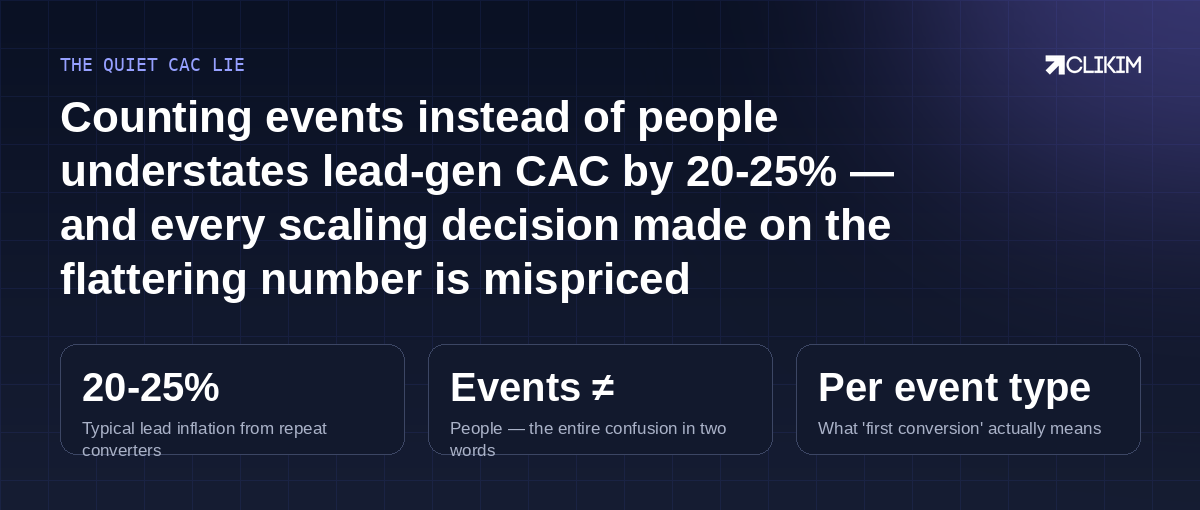
Optimize on events, budget on people — the two-noun discipline that keeps lead-gen CAC honest.
Frequently asked questions
Why does Ads Manager show more leads than my CRM?+
What exactly does 'first conversion' count?+
Should I switch my reporting to First Conversion?+
What is the conversion-count breakdown Meta added in 2026?+
How much does All Conversions inflate lead counts?+
So is my real CPL higher than Ads Manager says?+
Do duplicate leads mean my dedup/event_id setup is broken?+
How do I stop the same people converting repeatedly?+
What about instant forms — do they dedupe?+
What's the next-level fix after clean counting?+
Price CAC on people, scale on headroom
Whitelisted infrastructure — uncapped rails for lead-gen that's done the honest math.