
Facebook Attribution Windows Explained (1-Day vs 7-Day Click)
The window isn't a tracking switch — it's a crediting rule that redraws your scoreboard AND steers who the system optimizes toward. Here's how each window behaves, why yesterday's numbers keep improving, what view-through really claims, and how to reconcile Meta against your bank.
An attribution window decides how long after a click (or view) a conversion still counts as your ad's result. The default is 7-day click + 1-day view; the strict option is 1-day click. Two facts drive everything: conversions report on the click date (so yesterday improves for days — that's lag, not magic), and the window steers bidding toward people who convert inside it. Match the window to your measured sales cycle, hold it constant across everything you compare, and reconcile monthly against blended MER — the bank account arbitrates.
• An attribution window is a crediting rule: how long after a click (or view) a conversion still counts as yours. • Default = 7-day click + 1-day view; the strict alternative is 1-day click. • Conversions report on the click date — yesterday's results genuinely improve today. That's lag, not magic. • The window also steers bidding: the system optimizes toward people who convert inside it. • Longer windows report more conversions and better ROAS — same reality, different scoreboard. • Match the window to your sales cycle, then hold it constant everywhere. • Reconcile platform numbers against blended reality (MER) monthly — the bank account arbitrates.
What an attribution window actually is
When someone clicks your ad on Tuesday and buys on Friday, who gets credit? That's the entire question attribution windows answer. A 7-day click window says: any conversion within seven days of the click counts as the ad's result. A 1-day click window says: only within 24 hours. Add view windows (bought within a day of merely seeing the ad) and you have Meta's crediting vocabulary. The default — 7-day click + 1-day view — is what your numbers mean unless you changed it.
The critical reframe: the window is not a tracking setting. Your pixel and CAPI record the same events regardless. The window is an accounting rule laid over those events — which conversions get stamped with your campaign's name. Same reality, different ledger. Once you see it that way, most attribution "mysteries" become bookkeeping questions with calm answers.
The windows on the menu
The window is a crediting rule, not a tracking switch — the pixel sees the same events either way.
One campaign, two scoreboards
Same campaign, same sales — the window redraws the scoreboard AND retargets the optimization.
Run the same campaign under both windows and the 7-day version might report 83 conversions to the 1-day version's 51 — neither is lying. The longer window credits the Tuesday click that became a Friday purchase; the shorter one refuses maybes. Which is "right" depends on what you're deciding: brand-level truth wants strictness and blended checks; campaign-vs-campaign comparison just wants consistency. The unforgivable move is comparing one campaign on 7-day numbers to another on 1-day and concluding anything at all — the classic apples-to-oranges we flagged in the benchmarks guide.
The part everyone misses: windows steer bidding
The window isn't just a report — it's an optimization instruction. The delivery system hunts people likely to convert inside your window. Set 1-day click and it favors fast, impulsive converters; set 7-day and it can pursue the slower considerers your product may actually need. For a considered purchase (furniture, courses, B2B), a 1-day window can genuinely handicap delivery by telling the auction machinery to chase the wrong temperament of buyer.
This is why the choice belongs to your sales cycle, not your skepticism. Check the real data: Meta's time-to-convert breakdowns (or your store analytics) show how long your buyers actually take. Under a day? 1-day click is honest and sharp. Three to five days of mulling? The 7-day window is measuring — and optimizing toward — your actual funnel.
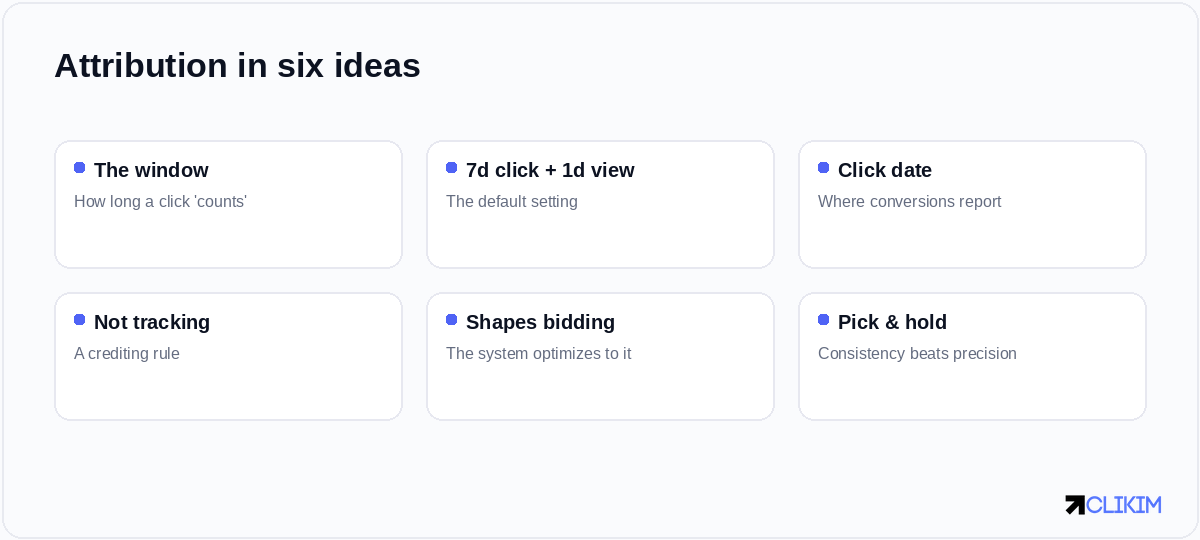
A crediting rule that doubles as an optimization target — pick it by sales cycle, then never mix scoreboards.
Attribution lag: why yesterday keeps improving
Conversions report on the date of the click, not the purchase. Tuesday's click converting Friday appears in Tuesday's column — retroactively. So yesterday's CPA genuinely improves for up to seven days as delayed conversions land, weekends "spike" Monday, and any single-day read on a 7-day window is structurally premature. This one mechanic underlies half the panic edits in the industry — and the kill-rule discipline of judging on 48–72h-plus windows exists largely to absorb it.
Half of all 'tracking is broken' panics are attribution lag and window mismatches doing exactly what they do.
View-through: the honest asterisk
The 1-day view credit bundled into defaults counts people who saw (didn't click) your ad and bought within 24 hours. Some of that is real influence — the feed impression that jogged the purchase. Some is coincidence wearing a medal: they were buying anyway, and your ad happened to render nearby. View-through is why platform ROAS flatters, why retargeting campaigns look supernatural, and why the platform-vs-blended gap exists at all.
Pragmatic posture: leave view credit on for delivery purposes (it feeds the system signal), but know your split — check the click-vs-view breakdown in Ads Manager, and treat campaigns whose results are mostly view-through with appropriate suspicion, especially retargeting.
Reconciling Meta vs your store
Meta says 90 purchases; Shopify says 60 came from ads; your bank says something else again. All three are answering different questions: Meta counts credited conversions (windows + views, click-date anchored), your store's last-click analytics count a different crediting rule, and the bank counts orders. The reconciliation isn't choosing a winner — it's running a monthly blended check: total revenue ÷ total ad spend (MER), trended over months. If platform ROAS climbs while MER sinks, credit is being claimed for sales that were coming anyway; if both move together, your scoreboard is honest enough to steer by.
Keep the loop tight by fixing the data layer first — CAPI with deduplication — so the differences you're reconciling are crediting rules, not missing events.
Beyond windows: the incrementality question
Every window — strict or generous — still answers "which conversions happened near our ads?", not the question the CFO is actually asking: "which conversions happened because of our ads?" Those differ whenever your ads reach people who would have bought anyway — brand-search clickers, loyal repeat customers, cart abandoners who'd have returned regardless. Attribution credits them all; incrementality asks what the counterfactual world without the ads would have looked like.
You don't need a data-science team to approximate it. The blended MER trend is the everyday proxy; geo holdouts (pause a region for two weeks, compare) are the accessible experiment; and Meta's own conversion-lift studies exist for bigger budgets. The practical takeaway for window-pickers: attribution is your steering wheel, incrementality is your occasional audit — steer daily by consistent windows, audit quarterly against reality.
The five window mistakes
Mixing scoreboards — comparing campaigns or months measured under different windows, the original sin. Judging days — reading a 7-day window on a 1-day cadence and panic-editing into lag. Window-shopping — switching to whichever setting flatters this quarter's report. Forgetting the bidding effect — running impulse-buy windows on considered products and wondering why delivery chases the wrong buyers. Trusting view-through in retargeting — where "saw the ad, bought anyway" inflates most aggressively.
All five have the same antidote: pick once, by sales cycle; hold everywhere; read on windows; audit on blended. Boring, like every measurement practice that works.
Setting it, practically
The window lives at the ad set level (under optimization & delivery). Playbook: match it to your measured sales cycle; hold it identical across campaigns you'll ever compare; recalibrate your CPA/ROAS targets if you switch (a 1-day scoreboard needs 1-day targets — numbers will "drop" ~20–40% without anything real changing); and annotate the switch date so future-you doesn't misread the discontinuity. For cost-goal campaigns, remember the goal manages the average as the window credits it — change the window, revisit the goal.
And resist window-shopping for the flattering number. Moving to 7-day view because the ROAS looks better is buying a nicer mirror, not a better business.
Stability makes attribution legible
Attribution analysis assumes a continuous account: weeks of clean data, stable campaigns, windows doing their crediting over uninterrupted delivery. Accounts that lurch through restrictions and resets never accumulate comparable windows — every interruption truncates cohorts mid-credit and turns the ledger into confetti. It's an underrated cost of fragile infrastructure: not just lost delivery, but lost measurability.
A stable, uncapped agency ad account keeps the timeline whole — so your windows, cohorts and monthly MER checks describe a business, not a series of accidents.
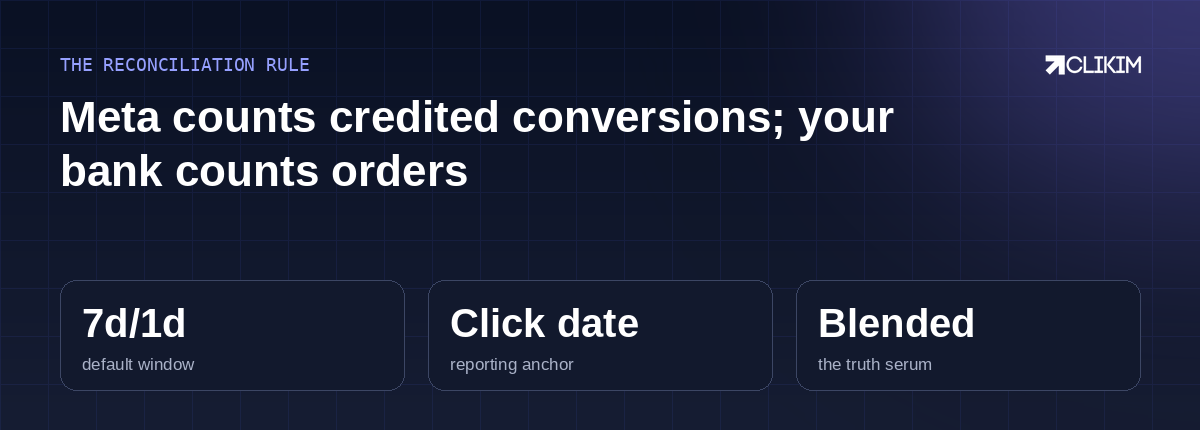
Pick by sales cycle, hold everywhere, judge on windows, reconcile on blended — attribution handled in four moves.
Meta's 2026 attribution changes — what the January and March updates did to reported conversions. the ROAS-drop diagnostic — how to tell a measurement drop from a real one.
Frequently asked questions
What is an attribution window in Facebook ads?+
What does 7-day click 1-day view mean?+
Should I use 1-day click or 7-day click attribution?+
Why do my Facebook results change retroactively?+
Do attribution windows affect delivery or just reporting?+
Why does Meta report more conversions than Shopify?+
What are view-through conversions?+
What happens to my numbers if I switch to 1-day click?+
Where do I set the attribution window?+
Does attribution lag affect cost caps and ROAS goals?+
How do I find my actual time-to-convert?+
Can account instability break attribution analysis?+
Measure a business, not a series of accidents
Stable, uncapped managed infrastructure keeps your attribution timeline whole — clean cohorts, comparable windows, honest scoreboards. Operated on BM2500 infrastructure.