
Meta's Incremental Attribution: The Built-In Reality Check
In April 2025 Meta built the case against its own inflation into Ads Manager: a reporting view that re-scores campaigns against modeled holdouts. Warm campaigns deflate 30–60%, prospecting holds, and the gap between views becomes your account's honesty metric. How to use it — and where its modeling ends.

Incremental Attribution (Ads Manager reporting option, April 2025) re-scores conversions to show only what Meta's models estimate wouldn't have happened without the ad — synthetic-holdout logic, free, no setup. Expect: retargeting deflates 30–60% vs standard view (matching independent lift-test findings), cold prospecting mostly holds. It's modeled, not experimental — Meta's own expert witness — and halo-blind (branded-search/direct lift invisible), so read it as a floor on true contribution where standard attribution is a ceiling. Protocol: monthly side-by-side, log deflation ratios per campaign, audit anything under ~0.4, route marginal budget by incremental CPA, and grade the model quarterly against store revenue. Under ~100 monthly conversions: 30-day trends only.
• Since April 2025, Ads Manager includes an Incremental Attribution reporting option — Meta re-scoring conversions against modeled holdouts to estimate what your ads actually caused. • Expect warm campaigns to deflate 30–60% under the incremental view while cold prospecting holds — the same pattern independent lift tests keep finding. • It's modeled, not experimental: a sophisticated estimate with Meta's own assumptions, not a randomized trial — directional truth, not courtroom evidence. • Use it as the free middle rung: standard view for optimization, incremental view for budget sanity checks, formal lift studies when real money rides on the answer. • Its known blind spot: halo effects (branded search, direct traffic lift) aren't in any Meta view — incremental included. • Small accounts: readable but noisy — trends over 30+ days, never day-reads.
What Meta shipped (and why it's remarkable)
In April 2025, Meta did something platforms rarely do: it built the case against its own inflation into the product. The Incremental Attribution reporting option re-scores your campaigns to show only the conversions its models believe wouldn't have happened without the ad — synthetic-holdout logic applied to your live account, free, in a dropdown. The mechanism matters: instead of crediting every conversion an ad touched (presence-based attribution, the credit-theft engine), the incremental view estimates the counterfactual using patterns learned from Meta's enormous history of real lift experiments. It is still a model — assumptions included, halo effects excluded — but it's the first native tool that answers "yes, but did the ad DO anything?" without a data-science team.
The three-lens ladder
Three lenses, one honest ladder: optimize on standard, sanity-check on incremental, adjudicate with experiments.
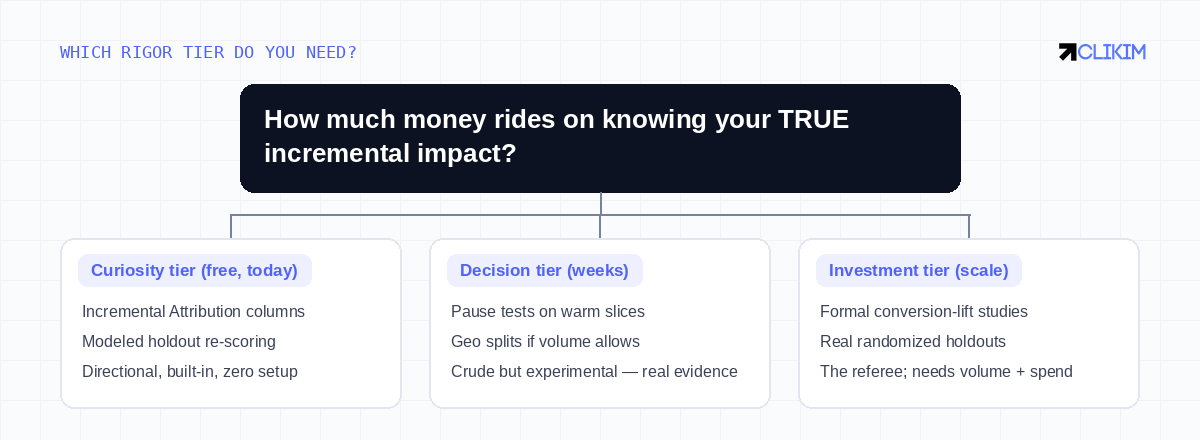
Match the rigor to the money — the free modeled view earns its keep long before formal experiments are affordable.
Reading your first incremental report
Flip a mature account to the incremental view and a predictable scene unfolds. Retargeting deflates hardest — a 6x standard-view campaign reading 2.2x incrementally is the median experience, not a malfunction, and it lands within the same 40–70% overstatement band independent testing established. Prospecting holds — broad cold campaigns typically retain most of their credit, confirming they were buying genuinely new demand. The gap BETWEEN views becomes your account's honesty metric: a small standard-vs-incremental spread means your mix was already discovery-weighted; a chasm means your dashboard has been celebrating harvest. Practical protocol: run both views side by side for a month, compute the deflation ratio per campaign, and let it re-rank where marginal budget goes — the campaign with the best incremental CPA is your true scaling candidate, even when the standard view crowns something else.
The honest limits
Three caveats keep the tool useful instead of oracular. It's Meta modeling Meta — the counterfactual comes from the defendant's own expert witness; treat directionally, verify the big calls with the pause tests and holdouts from the credit-theft playbook. Halo is invisible — no Meta view, incremental included, sees the branded-search and direct-traffic lift your ads create off-platform, so the incremental read is a floor on true contribution, just as standard attribution is a ceiling. Noise scales inversely with volume — under ~100 monthly conversions the modeled holdout gets jumpy; read 30-day trends and resist re-allocating on a week. Within those fences, it's the highest-value free upgrade Meta has shipped for measurement honesty since the Conversions API — and the natural companion to the drop-diagnosis and three-job disciplines this series keeps returning to.
The monthly 20-minute protocol
(1) Last 30 days, all campaigns: pull standard and incremental views side by side. (2) Compute deflation ratio (incremental ÷ standard) per campaign; log it. (3) Anything under ~0.4 gets the warm-audit treatment: frequency check, pool freshness, pause-test candidacy. (4) Marginal budget follows incremental CPA rankings. (5) Quarterly, sanity-check the model itself: did total store revenue respond to reallocations the way the incremental view predicted? That last loop — model vs bank account — is what keeps a modeled tool honest, and it's the whole method in one sentence: let Meta's skeptical view re-rank your spending, and let reality grade Meta's skepticism.
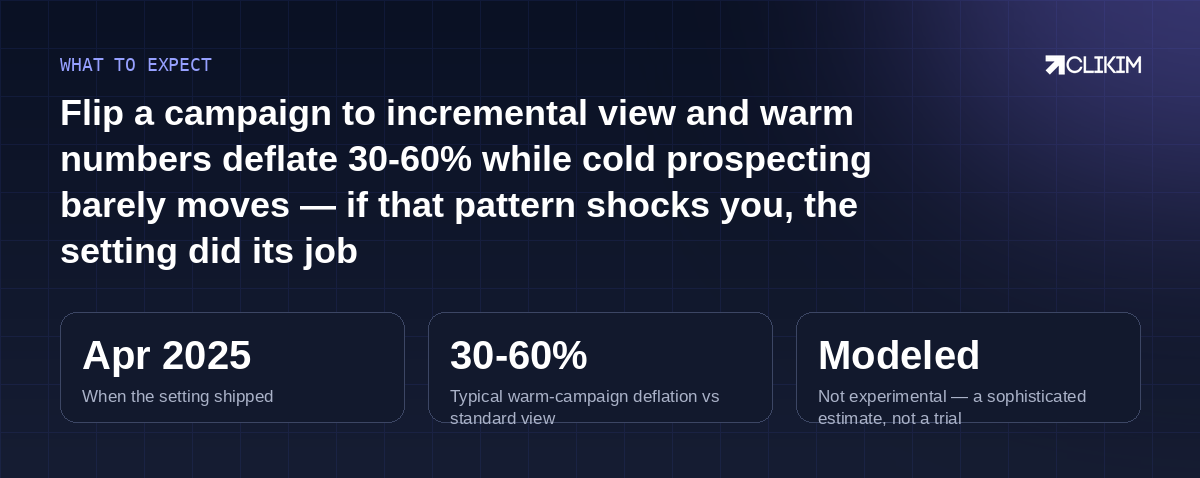
The platform finally argues against itself — use the argument, verify the verdict.
Frequently asked questions
What is Meta's Incremental Attribution setting?+
Where do I turn it on?+
Why do my retargeting numbers collapse under the incremental view?+
Is incremental attribution accurate?+
Does switching to incremental view affect delivery or learning?+
Should I optimize campaigns to incremental results?+
What does it miss?+
My account is small — can I use this?+
How does this differ from a conversion lift study?+
What deflation ratio should worry me?+
Did the 2026 attribution changes affect the incremental view?+
Is Meta grading its own homework here too?+
Fund what's actually incremental
Uncapped, whitelisted infrastructure — headroom for the prospecting your incremental view keeps vindicating.