
Slash Review: Banking for Media Buyers, Tested at Real Volume
Most Slash reviews are feature-page rewrites by people who never moved money through it. We run serious monthly ad-spend volume through this stack — client funds, top-ups, mass card issuance, API reconciliation — so this review covers what the marketing page can’t: how it behaves under load, and where it falls short.
Slash is the best banking platform for media buyers in 2026 — our rating: 4.6/5.
The case is concrete: unlimited per-client virtual accounts, unlimited cards with per-card controls, up to 2% uncapped cashback, a genuinely useful API with authorization webhooks, and the market’s only cashback on Meta invoice payments.
The honest cons: the full platform needs a US entity, balances are USD-only with a 1% FX fee, the API still carries a beta label, and — as with all fintech — some users report compliance closures. Plan a contingency account wherever you bank.
Who we are to judge this
Clikim runs ad-account infrastructure — thousands of managed accounts, eight figures of monthly ad spend processed across them. The banking layer under that operation handles per-client fund segregation, platform top-ups on deadline, and card issuance at a volume where the difference between a good and mediocre platform is a full-time employee. That’s the workload behind every judgment below; where a claim comes from Slash’s own materials rather than our usage, we say so.
What Slash is (and isn’t)
Slash is a US business-banking fintech (banking services through FDIC-member partner banks — it isn’t a bank itself, standard for the category) offering business checking, virtual accounts, virtual and physical cards, a daily-settling charge card, treasury yield, and working-capital products. It raised a $100M Series C led by Ribbit Capital in April 2026, which matters to an operator for one reason: counterparty durability. It is not an accounting suite, a multi-currency platform, or (for the full product) available to non-US entities — scope that correctly and it delivers; expect a Revolut-style everything-app and you’ll be disappointed.
The core: virtual accounts and cards, at operating volume
Virtual accounts are the feature the job is named after. Unlimited sub-accounts, each with its own balance, transaction history and account details, with routing rules that move incoming funds automatically. In agency practice: one account per client. Client funds never commingle, reconciliation collapses from a spreadsheet ritual into reading an account statement, and when a client leaves, their financial history is a clean export rather than an archaeology project.
One virtual account per client: funds never commingle, and reconciliation becomes reading a statement.
Cards behave like infrastructure. Unlimited instant virtual cards, assignable to specific virtual accounts, with per-card limits and merchant/category controls. The hygiene pattern every buyer should run — one card per ad account, killable individually — costs nothing to implement. A compromised card burns one account’s card, not a shared number fanned across twenty (the fan-out pattern that also feeds payment-risk flags on ad platforms).
Cashback and the Meta-invoice program
Card cashback: up to 2% uncapped on Pro ($25/mo), up to 1.5% on the free plan — paid as actual cash monthly, no points arithmetic, explicitly marketed on ad-platform spend. Read the “up to” honestly: rates gate by plan tier, and Slash’s own published agency case study showing a higher negotiated rate tells you enterprise terms exist above the sticker.
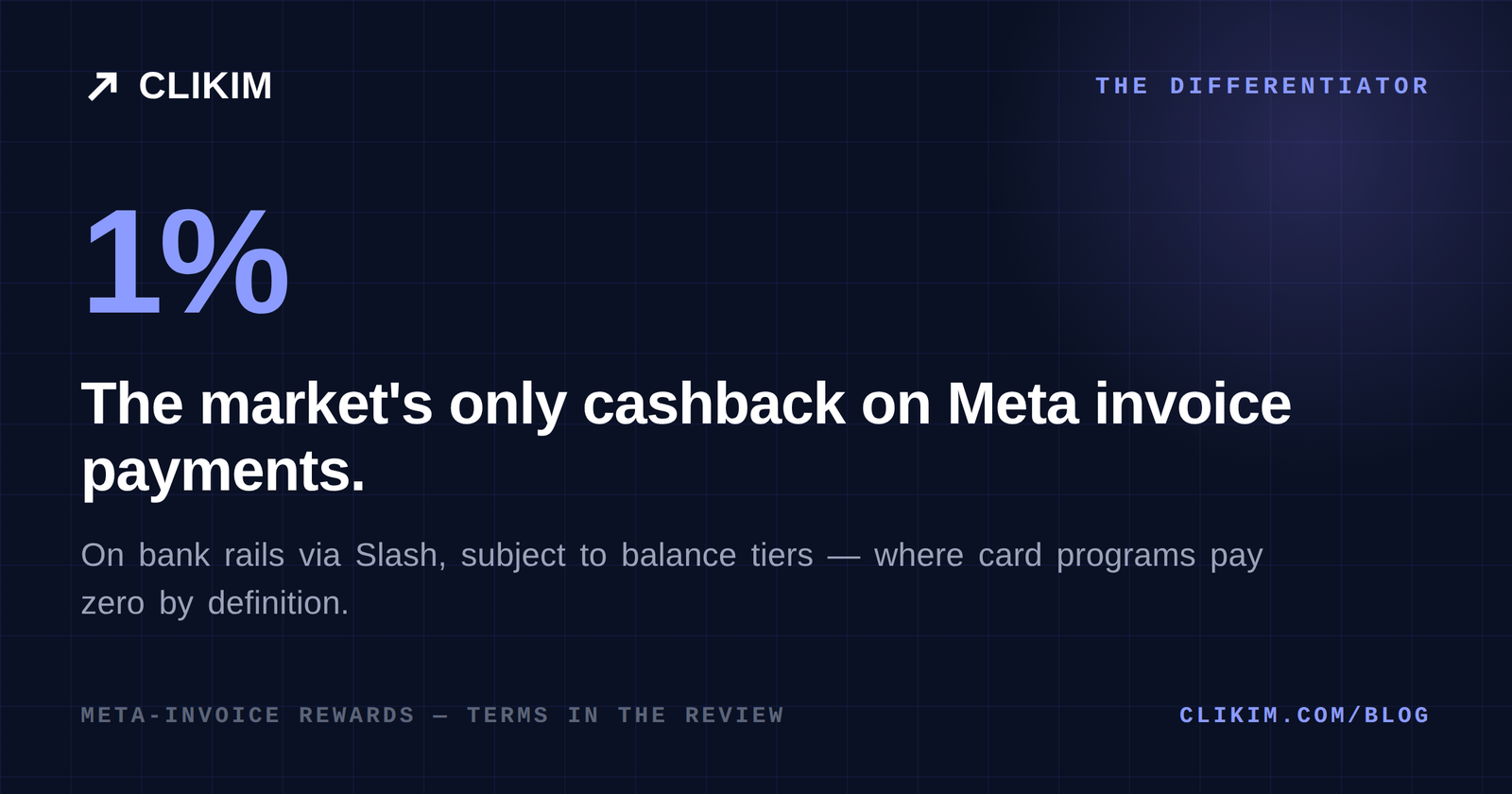
Launched March 2026, directly answering Meta's card removal — the only cashback that touches invoiced spend.
The differentiator is elsewhere: 1% cashback on Meta invoice payments settled by bank transfer through Slash, launched March 2026 — a direct response to Meta removing credit cards for its largest advertisers that April. For a large Meta spender, this is currently the only rewards program that touches invoiced spend at all; 1% on rails-money beats any percentage on card-money you no longer have. (Subject to qualifying balance tiers — read the program terms.) Full market context in our banking ranking.
The API: the difference between an app and infrastructure
Slash’s public API covers accounts, virtual accounts (create them programmatically), cards (create, update, group), transactions, balances, and webhooks — including real-time authorization webhooks that let your code approve or decline each card transaction against custom logic. In practice that enables: card issuance on client onboarding, per-platform spending constraints enforced in code, and transaction data feeding reconciliation without exports. Caveat noted below: the docs still carry a beta label, and beta means interfaces can move under you.
The honest cons
- US entities only for the full platform (owners can live abroad, subject to compliance review). The narrower global offering — USD accounts and stablecoin-backed cards without a US entity — is real but not the full product. Many international buyers form a US LLC precisely for this stack; that’s a cost, count it.
- USD-only balances, 1% FX on non-USD card spend. Heavy EUR/GBP operations should compare Juni or hold multi-currency elsewhere.
- Beta API. Useful today, but build with the assumption of change.
- Compliance closures happen. A recurring review-site complaint: accounts closed with limited explanation. Our operating stance applies to every fintech, Slash included — keep a contingency account funded elsewhere, always.
- Not a books platform — sync to your accounting stack; don’t expect it to be one.
- Mobile coverage is thinner than the web app per user reviews — this is a desktop-first operator tool.
Verdict: 4.6/5 — and who should pick something else
For the specific job of running agency and media-buying money, Slash is the strongest platform we’ve operated: the virtual-account architecture matches how this business actually works, the rewards are uncapped and now uniquely extend to Meta’s invoice rails, and the API turns banking from a chore into a component. The deducted 0.4 is real: entity restrictions, USD-only, beta API, and the closure-risk contingency every fintech demands.
Pick something else if: you’re UK/EEA-incorporated with no US entity (Juni), you mainly want maximum card cashback on spend that’s still cardable (layer dash.fi on top of any bank), or you’re a general startup where ads are a side line (Mercury is fine until ads become the main line). Comparisons in detail: the full ranking.
Frequently asked questions
Is Slash legit?+
What cashback does Slash pay?+
Does Slash work for non-US companies?+
Does Slash have an API?+
What are Slash’s fees?+
What’s the biggest downside of Slash?+
Banking sorted? Now the account layer.
Clikim runs the ad-account side — whitelisted accounts, funded balances, 0% wire top-ups, replacements included. Talk to a rep in minutes.