
Card BINs & Facebook Ads: Facts vs Folklore
Media-buyer forums treat BINs like occult knowledge — magic number prefixes that decide whether accounts live or die. Some of it is real payments infrastructure; a lot of it is marketing by card vendors with skin in the game. Here’s the whole layer, with every claim labeled: documented, reported, or folklore.
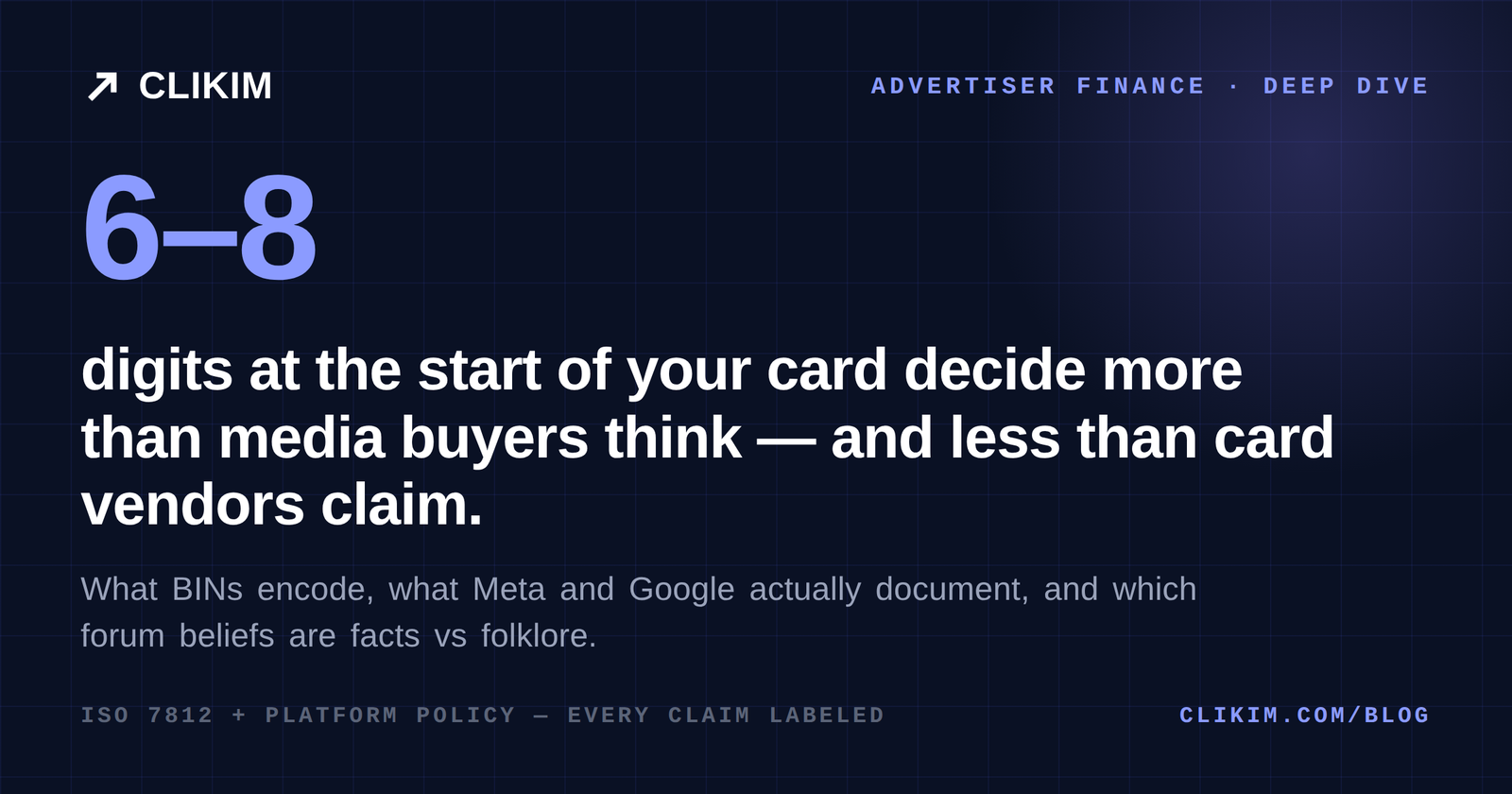
A BIN is the first 6–8 digits of your card number — and it tells every ad platform your card’s type, issuer and country on every single charge.
What’s documented: Google rejects prepaid cards for automatic payments, and Meta’s accepted-methods list omits prepaid entirely. What’s folklore: BIN blacklists, “success rates” and country tier-lists — much of it marketed by card vendors with skin in the game.
The boring truth that survives scrutiny: real cards from real banks, matching your account’s country, never recycled across accounts. That beats any “premium BIN.”
What a BIN actually is
Under ISO/IEC 7812, the first six digits of a card number (migrating to eight since 2022) identify the issuer. A BIN lookup returns: the network (Visa, Mastercard, Amex), the funding type — credit, debit, prepaid — the product tier (Classic, Platinum, World Elite, Infinite), consumer vs commercial designation, the issuing bank, and the issuing country. None of this is secret or ad-platform-specific; it’s standard payments plumbing, visible to any merchant’s processor on every transaction. So yes — Meta and Google can see, on every charge, what kind of card you’re using, who issued it, and where. The question is what they do with it.
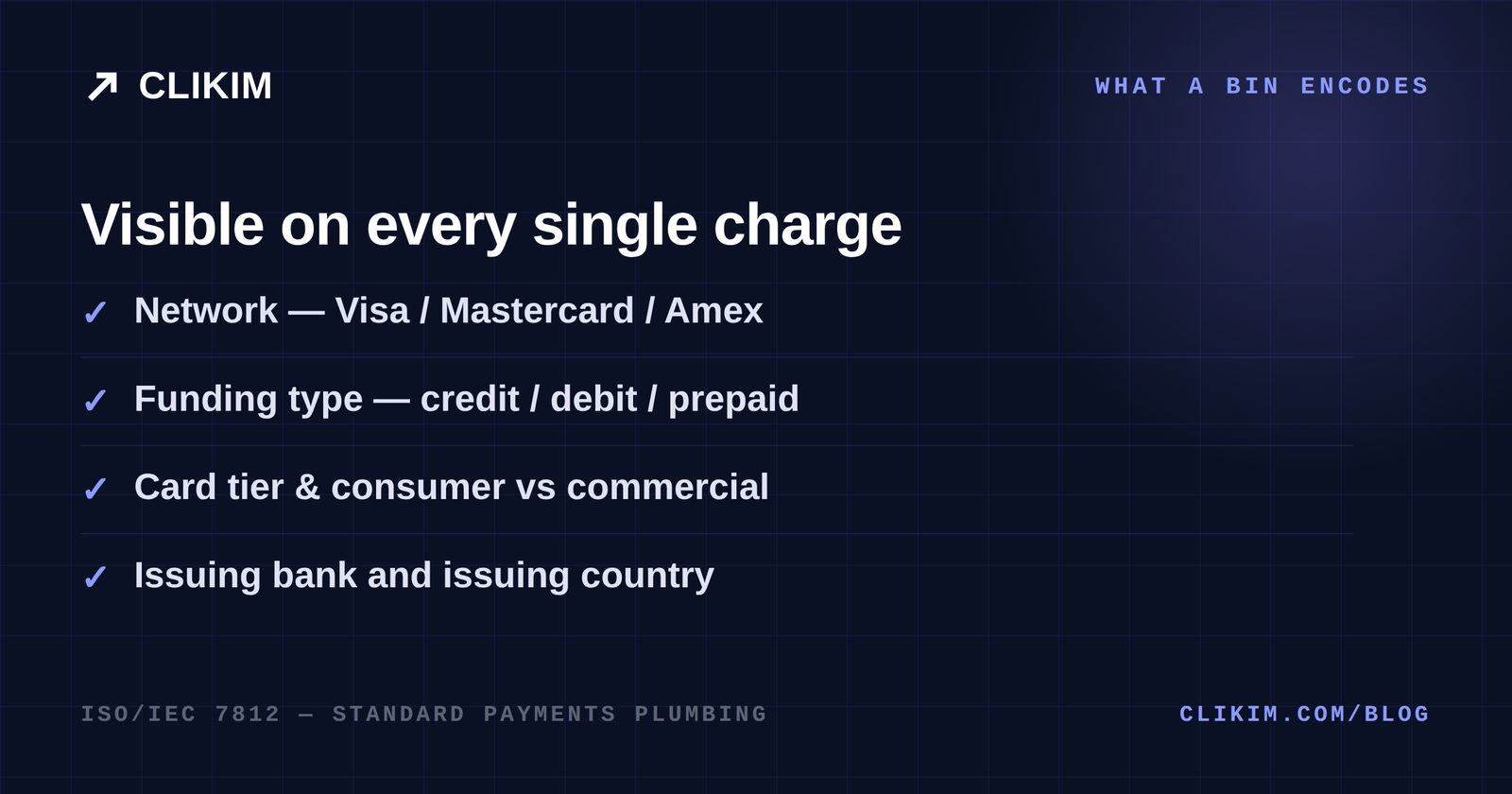
Every transaction exposes this metadata to the platform's processor — the question is what they do with it.
What the platforms actually document
| Claim | Status | The record |
|---|---|---|
| Google rejects prepaid cards on automatic payments | Documented | Google’s payment-methods documentation excludes prepaid cards from automatic (postpay) billing; they’re accepted only in manual-payment markets. The cleanest funding-type rule on any platform. |
| Meta doesn’t accept prepaid cards | Documented by omission | Meta’s accepted-methods pages list credit cards and co-branded debit cards (plus PayPal, direct debit and local methods by market). Prepaid is absent — ‘not supported’ rather than a published ban. |
| Payment failures can restrict ad accounts | Documented | Both platforms tie billing events to account standing; Meta’s escalating billing thresholds are explicitly a trust mechanism, and declines/chargebacks feed restrictions. (Our payment-failure guide covers the Meta side.) |
| Platforms score BINs specifically | Not documented | Neither platform publishes anything about BIN scoring, blacklists, or per-BIN approval rates. Anyone stating these as platform policy is guessing — or selling. |
What’s reported (credible, uncorroborated by platforms)
The Google-reinstatement industry — firms that live inside ‘suspicious payment activity’ appeals daily — converges on a consistent trigger list: virtual/prepaid/gift cards flagged more often “because they’re commonly used in fraud,” card-country vs business-country mismatches, and cards reused across accounts (especially previously-suspended ones). That’s practitioner consensus tracking real enforcement patterns, not platform documentation — credible, but hold it with one hand.
It’s also consistent with how the payments industry works generally: BIN-level fraud scoring is standard practice at processors and risk vendors. It would be surprising if ad platforms didn’t weight funding type and geography. The leap the forums make — from “risk models exist” to “this specific BIN list is blessed” — is where evidence ends.
The folklore, labeled as folklore
- “US corporate credit BINs have the highest trust score.” Plausible directionally (credit > prepaid, matching geography > mismatched), unverifiable as stated. No platform publishes trust scores.
- “Facebook blacklists BINs and tracks per-BIN success rates.” The mechanism is imaginable; the claim, as circulated with specific lists, comes from forums and card sellers, not evidence.
- “Private low-circulation BINs outlive mass-issued VCC BINs” — the “real cards live long, virtual cards die early” doctrine. Survivorship-flavored: heavily-abused BIN ranges plausibly attract scrutiny, but the specific-BIN recommendations attached to this belief are marketing.
- Country tier-lists (US/UK/CH good, offshore EMIs bad). Directionally aligned with the geography-mismatch signal; the precise rankings are invented.
- Full geo-alignment doctrine — IP, account country, card country and currency must all match. Undocumented as a scored rule; sensible as hygiene, cargo-cult as doctrine.
Follow the incentive: the VCC vendor angle
Most BIN content on the internet is produced by virtual-card vendors whose product is… cards on “premium BINs.” BIN anxiety is their customer-acquisition funnel: the scarier the folklore, the more valuable the claimed cure. That doesn’t make VCCs useless — bank-grade virtual cards from real fintechs are excellent operational hygiene (see the issuers we actually rate in our banking ranking) — but it should recalibrate how you read “which BINs work best” articles. The grey-market VCC mills selling crypto-funded cards with rotating BINs are a different animal: their whole pitch is evading the risk models, which is precisely the profile those models exist to catch.
The playbook that survives scrutiny
- Funding type: credit or real debit, never prepaid. The only funding-type rule the platforms actually document — respect it.
- Geography: match end to end. Card issued in the account’s business country, currency coherent. The most-reported flag, and the cheapest to avoid.
- One card, one account, never recycled. Card reuse across ad accounts — above all from a suspended one — is the strongest reported linking signal on both platforms.
- Bank-grade issuers over BIN mills. A virtual card from a regulated fintech attached to a verified business beats any ‘premium BIN’ from an anonymous crypto-funded vendor, because the entire identity behind it holds up.
- Stability is the meta-signal. Declines, card swapping and threshold games hurt more than any BIN choice helps. Boring billing compounds — the same conclusion as our financial-stack pillar.
Frequently asked questions
What is a card BIN?+
Do BINs really matter for Facebook ads?+
Does Facebook accept prepaid cards?+
Does Google Ads accept prepaid cards?+
Are virtual cards safe for ad accounts?+
What’s the best card setup for ad accounts?+
Why do so many articles recommend specific BINs?+
Cards clean, accounts still fragile?
The account layer matters as much as the card layer — managed whitelisted infrastructure on funded balances, with replacements and a rep in minutes.
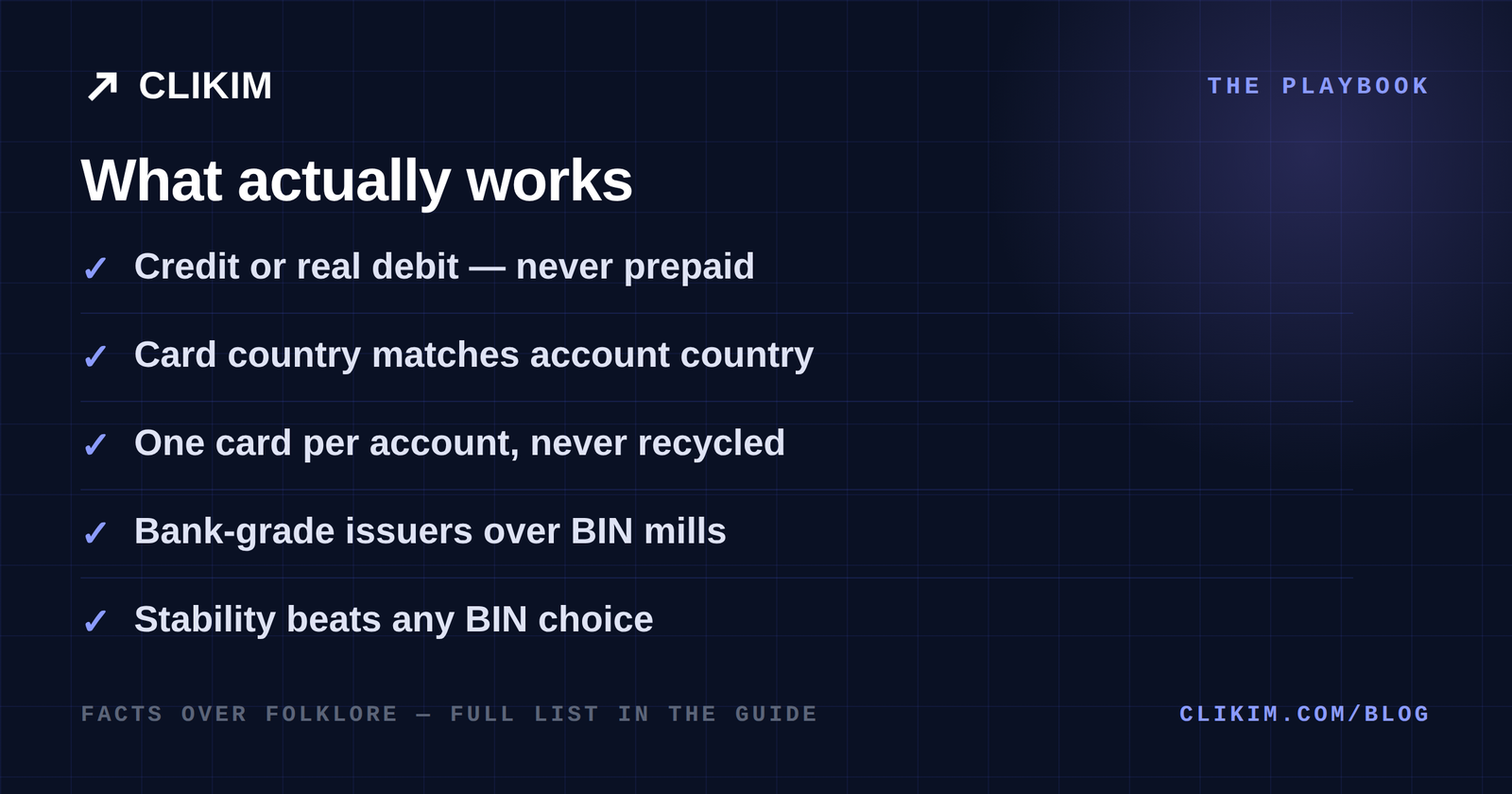
The boring truth that outperforms every 'premium BIN': real cards, matching geography, never recycled.