
Maximize Conversions on NewsBreak: When to Trust the AI
NewsBreak’s smart bidding gets described half-right everywhere: Nova is the machine-learning engine underneath; Maximize Conversions, Target CPA and Target ROAS are the strategies you actually choose. Here’s how the system works, the learning recipe that feeds it, and the honest cases where manual CPC still wins.
Nova is NewsBreak’s ML engine — six years of first-party in-app and newsletter behavioral data predicting who converts. Maximize Conversions (launched November 2023) is the bid strategy that lets it spend your budget.
The menu: manual CPC for control, Maximize Conversions as the opener, Target CPA as the stabilizer, Target ROAS as the ecommerce endgame. Official guidance: budget 5–10× your CPA goal — and smart bidding with broken tracking isn’t just wasteful, it’s a documented rejection cause.
The learning recipe: working pixel + postback before launch, ~20 conversions in the first 3–4 days, hands off mid-learning. Manual CPC still wins for cold tracking tests and tiny budgets.
Nova vs the strategies: naming things right
Half the confusion around NewsBreak bidding is taxonomy. Nova is the platform’s proprietary machine-learning engine — per its launch announcement, refined for roughly six years on data no one else has: first-party behavior inside the app and its newsletters, layered with local signals. Nova isn’t a setting you pick; it’s the intelligence under every smart strategy.
Maximize Conversions, launched November 2023, is the strategy that hands Nova your daily budget and says “spend it on predicted converters” — dynamically allocating bids and budget across native, display, immersive video, pre-roll and app-open placements. Target CPA and Target ROAS came after, adding constraints to the same engine.
Why the naming matters practically: when buyers say “Nova isn’t working,” the fix is almost always in what they fed Maximize Conversions — budget, signal, patience — not in the engine.
The four-strategy menu
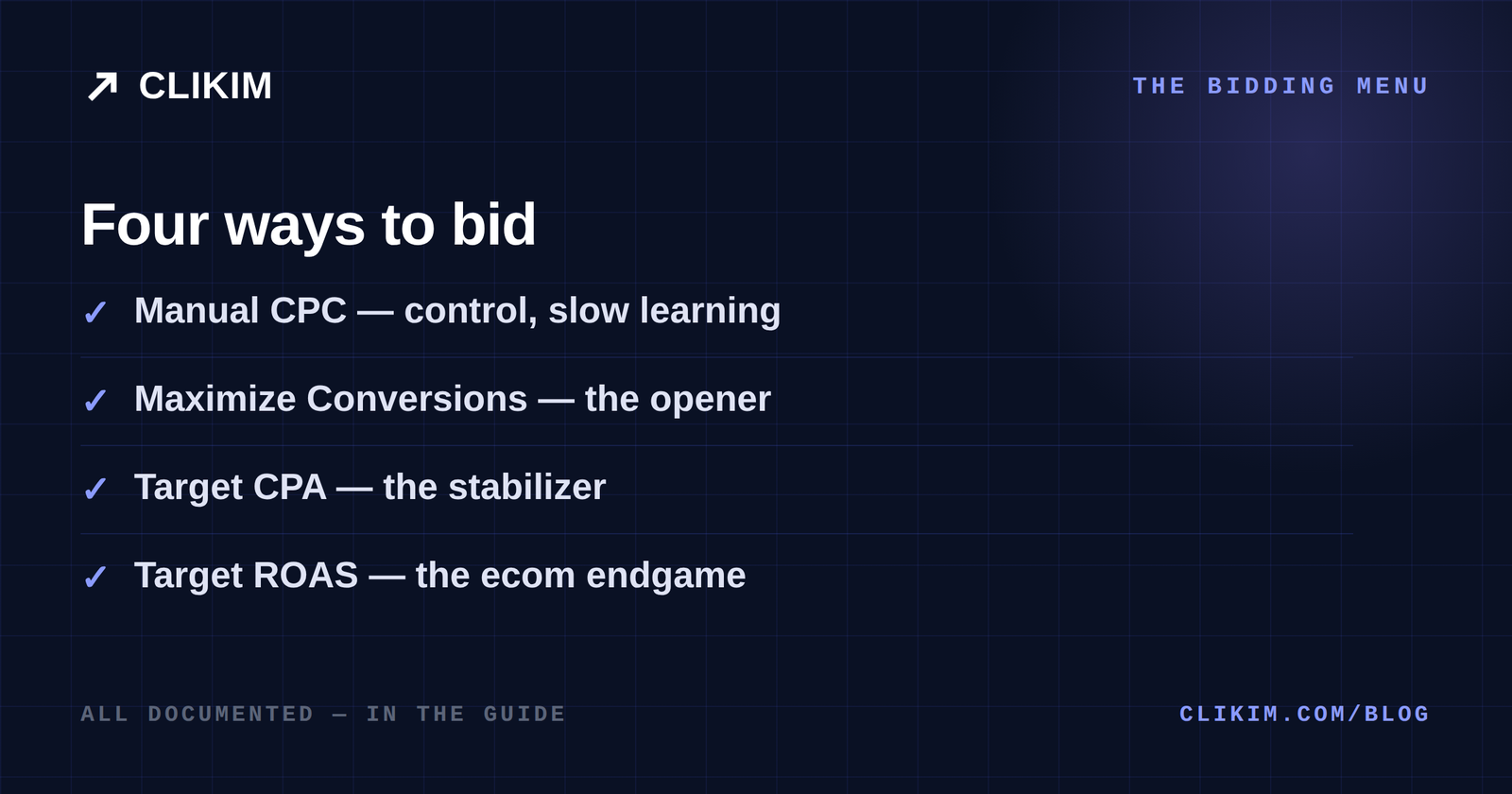
Four strategies, four jobs — Nova powers the three smart ones with first-party data.
| Strategy | What it does | The job |
|---|---|---|
| Manual CPC | You set the click price | Control: tracking tests, tiny budgets, floor-finding |
| Maximize Conversions | Spends the daily budget on predicted converters | The opener: fastest learning on new offers |
| Target CPA | Holds an average cost per conversion | The stabilizer: efficiency once volume exists |
| Target ROAS | Optimizes to revenue return | The ecom endgame: needs purchase values flowing |
One documented sharp edge: launching Target CPA with broken conversion tracking is a listed ad-rejection cause — NewsBreak’s own rejection documentation names it. Smart bidding without signal isn’t merely blind; it fails review.
The learning recipe
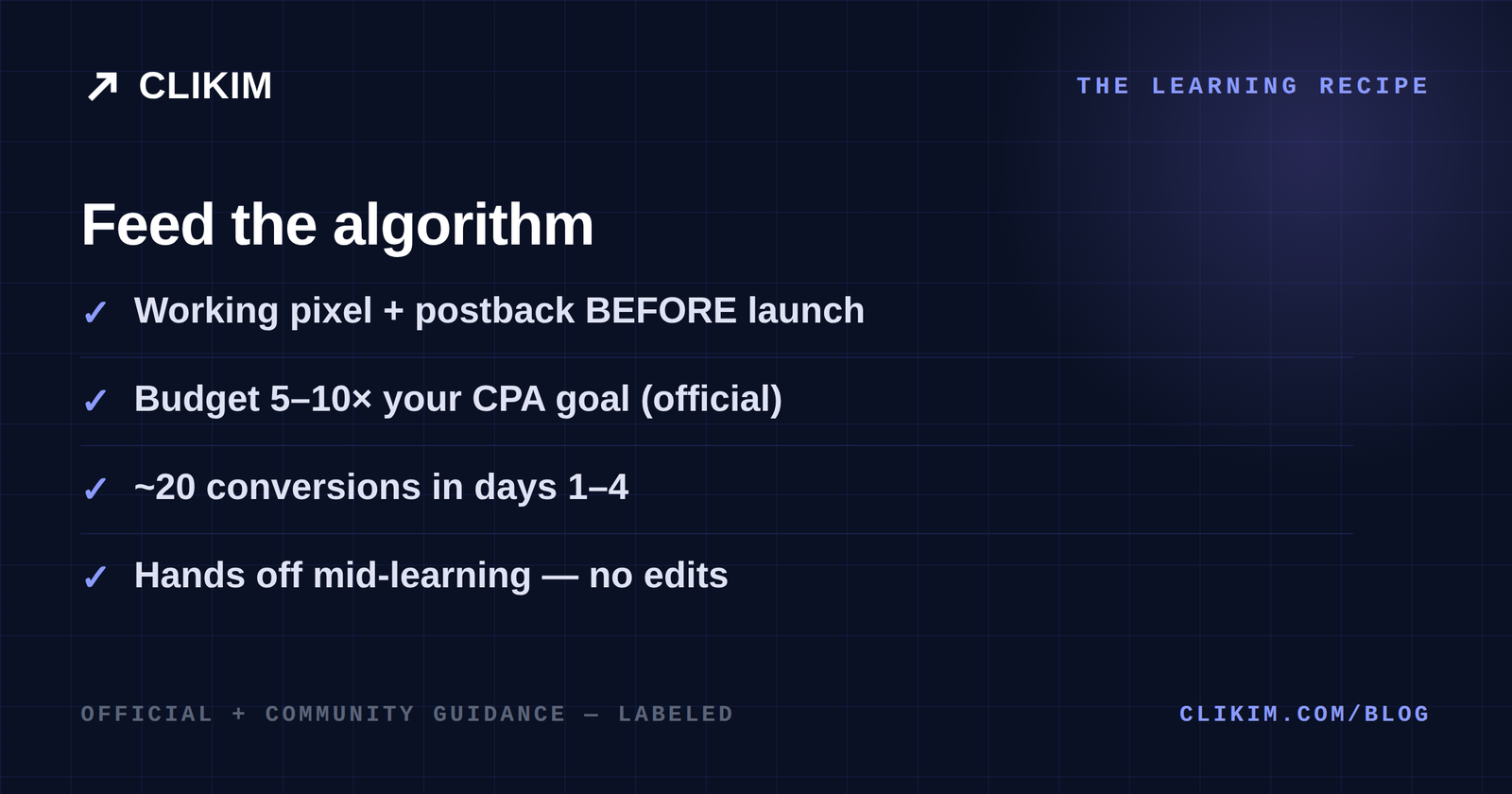
Smart bidding is a signal diet — feed it right or it starves loudly.
Smart bidding is a signal diet. The recipe, with sources labeled:
- Working pixel + postback before launch — verified with test conversions, per the setup guide. Full-funnel events (lander views, form starts, completions) give Nova a gradient, not just a binary.
- Budget 5–10× your CPA goal — NewsBreak’s official guidance, not community lore. A $30 CPA target wants a $150–300/day budget while learning.
- ~20 conversions in the first 3–4 days — the tracker-community consensus for feeding learning past the guessing phase.
- Hands off mid-learning — every edit restarts calibration; the most common failure is diagnosed impatience, per the mistakes guide.
Why is Maximize Conversions spending but not converting?
Three usual suspects, in order: conversions aren’t reaching the platform (test the postback first — always first), the budget is below the learning diet so pacing never stabilizes, or it’s day two of a process that needs four. Check signal, check budget math, then wait before touching anything.
When to switch strategies
The published operating pattern, assembled from ClickFlare, TheOptimizer and the one detailed public case:
- Open on Maximize Conversions — “more flexible, learns faster” is the consistent community verdict for new offers.
- Move to Target CPA at ~10× budget, once stable — when conversion flow is steady and you want efficiency locked; expect volume to tighten as the constraint bites.
- Or blend — the published beauty case ran 70% Maximize Conversions / 30% Target CPA concurrently: exploration and stabilization in parallel rather than sequence.
- Ecommerce graduates to Target ROAS — once purchase values flow reliably (the Shopify app wires this), revenue optimization replaces cost optimization, per the ecommerce playbook.
Scaling cadence on any smart strategy stays the same: +30–50% budget steps every 48 hours while metrics hold — the full rhythm in the scaling guide.
When manual CPC wins
The honest counter-cases, because “always smart bid” is vendor talk:
- Tracking validation — your first $50 should run manual while you verify events end to end; smart bidding on unverified plumbing risks rejection.
- Sub-learning budgets — under ~5× CPA daily, Maximize Conversions never exits calibration; manual CPC with tight creative outperforms a starved algorithm.
- Price discovery — a week of manual bidding maps your vertical’s real click floor before you hand Nova the wallet.
- Compliance-sensitive pacing — manual keeps spend deliberate while a gray-zone vertical confirms its policy footing, per the policy guide.
Does NewsBreak smart bidding work with small budgets?
Below roughly 5× your CPA goal per day, no — official guidance puts the learning diet at 5–10×, and a starved algorithm spends erratically. Small budgets do better on manual CPC with disciplined creative testing until the budget can feed learning.
Building the signal stack Nova deserves
Everything in this guide reduces to signal quality, so here’s the stack, bottom to top. Layer one: the pixel on every page you control, firing view and engagement events.
Layer two: the server-to-server postback carrying the money events — leads, purchases, qualified outcomes — with click IDs intact; documented integrations exist for ClickFlare, Voluum, RedTrack and wecantrack, and ClickFlare adds direct API cost sync. Layer three: value data — purchase amounts for tROAS, or lead-quality tiers posted as distinct events for lead gen.
The upgrade most accounts never make: posting downstream outcomes. When your CRM knows which leads qualified or which customers repeated, sending those as postback events teaches Nova to find buyers rather than form-fillers — the single highest-leverage change available to a working account, and the exact mechanism behind every ‘quality improved after we fixed tracking’ story in the ecosystem. Signal is strategy; the bid menu is just how you spend it.
Target CPA vs Target ROAS: choosing the constraint
Both graduated strategies constrain Nova; the choice is which truth you constrain it to. Target CPA speaks lead-economics: every conversion is worth roughly the same, so hold the average cost — the natural fit for lead gen, calls and single-SKU offers. Target ROAS speaks revenue-economics: conversions carry different values, so optimize the return — the fit for multi-SKU stores where a $120 cart and a $40 cart shouldn’t be bought at the same price.
The prerequisites differ accordingly. tCPA needs stable conversion volume; tROAS needs that plus accurate purchase values flowing on every event — which is why the Shopify app’s value passing matters more than it looks. Feed tROAS approximate values and it optimizes precisely toward your measurement error.
The transition discipline: change one constraint at a time, expect a re-learning wobble, and set the initial target conservatively — a tCPA at your current actual CPA (not your wish), a tROAS at your current actual return. Tightening a target the algorithm is already missing doesn’t motivate it; it starves delivery. Loosen into stability, then ratchet.
What Nova actually knows
The moat argument deserves specifics. Nova’s training data, per the platform’s own materials, spans behavior nobody else observes: which local stories a user opens and finishes, which newsletters they open daily, what their town-level context is — layered across years on an audience that visits as a habit rather than an impulse.
For an advertiser, that means conversion prediction built from reading behavior, not social-graph signals — a different lens on the same humans Meta models, and one reason ported audiences behave differently here.
The practical consequence: Nova rewards signal that matches its worldview. Full-funnel events (view, start, complete) mirror how it already models content engagement; single-event binary feeds waste its resolution. That’s the deeper reason the tracking-first rule keeps appearing in this cluster — you’re not just measuring, you’re teaching.
Reading the placement report
Once Maximize Conversions has a fortnight of spend, the placement report becomes your free format study. The reading discipline: judge each placement on conversion contribution against its spend share — not CTR, which the immersive format inflates by design. A placement eating 30% of budget with 8% of conversions is Nova exploring, not failing; give it the fortnight before curating.
If it persists, that’s the case for splitting a manual-CPC campaign targeting only your proven placements while the smart campaign keeps exploring — the two-track pattern that gets exploration and efficiency simultaneously, at the cost of one more campaign to manage inside the 1-2-3 discipline.
What smart bidding buys you
The under-appreciated feature: Maximize Conversions allocates across the whole placement pool — native, display, immersive video, pre-roll, app-open — by predicted conversion value. That’s a continuous, free placement test running inside your campaign; read the placement report instead of re-running it manually, and build creative that survives contexts you didn’t design for, per the format guide.
The strategic summary: Nova’s first-party data is NewsBreak’s genuine moat — nobody else has in-app plus newsletter behavior on this audience. Feed it honestly and it’s the best employee on the account; starve it and it’s an expensive random-number generator. Platform fundamentals in the complete guide; signal architecture at volume through managed access.
Frequently asked questions
What is Nova on NewsBreak?+
What bid strategies does NewsBreak offer?+
What budget does Maximize Conversions need?+
Why did my Target CPA ad get rejected?+
When should I switch from Maximize Conversions to Target CPA?+
Is manual CPC ever better on NewsBreak?+
Does Maximize Conversions work without the pixel?+
How long does NewsBreak’s learning phase last?+
Feed the engine properly
Managed NewsBreak agency accounts through Clikim: tracking architecture, funded budgets that meet the learning diet, and support when the algorithm needs a human.