
Taboola Ads in 2026: The Complete Operator’s Guide
Taboola stopped being a chumbox and became a performance platform with a new name on the door: Realize. This guide is the operator’s map — the publisher network your ads actually run on, the formats and bidding that matter, the budget rules Taboola really enforces, and the policy lines that decide whether your account ages or dies.
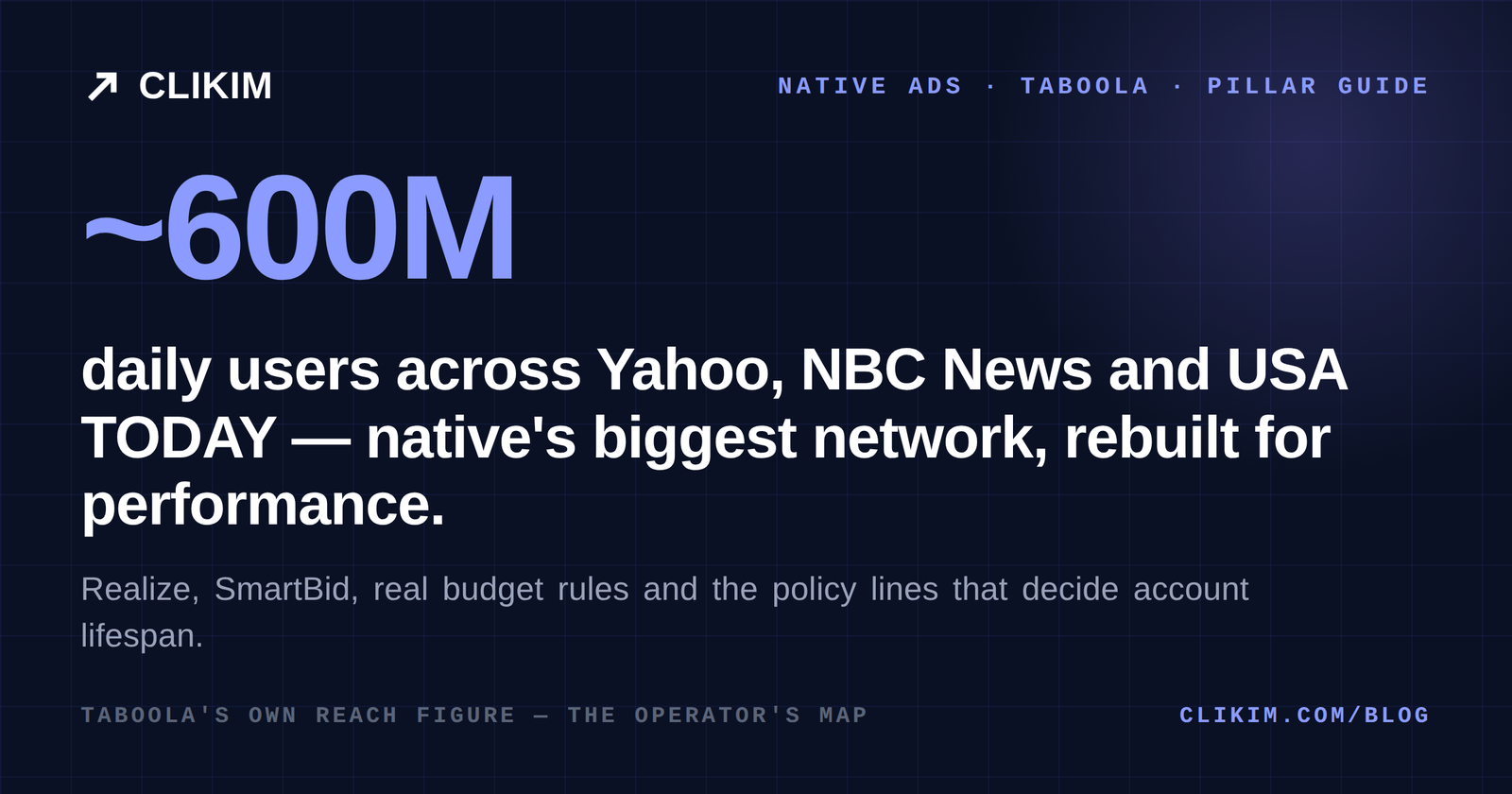
Taboola in 2026 is a performance platform (rebranded Realize) selling native and display placements across a premium publisher network — Yahoo, NBC News, USA TODAY, Business Insider and thousands more — reaching what Taboola cites as ~600 million daily users.
You buy CPC, with SmartBid strategies up to Maximize Conversions with a Target CPA. The real budget rules: daily budget ≥ your bid × 30, with $50/day officially recommended per campaign.
Win condition: pixel + S2S tracking wired, advertorial-style creative that respects the feed, aggressive site blocking, and two patient weeks per verdict.
What Taboola actually is
Taboola is a demand engine for the open web: it owns the recommendation and ad placements on thousands of publisher sites and apps, and sells that attention to advertisers on a CPC model. The company paid publishers over $1.5 billion in 2025 for the privilege, runs about $1.9 billion in annual revenue, and serves roughly 18,000 advertisers — numbers from its own releases and filings, but audited-adjacent ones.
What changed recently is ambition: in 2025 Taboola relaunched its buying platform as Realize, explicitly chasing the “$55 billion performance market beyond search and social” — meaning it wants your Meta-style DR budget, not just your content-arbitrage experiments. The product has largely caught up with the pitch: real conversion bidding, retargeting, CRM audiences, frequency capping, and expansion beyond native cards into standard display.
The network your ads run on
Native lives and dies by placement quality, so start with the roster. Taboola’s exclusive and marquee partners include Yahoo (a 30-year exclusive deal live since 2023, projected at ~$1B a year at signing), NBC News and CNBC (with NBC expanding into Taboola-run programmatic display in August 2026), USA TODAY / Gannett, TIME, Business Insider (exclusive feed), The Independent, BILD, Le Figaro, Microsoft’s MSN, plus OEM surfaces on Samsung and Xiaomi devices.
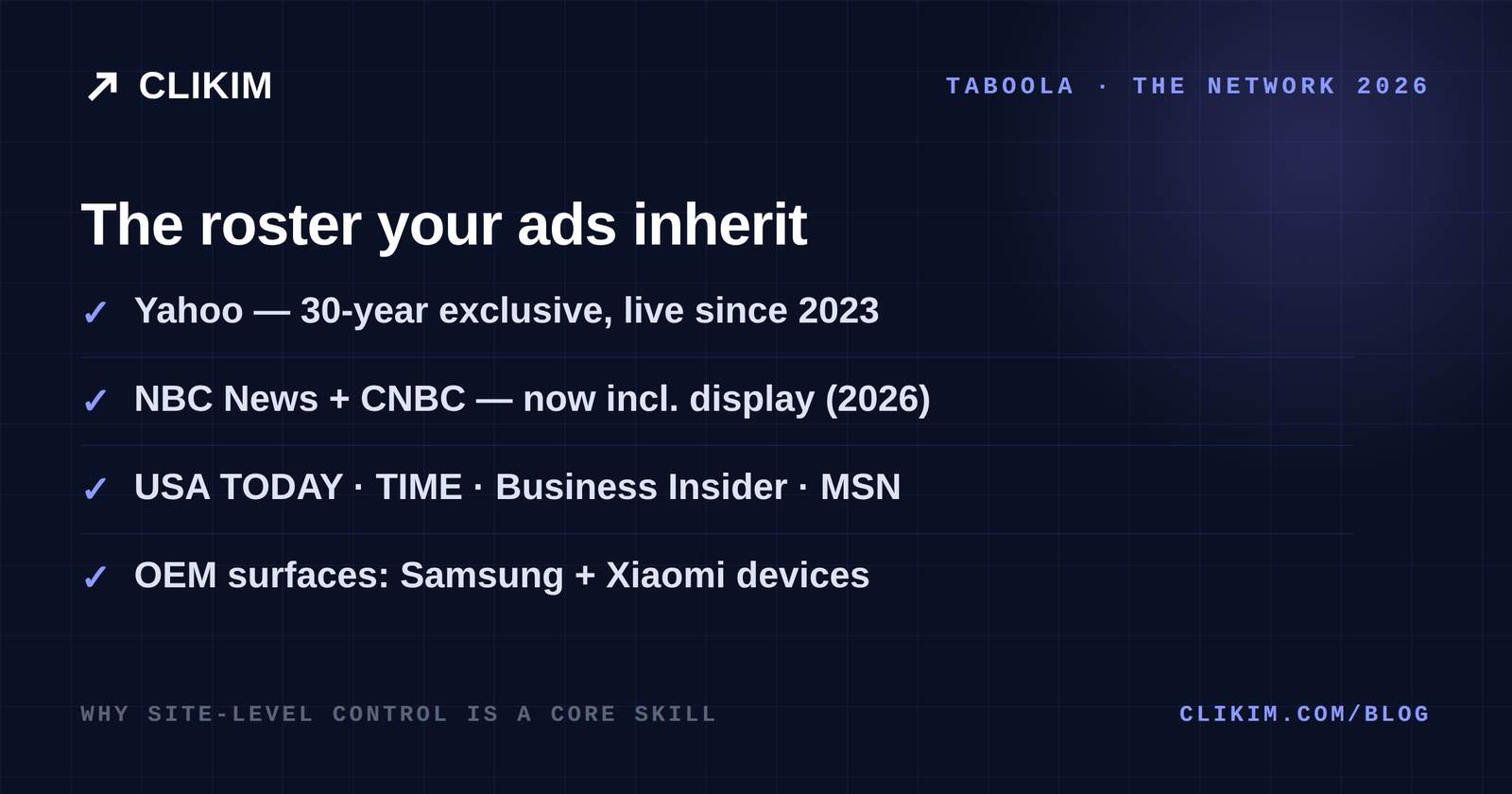
The roster your ads inherit credibility from — and the reason site-level control matters so much.
Reach claims: Taboola cites ~600 million daily active users (500M in some display-scoped materials — treat both as the vendor’s own figures). The practical read for buyers: enormous, genuinely premium-skewing reach — with a long tail of smaller sites where your money can quietly leak, which is why site blocking is a core skill here, not an advanced one.
For large advertisers, Taboola Select curates the top ~15% of premium US publishers into a brand-safe pool with standalone placements — the option to trade some scale for guaranteed neighborhood quality.
Realize: the 2025 rebuild
If you last touched Taboola before 2025, the interface you remember is gone. Realize (launched February 2025) replaced the old “Taboola Ads” manager — new domain, new account → group → campaign hierarchy, redesigned objectives, and launch features the old platform never had: frequency capping, real-time ad compliance checks, budget acceleration, and a performance simulator.
Metrics were renamed too (“Viewable Impressions” became “Impressions”; the old “Impressions” became “Served Ads”) — so any pre-2025 screenshot tutorial will actively mislead you.
Two AI layers ride along: Abby, a generative assistant that builds and manages campaigns conversationally, and — on the publisher side — DeeperDive, an AI answer engine (live on USA Today’s homepage) that Taboola monetizes with ads, making it one of the first networks selling placements inside AI answers. Watch that surface; it’s where native’s next decade starts.
Formats and placements
| Format | Where | Job |
|---|---|---|
| Feed cards | Below-article & feed placements | The workhorse: image + headline + brand |
| In-article | Mid-content recommendation blocks | Higher attention, editorial adjacency |
| Homepage placements | Publisher front pages | Reach with premium context |
| Motion Ads | Feed slots | Looping motion — thumb-stopping without video costs |
| Native video / vertical | In-feed & outstream, autoplay muted | Reuse social vertical assets |
| Display (via Realize) | IAB placements, incl. NBC News | Standard banners on the same rails |
The 2026 lineup. “Explore More” units you may see cited are publisher-side inventory, not a buyable format.
The craft is that native creative must read like content: editorial thumbnails, curiosity-with-substance headlines, advertorial landers where the vertical calls for them — the full discipline is in the creative guide.
Targeting and audiences
The levers: geo, device/OS/browser, day-parting, contextual segments, publisher controls — plus the audience stack: retargeting pools from your pixel events, CRM uploads with lookalikes built from them, and third-party Marketplace segments. One mechanic that trips Meta buyers: combining different audience types narrows your reach (an AND), while adding audiences within one type widens it (an OR). Build deliberately.
The targeting philosophy that works here is looser than social: native’s context does the qualifying, your headline does the targeting, and over-narrowed campaigns starve the algorithm of the click volume CPC optimization needs.
Bidding and SmartBid
Everything is CPC, and the bid strategies climb a ladder: Smart/Enhanced CPC (your base bid, flexed toward likely converters) → Maximize Conversions (fully automated against your budget) → an optional Target CPA once the account has earned it. Taboola’s own stated threshold for a Target CPA: at least 50 conversions in 7 consecutive days — set a target before that and you’re steering on noise.
Their claimed results (nearly 50% more conversions at flat cost; 15% average CPA cuts on Select) are vendor numbers; the direction matches buyer experience when tracking is clean.
The practical ladder: launch on Smart CPC with a bid your unit economics support, switch to Maximize Conversions once daily conversions flow, add a Target CPA only past the 50-in-7 line, then loosen it 10–15% whenever you want scale — the full loop lives in the optimization guide.
Tracking that holds up
The Taboola Pixel handles browser events and audience building; server-to-server postbacks carry the money events for anyone running trackers — RedTrack, Voluum and friends ship native integrations. One sharp edge: Taboola accepts event names in lowercase only, and names must match exactly.
Wire both rails, pass values, and test a conversion end-to-end before spending — CPC platforms punish blind optimization even harder than social does, because every click is billed whether or not you can see what it did.
Policy: the lines that matter
Taboola polices the gap between native and deceptive harder than its reputation suggests. The lines that end accounts:
- Finance: binary options, credit repair, get-rich-quick, NFTs, penny stocks are prohibited outright; affiliate investment lead-gen and Gold IRA campaigns require pre-approval; crypto runs only in an allowlist of ~40 countries.
- Health: no weight-loss claims beyond 2 lbs/week, mandatory diet-and-exercise disclosures, substantiation linked on the lander; no medical marijuana, no prescription offers outside gated pharmacies.
- Affiliate hygiene: no cloaking or split-destination URLs, advertorials labeled (“Sponsored by X”) at the top, and — notably — no “winner stories” in creative or landers even if true.
The pattern across all three: Taboola sells its publishers’ trust, and removes whatever spends it. Build funnels you’d defend to an NBC editor and the platform is welcoming; the full affiliate-side treatment is in Taboola for affiliates.
The operator’s playbook
Condensed to one paragraph: wire pixel + S2S and verify; launch one campaign per geo-device split on Smart CPC with a bid×30-compliant budget (Taboola recommends $50/day minimum); run 5–10 creative variants because native CTR spreads are wild; judge nothing for two weeks except obvious site-level leaks.
Then: block aggressively, feed winners, climb the bidding ladder, and scale by geo and placement expansion rather than raw budget jumps. Costs and the month-one math are in the cost guide; how it compares to its rivals is in Taboola vs Outbrain and Taboola agency accountsManaged native access — funded balances, invoicing and support at scale.See managed access →.
The Taboola library: every guide in this cluster
Each part of the platform gets its own operator-grade guide, linked back here.
Frequently asked questions
What is Taboola and how does it work?+
Is Taboola legit for advertisers?+
What is Taboola Realize?+
What’s the minimum budget for Taboola?+
Does Taboola work for ecommerce?+
Taboola or Outbrain — which is better?+
What does Taboola ban?+
Native at scale needs real rails
Managed Taboola access through Clikim — funded balances, invoicing and support — alongside the Meta, TikTok and NewsBreak infrastructure your media plan already runs on.