
The Facebook Learning Phase, Explained (and How to Exit It)
Most 'my new campaign is too expensive' panics and self-inflicted performance disasters trace straight back to the learning phase. Here's what it is, the ~50-events rule, your optimisation event, what resets it, the ad-set life cycle, and how to exit it faster.
The Facebook learning phase is the period when Meta gathers data to optimise an ad set, generally needing about 50 optimisation events within a week to exit and stabilise. Performance is choppier and costlier while learning, then settles. Almost any significant edit — budget, audience, creative, optimisation event — resets it, so the key is to fund ad sets properly, stop editing, and consolidate so each reaches enough events. Don't judge results during learning.
• The learning phase is when Meta gathers data to optimise an ad set — it wants ~50 events/week. • Performance is choppier and costlier while learning, then stabilises on exit. • Almost any significant edit resets learning — budget, audience, creative, optimisation event. • “Learning Limited” means the ad set can't reach enough events — consolidate or raise budget. • Don't judge results during learning, and don't tinker — patience is the strategy. • Optimising for a rarer event (purchase) is harder to learn than a frequent one. • Frequent restarts are a top hidden cause of high costs and unstable delivery.
What the learning phase is
Every time you launch or significantly change an ad set, it enters the learning phase — the period during which Meta's delivery system gathers data and figures out who to show your ads to, at what time, on which placements, for the best results. It's the algorithm feeling out the auction on your behalf. While this is happening, performance is unstable: cost per result swings, delivery is uneven, and the numbers you see aren't yet representative of what the ad set will do once it settles.
Understanding the learning phase is one of those small pieces of knowledge that quietly fixes a dozen problems. Most "my new campaign is too expensive" panics, most "why is this so inconsistent" frustrations, and a surprising number of self-inflicted performance disasters trace straight back to misunderstanding — or impatiently interrupting — the learning phase. Internalise it and you'll stop making the single most common unforced error in media buying.
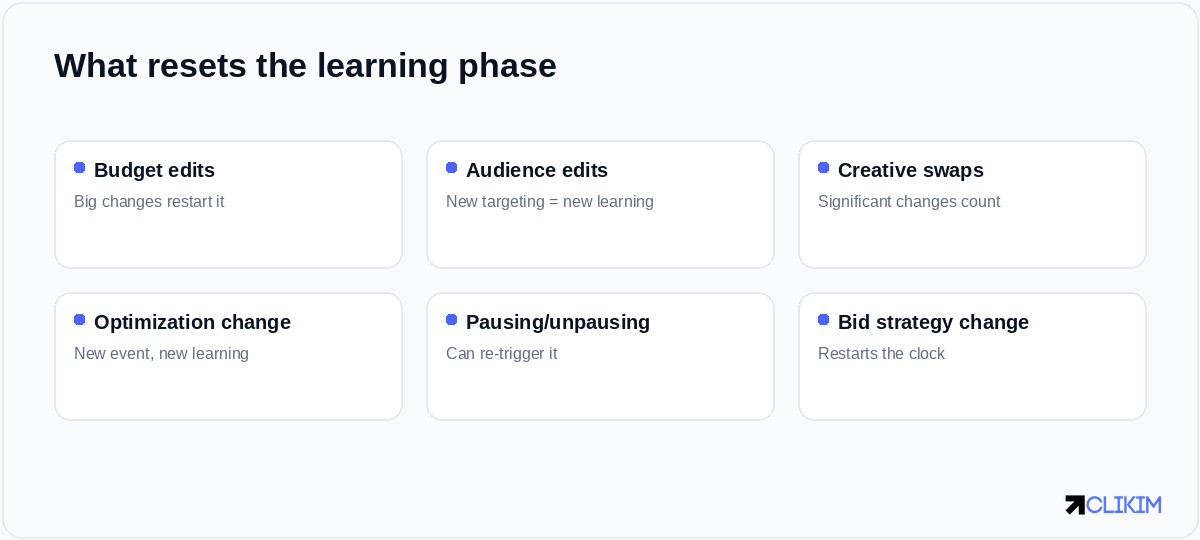
Almost any significant change throws an ad set back into learning — which is why constant tinkering backfires.
The ~50-events rule
The mechanism has a concrete target: Meta generally needs an ad set to accumulate roughly 50 optimisation events within about a week to exit the learning phase and stabilise. An "optimisation event" is whatever you've told the ad set to optimise for — a purchase, a lead, an add-to-cart. This number is why budget and structure matter so much: if your ad set can't realistically generate ~50 of your chosen events in a week, it will never properly exit learning, and it'll stay stuck in the expensive, unstable zone indefinitely.
This single fact has big implications. It's why optimising a small budget for purchases often fails (not enough purchases to learn from) while optimising for a cheaper, more frequent event can work. And it's why spreading budget across many thin ad sets is so damaging — you divide your events until none of them reaches the threshold. The 50-event rule is the hidden logic behind half the structural advice in media buying.
“Learning Limited” is the warning sign — the ad set will never stabilise until it can reach enough events.
Your optimisation event changes the difficulty
A subtle but crucial point: which event you optimise for determines how hard the learning phase is to clear. Purchases are relatively rare, so reaching 50 of them a week takes real budget; add-to-carts and leads are more frequent and easier to accumulate. This is why advertisers with smaller budgets sometimes optimise for an upper-funnel event to escape learning, then move down-funnel as volume grows.
There's a trade-off, though: optimising for a proxy event (add-to-cart) tells Meta to find people likely to do that, not necessarily to buy. The art is choosing the deepest event you can still generate ~50 of per week, so the algorithm optimises for something close to your real goal while still clearing learning. Get this balance wrong and you either never exit learning or you exit it chasing the wrong people.
Why it matters
The learning phase matters for two practical reasons. First, judgement: the results during learning are not the results you'll get, so making decisions — killing an ad set, slashing a budget — based on learning-phase data is making decisions on noise. Plenty of winning ad sets have been killed on day two because they looked expensive during learning, when another two days would have shown them stabilising into profit.
Second, cost: learning is the most expensive part of an ad set's life, so anything that forces an ad set to re-learn repeatedly keeps it permanently in that costly state. Stable, exited ad sets are cheaper and more predictable; the whole game is getting them there and keeping them there. An account full of perpetually-relearning ad sets is an account quietly bleeding money.
What resets the learning phase
This is the part that catches people out. The learning phase doesn't just happen once at launch — almost any significant edit throws the ad set back into it.
Almost any meaningful edit restarts learning — which is why disciplined, batched changes beat constant tinkering.
Small tweaks are usually fine, but the constant fiddling many advertisers do — nudging budgets daily, swapping creative on a whim, flipping the optimisation event — keeps their ad sets in a perpetual learning loop, which is exactly why their performance never stabilises. If you take one habit from this guide, make it: batch your changes, then leave the ad set alone.
The life cycle of an ad set
It helps to picture an ad set as moving through phases over its life, rather than existing in one fixed state.
An ad set's life cycles through these — the goal is to reach 'Active' once and stay there as long as possible.
A healthy account is mostly full of "Active" ad sets that exited learning a while ago and have been left to do their job. An unhealthy one is full of ad sets bouncing between learning and re-learning because someone can't stop touching them. The goal of everything below is to move ad sets to Active and keep them there.
How to exit the learning phase faster
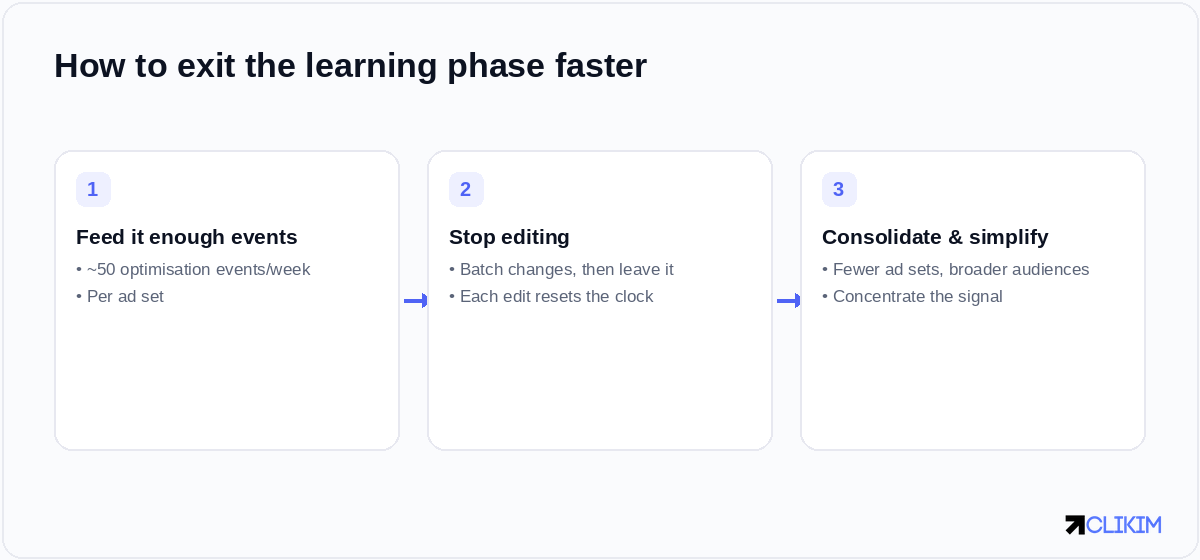
Exiting learning is mostly discipline: feed enough events, stop editing, and concentrate the signal.
- Feed it enough events. Make sure each ad set can realistically hit ~50 optimisation events a week — through adequate budget, a broad enough audience, or optimising for a more frequent event.
- Stop editing. Batch any changes, make them at once, then leave the ad set alone. Every significant edit resets the clock.
- Consolidate and simplify. Fewer ad sets with broader audiences concentrate your events instead of dividing them — the consolidated structure exists partly for this reason.
Dealing with "Learning Limited"
If you see Learning Limited, Meta is telling you the ad set can't get enough optimisation events to ever exit learning — it's stuck. The fixes are structural: consolidate ad sets to pool their events, broaden the audience, raise the budget, or optimise for an earlier, more frequent event.
Ignoring "Learning Limited" means accepting permanently unstable, expensive delivery, so treat it as the warning it is rather than a cosmetic label. It's one of the few status messages Meta gives you that translates almost directly into "do this specific thing," so act on it.
Reading the delivery status column
The Delivery column in Ads Manager is your dashboard for all of this, and learning to read it saves a lot of guesswork. "In review" means the ad hasn't started yet; "Learning" with a small progress indicator tells you the ad set is mid-phase and shouldn't be touched; "Active" means it has exited and stabilised; and "Learning Limited" is the red flag covered above. Hovering the status usually reveals how many more events Meta estimates the ad set needs, which is the single most useful number for deciding whether to wait or restructure.
Get into the habit of checking this column before you check the cost numbers. If an ad set is still in "Learning," its cost per result is provisional and you should resist drawing conclusions; if it's "Active" and still expensive, that's a genuine signal worth acting on. Reading the status first, results second, is a small discipline that stops you from killing winners and babysitting ad sets that just need another day to settle.
Patience as strategy
The hardest part of the learning phase is psychological. A new ad set looks expensive and erratic for the first day or two, and the instinct is to do something — cut the budget, change the audience, pause it. Almost always, doing something is the mistake: it resets learning and guarantees the instability continues.
The discipline is to fund the ad set properly, leave it alone, and judge it only after it has exited learning and run on stable footing. Boring patience beats anxious tinkering nearly every time — which is genuinely hard to accept when money is on the line, but is exactly what separates advertisers who compound results from those who churn through ad sets.
Scaling without resetting learning
Scaling is the most common reason advertisers needlessly reset learning. A big budget jump on a winning ad set can throw it straight back into the unstable phase, undoing the very stability you were trying to exploit. The fix is to scale in gentle steps — many buyers raise budgets around 20–30% at a time — and let delivery re-stabilise before the next increase. The full method is in scaling without getting banned, where avoiding needless re-learning is one of the central ideas.
When it's not learning — it's something else
Don't blame the learning phase for everything. If an ad set isn't spending at all (as opposed to spending choppily), that's usually a different problem — a budget, bid, billing or audience issue covered in why Facebook ads don't spend. Learning-phase instability is choppy delivery; a hard stop is a delivery blocker, and the two have different causes and fixes.
The account angle
One under-appreciated connection: account caps and restrictions force exactly the kind of disruptions that reset learning. When a spend cap stops delivery or a restriction freezes an account, the campaigns that come back often have to re-learn from scratch, wasting the data you'd built.
Running on a stable, uncapped agency account removes those interruptions, so your ad sets exit learning once and stay there — which, compounded over a busy account with many ad sets, is a real and ongoing efficiency gain rather than a one-off fix.
Event Match Quality benchmarks — the signal density that feeds learning. deduplication — doubled events teach the algorithm twice-wrong lessons.
Frequently asked questions
What is the Facebook learning phase?+
How many events to exit the learning phase?+
What resets the Facebook learning phase?+
Does my optimisation event affect the learning phase?+
What does 'Learning Limited' mean?+
How do I exit the learning phase faster?+
Should I judge results during the learning phase?+
Does editing my ad set reset learning?+
Why is the learning phase so expensive?+
Does scaling reset the learning phase?+
Can I avoid the learning phase?+
Do account restrictions affect the learning phase?+
Stop re-learning every time the account hiccups
Uncapped, stable managed infrastructure means fewer interruptions that reset learning — so your ad sets stabilise once and stay there. Operated on BM2500 infrastructure.