
Facebook Ad Creative: Best Practices That Convert
On broad audiences, creative is the targeting — most of your performance is decided here. This is the concrete playbook: the anatomy of a converting ad, why the hook is everything, testing angles instead of tweaks, designing per placement, and measuring it right.
On broad audiences, creative is the targeting, so it's the biggest performance lever you control. Every converting ad does four jobs in order — hook → value prop → proof → CTA — and the hook (first ~3 seconds) carries most of the result. Start from the customer's pain and words, not your features; test whole angles rather than cosmetic tweaks; design for each placement; and ship creative in volume to beat fatigue.
• On broad audiences, creative is the targeting — most of your performance is decided here. • Every winning ad does four jobs: hook → value prop → proof → CTA. • The hook (first ~3 seconds / first line) carries a disproportionate share of results. • Start from the customer's pain and words, not your feature list. • Test angles (different messages), not cosmetic tweaks like button colours. • Design for the placement — feed, Reels and Stories are different canvases. • Creative volume beats fatigue, but only an account that stays live can run it at scale.
Why creative is the most important lever
For most of Facebook's history, media buyers won by out-targeting each other. That era is over. As broad audiences and Advantage+ automation have taken over (see our account structure guide), the algorithm now decides who sees your ads — and the main thing you control is the creative. The hook, the message and the offer are what attract the right people from a broad pool, which means creative has quietly become the single biggest performance lever in the account.
This guide is about getting that lever right. Not vague "make good ads" advice, but the concrete anatomy of a converting ad, the angles worth testing, how to design for each placement, and the testing discipline that turns creative from guesswork into a repeatable system. Master this and you'll out-perform competitors who are still fiddling with audience settings.
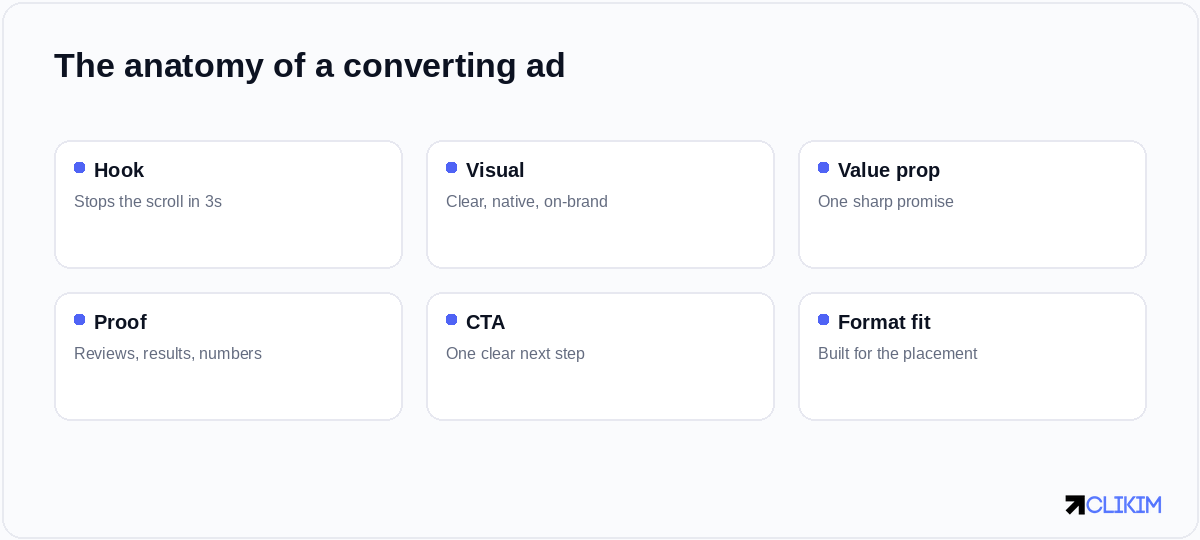
Converting ads share an anatomy: a hook, a clear visual, one sharp value prop, proof, and a single CTA.
The anatomy of a converting ad
Strip away the format and almost every high-performing ad does the same four jobs, in roughly this order.
Every winning ad does these four jobs in order — most weak ads skip straight to features and forget the hook.
The order matters as much as the elements. You earn attention with the hook, convert that attention into interest with a single clear promise, make it believable with proof, and then tell people exactly what to do. Weak ads usually fail by skipping the hook and the proof and leading with a feature list — talking about themselves to an audience that hasn't yet been given a reason to care.
Lead with the hook
The hook is the first three seconds of a video or the first line of copy and the opening image — and it decides whether the rest of your ad is ever seen. In a feed full of competing content, most people scroll past in that window, so a disproportionate share of your performance is determined before your product is even mentioned. A great offer behind a weak hook reaches almost no one.
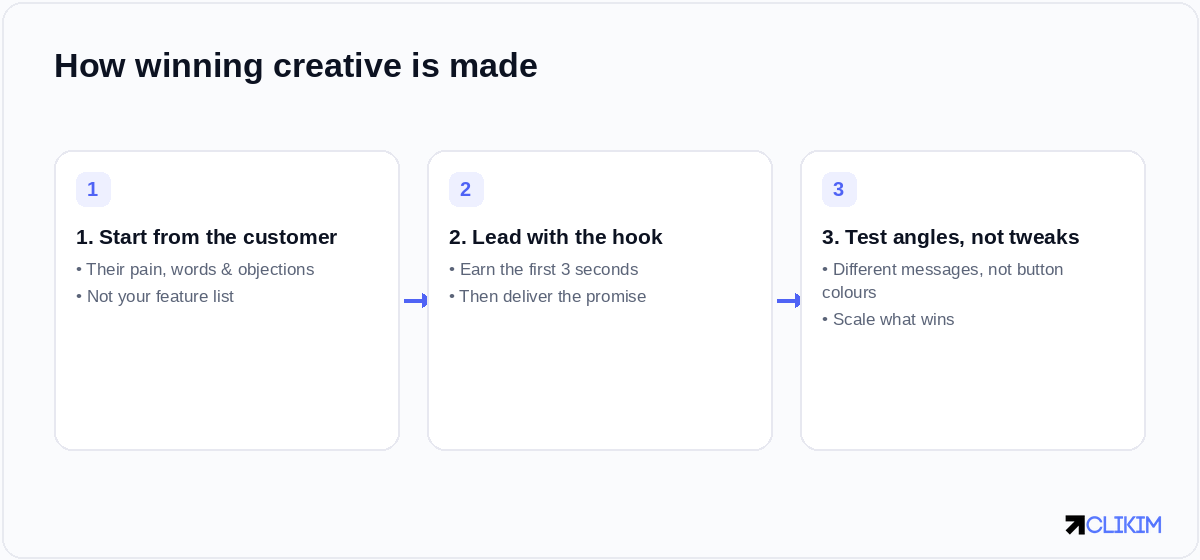
Winning creative starts from the customer, leads with the hook, and tests whole angles rather than tiny tweaks.
Treat the hook as your primary creative variable. Open with the customer's problem ("if your Facebook ads keep getting rejected…"), a bold claim, a surprising visual, or a pattern interrupt — then test several hooks against the same body. Often a new opening is the entire difference between a flop and a winner, which is why disciplined advertisers test hooks relentlessly.
Start from the customer, not the product
The most common creative failure is being product-centric — leading with features, specs and brand language the customer doesn't yet care about. Winning creative starts from the customer: their problem, their desired outcome, the exact words they'd use, and the objections stopping them from buying. Mine reviews, support tickets and comments for that language and build ads around it.
When an ad speaks to a pain the viewer actually feels, in words they actually use, it feels less like marketing and more like someone finally understanding them. That resonance — not production polish — is what converts. Features have their place, but they come after you've connected with the problem, never before.
Test angles, not tweaks
A huge amount of testing effort is wasted on cosmetic tweaks — button colours, minor copy edits, slightly different thumbnails. These rarely move the needle. The high-leverage variable is the angle: the core message and emotional approach of the ad.
An 'angle' is the core message, not the format — testing different angles beats endlessly tweaking the same one.
The same product can be sold as a problem-solver, an aspirational outcome, a trusted choice (social proof), a founder mission, or a great deal — and different angles resonate with different people. Testing across angles finds the message that unlocks an audience, which is worth far more than optimising the wording of an angle that was never going to work. Find the winning angle first; polish second.
Writing copy that supports the creative
While the visual or video does most of the heavy lifting in-feed, copy still matters — especially the first line, which shows before the "see more" cut. Lead with the hook in your copy too, keep sentences short and scannable, speak to one person not a crowd, and end with a single clear call to action. Walls of text get skimmed; tight, punchy copy gets read.
Match copy length to the buy. An impulse product can win on one punchy line; a considered purchase may need longer copy that handles objections and builds the case. The rule isn't "short" or "long" — it's "as long as it needs to be to move this specific buyer, and not a word more."
Design for the placement
A frequent, avoidable mistake is running one asset everywhere and letting Facebook crop it. Feed, Stories, Reels and right-column are genuinely different canvases, and creative should be built for each.
Design for the placement — a feed square and a 9:16 Reel are different canvases, not the same asset stretched.
Vertical 9:16 for Stories and Reels, square or 4:5 for feed, with text and key visuals positioned so nothing important gets cropped or hidden behind UI. It takes a little more effort to export per-placement versions, but native-fit creative consistently outperforms stretched one-size-fits-all assets — the audience can tell when something was built for where they're seeing it.
Build in proof and trust
Belief is half the battle. Even a perfectly hooked, well-targeted ad fails if the viewer doesn't trust the claim. Bake proof into the creative: real reviews and testimonials, specific numbers and results, recognisable logos or press, ratings, and authentic UGC that shows real people using the product. Specificity beats superlatives — "12,000 five-star reviews" outperforms "the best."
Proof matters even more for higher-priced or trust-sensitive purchases, where skepticism is the default. The more you're asking someone to risk, the more evidence the creative needs to carry. Folding social proof into the ad itself — not just the landing page — closes the believability gap at the exact moment attention is highest.
Volume and fighting fatigue
No single ad wins forever. Every creative eventually fatigues as the audience sees it too often and performance decays, so a steady supply of fresh creative is non-negotiable for sustained results. This is why creative is treated as an ongoing production line, not a one-off project — the brands that scale are the ones shipping new concepts and variants continuously.
Build a pipeline that reliably produces tested-ready creative, keep a backlog of winners-in-waiting, and rotate them in as performers fade. Volume also feeds the algorithm: more quality variants give Meta more to optimise across, which compounds the benefit. UGC is popular precisely because it makes this volume affordable.
Common creative mistakes
- No hook — a slow intro that loses people before the message lands.
- Feature-dumping — listing specs instead of speaking to a problem or outcome.
- One asset everywhere — stretching a feed square into Stories and Reels.
- No proof — making claims with nothing to make them believable.
- Tweak-testing — optimising button colours instead of testing angles.
- Set and forget — running winners until they fatigue with no replacements ready.
Measuring creative properly
Judge creative by the right metrics, in order. Hook rate (3-second views) tells you if the opening works; hold/thruplay tells you if it keeps attention; CTR tells you if it drives action; and CPA/ROAS is the final word on whether it sells. Reading these top-down turns "this ad failed" into a specific diagnosis — a weak hook, a boring middle, a flat CTA, or a downstream problem.
And resist judging creative by your own taste. The ads you personally like and the ads that convert are frequently different, because you are not your customer. Let the metrics decide, kill losers quickly, and scale winners — taste is a starting hypothesis, not the verdict.
Creative-led growth needs a stable account
A serious creative operation only pays off if it can run continuously and at scale — shipping new tests, spending into winners, iterating week after week. That sustained, scaling activity is exactly what strains fragile, low-trust accounts, which get throttled or banned right when your creative machine hits its stride, resetting your learning and interrupting your tests.
That's why creative-led advertisers pair their pipeline with a stable, high-trust agency ad account built to absorb real spend without dropping out. The best creative in the world can't compensate for an account that won't stay live — the two work together, or not at all.
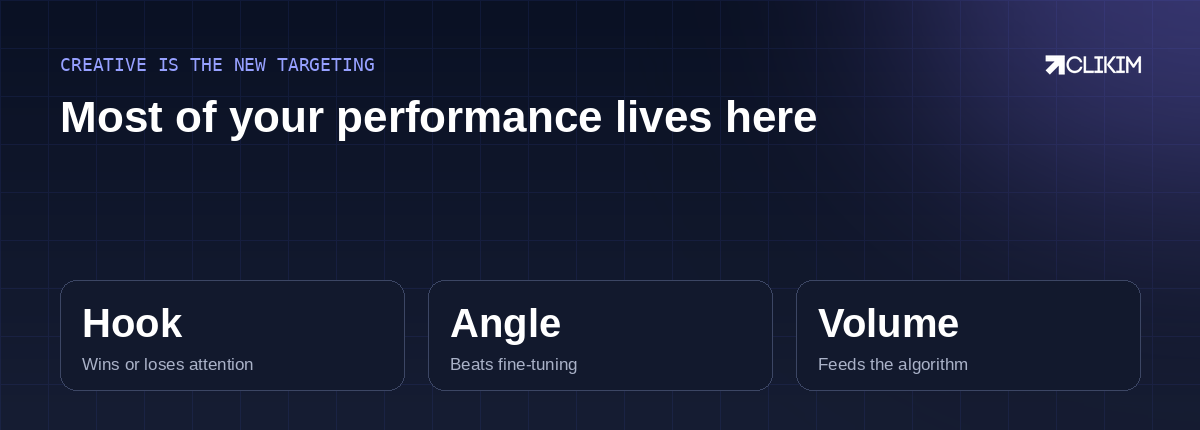
Creative is where modern performance is won — but the machine only compounds on an account that stays live.
Frequently asked questions
What makes a good Facebook ad creative?+
Why is creative so important now?+
What is a hook in a Facebook ad?+
Should I test angles or small tweaks?+
How do I write Facebook ad copy that converts?+
Should I make different creative for each placement?+
How important is social proof in ad creative?+
Why do my ads stop working over time?+
How do I measure ad creative?+
Should I trust my own taste on creative?+
How much creative do I need?+
Does great creative need a special ad account?+
Great creative deserves an account that won't quit
A creative-led strategy needs to spend and test continuously. Run on managed whitelisted infrastructure that absorbs real scale without interruptions. Operated on BM2500 infrastructure.