
Facebook Ads for Crypto & Web3 (What's Allowed in 2026)
Meta doesn't ban crypto anymore — it bans unlicensed crypto. The March 2026 three-tier system decoded: what needs written permission, what runs under standard review, the application package that clears, the creative rules no tier escapes, and the honest options when you don't have a license.
Since March 2026, Meta runs a three-tier authorization system for crypto: anything that lets users trade, stake, swap or custody funds needs written permission via Business Suite's Authorizations tab, backed by a recognized license (FCA, SEC, MAS, BaFin — Tier 1 unlocks full conversion campaigns). Ancillary products — tax tools, analytics, education — run under standard review. Review is now holistic: ad + targeting + landing page judged together. In every tier: no return promises, no invest-urgency, no get-rich imagery, 18+ geo-scoped targeting. Unlicensed? Get licensed, reposition outside monetization scope, or skip Meta — cloaking converts rejections into network-level bans. And guard the BM the authorization lives on: infrastructure kills more crypto campaigns than policy does.
• Meta allows crypto advertising in 2026 — for licensed operators with written permission, obtained via the Authorizations tab in Business Suite. • The March 2026 three-tier system decides what you can run: Tier 1 (recognized regulators — FCA, SEC, MAS, BaFin) gets conversion campaigns; lower tiers get less. • The permission trigger is monetization — trading, staking, swapping, custody — not the word 'crypto'. Education, news and ancillary tools run under standard review. • Review is holistic since March 2026: creative, copy, targeting and landing page are evaluated as one unit. • Creative rules survive authorization: no return promises, no urgency-to-invest, no 'get rich' — in any tier. • Unlicensed operators have three honest options: get licensed, reposition the product outside monetization scope, or don't run Meta ads — cloaking is the one unforgivable sin. • The account layer carries double weight in crypto: authorization attaches to verified, high-trust business infrastructure.
The 2026 reality: from blanket ban to licensing gate
Crypto advertising on Meta has cycled from banned (2018) to cautiously permitted to, since March 2026, a formal licensing gate: a three-tier authorization system in which what you may advertise is a function of how regulated you are. The primary sources are Meta's cryptocurrency ad standards and the Business Help Center policy page — but the operational summary is simple: Meta doesn't sell crypto ads; it sells distribution to licensed financial operators who happen to be in crypto. Approach it as a financial-services application, not a marketing task, and the whole process makes sense.
Also new since March: holistic review. Meta no longer evaluates the ad creative in isolation — copy, targeting, landing page and the advertiser's authorization status are assessed together. The era of a compliant ad in front of a moon-promising landing page is over; the funnel is the unit of review.
What needs permission (and what doesn't)
The scope table that settles most arguments. The trigger isn't the word 'crypto' — it's whether the product lets users monetize, trade, or move funds.
The table's logic is worth internalizing: the policy's trigger word is monetization. A product that lets users trade, stake, swap, custody or otherwise move value needs written permission and a license behind it. Products around crypto — tax software, portfolio dashboards, analytics, education, conferences — generally run under standard advertising review, though every claims rule in the general policy stack still applies. Web3 games are the honest gray zone: gameplay marketing is fine, but the moment the pitch features tokenized earnings or tradable assets, you've drifted into permission territory — market the game, not the token.
The three tiers, and what each unlocks
The three-tier system Meta rolled out in March 2026. Your tier decides your objectives, geographies and creative latitude — argue your tier at application, not in appeals.
Practical consequences of the tiering: Tier 1 operators (licensed exchanges and custodians under recognized regulators) can run the full funnel — awareness, app installs, conversions — with creative latitude approaching normal fintech. Tier 2 regimes get restricted objectives and geographies; plan campaigns around what your tier permits rather than discovering it in rejections. Tier 3 covers the ancillary world that never needed permission — but note that claiming Tier 3 while quietly onboarding users into trading is exactly what the holistic review exists to catch. Your tier is determined at application; the strategic move is assembling the strongest possible regulatory paper before applying, because re-tiering is slower than tiering right the first time.
The application, step by step
(1) Verify your business in Business Manager first — unverified businesses don't clear the starting gate. (2) Open Business Suite → Authorizations and Verifications and start the cryptocurrency application. (3) Submit the package: your regulatory license or registration (jurisdiction-matched to where you'll advertise), proof of custody insurance where applicable, and compliance certification from a recognized auditor. (4) Declare target geographies honestly — permission is geo-scoped, and advertising into an unlicensed jurisdiction is a fast unwind. (5) Expect the review to take weeks, not days; build it into launch timelines. (6) Once granted, the authorization attaches to your Business Manager — which makes the health of that BM (see below) a business-critical asset.
Creative rules that survive authorization
Permission changes what you may advertise, not how you may talk. The rules that still end campaigns in any tier: no promises or implications of returns (“earn 12% APY” framing on retail audiences is the classic kill), no urgency-to-invest mechanics (countdowns, “last chance”, FOMO framing), no get-rich narratives or lifestyle-flex imagery doing the promising your copy avoided, and 18+ targeting everywhere with additional geo exclusions per your license map. What works instead mirrors regulated fintech: product utility (“trade 200+ assets with transparent fees”), security and custody credentials, education-first funnels that let the landing page do the regulated disclosure work. The quality-ranking machinery applies unusually strongly here — crypto audiences report ads liberally, and negative feedback compounds category scrutiny.
The honest section: what if you're not licensed?
Three real options. Get licensed — jurisdictions like the UAE, Singapore and several EU MiCA regimes have workable paths for serious operators, and the license unlocks every other channel too. Reposition — if your actual product can stand without monetization mechanics (education, tooling, analytics), market that product honestly under standard review. Or don't run Meta ads — organic, community, KOLs and crypto-native networks remain open. What is not an option: cloaking — compliant landing pages swapped post-review, geo-gated bait pages, “presentation sites.” Cloaking is Meta's single most aggressively-hunted offense; it converts a rejected campaign into network-level bans that follow the entity, the people and the payment instruments. The industry graveyard is full of projects that treated cloaking as a growth hack — the restricted industries hub catalogs how those stories end.
A worked application: the exchange that tiered right the first time
The composite worth copying: a mid-size European exchange with a MiCA registration and a UK ambition. Instead of applying immediately, it spent six weeks assembling the package — FCA registration completed first (knowing Tier 1 status rides on the strongest license in the stack), custody insurance documentation refreshed, a compliance certification commissioned from a recognized auditor, and the Business Manager scrubbed: business verification done, stray admin profiles evicted, 2FA enforced, domain reputation checked. The application declared exactly the geos the licenses covered — UK and four EU markets — resisting the temptation to add “just awareness” campaigns elsewhere.
Authorization landed in under a month, at Tier 1. The launch plan then respected the creative rules as hard limits: utility-led ads (asset coverage, fee transparency, custody credentials), education-first funnels, zero APY numbers anywhere a retail user could see them. Six months on, the program runs conversion campaigns in five markets — while two better-funded competitors who applied with thinner paper sit in Tier 2 re-application queues, and a third burned its entity on a cloaked funnel in April. The moral isn't subtle: in this vertical, the boring six weeks before the application are the growth hack.
The account layer: where crypto campaigns actually die
Here's the vertical's operational secret: most crypto advertisers who have authorization still lose campaigns to infrastructure, not policy. The authorization attaches to a Business Manager — so a BM restriction from unrelated sloppiness (a hacked admin profile, a billing dispute, a flagged domain elsewhere in the portfolio) suspends the crypto permission with it. And fresh ad accounts inside even an authorized BM carry the standard new-account distrust: caps that strangle launch budgets, review queues that eat announcement windows. The professional setup mirrors the continuity playbook: authorization on a fortress BM, spend running through aged, managed whitelisted infrastructure with headroom and replacements, 2FA on every human, and the claims ladder enforced on every asset touching the funnel. Crypto is the vertical where infrastructure diligence pays its highest premium — because re-earning a suspended authorization makes a normal account appeal look quick.
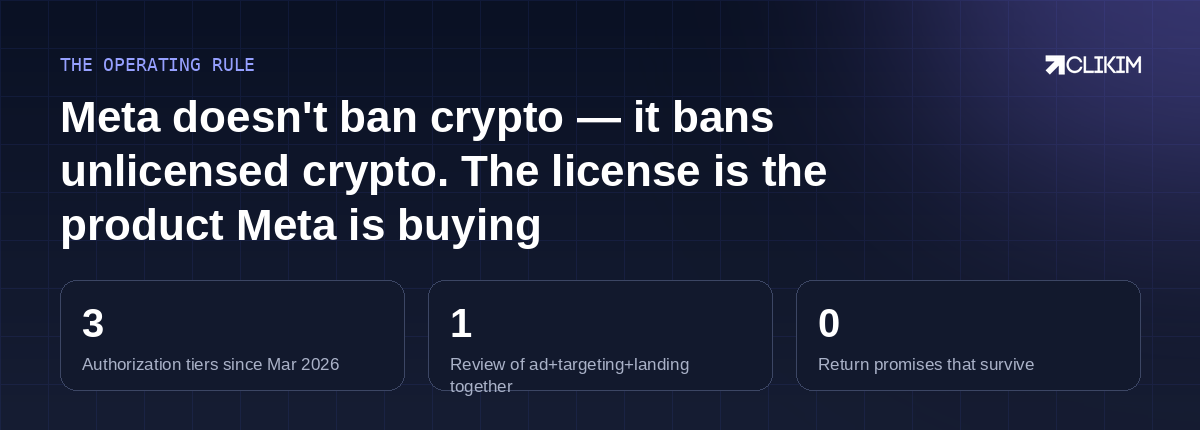
License, authorize, then advertise like a regulated fintech — the boring path is the only one still standing.
Frequently asked questions
Can you advertise crypto on Facebook in 2026?+
What crypto products need Meta's written permission?+
What can I advertise WITHOUT crypto authorization?+
Which licenses does Meta accept for crypto ads?+
How long does Meta's crypto authorization take?+
What are the three tiers Meta introduced in March 2026?+
Why do authorized crypto ads still get rejected?+
Can I advertise an NFT project or web3 game?+
What happens if I run crypto ads without permission?+
Is cloaking ever worth the risk for crypto?+
Do crypto advertisers need special ad accounts?+
Where should unlicensed crypto projects advertise instead?+
Does the authorization cover all my ad accounts?+
Can I mention token prices or market performance in ads?+
Authorization deserves a fortress underneath it
Aged, whitelisted infrastructure on high-trust BMs — headroom for launches, replacements for emergencies. Operated on BM2500 infrastructure.