
Running Facebook Ads in Restricted Industries: The Playbook
Compliance gets you approved; infrastructure keeps you alive — restricted verticals demand both layers. The full map: prohibited vs restricted vs grey, the unwritten enforcement rules, the compliance stack, vertical-by-vertical notes, and why serious operators run agency infrastructure.
Facebook’s rules come in tiers — and success in restricted verticals is two layers: compliance and infrastructure.
The tiers: prohibited (no path), restricted with authorization (gambling, crypto, politics — real application paths, mostly via partners), restricted with limits (alcohol, dating, finance), and grey zones (supplements, weight loss, MMO, dropshipping) where enforcement polices framing: before/afters, outcome claims, income flexes and personal-attribute language kill accounts.
The two layers that survive it: a compliance stack (claims surgery, LP match, licenses, pre-launch review) and an infrastructure layer — high-trust agency accounts with escalation and replacement continuity.
- Facebook’s rules come in tiers: prohibited (no path), restricted (permission/limits), and grey zones policed by enforcement patterns.
- The unwritten rules matter more than the policy text — before/afters, income flexes and personal-attribute framing kill accounts.
- Success is two layers: a compliance layer (claims hygiene, LP match, licenses) and an infrastructure layer (trust, escalation).
- Self-serve accounts in restricted verticals live on borrowed time — zero policy credit, bot enforcement, no humans.
- Authorization tiers (gambling, crypto, politics) have real application paths — through partner infrastructure.
- Strip claims to provable and non-outcome; let the product page close what the ad can’t say.
- Restricted-vertical operators diversify: multiple platforms, owned channels, backup accounts.
The two-layer reality of restricted advertising
Every restricted-vertical operator eventually learns the same lesson: compliance and survival are different problems.
Compliance — clean claims, proper licenses, matching landing pages — gets ads approved. Survival — accounts that don’t evaporate at the first automated flag — is an infrastructure problem, decided by account trust, escalation paths, and how the platform’s risk systems classify you before a human ever looks.
Brands that solve only the first problem run compliant ads on disposable accounts and still die monthly; brands that solve only the second run bulletproof infrastructure into policy strikes it can’t deflect.
This playbook covers both layers. First the map — what's actually prohibited versus restricted versus grey — then the unwritten enforcement rules, the compliance stack, and the infrastructure question that decides whether your vertical is a business or a subscription to appeals.
The map: prohibited, restricted, grey
Know your tier before spending a dollar — each has different rules, risks and infrastructure needs.
The tiers behave differently under Meta’s Advertising Standards:
- Prohibited is a wall — no creative cleverness changes it, and attempts poison everything the attempt touches.
- Restricted with authorization (online gambling, crypto exchanges, political ads) has a real path: applications, licenses, written permission — bureaucratic but navigable, mostly through partner channels.
- Restricted with limits (alcohol, dating, financial products) runs under special rules — age floors, geo fences, special ad categories for housing/credit/employment.
- Grey zones — supplements, weight loss, make-money, dropshipping — are where most of the carnage happens, because the products are allowed while the marketing that sells them best is not.
The unwritten rules (where accounts actually die)
The policy text is the floor; enforcement patterns are the real ceiling — operate to the ceiling.
The pattern across every row: enforcement polices framing, not just products. A supplement is legal; a before/after implying it cures something is a strike. A trading platform is licensed; a Lambo-and-income-screenshot ad is a flag.
Addressing viewers by their condition (“struggling with X?”) violates personal-attributes policy regardless of product legality. Restricted-vertical creative lives inside a narrower box than the policy text implies — and per our rejection guide, strikes accumulate invisibly at the account level long before the ban arrives.
Why do my compliant ads still get rejected?
Enforcement polices framing and patterns beyond the policy text, and restricted categories run on stricter automated review with lower strike tolerance. Also: the landing page is reviewed as hard as the ad — mismatch or aggressive funnels flag compliant creative.
Layer one: the compliance stack
Restricted verticals don't get the benefit of the doubt — the compliance layer replaces it.
The heart of it is claims surgery: strip every ad to what’s provable and non-outcome. “Supports your morning routine” survives where “melts fat” dies; “trusted by 40,000 customers” survives where “guaranteed results” doesn’t.
Let the ad sell the feeling and the proof, and let the product page — which Meta reviews more leniently than ad creative — carry the details.
Then add landing-page match (the destination is reviewed as hard as the ad, as every TikTok casualty also learns), visible policies, and a pre-launch review gate for every creative batch: in restricted verticals, the testing engine needs a compliance check between brief and launch.
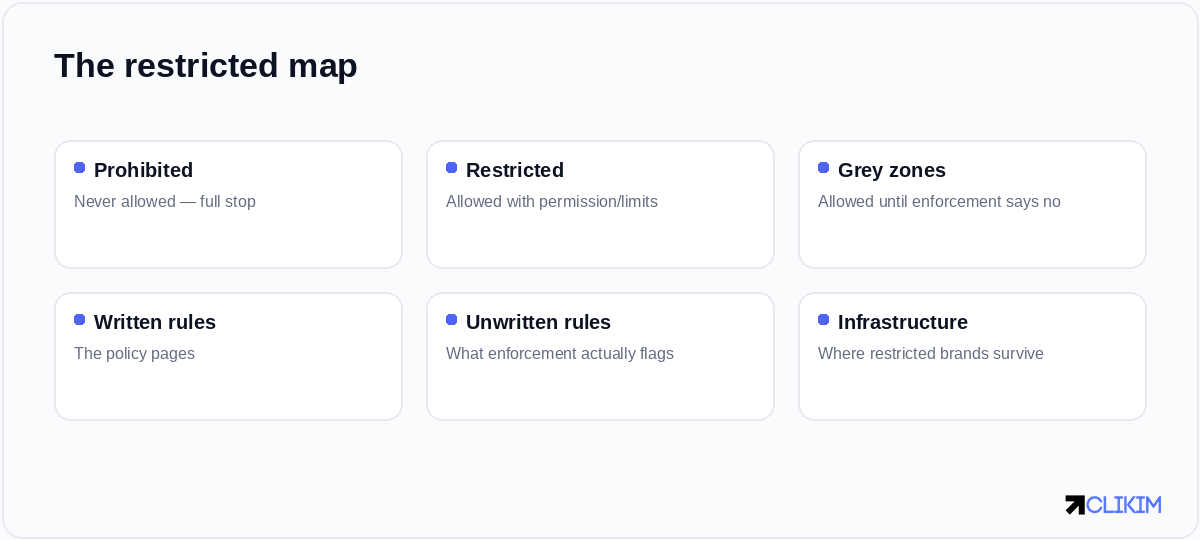
Prohibited, restricted, grey — then the rules nobody wrote down, and the infrastructure that survives them.
Layer two: the infrastructure question
Here’s the asymmetry that defines restricted advertising: your vertical starts every account at elevated suspicion. Automated systems classify by category signals — supplement funnels, finance language, dating creative — and apply stricter review, faster escalation and lower strike tolerance from day one.
A fresh self-serve account in a grey vertical is a probationary account in a high-crime category: zero accumulated trust, bot-first enforcement, and appeal queues instead of humans when the inevitable false positive lands.
Do agency ad accounts help in restricted industries?
They’re the infrastructure layer: inherited trust that absorbs ambiguity, real authorization paths for licensed tiers, human escalation when automation over-fires, and replacement continuity when actions land anyway — the difference between losing a day and losing a quarter.
This is why serious restricted-vertical operators run agency ad accounts: inherited standing that absorbs ambiguity, actual authorization paths for the licensed tiers (gambling, crypto, finance), human escalation when automation over-fires, and replacement continuity when an account is actioned anyway — because in these verticals, occasional actions are a cost of doing business, and the difference between operators and casualties is whether an action costs a day or a quarter.
Quick notes by vertical
- Supplements & wellness — the claims box is the whole game: no outcomes, no before/afters, no condition-targeting language; UGC testimonials need disclaimers and restraint.
- Financial services & crypto — licensed products have authorization paths (use them); income promises and screenshots are the kill-switch; crypto rules shift quarterly — recheck.
- Dating — restricted with permission requirements and strict creative rules; suggestive imagery burns accounts.
- iGaming — authorization-tier with geo-licensing complexity; partner infrastructure is effectively mandatory.
- Dropshipping & MMO — technically unrestricted, behaviorally profiled: outcome promises, fake scarcity and sketchy LPs are what actually flag; boring honesty scales furthest.
Every vertical shares one rule: recheck the policy quarterly. These lists move, and last year's compliant angle is this year's strike.
Operating rhythm for restricted brands
The habits that keep restricted accounts alive read like a stricter version of the standard ban-prevention playbook:
- Compliance-gate every creative batch.
- Watch Account Quality weekly and treat any flag as a fire drill.
- Scale in gentle steps — velocity flags fire faster in profiled categories.
- Keep billing pristine.
- Never run the whole business through one account — separation and backups aren’t paranoia here, they’re accounting.
Add the diversification layer: owned channels (email, SMS) capturing every paid visitor, and a second platform so no single enforcement system owns your revenue.
And document everything — licenses, approvals, correspondence. When a human finally reviews your case, the operator with a paper trail gets a different conversation than the one with vibes.
Claims surgery, demonstrated
Abstract rules land better with before/afters of the copy itself.
A weight-management brand’s dead ad: “Lose 12 lbs in 30 days — guaranteed! Are you tired of belly fat that won’t budge?” — outcome promise, timeline claim, guarantee, personal-attribute framing: four strikes in two sentences.
The compliant rebuild that scaled: “40,000 customers made mornings simpler with one scoop. Here’s what a dietitian says about what’s inside.” Social proof, provable number, authority transfer, zero outcomes — the desire arrives by implication, which is the only way it’s allowed to arrive.
Same surgery for finance: "I made $30k last month trading — screenshot inside" becomes "Licensed platform. 2M users. Learn how CFD trading actually works — including the risks." The first is a kill-switch; the second passes review and, counterintuitively, converts better with cold audiences who've learned to distrust the Lambo genre. Compliance and persuasion aren't opposites — the constraint just relocates the persuasion from claims to proof.
Is it worth it?
Restricted verticals carry a permanent operating tax: narrower creative, compliance overhead, infrastructure costs, occasional account actions even when you do everything right.
What justifies the tax is the same thing that created it — these categories print money precisely because most competitors can’t survive the filter. The brands that industrialize compliance and infrastructure operate in markets with structurally suppressed competition; the ones that treat either layer as optional fund the appeals economy instead.
The decision is honest math: if your unit economics can't absorb the tax, pick a different vertical; if they can, build both layers properly and enjoy the moat the filter builds around you.
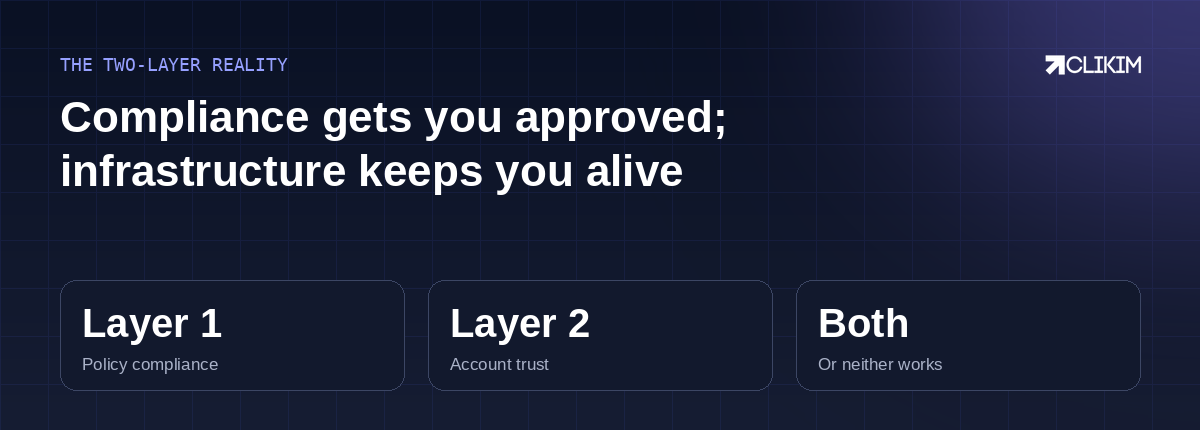
Approved by compliance, alive by infrastructure — restricted verticals demand both layers, and reward them.
Frequently asked questions
Which industries are restricted on Facebook?+
Can I run supplement ads on Facebook?+
Can I advertise crypto or gambling on Facebook?+
What are the 'unwritten rules' of restricted advertising?+
Why do restricted-vertical accounts get banned so often?+
What is the compliance stack for restricted verticals?+
Is dropshipping restricted on Facebook?+
How do I keep a restricted-vertical account alive?+
How often do restricted-category rules change?+
Is advertising in a restricted vertical worth the overhead?+
Built for the verticals others can't survive
High-trust managed infrastructure with authorization paths, human escalation and replacement continuity — infrastructure for restricted-vertical operators. Operated on BM2500 infrastructure.