
The Complete Facebook Retargeting Guide
Retargeting is the most efficient spend in most ad accounts — and the most misunderstood. Here's how to build audiences, segment by intent and recency, write ads that fit the warmth, cap frequency, and why retargeting ROAS flatters you into bad decisions.
Facebook retargeting shows ads to people who already know you — site visitors, engagers and past customers — so it converts far better than cold prospecting. Build audiences from the pixel, engagement or a customer list, and segment them by intent and recency so a cart abandoner and a casual browser see different ads. Use frequency caps, exclude recent buyers, and remember retargeting is the closer, not the engine — it has high ROAS but limited volume and needs prospecting feeding it.
• Retargeting shows ads to people who already know you — site visitors, engagers, past customers. • It's the closer, not the engine: high ROAS but limited volume, because warm audiences are finite. • Segment by intent and recency — a cart abandoner and a casual browser need different ads. • Most website audiences rely on the pixel; engagement and list audiences don't. • Use frequency caps and rotate creative so you don't fatigue (and annoy) warm users. • Exclude recent purchasers and current customers so you don't pay to reach people who already bought. • Retargeting can't grow you alone — it needs cold prospecting feeding it fresh warm audiences.
What Facebook retargeting actually is
Retargeting (sometimes called remarketing) is the practice of showing ads to people who have already interacted with your business — visited your website, added something to cart, watched a video, engaged with your page, or bought from you before. Instead of paying to introduce yourself to strangers, you're paying to follow up with people who already know who you are. That single difference is why retargeting is the most efficient-looking spend in most ad accounts.
It works because warm audiences are dramatically more likely to convert than cold ones. Someone who added a product to their cart yesterday and got distracted needs only a nudge; a stranger seeing your brand for the first time needs convincing. Retargeting is the gentle nudge at scale — and understanding how to build, segment and cap it is one of the highest-leverage skills in paid social.
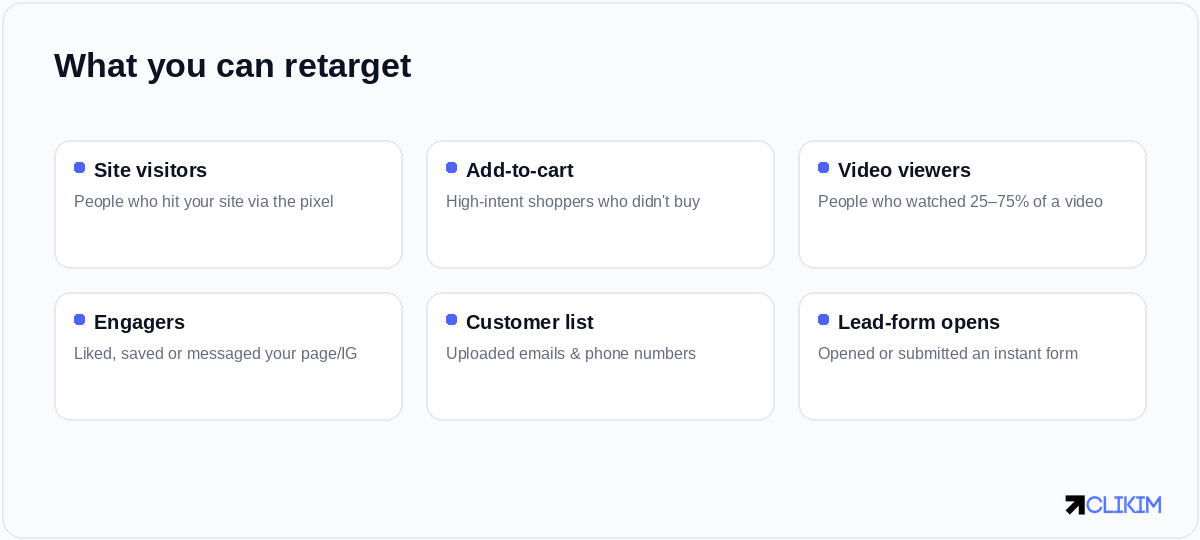
Retargeting audiences come from many sources — each captures a different slice of people who already know you.
Cold, warm and hot audiences
It helps to think in temperatures. Cold audiences are strangers — people who've never heard of you, reached through prospecting. Warm audiences have had some contact: they visited your site, watched your video, follow your page. Hot audiences are deep-intent — cart abandoners, checkout starters, repeat customers. Retargeting lives in the warm-to-hot range, and the hotter the audience, the higher the conversion rate and the smaller the size.
The whole craft is matching spend and message to temperature. Pour your persuasion budget into cold prospecting to create warmth, then let efficient retargeting harvest it. Skip either step and the machine breaks: no prospecting means no warm audiences to retarget; no retargeting means you create demand and let it leak away unconverted.
Where retargeting audiences come from
You can build retargeting audiences from several sources, and not all of them depend on the website pixel — which matters in a privacy-degraded world.
Engagement and list audiences work even when the pixel is degraded — a useful hedge against signal loss.
The practical takeaway is to diversify. Website custom audiences are powerful but shrink when the pixel is blocked, so pairing them with engagement audiences (which Meta tracks on-platform) and a regularly-updated customer list gives you retargeting pools that survive signal loss. If your website audiences look thin, weak pixel coverage is often why — the same issue covered in why your pixel isn't working.
Segment by intent, not just "visitors"
The single biggest retargeting mistake is treating everyone who touched your site as one audience and showing them all the same ad. Intent varies enormously, and your message should vary with it.
Match the message to the intent — a cart abandoner and a casual browser should never see the same ad.
A person who reached your checkout and bailed is worth a direct, urgent offer; someone who read a blog post is barely warm and needs softer reassurance. Building separate audiences by depth of intent lets you spend more where it pays and speak to each group in a way that actually fits where they are. This segmentation is where most of retargeting's extra ROAS is hiding.
Recency windows are temperature dials
Alongside intent, recency is the other axis of segmentation. Someone who visited an hour ago is far hotter than someone who visited two months ago, even if they did the same thing. Splitting audiences into recency windows lets you bid and budget by how close people are to buying.
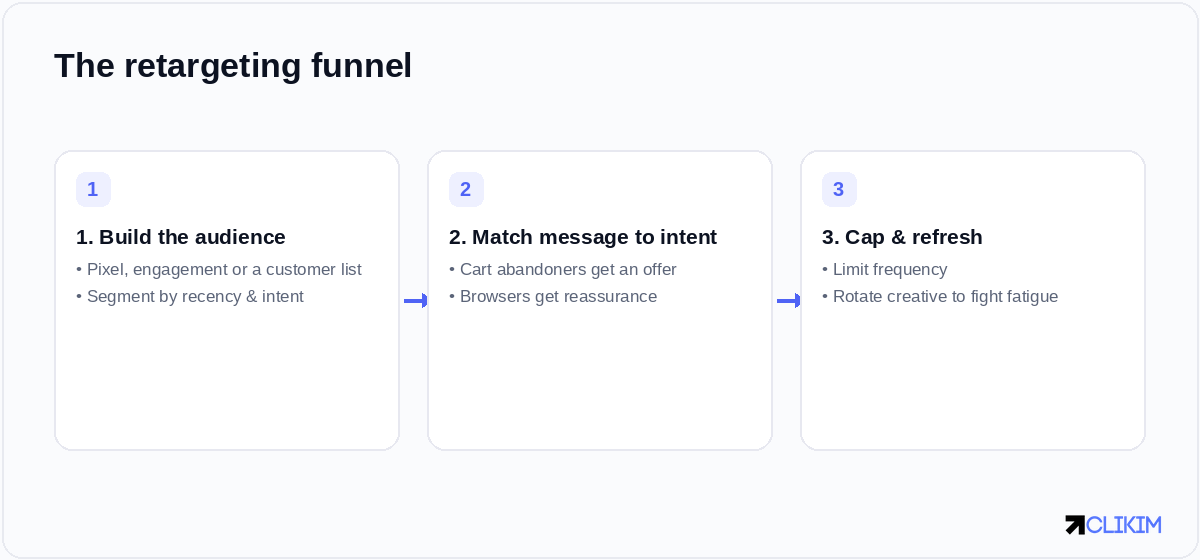
A simple retargeting loop: build the audience, match message to intent, then cap frequency and refresh creative.
Recency is temperature — segment your windows so you can spend more on the people closest to buying.
A common setup runs a tight 1–7 day window for cart abandoners with an aggressive offer, a 30-day window for general visitors with softer messaging, and a customer-list audience for loyalty and repeat purchases. The shorter the window, the smaller and hotter the pool — so the more you can justify spending per person.
What to actually say in a retargeting ad
Cold ads introduce; retargeting ads overcome the specific reason someone didn't buy. Cart abandoners often left over price, shipping or hesitation, so an offer, free-shipping reminder or a reassurance (returns policy, reviews) works. Browsers who didn't add to cart need the product's core benefit restated and social proof. Past customers respond to "what's next" — replenishment, upsells, new arrivals.
The mistake is recycling your prospecting creative into retargeting unchanged. The audience has already seen your intro; showing it again wastes the warmth. Treat retargeting creative as the answer to an objection, and your conversion rate climbs without touching your budget.
Exclusions: the other half of the job
Good retargeting is as much about who you exclude as who you include. Always exclude recent purchasers from your "abandoned cart" audience — there is nothing more wasteful (or more annoying to customers) than chasing someone with a discount for a product they already bought. Exclude current customers from acquisition offers, and exclude converters from each funnel stage so you don't pay twice.
Set these exclusions deliberately and revisit them, because as your funnel grows the overlaps multiply. A clean exclusion strategy quietly saves budget and protects the customer experience — two things that compound over time.
Frequency caps and ad fatigue
Because retargeting audiences are small, the same people see your ads again and again, and frequency climbs fast. Past a point this stops helping and starts hurting: people get annoyed, your brand feels desperate, and performance decays. Watch the frequency metric, cap it where you can, and rotate creative regularly so the warm audience doesn't burn out.
Creative fatigue hits retargeting harder than prospecting precisely because the audience is finite — there are only so many cart abandoners, and they see everything. Refreshing your retargeting creative every few weeks, and capping how often any one person is hit, keeps the channel healthy instead of grinding it into the ground.
Why retargeting ROAS is flattering
Retargeting almost always shows the highest ROAS in the account, and that number fools a lot of advertisers into over-investing. The catch is attribution: retargeting harvests demand that often would have converted anyway, so it claims credit for sales your prospecting actually created. A high retargeting ROAS on a small spend is not a signal to shift your whole budget there.
If you pause prospecting and pile into retargeting because the ROAS looks great, the warm audience empties within weeks and the whole account collapses — there's no one left to retarget. Judge retargeting by its role (closing demand) and keep funding the cold prospecting that creates the demand in the first place.
The volume ceiling
Retargeting cannot scale your business on its own, full stop. The audience is capped by how many people enter your funnel, so there's a hard ceiling on how much you can profitably spend retargeting them. Double your retargeting budget against a fixed warm audience and you just raise frequency and fatigue, not results.
This is why retargeting is the closer, not the engine. Growth comes from expanding the top of the funnel — more cold prospecting reaching more new people — which in turn enlarges the warm pool retargeting can work. The two are a system: prospecting fills the tank, retargeting burns the fuel efficiently.
How retargeting fits your account structure
Retargeting belongs in its own campaigns, separate from prospecting, so you can see and control exactly how much you spend re-engaging warm audiences versus finding new ones. Mixing them hides the truth and lets retargeting's flattering numbers mask weak prospecting. Our guide to account structure covers where these campaigns sit.
A typical structure is a prospecting stack (testing plus scaling) feeding a retargeting campaign with a few intent-based ad sets. Keep the retargeting budget proportionate — it should be a slice of total spend, not the bulk of it — and let it scale only as your prospecting enlarges the warm audience.
Retargeting in the Advantage+ era
Meta increasingly blends prospecting and retargeting automatically inside Advantage+ shopping campaigns, deciding the split for you rather than making you build separate audiences. For many ecommerce accounts this works well and reduces manual overhead. But it also means you cede some control over how aggressively warm users are hit.
The pragmatic 2026 approach is hybrid: let Advantage+ handle the bulk of blended delivery, while keeping a dedicated manual retargeting campaign for your hottest, highest-intent segments (cart abandoners, recent checkout drop-offs) where a tailored offer materially lifts conversion. Use automation for breadth and manual retargeting for the surgical, high-value moments.
Retargeting needs an account that stays live
Retargeting audiences are an asset you build over time — months of pixel data and engagement history. An account restriction or ban doesn't just pause your ads; it can sever access to those audiences and the pixel feeding them, wiping out warm pools you spent real money accumulating. The more valuable your retargeting, the more an unstable account costs you when it falls over.
That's why advertisers who lean on retargeting run on a stable, high-trust agency ad account — so the audiences they've built keep working and the pixel keeps feeding them, without the interruptions that reset everything. Protecting the infrastructure protects the asset.
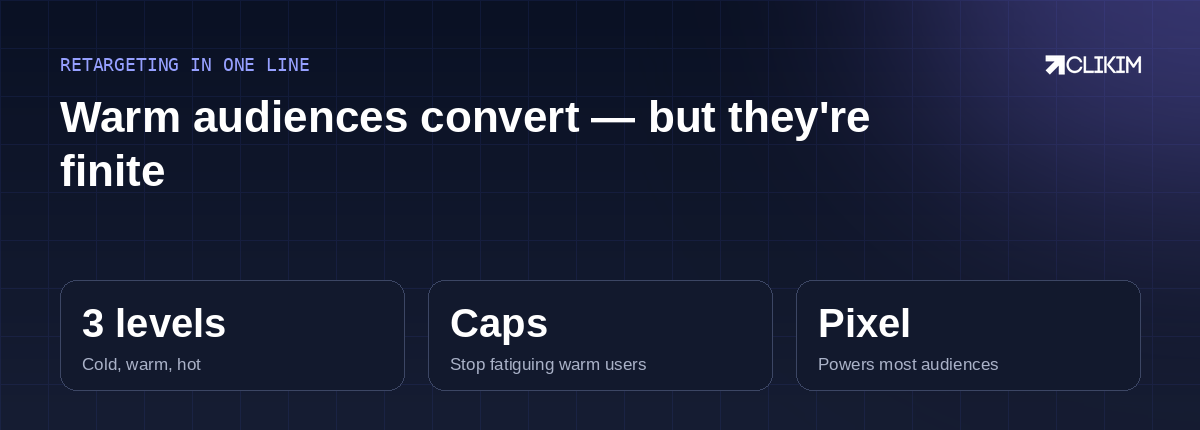
Retargeting is efficient but finite — cap frequency, exclude buyers, and keep prospecting feeding the warm pool.
iOS 26 and retargeting pools — the fbclid change that shrank them. EMQ benchmarks — match quality decides who your pools even recognize.
Frequently asked questions
What is Facebook retargeting?+
How is retargeting different from prospecting?+
Do I need the pixel for retargeting?+
How should I segment retargeting audiences?+
What should a retargeting ad say?+
Who should I exclude from retargeting?+
Why is my retargeting frequency so high?+
Why is retargeting ROAS so high?+
Can I scale my business with retargeting alone?+
What recency windows should I use?+
Does Advantage+ replace manual retargeting?+
Can I lose my retargeting audiences?+
Don't let a ban wipe out the audiences you built
Your retargeting pools are months of data. Run on stable, managed whitelisted infrastructure so your pixel and warm audiences keep working — no resets, no lost history. Operated on BM2500 infrastructure.