
What Is a Good CPM on Facebook? (2026 Benchmarks)
CPM is the price of being seen — and obsessing over it in isolation is a classic way to draw the wrong conclusion. Here's what a good Facebook CPM looks like in 2026, by industry, placement and audience, what drives it, how to lower it, and why you must always read it in context.
A good Facebook CPM in 2026 is contextual: a common broad range is around $8–20 per 1,000 impressions, but it varies enormously by industry, placement, audience and season (Q4 spikes hard). CPM is set by an auction, so you lower it by being more relevant or competing in less crowded auctions. Crucially, a low CPM isn't automatically good — judge it next to your cost per result and ROAS, never on its own.
• CPM is the cost per 1,000 impressions — what you pay to be seen, not to be clicked. • A “good” CPM is contextual; ~$8–20 is a common broad range, but it varies hugely by industry, audience, placement and season. • CPM is set by an auction — it's a price you compete for, not a rate card. • Relevance lowers CPM: stronger creative and CTR earn cheaper impressions. • A low CPM isn't automatically good — cheap impressions to the wrong people still lose money. • Judge CPM next to CPA and ROAS, never on its own. • Q4 spikes CPMs across the board; rising frequency from fatigue does too.
What CPM actually is
CPM stands for cost per mille — the cost per 1,000 impressions. It's the price of being seen, not the price of a click or a sale. When you run Facebook ads, you're bidding in an auction for attention, and CPM is the clearing price for showing your ad a thousand times to your chosen audience. Because it sits upstream of everything — clicks, conversions, revenue — it quietly shapes your whole cost structure, which is why advertisers obsess over it.
But here's the thing to hold onto from the start: obsessing over CPM in isolation is one of the most common ways to draw the wrong conclusion in all of paid social. CPM is an input, not an outcome. A campaign with an expensive CPM can be wildly profitable, and a campaign with a cheap CPM can quietly bleed money. This guide answers the real question behind "what's a good CPM" — which is rarely about a single number and almost always about context: your industry, your audience, your placements, the season, and crucially what those impressions actually buy you.
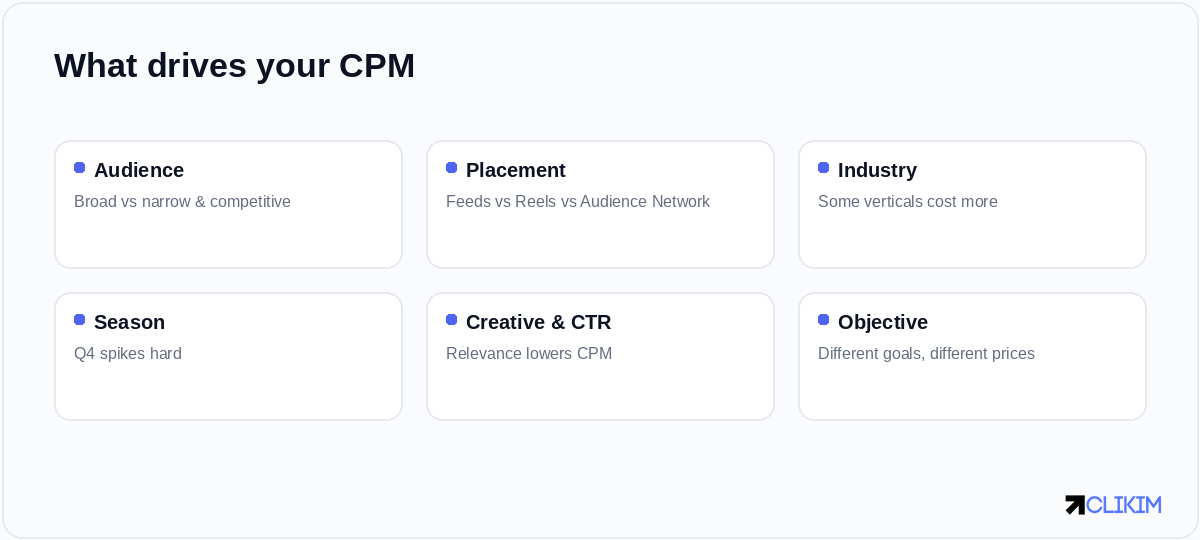
CPM isn't one number — it's the output of your audience, placements, industry, season and relevance.
How the price is actually set
To understand CPM you have to understand that there's no price list. Every time your ad could show, Meta runs an instant auction among all the advertisers competing for that same person's attention. The "winner" isn't simply the highest bidder — Meta blends your bid with estimated action rates and ad quality into a total value, then charges roughly what it took to beat the next competitor. CPM is the downstream expression of all those micro-auctions averaged together.
This matters because it reframes how you lower CPM. You're not haggling over a rate; you're trying to win auctions more cheaply, which you do by being more relevant (so Meta values your ad higher for the same bid) or by competing in less crowded auctions (broader audiences, cheaper placements). Keep that mental model and the rest of this guide stops being a list of tips and becomes a coherent strategy.
What counts as a good CPM?
Across a broad range of accounts, Facebook CPMs commonly land somewhere around $8–20, but that band hides enormous variation. A broad, lower-competition audience on cheaper placements might see single-digit CPMs; a narrow, high-value B2B audience in Q4 can see CPMs several times higher. Here's a rough map to orient yourself.
Illustrative 2026 ranges — validate against your own account, industry and placements; CPM varies enormously.
Treat those as starting reference points, not targets. The only benchmark that truly matters is your own account's trend over time, compared against what those impressions produce. A CPM that's "high" for one business is a bargain for another, depending entirely on what a customer is worth — which is the whole reason a single benchmark is so misleading.
CPM by industry
Industry is one of the largest swing factors in CPM, because some verticals are simply competing for more valuable — and more contested — customers. A business selling a $2,000 financial product can profitably outbid a business selling a $20 gadget for the same person's attention, which pushes CPMs up across that whole vertical.
Industry is one of the biggest swing factors — verticals chasing the same valuable customers pay more to reach them.
The practical takeaway: don't compare your CPM to a screenshot from a different industry. A finance advertiser celebrating a $25 CPM and an impulse-ecommerce advertiser horrified by a $25 CPM can both be right, because they're playing different games for different customers.
CPM by placement
Where your ad shows changes its price. Premium, high-attention placements — certain feed positions — command higher CPMs because they're in demand; cheaper inventory like parts of the Audience Network or some Reels placements carries lower CPMs. This is why a single campaign can show a blended CPM that hides wide variation underneath.
The lever here is letting Meta optimise across all placements rather than hand-restricting to the expensive ones. Advantage+ placements widen the auction pool and let the system find cheaper impressions that still convert, which usually beats manually forcing your ads into only the priciest spots.
CPM by audience
Audience choice is a direct CPM lever. Narrow, heavily-layered, or hotly-contested audiences (think small retargeting pools or tightly-defined interests) cost more per impression because more advertisers crowd those same people. Broad audiences spread you across a larger, less-contested pool, which is one reason the modern consolidated approach — broad targeting, fewer ad sets — tends to lower CPMs as well as improve learning.
This is also why retargeting CPMs run high: you're repeatedly hitting a small, valuable, saturated audience, and frequency climbs fast. It can still be worth it because the conversion rate is high — but never mistake retargeting's high CPM for a problem to "fix" by abandoning it, or its high ROAS for something you can scale.
Seasonality and CPM
The calendar is a CPM force in its own right. The fourth quarter — Black Friday, Cyber Monday, the holiday run — floods the auction with advertisers spending their biggest budgets of the year, and CPMs spike accordingly, sometimes dramatically. The same effect appears in miniature around other peak shopping moments.
You can't opt out of seasonality, but you can plan for it: budget for higher Q4 CPMs rather than being blindsided, front-load some prospecting before the crush, and accept that efficiency you enjoyed in a quiet month won't hold in the busiest one. Judging Q4 CPM against July CPM and panicking is a classic unforced error.
Why CPM matters (and where it misleads)
CPM matters because it's the base cost everything else is built on — a lower CPM means more impressions for the same budget, which means more chances to convert. Cut your CPM in half and, all else equal, you've doubled your reach for free. So it's a genuinely important number to watch and to influence.
But here's the trap that catches so many advertisers: a low CPM is not automatically good. Cheap impressions shown to the wrong people, or to an audience that never converts, are cheap in exactly the way a product nobody buys is cheap. Plenty of advertisers proudly drive their CPM down by chasing the broadest, cheapest, lowest-intent inventory — straight into unprofitable campaigns. CPM is a means; results are the end.
What drives a high CPM
If your CPM is higher than you'd like, the cause is almost always one of a handful of forces — each of which is a lever you can pull:
- Audience. Narrow, high-demand or heavily-competed audiences cost more per impression than broad ones.
- Placement. Premium feed spots cost more than cheaper Audience Network or Reels inventory.
- Industry. Verticals competing for the same high-value customers run higher CPMs.
- Season. Q4 and peak-shopping moments spike CPMs as everyone floods the auction.
- Relevance and CTR. Low engagement signals low relevance, and Meta charges you more; a strong click-through rate pulls CPM down.
- Frequency / fatigue. As the same people see your ad repeatedly, engagement falls and CPM creeps up.
How to lower your CPM
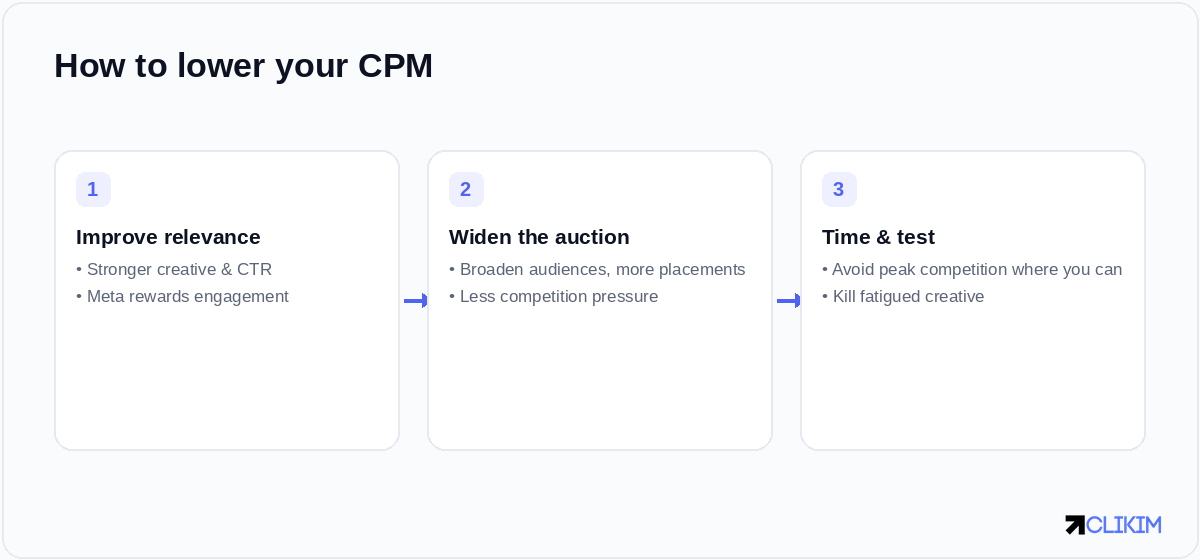
Lower CPM by earning relevance, widening the auction, and cutting fatigued creative — not by chasing the cheapest impressions.
- Improve relevance. The most durable lever — stronger creative and a higher CTR signal relevance, and Meta rewards it with cheaper impressions. If creative is your bottleneck, our roundup of ad creative tools is a good place to start.
- Widen the auction. Broader audiences and Advantage+ placements reduce competitive pressure and let Meta find cheaper impressions that still convert.
- Refresh fatigued creative. Rising frequency drives CPM up as you saturate an audience; rotate before fatigue sets in, not after.
- Mind the calendar. Where flexible, avoid the most competitive windows, and budget for Q4 CPM spikes rather than being surprised by them.
Notice that none of these is "bid lower" — bidding your way to a cheap CPM usually just throttles delivery. The durable path is to make your ad worth more to the auction, which is mostly a creative and targeting problem.
CPM vs CPC vs CPA
It's worth keeping the metrics straight, because they answer different questions and chasing the wrong one leads you astray.
CPM is upstream of everything — but the metric your profit depends on is CPA, not CPM.
They're linked — a better CTR turns cheap impressions into cheap clicks, and good conversion turns cheap clicks into cheap acquisitions — but they're not interchangeable. For the full relationship and how to lower both CPM and CPA together, see CPM vs CPA explained, and for the wider budget picture, how much Facebook ads cost.
Always read CPM in context
The single most useful habit with CPM is to never look at it alone. A $30 CPM that produces a $20 cost per purchase on a $200 product is fantastic; an $8 CPM that produces a $90 cost per purchase on a $40 product is a disaster. The impressions are not the point; the results are.
So pair CPM with your cost per result and your return on ad spend, and judge the campaign on what the impressions actually buy. A useful discipline: whenever you catch yourself reacting to a CPM number, immediately ask "and what did it produce?" before drawing any conclusion. That one habit prevents most CPM-driven mistakes.
CPM and scaling
One more wrinkle: CPM tends to rise as you scale, because pushing more budget into the same audiences increases competition and frequency. That's normal and not a reason to panic — what matters is whether your results hold as CPM climbs. A modest CPM increase that comes with continued profitable conversions is the price of growth, not a problem.
Scaling efficiently — in steps, with fresh creative and broad audiences — keeps CPM increases gentle, and doing it on an account with no preset spend cap means you can actually scale far enough to learn where your CPM ceiling really is, instead of stalling at a few hundred a day. For the safe ramp, see scaling without getting banned.
CPM, trust and the account
A subtler point most CPM guides miss: account quality feeds into your effective cost of being seen. Low-trust accounts get worse, more restricted delivery and tighter limits, which can quietly raise the price of reaching your audience and cut short the testing you need to find efficient CPMs. It's not the headline driver, but on a fragile account every other CPM lever works against more friction. Running on a stable, high-trust whitelisted account removes that friction so your relevance and targeting work can actually show up in the price.
Frequently asked questions
What is a good CPM on Facebook?+
What is CPM?+
What is the average CPM on Facebook?+
Why is my Facebook CPM so high?+
How do I lower my Facebook CPM?+
Is a low CPM always good?+
Does CPM vary by industry?+
Does CPM vary by placement?+
What's the difference between CPM, CPC and CPA?+
Does CPM go up when I scale?+
Why are CPMs higher in Q4?+
Does a higher CTR lower CPM?+
Cheap impressions are wasted on a capped account
Run on managed whitelisted infrastructure with no preset spend cap, so when you find efficient CPMs you can actually scale them. Operated on BM2500 infrastructure.