
How Much Do Facebook Ads Cost in 2026?
There's no sticker price — Facebook ads cost what the auction charges for your audience, industry and season. Here's the mental model: the metrics you pay on, realistic budgets, what drives cost, and why the real question is cost per customer versus customer value.
Facebook ads have no flat price — you pay an auction price that varies by audience, industry, creative and season. You're billed mainly on CPM (~$8–20 per 1,000 impressions) and judge efficiency on CPC and CPA. A sensible test budget is ~$20–50/day per ad set; set budgets by working back from a target cost per result and funding the learning phase. The number that matters is cost per result versus customer value, not total spend.
• There's no flat price — Facebook ads cost what the auction charges for your audience, industry and season. • You pay via CPM (to be seen), and judge efficiency via CPC and CPA. • A realistic test budget is ~$20–50/day per ad set; what matters is funding the learning phase. • Set budgets by working back from a target cost per result, not by guessing a round number. • Q4 is the most expensive season; new accounts are capped near $250/day regardless of budget. • Undercounted conversions make ads look more expensive than they are — fix tracking first. • The number that matters isn't spend — it's cost per result vs customer value.
The honest answer: it depends — here's how to think about it
"How much do Facebook ads cost?" is the most-asked and least-answerable question in paid social, because there is no sticker price. Facebook ads cost whatever the auction decides to charge for showing your ad to your chosen audience, and that price swings with competition, industry, audience, creative quality, objective and season. Two businesses can run the same budget and get wildly different results, because cost isn't set by a rate card — it's set by an auction you're competing in.
So rather than chase a single number, this guide gives you the mental model: the metrics you actually pay on, realistic starting budgets, what drives cost up and down, and — most importantly — why the real question isn't "how much do they cost" but "how much does a customer cost me, and is that less than they're worth." Get that framing right and the cost question stops being scary and starts being a calculation.
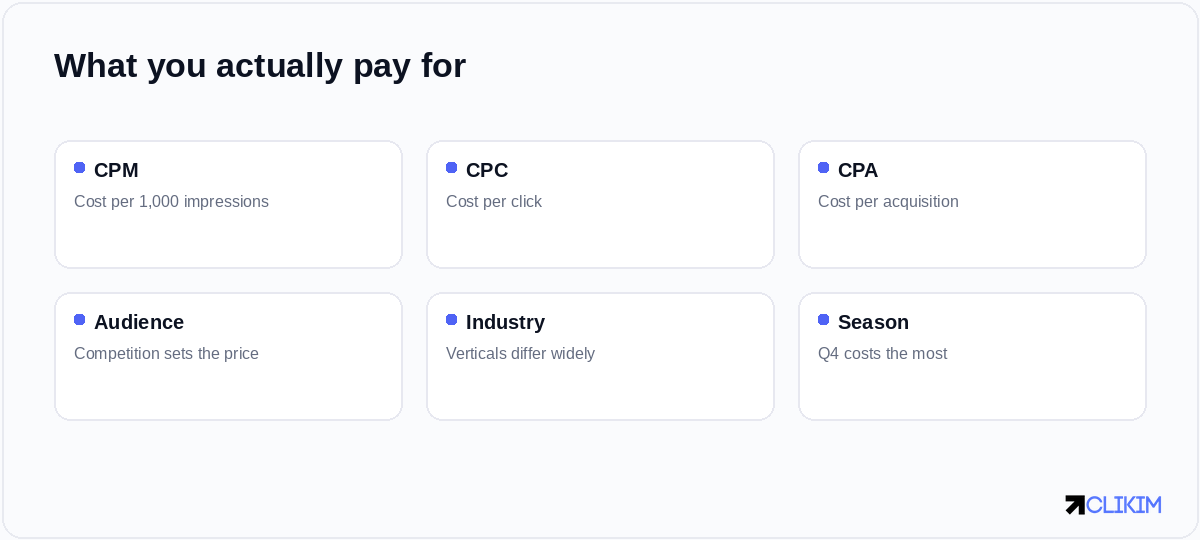
You don't pay one price — you pay an auction price expressed through CPM, CPC and CPA.
The metrics you actually pay on
Facebook ad cost is expressed through a small set of metrics, and keeping them straight is the foundation of everything else.
Illustrative 2026 ranges — your numbers depend on industry, audience, creative and offer. Validate against your own account.
You're billed primarily on impressions (CPM), but you judge cost on results (CPA). A campaign with a high CPM can still be cheap per result if the creative converts, and a campaign with a low CPM can be ruinously expensive per result if it doesn't. Our deep dives on a good CPM and CPM vs CPA unpack each in detail.
What drives the cost up or down
The same forces that move CPM move your overall cost — and seeing them as levers, not fixed facts, is what turns "ads are expensive" into "here's what I'll change."
Cost isn't a fixed rate — it's the sum of these forces, and most of them are levers you control.
Notice that most of these are within your control. Audience and creative are pure levers; industry and season you adapt to; account quality you can upgrade. The only thing you can't change is that there's an auction at all — and the auction rewards the advertiser who's most relevant to the person they're trying to reach.
Being seen: what CPM costs you
The base layer of cost is reach. CPM — cost per 1,000 impressions — is what you pay simply to put your ad in front of people, before anyone clicks or buys. For most accounts it sits somewhere around $8–20, but it climbs for narrow audiences, premium placements, competitive industries and Q4. The lower your CPM, the more impressions your budget buys, so it's worth influencing — but never at the expense of relevance.
The key insight is that CPM is largely earned, not bought. A more relevant, higher-CTR ad is valued more by the auction and rewarded with cheaper impressions, so the path to a lower CPM runs through better creative far more than through lower bids.
How much should you budget?
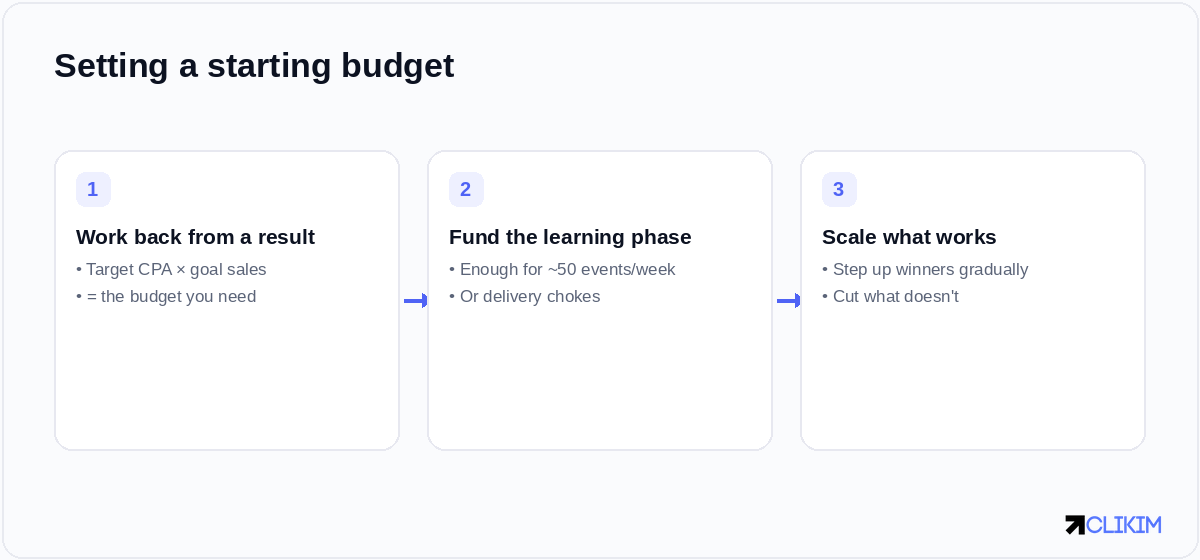
Set budgets by working back from a target cost per result, then funding enough to actually learn.
The right budget is the one that lets the system learn and gives results room to emerge — not a number plucked from the air. Two principles: first, work back from a target result (if you can afford a $20 cost per sale and want 10 sales a day, that's a ~$200/day target); second, fund the learning phase, because an ad set that can't reach roughly 50 optimisation events a week will struggle to stabilise. Here's a sensible starting frame.
Budgets are means to an end — fund enough to learn, then let results dictate the rest.
Start smaller than you think for testing, then concentrate budget on what works. Spreading a tiny budget across many ad sets starves them all of the signal they need — a structural mistake covered in how to structure an account for scale.
Why the learning phase shapes cost
New campaigns spend inefficiently at first because Meta is still learning who to show your ads to. During the learning phase, cost per result is usually higher and choppier; it settles once the ad set exits learning. Underfunding an ad set keeps it stuck in learning indefinitely, which is one of the most common reasons costs look terrible early on.
Patience and adequate budget are, counter-intuitively, cost-saving here. The advertiser who funds an ad set properly and leaves it alone for a few days usually ends up with a lower cost per result than the one who panics and slashes budget on day one — which only restarts the expensive learning process. (If spend is stalling entirely rather than just being expensive, that's a different issue — see why Facebook ads don't spend.)
The hidden cost ceiling: account trust
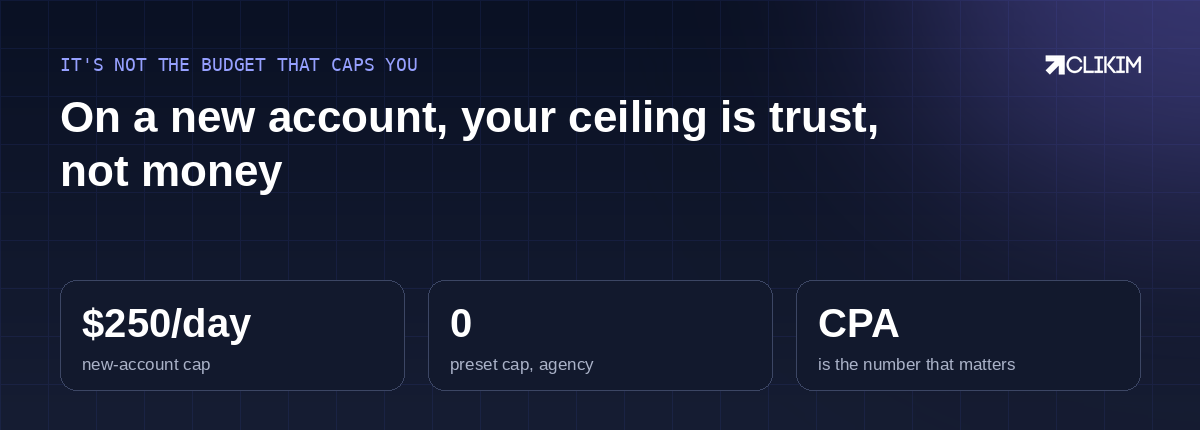
On a fresh account, your real constraint isn't budget — it's the trust-based spend cap.
Here's a cost factor most guides miss entirely: on a new or low-trust account, you can't spend freely even if you want to. Meta caps fresh accounts near $250/day, so your "budget" is theoretical above that ceiling — the account simply won't deliver more, and your spending limit rises only slowly.
That means the practical cost question for scaling advertisers isn't just "what's my CPA," it's "can my account even spend what I want to spend." An agency account with no preset cap removes that ceiling entirely, so your budget is decided by your results rather than by Meta's trust curve. For a business trying to grow, that's the difference between a hobby budget and a real one.
How to lower your cost per result
Lowering cost is mostly about improving the inputs, not finding a cheaper rate:
- Sharpen creative. The biggest lever — better creative raises CTR, lowers CPM, and improves conversion. See our creative tools roundup.
- Fix your tracking. Undercounted conversions make everything look more expensive than it is; clean server-side tracking recovers that in the data.
- Tighten the funnel. A better landing page and offer convert more of the clicks you already pay for.
- Scale efficiently. Step up winners gradually so costs rise gently, not violently.
Cost benchmarks by objective
One reason cost questions feel so slippery is that the same account pays very different prices depending on what it's asking for. Awareness and reach objectives are usually the cheapest, because Meta is only being asked to show your ad to a lot of people; traffic sits in the middle; and conversion or purchase objectives sit at the top, because you're asking the system to find the relatively rare people likely to take a valuable action. That's not a penalty — it's the auction pricing the difficulty of the job. A "high" cost on a purchase campaign can still be your cheapest source of customers.
This is why comparing your numbers to someone else's screenshot is mostly useless unless you know their objective, offer and audience. A lead-gen advertiser quoting a $3 cost per result and an ecommerce brand quoting a $40 one may both be doing brilliantly, because they're buying different things. Benchmark against your own account's history and your own unit economics, not against a number from a different business in a different vertical chasing a different action.
Budgeting mistakes that inflate cost
A handful of budgeting habits quietly make ads more expensive than they need to be. The most common is spreading a small budget across too many ad sets, which starves each of the events it needs to exit learning, so they all stay stuck in the expensive phase. The second is impatience — cutting or boosting budgets daily, which resets learning and keeps cost per result permanently elevated. The third is judging cost before tracking is trustworthy, so undercounted conversions make profitable campaigns look like failures.
The fix for all three is discipline rather than spend: consolidate budget so ad sets can learn, make changes in batches and then leave them alone, and fix your conversion tracking before drawing conclusions. None of these cost a cent more — they simply stop you from paying the hidden tax that bad budgeting habits impose on every campaign you run.
Is it worth it? Judging cost properly
The final and most important reframe: Facebook ad cost only means something next to customer value. A $50 cost per acquisition is a disaster for a $40 product and a triumph for a $2,000 service. Before you decide ads are "too expensive," calculate what a customer is worth to you over their lifetime — then judge the cost against that, using return on ad spend as your scoreboard.
Cheap ads that don't convert are expensive; "expensive" ads that print profit are cheap. The businesses that win on Facebook aren't the ones that found the lowest CPM — they're the ones that know exactly what a customer is worth and are willing to pay up to that number, again and again, on an account that lets them.
Frequently asked questions
How much do Facebook ads cost in 2026?+
What is a good daily budget for Facebook ads?+
How do I set a Facebook ad budget?+
What's the minimum to start with Facebook ads?+
Why are my Facebook ads so expensive?+
How do I lower my Facebook ad costs?+
Does the learning phase make ads more expensive?+
Why can't I spend more than $250 a day?+
Is Facebook advertising worth the cost?+
Do Facebook ads cost more in Q4?+
What's the difference between CPM, CPC and CPA?+
Does account quality affect my costs?+
Don't let a $250 cap decide your budget
Run on managed whitelisted infrastructure with no preset spend cap — so your budget is decided by your results, not Meta's trust curve. Operated on BM2500 infrastructure.