
Google Ads Threshold Accounts: Anatomy of a Scam Market
They’re sold on forums and Telegram as a cheat code: aged Google Ads accounts that spend hundreds of dollars before billing ever catches up. Here’s how the threshold mechanism really works, what the resale market actually delivers, and why the math never survives contact with Google’s fraud systems.
Google Ads threshold accounts exploit postpay billing: they spend up to the billing threshold on a card that will never actually pay.
Sellers farm accounts, raise their thresholds, and sell the “free spend” window. Three problems: it’s fraud against Google, the accounts die fast once flagged, and the resale market is dominated by scammers selling dead or reclaimed accounts.
The legitimate version of what buyers want — established billing trust — exists: your own patiently-built account, or agency structures that already hold it.
The billing mechanism behind the market
Google Ads’ default billing mode is automatic payments — postpay. Your ads run first; Google charges your card when spend hits a billing threshold or thirty days pass, whichever comes first. Thresholds start small and rise as an account builds successful payment history — the same trust-laddering Meta uses with its escalating billing thresholds.
That gap between spending and charging is the entire grey market. An account whose threshold has been raised through months of “good behavior” can run meaningful spend before the next charge attempt. Load it with a payment method that will decline — or belongs to someone who’ll never pay — and the window between launch and Google’s first failed charge becomes “free” traffic. The account seller isn’t selling an account; they’re selling that window.
How the resale market actually operates
Browse the forums where these trade — BlackHatWorld threads, Telegram channels, marketplace sites — and a consistent structure emerges:
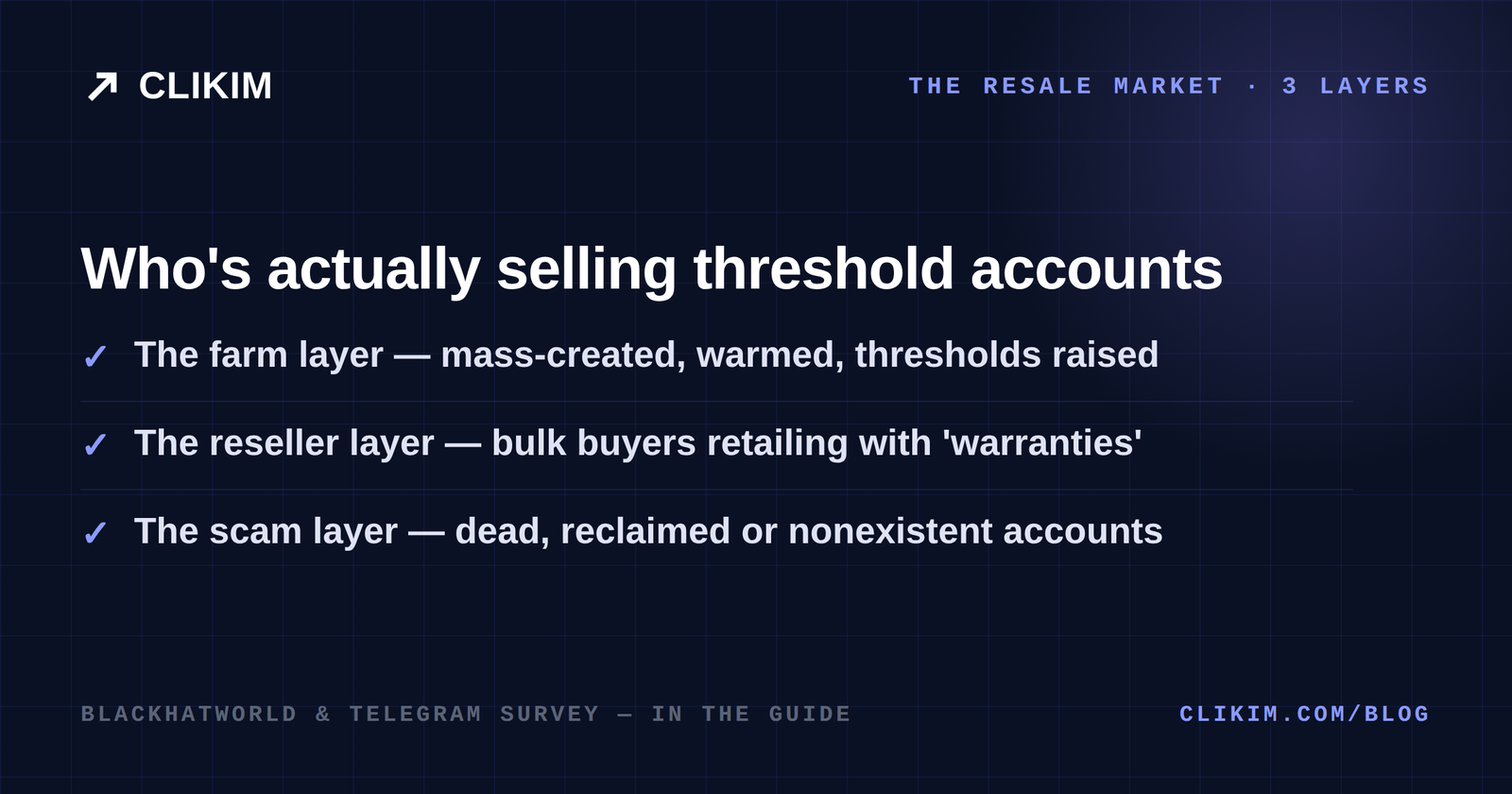
The market has three layers — and the biggest one by volume is selling nothing at all.
- The farm layer: operators mass-create or buy aged Google accounts, warm them with small legitimate spend, and push thresholds up. Real work, done at scale, usually with stolen or synthetic payment credentials somewhere in the chain.
- The reseller layer: middlemen buy in bulk and retail individually with promises — “$350 threshold, farmed 6 months, replacement warranty.”
- The scam layer: the largest layer by volume. Since buyers can’t verify an account before paying (and pay in crypto to anonymous sellers), the cheapest business model is selling nothing: dead accounts, already-flagged accounts, or credentials the seller reclaims an hour after delivery. Forum complaint threads about threshold-account sellers outnumber success stories by an order of magnitude.
What buyers actually get
| What’s promised | What typically arrives |
|---|---|
| “Aged account, high threshold, ready to spend” | An account whose warming history looks fine until Google’s models re-score it under new activity — new device, new geography, new vertical, new spend pattern. Re-scoring is exactly what a sale triggers. |
| “Replacement warranty” | A warranty from an anonymous crypto-paid seller is worth what recourse you have: nothing. Warranty claims are where sellers stop replying. |
| “Spend before billing” | Sometimes real for days. Then the first failed charge lands and the account — plus everything fingerprint-linked to it — enters the suspension cascade. |
| “Undetectable” | You now share fate with every other buyer from the same farm. When Google burns the farm’s fingerprint, every descendant account goes with it. |
How Google catches it
Threshold abuse attacks Google’s own revenue, which makes it the best-defended surface on the platform. The signals are the ones the suspicious-payment machinery already scores: ownership-change fingerprints (new devices, IPs, geos on an aged account), payment methods that fail or pattern-match earlier fraud, landing-page and vertical changes inconsistent with account history, and links to previously-burned assets. And unlike content policy, there’s no judgment call in a failed charge — enforcement is mechanical.
The real math
Price a typical listing honestly: an account sold for $100–$400 promising a few hundred dollars of pre-billing spend. Best case, you’re buying media at a discount-to-face that evaporates after one or two cycles. Median case, the account dies before spend matures — CPCs paid into campaigns that never conclude, pixels that never season, a domain now associated with a fraud-flagged account. Worst case: you’ve linked your site, your conversion data, and any reused fingerprint to a confirmed-fraud cluster — contaminating the legitimate account you’ll eventually need. The threshold market sells borrowed time priced as an asset.
Best case: a small discount that evaporates. Worst case: your site and data linked to a fraud cluster.
The legitimate alternatives
Build clean: a properly verified account with boring, matching billing and a compliant destination — ramped patiently — remains the cheapest durable asset in the ecosystem. Or rent trust legitimately: Google Ads agency accounts operate inside established manager structures with real billing history and human escalation — you pay a transparent fee for stability instead of gambling on a countdown. The comparison isn’t close: one path compounds (history, data, trust), the other resets to zero on a schedule you don’t control. This is the same conclusion the market reached on Meta years ago, where agency infrastructure replaced account-flipping for everyone playing long games.
Frequently asked questions
What is a Google Ads threshold account?+
Is buying a Google Ads threshold account illegal?+
Do threshold accounts actually work?+
How much do threshold accounts cost?+
What happens when Google catches a threshold account?+
What’s the legitimate version of a threshold account?+
Done gambling on borrowed accounts?
Get access through real structures instead — established billing, replacements included, and a rep who answers in minutes.