
Google Ads Account Suspended? Every Reason & Fix
Google suspends advertiser accounts at a scale no other platform matches — millions per year by its own safety reports, frequently by automation, often before a single ad has served. Here’s what each suspension reason actually means, how the appeal process really works, and what to do when it doesn’t.
Google Ads suspensions come in three families: billing & payments, policy, and identity — and the fix is different for each.
Read the exact reason in your account notice first. Fix the underlying cause — payment profile, landing pages, or verification documents — before you appeal, because reviewers re-check reality, not promises. You get one realistic, evidence-based appeal; automated verdicts rarely reverse without something actually changing.
If the account is gone for good, don’t spin up a lookalike — it inherits the ban. The clean paths are a properly separated rebuild or an established agency structure.
The three suspension families
Google’s enforcement machine looks monolithic from the receiving end, but suspensions cluster into three distinct families, and the right response depends entirely on which one hit you.
Billing & payments suspensions are governed by a dedicated policy — its published grounds are promotional code abuse, requesting a chargeback, suspicious payment activity, and unpaid balances. These are the fastest-firing and the most automated: payment signals are machine-readable, so the system acts on them without a human ever seeing your ads.
Policy suspensions — circumventing systems, unacceptable business practices, misrepresentation — judge your ads, your site, and your perceived intent. They’re the hardest to appeal because the verdict is about trust, not a fixable data point.
Identity suspensions come from the advertiser verification program: miss the verification window, fail document checks, or trip a mismatch between your account details and your legal identity, and the account pauses or suspends until resolved.
Each reason, decoded
| Suspension reason | What Google says | What it usually means in practice |
|---|---|---|
| Suspicious payment activity | Payment info or activity poses a risk | New account + payment signals the fraud model dislikes: card/country mismatch, a card seen on another (often suspended) account, virtual/prepaid cards, repeated failed charges. Frequently fires within days of signup — sometimes before any ad serves. Full breakdown in our suspicious payment activity guide. |
| Circumventing systems | Attempting to evade enforcement | The nuclear verdict: cloaking, opening a new account after a suspension, running restricted content through tricks — or, painfully often, false positives on legitimate advertisers whose setup pattern-matches evasion (shared IPs, templated sites, recycled assets). |
| Unacceptable business practices / misrepresentation | Deceiving users | Destination problems: thin or broken sites, unrealistic claims, missing contact/refund information, mismatch between ad promise and landing page reality. |
| Chargeback | You disputed a Google charge with your bank | Near-automatic suspension. Never dispute Google Ads charges through your bank — resolve billing inside the platform. |
| Unpaid balance | Outstanding debt on the account | Also inherited: accounts linked to an entity with old unpaid Google Ads debt get caught at signup. |
| Verification failure | Advertiser identity not verified | Documents that don’t match payment profiles, expired deadlines, or business models Google can’t map to a verifiable entity. |
How appeals actually work
The mechanics are simple; the expectations are what advertisers get wrong. You appeal from inside the account (the suspension notice links the form) — choose the closest reason, state what you fixed or why the verdict is wrong, and submit. Then the realities:
One evidence-based appeal outperforms five thin ones — resubmissions train the system to auto-reject.
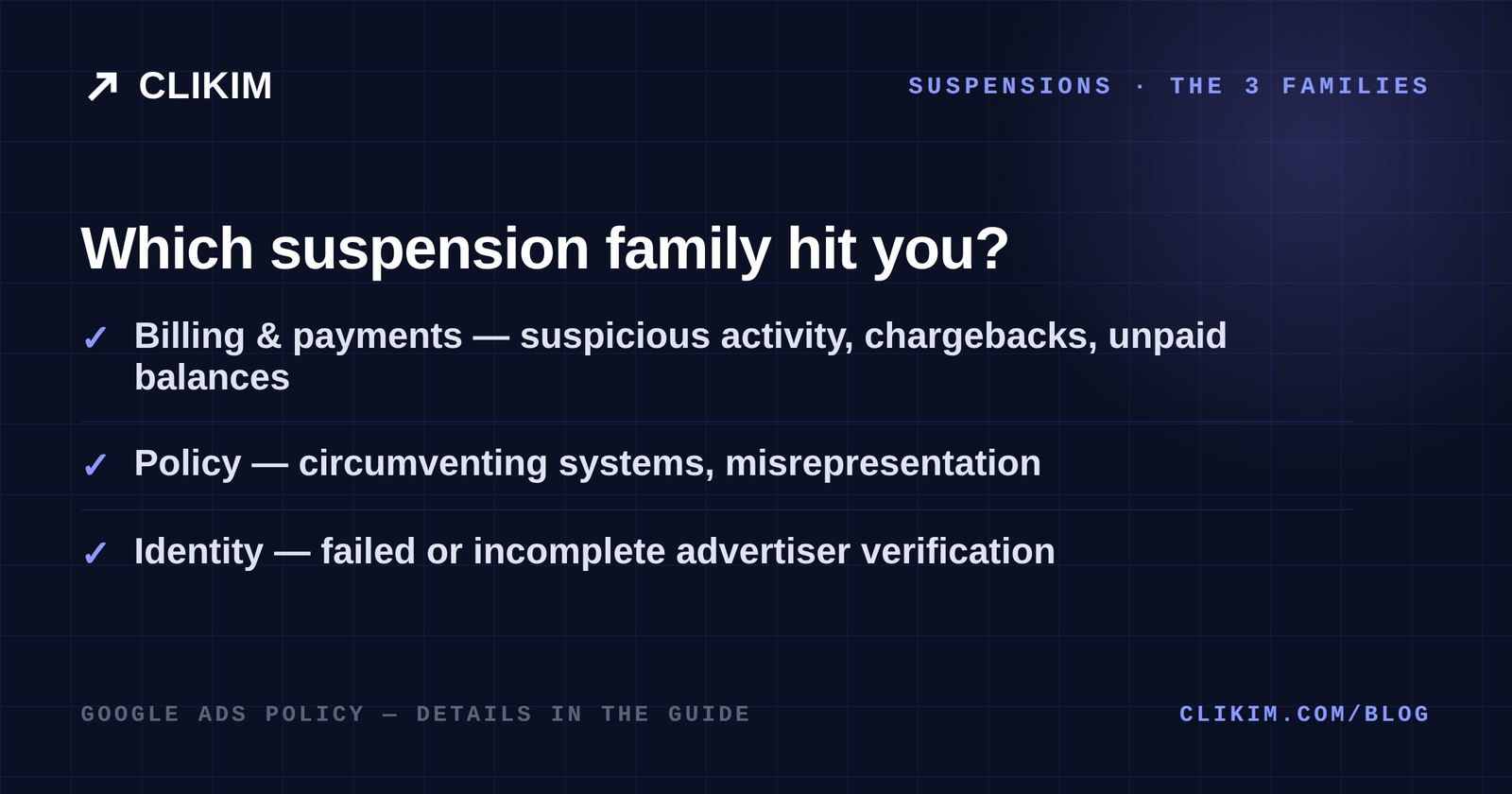
Every suspension traces to one of three families — and the right response depends on which one hit you.
- You’re writing for a reviewer with minutes, not a judge with hours. Appeals that read as complaints get template rejections. Appeals structured as evidence get read.
- One strong appeal beats five weak ones. Repeated identical appeals train the system to auto-reject you. If your first appeal was thin, the second must contain genuinely new evidence.
- Timelines vary wildly — some resolve in 24–48 hours, others sit for weeks. Silence is not progress; a follow-up through the same thread after a week is reasonable, opening parallel threads is not.
- Automated verdicts rarely reverse without change. If the machine flagged your payment profile and you appeal with the same payment profile, expect the same answer.
Building an appeal that lands
Structure it like a case file: (1) identify — account ID, when suspended, stated reason; (2) diagnose — the specific thing that plausibly triggered it, named honestly (“our card’s billing country didn’t match our business registration”); (3) prove the fix — screenshots and documents: new payment method matching the verified entity, corrected landing pages, business registration, bank statements for payment issues; (4) commit — one line on what changes going forward. For payment suspensions, matching documents do the arguing: business registration + payment method + verification identity all agreeing is what the reviewer needs to see. For policy suspensions, fix the destination before appealing — reviewers re-check the live site.
If the appeal fails: the honest options
What not to do: spin up a fresh account with the same site, payment method, or Google identity. Google links accounts through dozens of signals; the new account inherits the suspension as “circumventing systems,” and now you genuinely are what the first verdict only suspected.
Legitimate paths: a genuinely new, properly separated setup (new entity where warranted, clean payment profile, compliant destination — rebuilt slowly); or running through an established agency structure, where the account operates inside a manager account with existing billing history and support paths — the practical route for advertisers whose businesses are legitimate but whose profiles keep tripping automation. What separates that from the grey market: real entities and real billing, versus the threshold-account resale market, which is scams and countdown timers.
Preventing the next one
- Verify early. Complete advertiser verification before the deadline forces the issue — documents matching your payment profile exactly.
- Boring billing wins. One stable card or bank account, matching billing country, never recycled from another Google account. Payment inconsistency is the single most automatable suspension signal.
- Destination hygiene. Working site, honest claims, visible contact and policy pages, ad-to-page consistency.
- Ramp, don’t spike. Overnight scaling on a young account reads as fraud to a pattern-matcher trained on fraud.
- Separate what should be separate. Client accounts under proper manager structures, not one identity juggling many businesses.
The same discipline applies across platforms — see our Meta version in the Facebook account ban playbook.
Frequently asked questions
Why did Google suspend my account before I ran any ads?+
How long does a Google Ads suspension appeal take?+
Can I open a new Google Ads account after a suspension?+
What’s the difference between suspended and limited?+
Do agency accounts get suspended too?+
Is it worth appealing a ‘circumventing systems’ suspension?+
Does verification prevent suspensions?+
Suspended and out of appeals?
Talk to us about running on established structures instead of rolling new accounts — real entities, real billing, and a rep in minutes.