
Conversion Leads: Optimize for Buyers, Not Form-Fillers
Default lead optimization buys exactly what it measures: form submissions — so delivery drifts toward sweepstakes fillers and the chronically curious. Conversion Leads feeds your CRM's truth back into the auction. Here's the plumbing: the lead_id join key, the 1–40% stage rule, and what honestly changes.
Conversion Leads re-aims delivery at leads your CRM says progressed — Meta's biggest lead-quality lever. Five requirements: store the 15–17 digit lead_id on every CRM record from intake (the only join key — middleware that drops it severs the loop), define clean funnel stages, pick an optimization stage 1–40% of leads reach ("closed won" at 0.5% starves the model; "qualified"/"opportunity" is usually right), send stage events promptly via the Conversions API CRM integration (the legacy Offline Conversions API is sunset), then flip the campaign's performance goal to Conversion Leads. Expect CPL to rise while cost per QUALIFIED lead falls, judge at 30 days, and fix your lead pipe first — the loop amplifies whatever integrity it's fed.
• Default lead optimization rewards form-fillers; Conversion Leads re-aims delivery at leads your CRM says became real — the single biggest lever on lead quality Meta offers. • The whole system hinges on storing the 15–17 digit lead_id at intake — it's the only join key between CRM stages and the ad system. • The 1–40% rule: optimize toward a funnel stage that 1–40% of leads reach — 'closed won' at 0.5% starves the model; 'opened email' at 80% filters nothing. • Stage events flow through the Conversions API CRM integration — the legacy Offline Conversions API is sunset; migrations go to CAPI. • Send stage updates promptly and continuously — the loop compounds: better signal → better lookalike delivery → cheaper qualified leads. • Prerequisite zero: a lead pipe that actually delivers — a funnel-feedback loop on top of a leaky sync amplifies nothing.
The form-filler problem, stated honestly
Run a Leads campaign with default optimization and you've asked Meta for one thing: maximum form submissions per dollar. Meta is spectacular at exactly what you ask — so delivery drifts toward the humans (and near-humans) most statistically likely to fill forms: serial sweepstakes entrants, bored scrollers, bottom-feeders of every auction. Sales teams then report the eternal complaint — "Facebook leads are garbage" — which is precisely backwards: the leads are what the optimization target ordered. Conversion Leads optimization changes the order. By feeding your CRM's stage progressions back into Meta, delivery re-aims at users who resemble the leads that answered the phone, qualified, and bought — and Meta's own published case studies report on the order of 20%+ more qualified leads at flat budgets once the loop runs. The price of admission is plumbing, and the plumbing has exactly five requirements.
The feedback loop, end to end
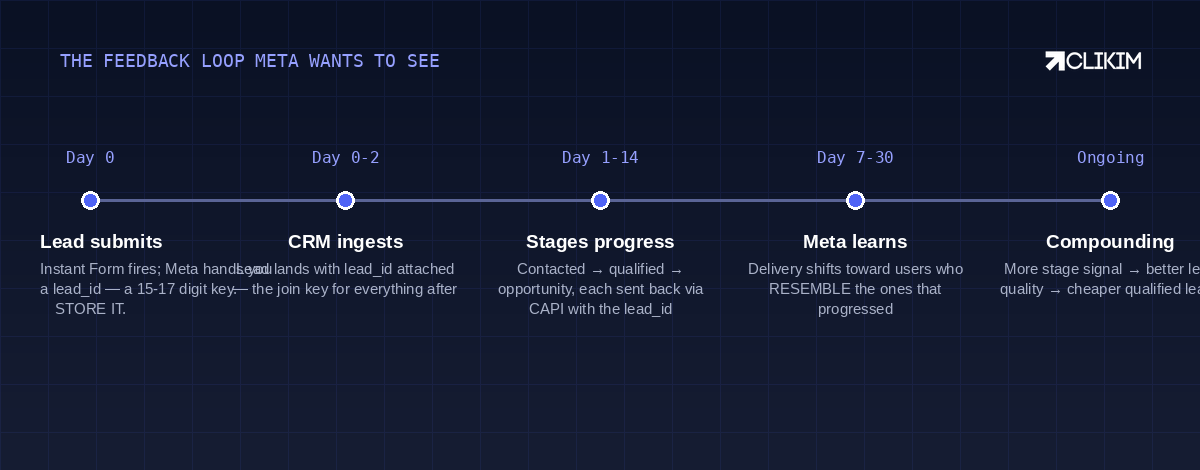
From submit to compounding — the loop only closes if the lead_id survives every hop.
The five requirements (and the two everyone fails)
Five requirements, one design principle: give the machine a joinable, timely, statistically usable trail from click to revenue.
The two chronic failures: losing the lead_id at intake — the 15–17 digit identifier Meta attaches to every Instant Form lead must be persisted as a field on the CRM record, and any middleware hop that drops it (a mapping nobody configured, a Zapier field left unmapped) severs the join permanently; and choosing a vanity stage — teams point optimization at "closed won" because it sounds rigorous, discover it occurs for 0.4% of leads, and the model starves below the 1% floor. The band exists for statistics, not bureaucracy: below 1%, too few positive examples to learn from; above 40%, the stage barely distinguishes signal from noise. The right pick is usually "qualified" or "opportunity" — early enough for volume, late enough to mean something. Meta's Conversion Leads documentation lists the per-CRM setup paths.
The setup, per stack
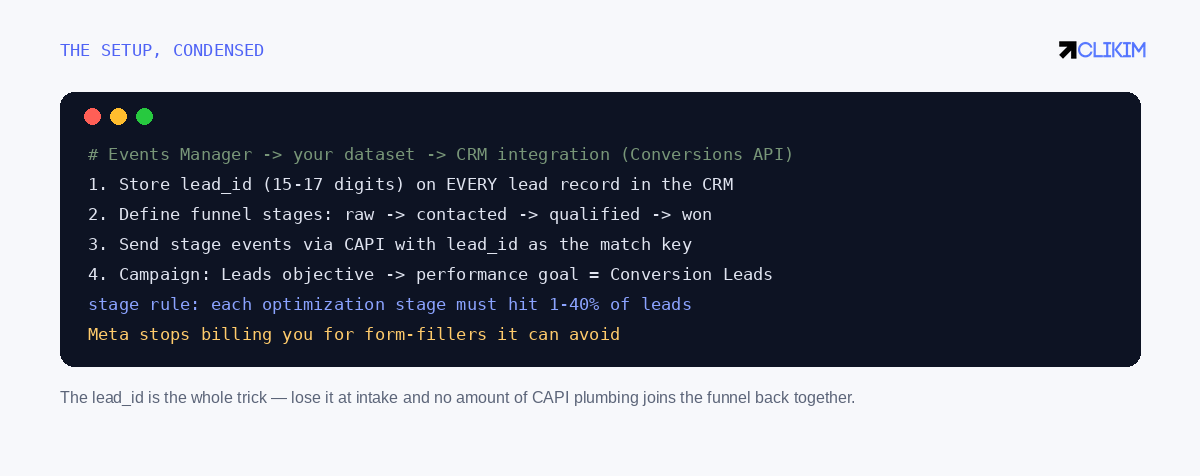
Four steps and a rule — the campaign-side toggle is the trivial part.
Native-integrated CRMs (HubSpot, Salesforce, and the other majors) expose guided Conversion Leads setup inside Events Manager's CRM integration flow — mapping stages point-and-click. GoHighLevel and similar: the platform's Meta integration handles intake, but stage-event feedback needs the CAPI connection configured — and agencies running multi-client GHL fleets should templatize it once per sub-account like everything else. Custom stacks send stage events directly via CAPI with the lead_id as match key — a webhook on your CRM's stage-change event is the whole architecture. If you're migrating from the legacy Offline Conversions API, the direction is one-way: offline event sets are sunset infrastructure, and CRM signals now live in the same Conversions API as your pixel-side events — one dataset, one dedup surface, one place to audit. On the campaign side, it's an anticlimax: Leads objective, performance goal switched to Conversion Leads, and the stage you chose. The work was always in the pipe.
What to expect (the honest part)
Three expectations to set before the kickoff meeting. CPL rises; cost per qualified lead falls. You're buying a scarcer human — raw submits get more expensive while the metric that pays gets cheaper; report the second number or the project dies in week two. The loop needs weeks, not days — delivery re-aims as stage signal accumulates; judge at 30 days with a proper qualified-lead comparison, not at 72 hours. The loop amplifies your pipe's integrity — stage events that arrive late, sporadically, or joined to half the leads (because the lead_id survives only some routes) teach the model a biased lesson. Prerequisite zero is boring reliability: every lead actually reaching the CRM, with its id intact, and stages updated as sales actually works them — which makes Conversion Leads the rare Meta feature whose main dependency is your sales team's CRM hygiene.
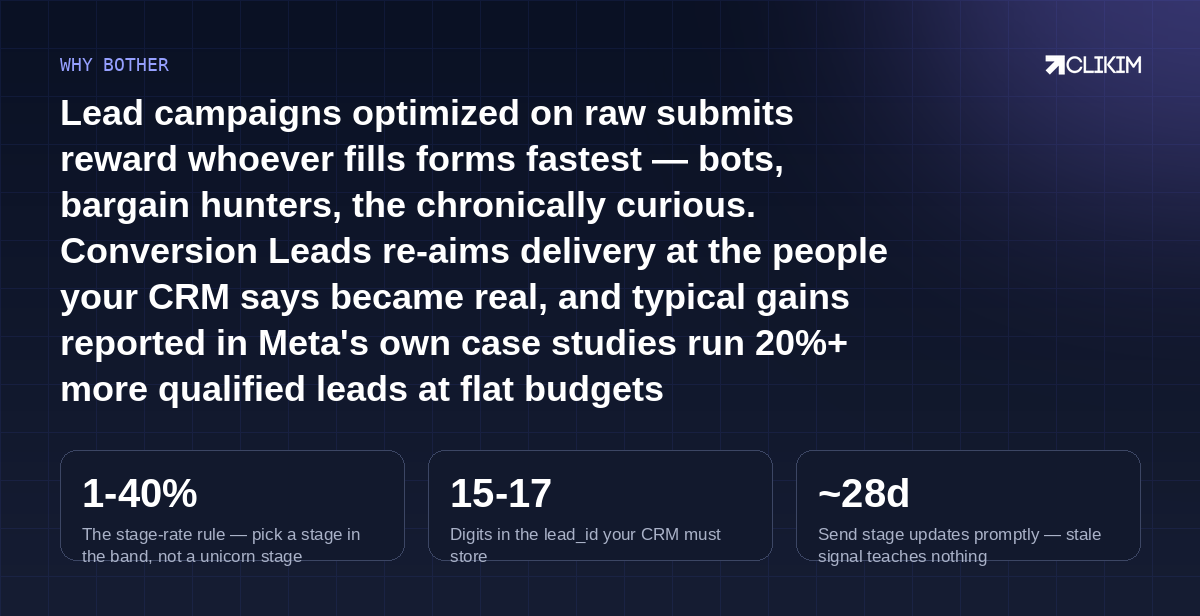
The trade: plumbing effort in, qualified-lead economics out — with a rule of thumb for the stage pick.
Frequently asked questions
What is Meta's Conversion Leads optimization?+
What is the lead_id and why does it matter?+
What is the 1-40% stage rule?+
Do I need a specific CRM for Conversion Leads?+
What happened to the Offline Conversions API?+
Will Conversion Leads lower my cost per lead?+
How long until Conversion Leads starts working?+
How quickly should I send stage updates?+
Can I use Conversion Leads with website forms instead of Instant Forms?+
Why isn't my Conversion Leads campaign learning?+
Is Conversion Leads worth it for small accounts?+
Qualified signal, capable account
Whitelisted infrastructure for serious lead-gen — infrastructure that turns your CRM's truth into cheaper real customers.