
Top 5 Reasons Facebook Ad Accounts Get Disabled
Almost never one bad ad — always a pattern. The five that actually kill accounts, ranked by frequency, including the two nobody sees coming: billing behavior and login patterns.
Bans are risk-score decisions, not single mistakes. Five patterns trigger them: repeated policy violations, circumvention (the near-permanent one), payment friction, identity mismatches, and sudden behavior spikes. Most are preventable with boring discipline — and the time to fix a pattern is at rejection one, not strike three.
5 PATTERNS CIRCUMVENTION ≈ PERMANENT CHARGEBACKS = POISON FIX AT STRIKE ONE
Bans are pattern-matching, not punishment
Meta disables roughly nothing for a single mediocre ad — enforcement at the account level is a risk-score decision built from patterns: how often your ads get rejected against Meta's Advertising Standards, how your payments behave, what users report after buying, who logs in from where. That reframe matters because it changes prevention: the goal isn't avoiding every rejection (everyone gets some); it's making sure rejections stay events instead of becoming a pattern. Here are the five patterns that actually kill accounts, ranked by how often we see them.
All five share a trait: they're patterns, not events — which is why prevention beats appeal in every case.
The two that surprise people
#3 — payments. Advertisers rarely connect billing to bans, but a declined card at a threshold, an unpaid balance, or — the nuclear one — disputing a Meta charge with your bank all feed the fraud-risk model directly. A chargeback against Meta is functionally a self-report; resolve billing inside the platform, always. #5 — access patterns. The freelancer logging in from a new country, the credential-shared "team login," the VPN that hops geos daily — all pattern-match to account takeover, and takeover-suspicion triggers protective locks and reviews. The boring fix is real Business Manager roles for every human, 2FA everywhere, and consistent access geography.
If it already happened
Appeal fast (Account Quality → Request Review, within 48 hours), once, cleanly — serial identical appeals slow the queue and repeated new-account creation converts a recoverable situation into permanent circumvention flags (that's #2 eating your future). While the appeal runs, audit honestly: which of the five patterns above describes the account? The full recovery guide covers the process step by step. And structurally: operators who've been through one false positive learn the same lesson — keep a warmed backup structure, and consider running spend on agency accounts with replacement cover, where a dead account is a days-long inconvenience instead of a business stoppage. Prevention and resilience aren't alternatives; scaled operations run both.
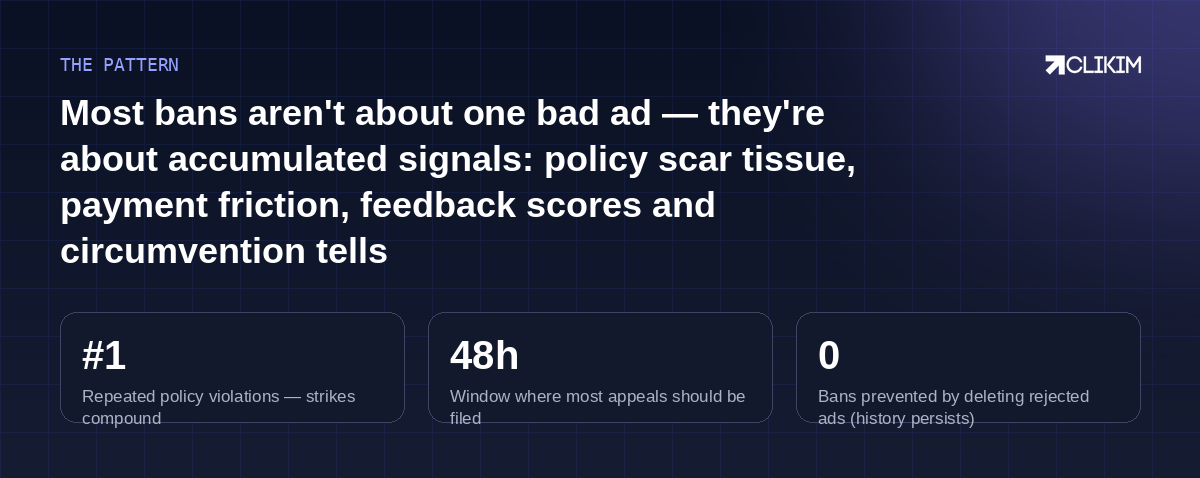
Rejections are events; bans are patterns — manage the pattern and the events stop mattering.
Facebook Ad Account Bans in 2026: The State of Enforcement — what triggers bans, real appeal odds, vertical risk multipliers and the ban-proofing stack, with sources and quarterly updates.
Frequently asked questions
Can my account really get banned with no violations?+
Does deleting rejected ads clean my record?+
How many rejected ads trigger a ban?+
Is it safe to run ads again right after a ban is overturned?+
Why did a payment issue ban my ACCOUNT instead of just pausing ads?+
Do VPNs really cause account bans?+
What's the single best prevention habit?+
Make bans an inconvenience, not an outage
Managed whitelisted infrastructure with replacement cover — when a review misfires, you're back in days, not appeal-queue weeks.