
Facebook Account Health in 2026: The State of Enforcement
Meta doesn’t publish ban numbers, so we built the report the niche was missing: what actually triggers bans, what appeals are really worth since review went AI-first, which niches carry structural risk — and the four-layer stack that keeps serious advertisers live. Every estimate labeled, every source listed, refreshed quarterly.
Most bans aren’t about how much you spend. They’re about signals — who you are, how you pay, and what your ads claim. Appeals are a one-shot game now, so preparation beats persistence. And if you fix only one thing after reading this: verify the business before Meta asks, and never build on recycled assets.
POLICY CLAIMS ≈38% PAYMENT & IDENTITY ≈22% APPEALS ~30% WIN 180-DAY DEADLINE ONE REALISTIC SHOT
How common are Facebook ad account bans in 2026?
Meta does not publish an ad-account ban count, so anyone quoting one number is guessing. What Meta does publish is enforcement direction — its Advertising Standards and transparency reporting show automated enforcement expanding every year since 2023.
The community signal is louder. Recovery megathreads on Reddit and marketing forums have grown every quarter since the late-2024 false-positive waves, and “why was my account disabled” remains one of the most-asked questions in every media-buying community we monitor.
Our own vantage point: Clikim provides agency ad accounts to 500+ active advertisers, which means we see enforcement outcomes across thousands of accounts — including the accounts advertisers ran before they came to us. The numbers below combine that support experience with public data, and every estimate is labeled as one.
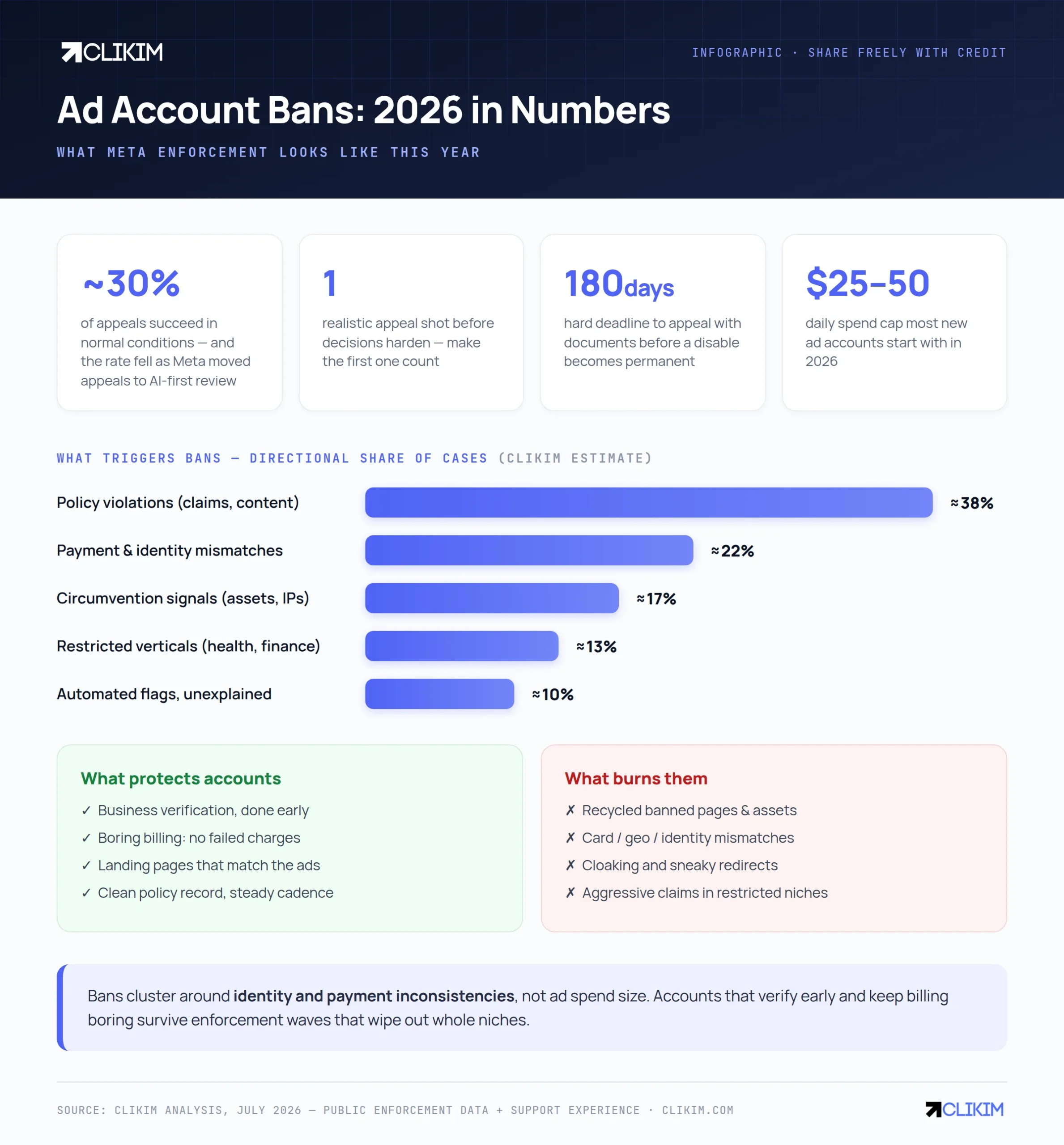
The 2026 enforcement picture in one graphic — share freely with credit.
What actually gets Facebook ad accounts banned?
Five trigger families cover nearly every ban we see. The percentages are directional estimates — good enough to prioritize your defenses, not audit-grade.
Policy violations (~38%). Prohibited claims, before/after imagery, personal attributes, misleading offers. Most are honest mistakes against a long rulebook — but the system doesn’t grade intent.
Payment and identity mismatches (~22%). Card name vs profile name, IP geography vs billing country, sudden payment-method changes. This family is almost entirely preventable, which makes it the most frustrating way to lose an account.
Circumvention signals (~17%). Recycled pages or domains that were previously flagged, shared devices and IPs across banned assets, cloaking. Meta treats circumvention more harshly than the original offense.
Restricted verticals (~13%). Health, finance and other sensitive categories carry structural restrictions — including the January 2025 data-source rules — so ordinary campaigns trip extraordinary wires.
Automated flags (~10%). The unexplained remainder: no cited policy that makes sense, no obvious cause. This bucket grew during every automation push, and it’s the reason appeals exist at all.
Two behaviors reliably make any trigger worse. Velocity panic — mass-editing campaigns, swapping cards, or launching duplicate accounts in the hours after a flag — reads as evasion to systems tuned for exactly that pattern. And asset borrowing — “warmed” pages, aged profiles, rented pixels from marketplaces — imports someone else’s enforcement history into your operation. Both convert minor cases into terminal ones.
What changed in Meta enforcement between 2024 and 2026?
Enforcement didn’t get stricter in one jump — it got more automated in several. Each step below shifted outcomes for ordinary advertisers.
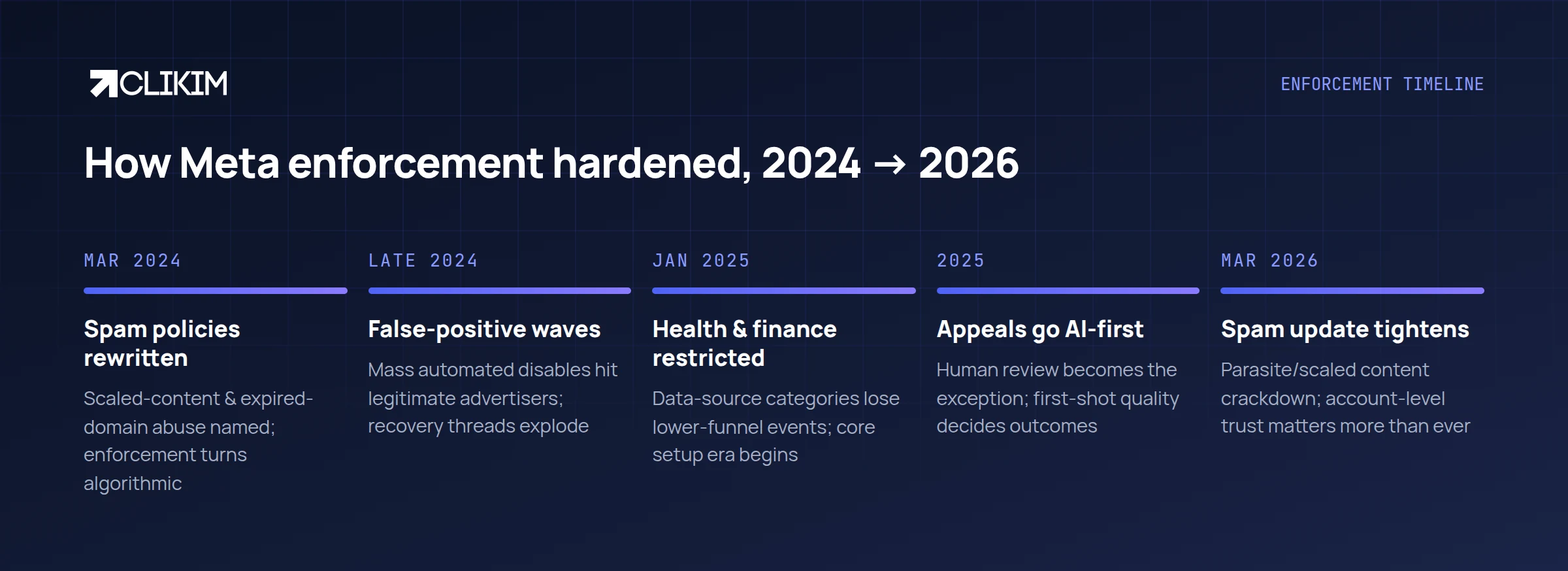
Five shifts that explain why 2026 enforcement feels different from 2023.
The pattern across all five: human review became the exception. That raised the price of sloppy first appeals and made pre-emptive trust signals — verification, clean billing, consistent identity — worth more than post-hoc explanations.
It also changed what kind of advertiser gets hurt. Pre-2024 enforcement mostly caught rule-breakers; automated enforcement catches pattern-matchers — legitimate businesses whose signals happen to resemble abusers. That’s why the late-2024 waves felt so arbitrary, and why the defensive posture in this report focuses on signals rather than intentions. The system can’t read your intentions.
How do you read an Account Quality notice correctly?
Every recovery starts at Business Support Home / Account Quality, and most advertisers misread what they find there. Three reading rules prevent the classic mistakes.
Rule one: the cited policy is the whole case. Meta’s reviewers — human or automated — evaluate your appeal against that citation, not against your general innocence. If the notice says “Unacceptable Business Practices,” your appeal must speak to trust signals and business legitimacy; if it says “Personal Attributes,” it must speak to creative language. Appeals aimed at the wrong policy read as non-responsive and lose.
Rule two: the asset named matters as much as the policy. A notice on the ad account is not a notice on the Business Manager, and vice versa. Fixing the wrong layer wastes your appeal on a case that wasn’t open.
Rule three: template text is a tell. When the notice is generic boilerplate with no specific ad or behavior named, you’re likely in the automated-flag bucket — which changes strategy: lead the appeal with verification and identity evidence rather than creative arguments, because there is no creative to defend.
Which type of ban do you have?
Recovery starts with naming the problem precisely, because “banned” covers four different situations. Each has its own surface, its own reviewer, and its own odds.
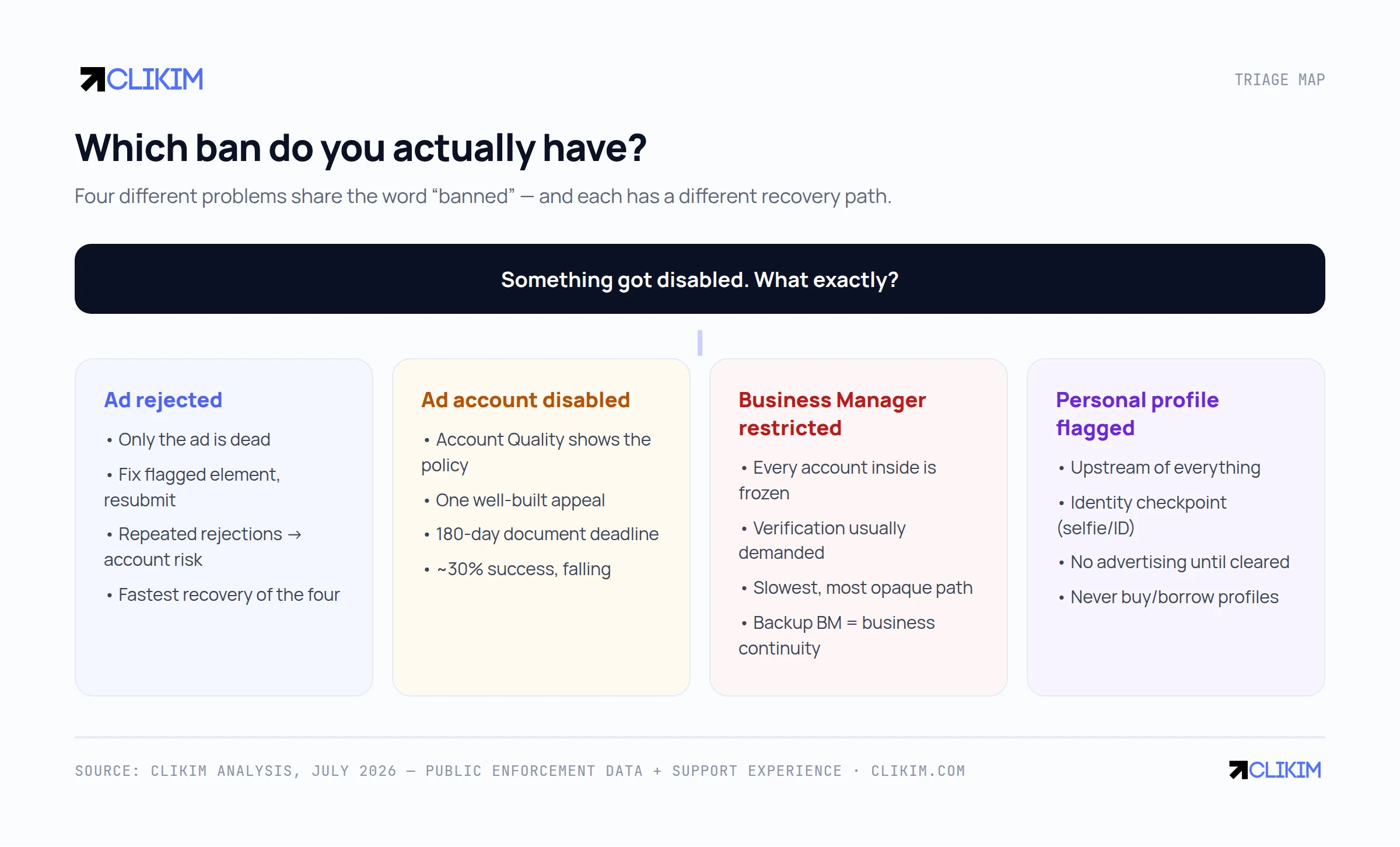
Four problems share one word — the recovery paths are completely different.
A rejected ad is the mildest case: fix the flagged element and resubmit. A disabled ad account is the classic case this report covers — one good appeal inside 180 days. A restricted Business Manager freezes everything inside it and usually demands verification. A flagged personal profile sits upstream of all of it: until the identity checkpoint clears, nothing else matters.
If you’re unsure which you have, read the exact notice in Account Quality before touching anything. The distinction between disabled and restricted changes your next move.
Which niches face the highest ban risk?
Ban exposure is not evenly distributed. Our directional multipliers — anchored to standard ecommerce at 1.0× — come from public recovery reports plus what we see across managed accounts.
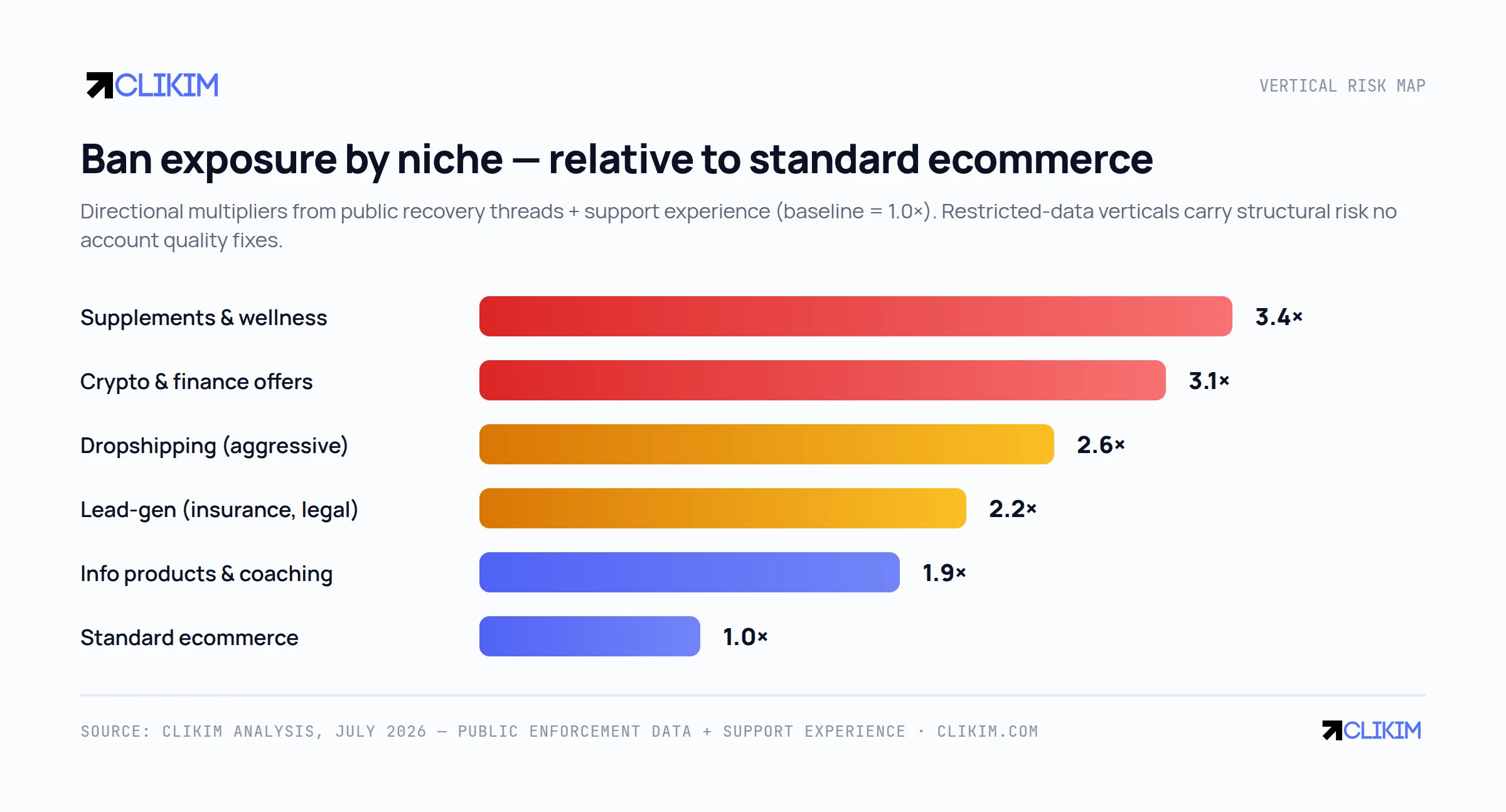
Relative exposure by niche. Restricted-data verticals carry structural risk that account hygiene alone cannot remove.
Two forces drive the top of the chart. Aggressive-claim pressure: supplements and money-making offers live closest to the policy line, so creative drift gets punished fast. And structural restriction: since January 2025, health and finance data sources operate under reduced-signal rules, which multiplies both honest mistakes and automated suspicion.
Supplements and wellness (~3.4×) sit at the top because they combine both forces: outcome claims are the most-policed language on the platform, and the health categorization triggers the 2025 data rules. Even compliant brands inherit the neighborhood’s reputation.
Crypto and finance offers (~3.1×) add a third layer — regional licensing requirements — so identical ads can be legal in one geo and violating in the next. Aggressive dropshipping (~2.6×) earns its multiplier through customer-feedback scores: shipping complaints feed page feedback, and low feedback throttles accounts before any policy is cited.
Lead-gen in regulated categories (~2.2×) — insurance, legal, home services — trips special-ad-category rules and personal-attribute language in the same funnel. Meanwhile standard ecommerce (1.0×) mostly gets banned for the boring reasons: billing turbulence and recycled assets.
If you operate in one of these niches, the honest conclusion isn’t “don’t advertise” — it’s that prevention and infrastructure planning stop being optional.
What are your real odds when you appeal a ban?
Roughly 30% of well-built appeals succeed under normal conditions — and the rate fell as Meta moved first-pass review to automation. Generic “we did nothing wrong” appeals perform far worse than appeals that address the cited policy directly.
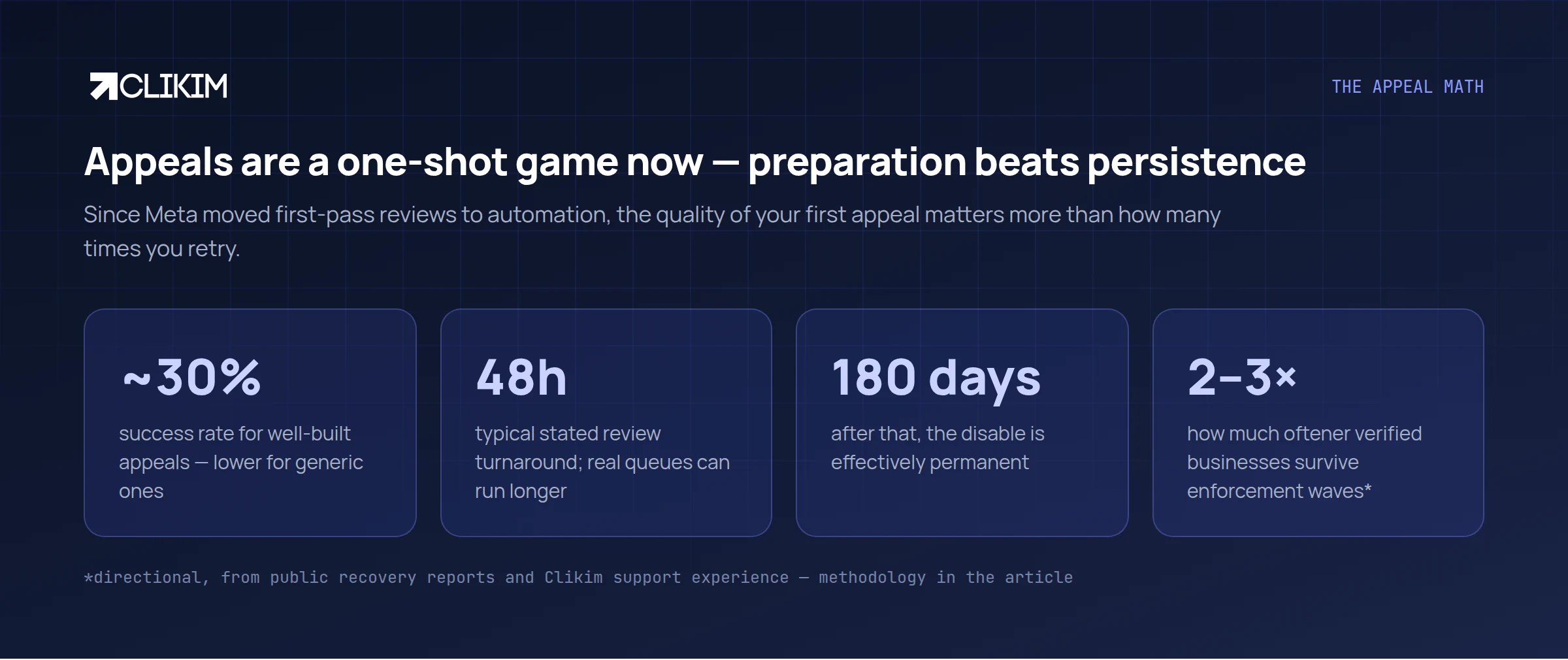
The appeal math in 2026 — preparation beats persistence.
Three numbers govern the process. Meta states most reviews complete within about 48 hours, though real queues can run longer. You have 180 days to appeal with documents — after that, the disable is effectively permanent. And functionally, you get one realistic shot: repeat appeals of a rejected case rarely reverse it, which is why the first submission deserves the preparation most people give the third.
What Meta says officially — and what the field shows
Both columns below are true. The gap between them is where advertisers get hurt, because planning around the official line alone leaves you unprepared for the queue you actually enter.
Neither column lies. Plan with the right-hand one.
What should you do in the first 48 hours after a ban?
The first two days decide most cases, and most advertisers spend them doing the two worst things: refreshing the dashboard and drafting angry appeals. Here is the sequence that protects your options instead.
Hour one: read, screenshot, export. Read the exact notice in Account Quality and screenshot it. Export what you still can — audiences, creative, reports. Access sometimes narrows as cases progress, and the export costs nothing.
Hours two to twelve: fix, verify, gather. Repair the flagged element (paused ad, corrected landing page, settled billing). Complete business verification if it isn’t done — appeals submitted by verified businesses simply read differently. Gather documents: registration, ID, invoices, domain ownership.
Day two: submit the one appeal. Address the cited policy directly, in plain language, with evidence attached. Two short paragraphs beat two angry pages. Then stop — no parallel new accounts, no second submissions, no “testing” from the same profile.
While you wait: keep the business running on whatever continuity you prepared — backup BM, partner account, or agency infrastructure. If you prepared nothing, this is the week you learn why the ban-proofing section below exists.
Two case files from the support desk
Composites of patterns we see monthly, details changed. They bracket the honest range of outcomes.
Case 1 — the reversible ban. A DTC skincare brand, ~$40k/month, disabled the morning after a creative refresh. The notice cited personal-attributes language; the new ads asked “struggling with your skin?” in the first line. They paused the batch, rewrote the openers, completed the business verification they’d been postponing, and filed one appeal quoting the exact policy and the exact fix. Reinstated in four days. Total damage: one lost weekend and a lesson about pre-flight creative review against the policy list.
Case 2 — the unwinnable appeal. An affiliate operation re-entered the auction using a page bought from a broker — a page that had been flagged twice under its previous owner. The new account inherited the asset graph, tripped circumvention within a week, and took the connected profile down with it. No appeal succeeds against circumvention with recycled assets; the recovery was a clean rebuild — new verified BM, new domain, new page — plus agency infrastructure for continuity. Weeks, not days.
The distance between those two outcomes is the whole thesis of this report: case one had clean inputs and a fixable trigger; case two had poisoned inputs before the first ad ran.
How do you recover a banned ad account, step by step?
The 40-word version: read the exact policy cited in Account Quality, fix that specific element, verify the business and the person, then submit one complete appeal with documents inside the 180-day window. If it fails, escalate where possible — or rebuild on compliant infrastructure.
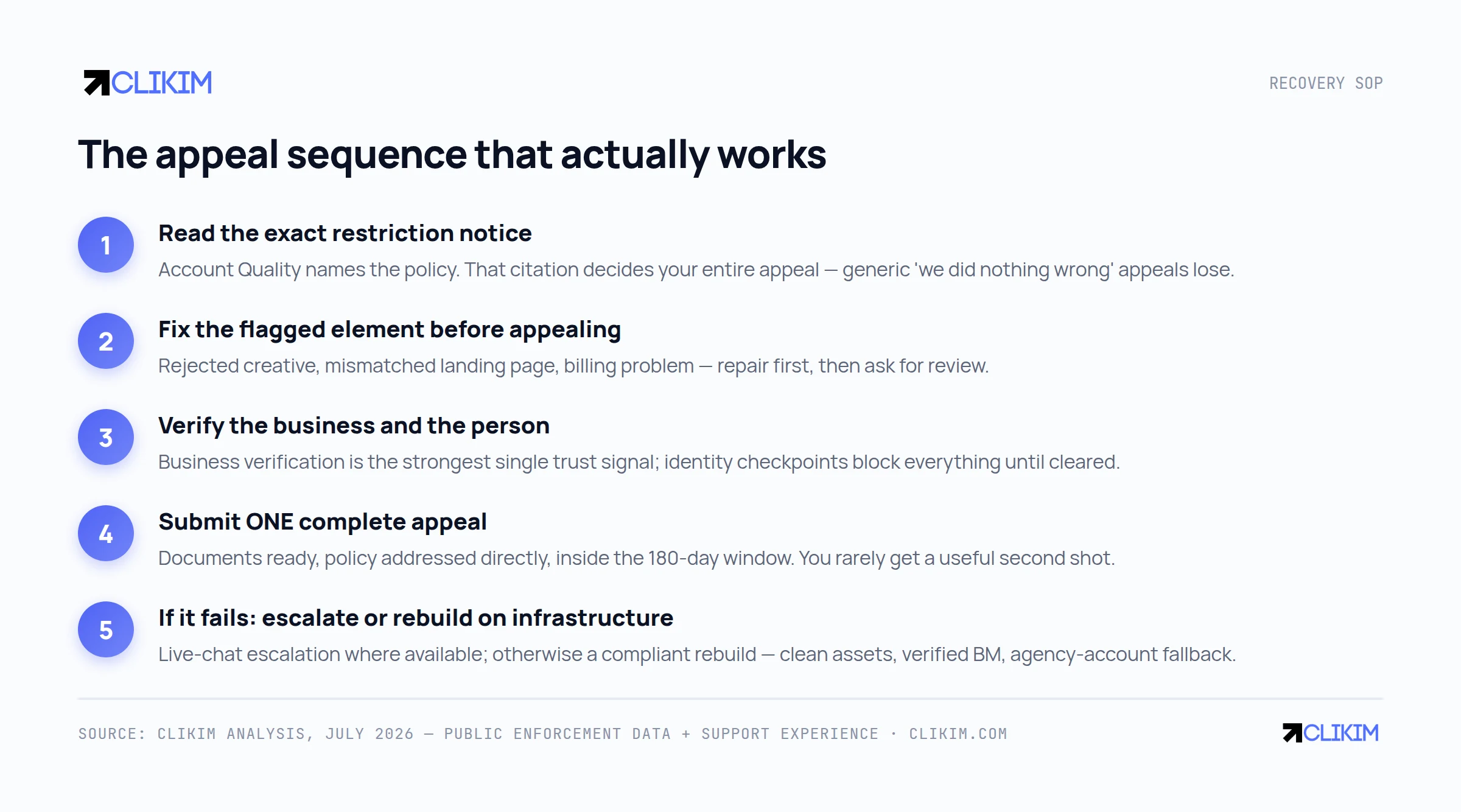
The five-step sequence — each step exists because skipping it kills appeals.
The full walkthrough, screen by screen, lives in our ad-account recovery guide and the companion piece on writing appeals that get read. If your account was compromised rather than banned, that’s a different emergency with its own path.
One warning that saves accounts: do not spin up a lookalike account from the same profile while an appeal is pending. That converts a possibly-reversible policy case into a circumvention case, and circumvention almost never comes back.
How do serious advertisers ban-proof their operations?
The advertisers who survive enforcement waves don’t out-argue Meta — they out-structure it. The defensive stack we see working in 2026 has four layers.
Identity, settled early. Business verification completed before it’s demanded; one consistent identity across profile, page, domain and card. Verified operations survive checkpoint events that end unverified ones — in our experience, several times as often.
Billing, kept boring. One stable payment method, no failed charges, thresholds paid on time. Payment turbulence is the quiet second-largest trigger family, and it’s entirely controllable.
Assets, kept clean. No recycled pages, no borrowed pixels, no shared devices with banned operations. Meta’s graph remembers relationships long after you’ve forgotten them.
Continuity, planned in advance. A backup Business Manager, exported audiences and creative, and — for operations where downtime is unaffordable — managed whitelisted infrastructure as the continuity layer. That last one is our business, so discount it accordingly; the rest of this report stands on its own either way. The honest framing is in our piece on whether agency accounts are legit.
The 10-minute ban-risk self-audit
Ten questions, one honest pass. Every “no” is a specific exposure — and every one of them is fixable this week, which is more than can be said for an appeal.
Identity: Is the business verified? Does the name on the card match the profile and the BM? Does your billing country match where you actually log in from? Three yeses here neutralize the second-largest trigger family outright.
Assets: Did every page, domain and pixel in your stack start life with you? Are you free of shared devices or IPs with any banned operation? Marketplace “aged” assets fail this test by definition.
Content: Would every live ad survive a literal reading of the personal-attributes and claims policies? Does every landing page match its ad’s promise? These two questions cover most of the ~38% family.
Continuity: If this account died tonight, do you have a verified backup BM, exported audiences, and a route back to spend within 48 hours? If the answer is no, the ban itself isn’t your biggest risk — the downtime is.
Methodology, sources and how to cite this report
What’s measured vs estimated: dates, deadlines and review windows come from Meta’s published documentation and its Advertising Standards. Trigger-share percentages and vertical multipliers are directional estimates, built from three inputs: public recovery communities (Reddit’s advertising subs, major marketing forums), published enforcement analyses, and Clikim’s support experience across 500+ active advertisers.
What this report is not: an audit of Meta’s systems, or a promise about your individual case. Where our numbers are wrong, we want to fix them — corrections and datasets are welcome at the contact page, credited if you wish.
How the estimates are built: we tag support cases and public reports by trigger family, weight recent quarters more heavily, and round aggressively — precision would imply a confidence the data doesn’t support. Vertical multipliers compare flag frequency per active advertiser against a standard-ecommerce baseline. Where public reporting and our support data disagree, we widen toward the public signal and say so.
Citing: quote any number or graphic with a link to this page. The infographic is licensed for reuse with credit. This report updates quarterly; next scheduled refresh: October 2026. Significant revisions are listed here as a changelog, starting with the October update.
Frequently asked questions
What percentage of Facebook ad account appeals succeed?+
How long do I have to appeal a disabled Facebook ad account?+
What is the most common reason Facebook ad accounts get banned?+
Can Facebook ban my ad account for no reason?+
Does spending more money protect my ad account from bans?+
Which niches get banned most on Facebook?+
How long does Meta take to review a ban appeal?+
Should I create a new ad account while my appeal is pending?+
Is it worth appealing more than once?+
What’s the difference between a disabled account and a restricted Business Manager?+
Do agency ad accounts get banned too?+
How often is this report updated?+
Can a banned Facebook ad account come back after 180 days?+
Do 'aged' or 'warmed' accounts from marketplaces reduce ban risk?+
What's the single cheapest thing I can do today to lower ban risk?+
Enforcement-proof your operation
Whitelisted Meta & TikTok infrastructure — the continuity layer for advertisers who can’t afford downtime.