
Zapier Keeps Missing Your Meta Leads: Escape Routes, Ranked
It's not your zap — it's the architecture: polling intervals, per-task quotas, and a Meta pipe that fires exactly once into whatever's listening. Here are the escape routes ranked by cost and latency, the pricing cliff to model before you sign, and the migration sequence that doesn't drop a single lead.

Zapier misses Meta leads structurally: polling cadence on lower tiers (an interval is a gap), per-task quotas that pause zaps mid-month, and fire-once upstream delivery — leads that fire during any downtime are never re-delivered (the May 2026 incident made it visible). Escape routes in order: (1) your CRM's native Meta integration — free, webhook-pushed, most escapes end here; (2) a LeadSync-class specialist ($20–50/mo, built only for this); (3) Make (cheaper, webhook-triggered, steeper UI); (4) raw Graph API webhook ($0 + an engineer who owns it). Model 12 months of volume against the FULL tier table of any per-volume tool — LeadsBridge runs $79 entry to $1,549 enterprise. Migrate with a week of parallel running, daily Leads Center reconciliation, then retire the zap.
• Zapier misses leads for structural reasons — polling cadence, per-task limits, and fire-once delivery during downtime — not because you configured it wrong. • Check your CRM's native Meta integration first: it's free, webhook-pushed, vendor-maintained, and most escape stories end there. • The ranked alternatives: native → specialist (LeadSync-class, $20–50/mo) → Make → raw webhook — each trades money for maintenance differently. • LeadsBridge is good software with a pricing cliff: $79 entry, $1,549 at enterprise tier — model your 12-month lead volume before committing to ANY per-volume tool. • Whatever route you pick, Meta never re-delivers a missed lead — so migration overlap plus a weekly Leads-Center-vs-CRM reconciliation is non-negotiable. • The May 2026 incident is the lesson, not the anomaly: any single automation vendor is a single point of failure for a fire-once pipe.
Why Zapier specifically keeps missing Meta leads
Three architectural facts, none of them fixable from your zap editor. One: polling. On lower plans, the Facebook Lead Ads trigger checks for new leads on an interval rather than receiving pushes — and an interval is a gap wearing a schedule. Two: per-task pricing. Volume spikes eat your monthly task quota, and a zap that hits its limit mid-month stops moving leads with a politeness that reads, in the CRM, as "leads slowed down." Three: fire-once upstream. As covered in the seven failure points, Meta delivers each lead exactly once — during any Zapier incident, auth hiccup or paused-zap window, leads fire into a dead pipe and are never re-delivered. The May 2026 outage (documented on Zapier's own status page) turned that architecture into a lot of empty CRMs at once — but the architecture was always there. None of this makes Zapier bad software; it makes it a general-purpose automation tool being graded on a mission-critical delivery job, which is a different exam.
The escape routes, ranked
Latency and failure behavior — not features — are the columns that decide lead delivery. Price the route against your lead volume, not your task count.
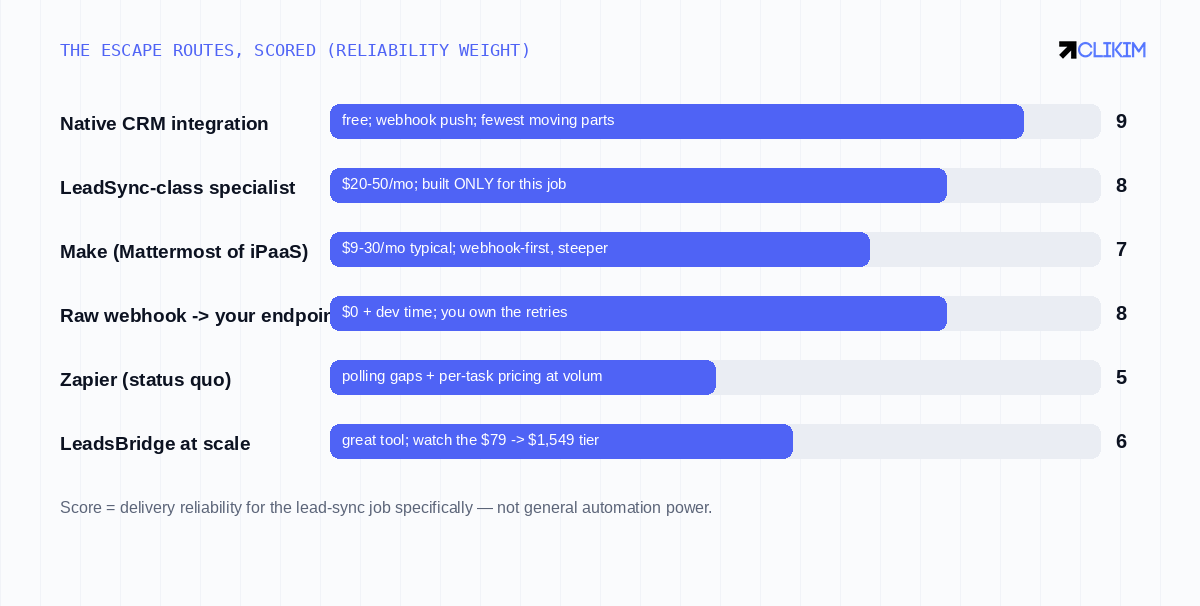
Scored for the lead-delivery job only — a tool can be a great automation platform and a mediocre lead pipe.
Route 1: the native integration you might already own
The most under-checked fact in this niche: HubSpot, Salesforce, Pipedrive, Zoho and most mainstream CRMs ship a direct Meta Lead Ads integration — webhook-pushed, free, and maintained by the vendor whose logo is on your invoice. If your only Zapier job is "lead form → CRM record," you may be paying a subscription to add a failure point. The honest caveats: native integrations map standard fields more gracefully than exotic custom questions, multi-step logic (enrich → route → notify) is out of scope, and they break on the same token/permission events as everything else. But for the core job — every lead, quickly, reliably — vendor-native wins on moving-parts count alone. Check this before reading another comparison table, including this one.
Routes 2–3: specialists and Make
If native doesn't fit — niche CRM, custom fields, routing logic — the next stop is a specialist built only for this job: LeadSync is the category's namer ($20–50/mo range), with webhook-based delivery, per-form mapping and failure alerts as the entire product. The generalist alternative is Make — meaningfully cheaper than Zapier at comparable volume, webhook-triggered rather than polled for Meta leads, and capable of real multi-step flows; the price is a steeper learning curve and enough flexibility to build something fragile if you're not disciplined. Between them sits LeadsBridge — genuinely strong for franchise and multi-location operations — with one loud caveat this article exists to give you: the tier ladder runs from $79 to $1,549/mo, and teams that priced the entry tier against this month's volume have met that ladder mid-scale. Model twelve months of lead volume against the ENTIRE tier table of any per-volume tool before signing.
Route 4: the raw webhook (for teams with engineers)
Meta's Graph API will happily deliver every lead to your own endpoint the second it fires: subscribe to the page's leadgen webhook, exchange the lead ID for the payload, write to the CRM's API. Zero monthly cost, instant latency, total control — and total ownership: the retries, the queue, the token refresh, the alerting when it 500s at 2 a.m. are all yours now. It's the right route exactly when a named engineer owns it as infrastructure, and a trap when it's a weekend project that becomes load-bearing. If the phrase "who gets paged" has no answer, buy a tool.
Migrating without dropping leads (the part everyone rushes)
Because the pipe is fire-once, a careless cutover IS a delivery gap. The sequence: stand up the new route first and send a test lead through your real form; run both routes in parallel for a week, deduping in the CRM (email + created time) so doubles are boring rather than dirty data; reconcile daily against Leads Center — the export is ground truth, since even the API view omits spam-withheld leads; then retire the zap. Keep the weekly Leads-Center-vs-CRM count check forever, whatever route you land on — the lesson of every incident, Zapier's included, is that the pipe must be monitored from outside the pipe.
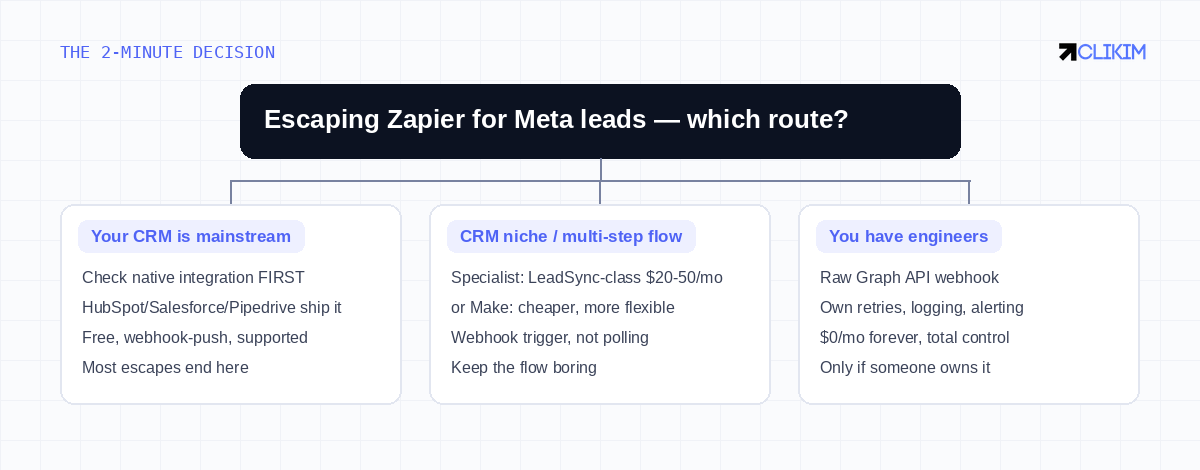
Most escapes end at the native integration nobody checked — the rest split on engineering capacity.
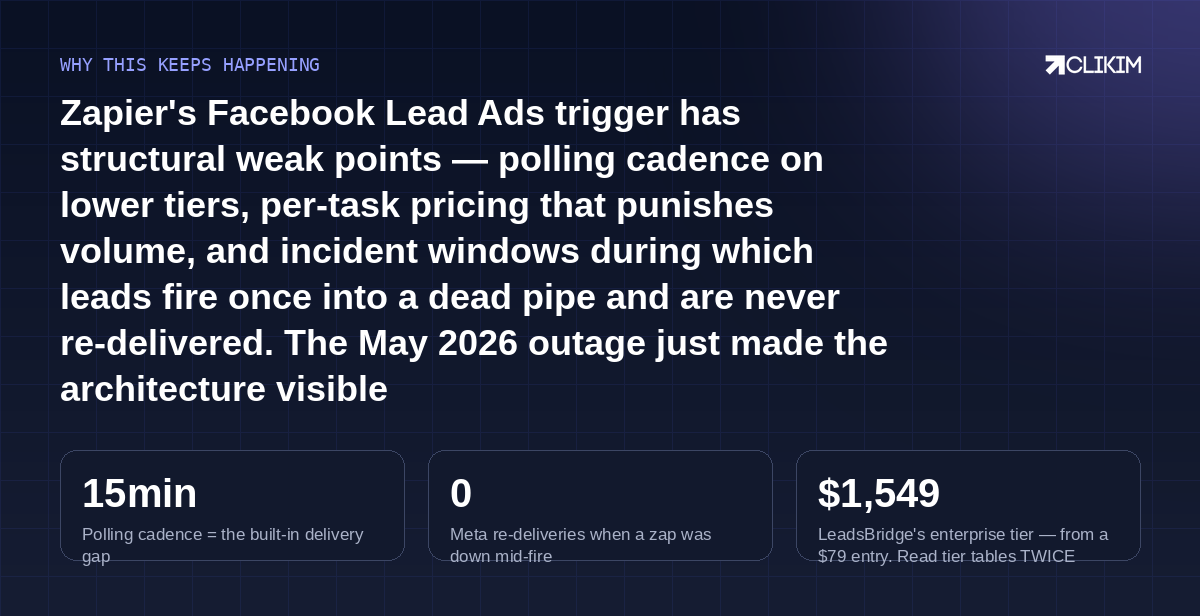
Polling, per-task quotas and fire-once upstream: the incident made visible what the architecture always was.
Frequently asked questions
Why does Zapier miss Facebook leads?+
What is the best Zapier alternative for Facebook lead ads?+
Is Make more reliable than Zapier for Meta leads?+
What happened with Zapier and Facebook leads in May 2026?+
How expensive is LeadsBridge really?+
Can I connect Facebook Lead Ads directly to my CRM without any tool?+
How do I switch tools without losing leads?+
How do I recover leads Zapier already missed?+
Is the raw webhook route worth it?+
Do I still need monitoring after switching?+
Does lead delivery speed actually matter?+
Leads flowing, account solid
Whitelisted infrastructure for lead-gen operators — infrastructure that matches the pipe you just fixed.